Архив за месяц: Май 2024

Promenade Svetlogorsk Upmarket Apartments

Svetlogorsk Promenade a New Chapter in its History

Promenade Apartments Svetlogorsk Showcase Stylish Living

30 May 2024 ~ Svetlogorsk Promenade a New Chapter in its History

At the point at which the new stretch of promenade on Svetlogorsk’s coastline meets the old, a broad canvas containing an evocative black and white photograph of the promenade as it appeared when Svetlogorsk was German Rauschen effectively softens the large metal fence behind which work is ongoing to upgrade the original walkway.

Promenade Rauschen, today Svetlogorsk

The photograph, which was taken in the early twentieth century at a time which we in England would call Edwardian, harks back to a quieter, more sedate and less populated period in the evolution of the modern world and in Svetlogorsk’s personal history. In those days, people dressed better (that is, those who could afford to do so), and life, at least in the pictures, had a better feel about it and seemed to move at a far more leisurely pace.

‘Oh! I do like to be beside the seaside!
I do like to be beside the sea!
Oh I do like to stroll along the Prom, Prom, Prom!’ ~ John H. Glover-Kind (1907)

Fast forward to the third decade of the 21st century:

Walking along the ‘Prom, Prom’ ~ as there are (or nearly are) two in Svetlogorsk ~ has not been the easiest thing to do in the Kaliningrad region’s coastal town for quite some considerable time.

First, there was the Sovietised prom left behind by the Germans; then there was a quiet, narrow stretch of beach left behind by perestroika; then there was the construction of a new promenade; then the promised construction of a sparkling, spanking new set of des-res apartments hugging the new prom coastline; and then … and then it stalled.

When the first stage of the new promenade reached accessibility, those of us who had not grown impatient and swapped allegiance for Zelenogradsk, strolled along the ‘prom, prom, prom’; some of us marvelling at what was to come and some, no doubt, bemoaning the loss of the rocky ribbon of beach, with its golden memories of long hot days, the basking bodies of former girlfriends, the odd kapoosta pie or two and a couple of tins of lager. 

At this juncture in Svetlogorsk’s transformation from sleepy spa retreat to resort boutique, the old legacy prom with its cafes, restaurants, outside bars and amber-selling stalls was still firm favourite.

Then, possibly a couple of years ago (the memory grows dim), one evening, when the sea was particularly tantrum prone, a section of the old prom surrendered to its attitude problem and promptly fell apart, as old proms and seaside piers have the disturbing habit of doing.

The missing piece was soon replaced, but shortly afterwards came the announcement that the old prom would temporarily close for a period of refurbishment. And that is the way it has been for a proverbial month of Sundays and considerably more than a month of sunny summer days.

Behind the ubiquitous blue and white building-site fences, obscuring both prom and the sea, an extensive restructuring programme to defend the platform from the sea’s worst excesses labours on relentlessly, incorporating a face lift which, when it is finished, I should imagine, aims to bring the old prom cosmetically into line with its glossy, upmarket protégé.

The simultaneous reconfiguration of both of Svetlogorsk’s proms led to the loss of the beach from one end of its coastline to the other. The collateral damage was marked by a substantial tourist exodus from Svetlogorsk to Zelenogradsk, the Kaliningrad regions second resort, and indeed to the other resorts that share the Baltic coastline. Fortunately ~ for Svetlogorsk that is ~ stunning sea views from the uppermost reaches of the coastline’s steep embankment and a seamless stream of investment into the town’s inland facilities and its tourist attractions cushioned the brunt of the blow. And some of us kept coming back just to see how things were progressing. I was one of those someones.

Svetlogorsk Promenade a new chapter in its history

I returned to Svetlogorsk earlier this May, approaching the seafront via the Central Staircase, the great parade of steps that since 1974 has led to the giant sundial. The steps still go where they have always gone, but the sundial, including its brilliant tessera mosaic based on the signs of the zodiac, appears to have been uprooted.

Svetlogorsk Sundial as it was in 2021

Above: Svetlogorsk Sundial in June 2021
Below: The same location as it is today, photographed from the Central Staircase

Central Stairs in Svetlogorsk, Russia
Where the sundial used to be in Svetlogorsk

In a less exuberant period, before Svetlogorsk was ‘discovered’, when a ‘permit’ was needed to enter the town by car, as it was then considered a health resort in which the ozone air was sacrosanct, the sun dial, designed by Nicholas Frolov, was counted along with the water tower as one of the town’s star attractions.

The Sundial at Svetlogorsk

On an evening in the year 2000 ~ it was the month of December and blisteringly cold ~ I took  hold of the sundial gnomon, the upright blade that casts the shadow. “I shouldn’t have done that,” I thought. “My hand is freezing to it!” And then I thought, “I am actually here. I am actually here in Russia!” That moment was quite symbolic; quite a personal moment. Let’s hope they put the sundial back. They ought to, don’t you think? If only just for me.

Svetlogorsk Promenade a new chapter in its history

As it is no longer possible to access the old promenade due to its debasement as a construction site, a temporary boardwalk filters pedestrians onto the new promenade (Novyy Promenade), where ~ lo and behold! ~ after what seems like a brief eternity, or the torturous interval we had once to endure between the opening times of English pubs, the foundations for a three-phase series of swanky new apartments are finally metamorphosising into the shape of things to come. 

You can see what this stretch of coastline looked like in the earlier stages of the apartments’ construction by clicking on the following links:

> Svetlogorsk, a tale of two lifts
> Svetlogorsk promenade ~ perchance to dream
> Whenever I need a lift, I go to Svetlogorsk

This is the closet that I have been to a high-rise building site in years, and it must be said, for want of a better reason, such as getting onto the beach, it is worth toddling off to Svetlogorsk to see exactly how they do it, build buildings that high, I mean, and by becoming a casual observer catch history in the making.

Svetlogorsk Promenade artists impression

Before gawping skywards, it is interesting to study first the full-colour canvas banners strapped to the baseline hoarding, each containing artist’s impression of how the built coastline will look when the job is completed. Then, when you have matched the buildings in the illustrations to their skeletal incarnations, marvel at the blokes aloft, hauling heavy and awkward building materials from one man to another up different levels of scaffolding and the audacity of those above them, who, defying the laws of gravity, precariously perch on slim steel girders, working away with hammer or drill some seventy feet above your head. It’s enough to remind you of what you could do, although you never would.

Looking upwards is sufficiently vertiginous without the encumbrance of climbing ladders. Best to look to the sea. It does not hurt your neck, and it can be therapeutic.

Above and beyond the promenade wall, which is hefty, tall and chunky, the sea is visibly seeable, but not without a distracting impediment. Someone, when no one was looking, appears to have gone and dumped thousands of tons of granite boulders over the seaward side of the wall, completely overriding what little was left of the beach.

Boulders on Svetlogorsk beack

I was asked, as if I was the prime suspect, whether these outsized chunks of stone would remain in their present location or be used to bolster the groynes (yes, I’ve spelt it right!), the heavy pole-shaped wave-breakers that march regimentally in parallel lines from Svetlogorsk’s shore out into its sea.

I knew the answer, of course, but I wasn’t about to let on. It could be that I was busy contemplating what it would be like to own and to live in a luxury apartment overlooking the Baltic Coast.

The sunsets along the Baltic Coast rank among the most spectacular anywhere in the world. Imagine sitting in your des-res flat. Would you ever tire of the spellbinding view? It’s doubtful.

At present, the new promenade is serviced by one bar and one restaurant only, both integral features of the embankment lift. But when the residential complex is complete, apart from and in addition to the plush apartment interiors, nature in all its natural glory and everything else that Svetlogorsk has to offer ~ eclectic bars and restaurants, good shopping facilities, tranquil woodland walks, engaging cultural and social history, convenient road and rail links both to Kaliningrad and the region’s airport  ~ those lucky promenade dwellers will have right upon their doorstep the use of a pump room, spa and clinic all wrapped up in a breathtaking view inside a great location.

You can find more about this desirable lifestyle by clicking the link to the developers’ website here > https://promenad-park.ru/

In the meantime, I will bide my time in the sure and certain knowledge that any day now I will hear the sound of keys dropping into my post box, heralding the arrival of a personal invitation to take complementary possession of a deluxe apartment on Svetlogorsk’s prom.

You have to admit, it’s nice of them. My thank-you note is already written.

Svetlogorsk Promenade Posts
Svetlogorsk, a tale of two lifts
Svetlogorsk promenade ~ perchance to dream
Whenever I need a lift, I go to Svetlogorsk

Copyright © 2018-2024 Mick Hart. All rights reserved.

Life in Kaliningrad in spring. Youth Park.

Life in Kaliningrad through the lens of a camera

A few snapshots from my Kaliningrad album

22 May 2024 ~ Life in Kaliningrad through the lens of a camera

They could be curated, they could be aggregated, but I suspect that they are a random collection of photographs, some more recent than others, taken in and of Kaliningrad. Judge for yourselves.

Life in Kaliningrad

Above: Trams {Click on images to enlarge}
The new and the old ~ and I am not referring to myself. Here am I riding one of Kaliningrad’s latest trams. They are smooth and swish, and you can buy your ticket using touch-card technology. The old trams, c1970s (second photograph), good looks, as far as I am concerned. For me, these two-carriage ‘biscuit tins’ have classic kudos. I love the sounds and the movements they make. I even love the metal seats. Whenever I use these trams, our old friend Victor Ryabinin comes to mind. I can see him now, holding onto the rail at the back of the tram, observing life, as artists do, through the tram’s rear window. Rear Window! That’s a good name for a film.

Mick Hart and Olga Hart at Kaliningrad vintage car show 2019

Above: 2019 Golden Shadow of Königsberg
When things were different, and they often are, the Auto Retro Club Kaliningrad held an international and classic car show. The photo of me in a wide-brimmed trilby (a Fedora) was taken in what was that year (2019) the main arena for car competitions, the carpark of the King’s Residence, Kaliningrad’s most elaborate family leisure centre and restaurant complex. (Tweed jacket courtesy of Mr Wilcox)

Mick Hart in front of Kaliningrad's Cathedral of Christ the Saviour

Orthodox Christian Cathedral Kaliningrad
The photograph of yours truly was taken in March of this year (2024) in Victory Square in front of The Cathedral of Christ the Saviour, Kaliningrad. In days of yore, meaning the early 2000s, this spot was dominated by a large bronze statue of Lenin, since removed to another quarter of the town. With the construction of the cathedral, the centre of Kaliningrad moved from Königsberg’s cultural and spiritual centre, directly in front of the Kaliningrad Hotel, to where it is today. In Königsberg’s days, the area known as Victory Square and everything beyond lay outside the city’s defensive walls. (Yes, I know, from a compositional perspective, it would have been much better had I stood so that I was centred in the photograph in line with the door. It annoys me as well!)

Königsberg relics at fleamarket in Kaliningrad

< Left: Königsberg Relics
A lot of Königsberg was blown into bits and pieces during World War Two, so it is hardly surprising that bits and pieces of its past keep turning up, and a good place to find them ~ in fact the best ~ is at Kaliningrad’s flea market, just to one side of the city’s central market. This photo illustrates why I love this market so much.

Below: QR Code Checkers
Here’s a blast from the past ~ and let’s sincerely hope that it remains that way. Here we have QR Code Checking Officers on duty during the Coronavirus era, not letting anybody inside the cathedral unless they had a QR code proving they had been ‘jabbed’. Looking back on this sinister period of history makes walking in and out of doorways unchallenged instantly gratifying.

Life in Kaliningrad

QR Code checkers monitor access to Kaliningrad Cathedral in the Coronavirus year of 2021
Kaliningrad Botanical Gardens: an autumnal scene of the lake

Above: Kaliningrad Botanical Gardens
Unlike many cities, you do not have to travel far in Kaliningrad to enjoy nature in its natural habitat. This photograph captures the tranquility of the lake in Kaliningrad’s Botanical Gardens. It was taken in autumn 2023.

Above: Kaliningrad Sculptures {Click on images to enlarge}
Kaliningrad is renowned for its sculptures: Schiller, Kant, Lenin and the composition of two fighting bison to name but four. They may possess an attitude of assumed permanence thanks to who and what they are, but this distinction should not cancel out the ephemeral and the esoteric. This purple faceted moggy was last seen sitting statuesque outside Kaliningrad’s latest shopping centre in the central market district, and it is not everyday you will see an updated Russian samovar sitting on top of an oil drum in the grounds of Königsberg Cathedral.

Life in Kaliningrad: Three iconic buildings in Kaliningrad, but the House of Soviets is no more ...

Above: House of Soviets
A poignant picture of the House of Soviets framed between the hotel and restaurant buildings of Kaliningrad’s Fishing Village and the reconstructed ‘New Synagogue’ c.2023. Stand in the same spot today where the photograph was taken to appreciate the laws of transience by which our lives are governed.  

Mick Hart with USSR ice cream

Above: CCCP (that’s USSR to you)
As you know, because it’s general knowledge, there’s no time like the past, which is why as a collector of what’s left of it, I was thrilled to discover on a hot day in ’22 an ice cream with an historical theme. After chilling out on it, I was able to say with impunity, “ I enjoyed the USSR”.

Above: Sunny Day in Youth Park {Click on images to enlarge}
They say that ‘youth is wasted on the young’, but whenever I stroll through Kaliningrad’s Youth Park, I put this prejudice behind me and think instead ‘young at heart’. Some would say, ‘never grown up!’ I vow one day that I will attempt to complete every adult ride in the park in series. Until that day dawns, I will continue to enjoy those days when the park is less rumbustious. At the time these photos were taken (May 2024), I was more than happy simply to purchase a cup of specialty tea and sit and drink it on a park bench. The park attendants were filling the planters with flowers, and the sun had got its hat on.

Above: Königsberg Villas
It is hardly surprising that when residents of Moscow, Siberia and other far-flung places across this huge territory that is Russia, visit Kaliningrad, they fall in love with the city. Kaliningrad, in all its many and diverse facets, is, by virtue of its Prussian-Russian history, a unique experience, central to which is its surviving German buildings. Contrary to the belief that all of Königsberg was raised to the ground during WWII, many splendid, curious and fine examples of architectural merit are extant, and it is not always necessary to adopt a  ‘seek and ye shall find’ approach. In the districts of Amalienau and Maraunenhof, for example, almost every street contains something of architectural significance, and some streets have enough large houses and grand villas on them to make even the most abstemious ashamed of their secret envy.

Above: Contrasting Scenes of Kaliningrad {Click on images to enlarge}
Two cityscape views: one taken from a high-rise flat complex; the other from a balcony (May 2024), to coincide with the first blooms of spring.

Copyright © 2018-2024 Mick Hart. All rights reserved.

Olga Hart and friends on Ozerki Lock

Ozerki Lock Masurian Canal the brave and beautiful

An incomplete German masterpiece

17 May 2024 ~ Ozerki Lock Masurian Canal the brave and beautiful

Pursuant to our trip to Znamensk, we motored on that same afternoon to a lock on the  Mazurski Canal (aka Masurian Canal), a German project implemented in 1911. The plan was for the canal to connect Königsberg (now Kaliningrad) with Lake Mauersee (aka Lake Mamry), but the project faltered and eventually failed due to Germany’s hyperinflation.

Travelling from Znamensk, we were to pick up the trail of the Mazurski Canal at the Ozerki Lock. There are no major roads servicing this region, thus the trip by car from Znamensk is seemingly protracted but on the way you get to appreciate views of woodland, open countryside and original East Prussian dwellings, some of which are delusively quaint for the sightseer, or, where standing empty and derelict, curious objects on which to dream and speculate. These are the homes of those who enjoyed, or did not, the day-to-day realities of an agrarian lifestyle and do, or do not, enjoy it today.

Ozerki Lock Masurian Canal

Popular theory has it that first impressions are often wrong and in the case of Ozerki Lock, they are often wrong and right. Yes, Ozerki Lock is a great slab of concrete, this is the first impression, but as with most first impressions, there is more to the subject than meets the eye.

Ozerki Lock in Russia Kaliningrad

Like a lot of things German, especially leading up to and during the Second World War, Ozerki takes you unawares, sitting there, as it does, on a 90-degree sharp bend, camouflaged to a certain degree (Them Germans were good and are good camouflagers.) by the outer reaches of a ragged coppice. But the real drama is concealed inside, waiting patiently to ambush your senses blitzkrieg style. It’s all so very German, isn’t it!

Pulling off the road, we came to a halt on a dirt track widened on the nearest side to the lock by constant use as a makeshift carpark. Although the number of vehicles in our retinue had diminished since we left Znamensk, some drivers having decided that it was time to head back home, the improvised carpark was yet insufficient to take all of the remaining retro club cars, thus those that could not be accommodated dutifully regrouped on the outside curve of the bend. 

A metal staircase with an open rail, similar to those in England that climb the sides of control towers on disused WWII bomber bases, was the means by which we would ascend to the upper level of the lock’s superstructure

I am not very good when it comes to guessing heights, but I would say that we were about twenty-five  feet above ground level when the old metal staircase on which we were climbing turned at an angle of 90 degrees. No great height, admittedly, but the unexpected discovery that age and rust had done for the handrail had quite an unnerving effect. It actually signalled what was to come, but nothing of a preparatory nature was in and of itself sufficient to subtract from first-hand experience.

The initial encounter is, to coin a phrase, breathtaking. There are no handrails, no safety rails of any type; nothing to stabilise or assist yourself with. You are standing upon a ledge little more than six feet in width, staring across the cut to its opposite half, a sheer and brutal-walled descent into a dark abyss of semi-stagnation. You follow this man-made ravine, drawn to what appears to be a solid wall of water at the farthermost end of the lock. It is nothing of the sort, of course, simply an illusion, created and perpetuated by a constant flow of water escaping at a uniform rate over the top of the lock gate. Nevertheless, the spectacle makes you pause, and then you are falling, visually down, carried by the sheet of water into the yawning gulf below ~ a precipitous man-made canyon entombed in reinforced concrete.

Ozerki Lock Masurian Canal Kaliningrad region
Olga Hart at Ozerki Lock

Hailing from Northamptonshire in England, to be a stranger to waterway locks would be more difficult than impossible. Along the river Nene and Grand Union Canal, many fine examples are to be found, some in fact quite deep, but nothing that comes nearly as close to the overpowering awesomeness of this giant concrete sandwich.

Ozerki Lock Masurian Canal

Far be it for me to confess that I shrunk from my response and instinctively made my way towards one of two small rooms that flank the structure at its roadside end. But had I gone in search of solace, I would not find it there, for not only was the chamber skeletised ~ it had no doors, no roof, its windows had no frames nor glass ~ it was in short as open to the world as any object could be ~ but also and often at floor level deep declivitous shafts, waterlogged some several metres below so that they borrowed in appearance from a staggered series of man-made wells, presented themselves as cunning traps intended to compromise life and limb. The feeling, or rather the inclination, that this combination of heights and pits engender, is an interesting voyage of self-discovery that is not to be fostered or encouraged.

Shell of a room Ozerki Lock Masurian Canal

A second doorway, second to the one through which I suspect I had passed in haste, also had no wood to close. It looked out high above the road, giving access to a narrow walkway, some of which was shattered, connecting either side of the lock to the other. It formed a bridge, a precarious one, between the two opposite chambers.

Ozerki Lock Masurian Canal open to the elements

As myself and my male associate hesitated, contemplating the daunting prospect of crossing the narrow divide, the ladies in our company took the initiative for us and verily showed us up, as altogether in one mind and without a second thought, even pausing at the midway point to pose for several selfies, they traversed what we had not and eventually decided would not.

Olga Hart Ozerki Lock

“Huh, anyone can do that!” I thought.

Back on terra firma (about two seconds after “Anyone can do that!”), I decided to walk in line with the lock and approach it again at the opposite end via an earthen bank. This I succeeded in doing with no incredible effort, arriving at the end of my circumventing labours once again at the top of the lock but overlooking the gate.

The vertical view at this point is altogether astonishing, invoking a sense of sublimity in the purest sense of the term.

A momentary distraction

A beautiful young lady with her midriff all on show, whom and at which I was looking purely because she and it offered some respite from the effect of staring giddily down into the swirling depths, had a large boyfriend with her, so I quickly looked away. But then, quite unexpectedly, it was he who became the object of my fascination, and for reasons understandable; for caring not a fig, even if he should have done (does anybody care a fig?)  he strutted across to the other side of the ramparts and, without a care in the world, or care to remain within the world, judging by his temerity, proceeded to descend inside the bowels of the concrete monster via a series of cylindrical rungs embedded in its wall. Meanwhile, the voluptuous Miss Midriff, teetering on the edge of the platform arm in arm with her own excitement, leant out at a remarkable angle and snapped some photos of her man, who had decided to take his fate in one hand and also on one leg.

This ‘cast all caution to the wind and laugh in the face of danger’ stunt is one that I can readily associate with my English friends, the Wilcox family, who, in all the long years that I have known them, have never been backwards in coming forwards when Challenge throws down its gauntlet, no matter how dangerous that challenge may be or simply because it is dangerous.

I returned to the car and drank tea.

When we were all safely back inside the car, not talking about who had been brave and who hadn’t, it was time to motor off to a nearby glade opposite a dwelling place. Unbeknown to me, arrangements had been made to stop here for refreshments.

The occupants of the aforementioned house showed us to a picnic table at the side of the canal, whose footpath they had cleared. Here we were able to park our arses and partake of the picnics we had brought with us. Some people, those who had not signed a secret treaty many years ago with the Vegetarian Society, were occasioned with meat soup from a sizeable cauldron, so expertly slotted into a motor-vehicle hub mounted on a metal pole that customisation could not be ruled out.

The spot was perfect, but for the absence of a public lav? It was a long way to the bushes and without a rope and a course in abseiling, it would have been indecent, but rejoicing came in two flavours: one, that the owners of the nearby abode possessed a privy we were welcome to use, and two, it was outside.

What a thrill! Talk about reliving my childhood! Our family had, and had a reputation for having, the last outside loo in our village. It became so phenomenally unusual by virtue of its archaism and also so utterly embarrassing for reasons of the same that I cannot imagine what life would have been like without it: more difficult certainly, yet not so amusing. It furnished us with many a joke and anecdote and became so embedded in family folk lore and legend that it and it alone was enough to turn us one and all into after-dinner raconteurs.

It is difficult to explain such an honest affection honestly to someone with an outside loo without sounding condescending and raising the hackles of suspicion, but as in Monopoly I took a chance, and the people to whom the loo belonged took it in good part. It was far less controversial than the passionate urge to sing, on seeing Olga’s photograph, “Oh dear what can the matter be, xxx lady stuck in the lavatory.” Best not, ay! Discretion, as they say, is the better part of valour! I was heavily into discretion today.

Olga Hart's outside toilet experience

From Ozerki lock to outside privies in one fell swoop, there’s an epic digression for you!

Ah hem: Getting back on subject, the Ozerki Lock. If I had been expecting somewhere National Trust protected, the lock renovated, enclosed within its own neat grounds, with a ticket office up front, a carpark in the near beyond and the whole outlay serviced by cafes and souvenir shops then, like they say of the teddy bears’ picnic, I would have been in for a big surprise. Seeing it as it is and exploring it in the raw, so to speak, and doing it all for free, has obvious advantages, but I would not be at all surprised if my fertile imagination does not one day give birth to fact and the vision that I have outlined is not a reflection of Ozerki’s future.

“Ozerki Lock! Tickets, please! And mind the steps as you go!”

Canal Wall Ozerki

Copyright © 2018-2024 Mick Hart. All rights reserved.

Recent posts

Water Tower Gothic design in Znamensk (Wehlau)

Znamensk (Wehlau) Before You Go What to Know!

There are more things in Znamensk than meet the eye

Victory Day Russia 2024

9 May 2024 ~ Znamensk (Wehlau) Before You Go What to Know!

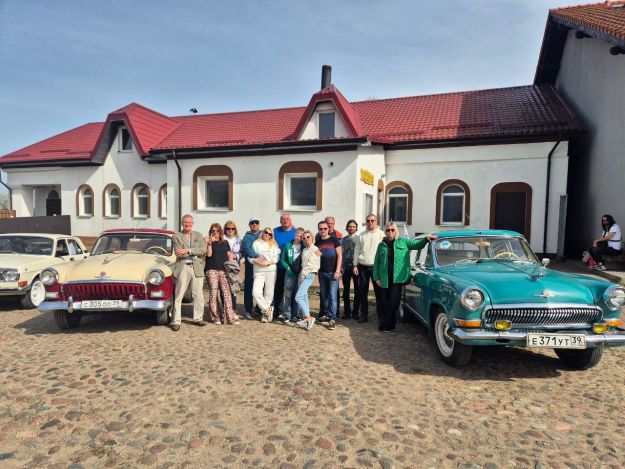
It is about 50km / 30 miles from Kaliningrad to Znamensk. That is no distance when you are whipping along in an all-mod-cons motor vehicle, but when you are travelling by classic car, such as a 1960s’ Volga, ‘Vorsprung durch Technik’ is less likely to spring to mind than ‘oversprung and lurch quite drastic’. But isn’t that just the fun of it!

As is the custom of the Kaliningrad Auto Retro Club, those members who were attending the latest meet, met up on the concourse of a filling station. As pre-planning goes, this strategy cannot be faulted. Most large filling stations have all you need for a temporary stop: fuel, food, tea and coffee, toilets, and, most importantly, a place to park and space to stretch your legs.

Mick Hart & Olga Hart with a classic Volga car in Kaliningrad Oblast

They are also perfect for saying hello to and shaking hands with people whom you may not have seen for months, and you can amble around and look at the cars and, of course, take numerous photographs.

All of these things we did, until, when all the participants were herewith assembled, we hopped into our respective motors and cavalcaded away.

Znamensk (Wehlau)

Znamensk, our destination, is a small rural settlement, population less than 5000, situated in the Gvardeysky District, east of Kaliningrad, Russia. As with many places in this region it has a chequered and violent history, changing hands many times over the course of centuries.

Wehlau, as Znamensk was known in Prussian times, fell to the Teutonic Order in the mid-13th century. Having populated it with Germans, the Order then went on to fill the town with horses. In the first half of the 14th century, civic charters were granted turning the hitherto sleepy settlement into a major centre for horse trading. Three horse fairs were held each year, one of which lasted for three whole days.

FOLLOW THIS LINK FOR PHOTOS OF WEHLAU >
Велау (Знаменск). Довоенные виды. | Pro History | Tilsit | Дзен (dzen.ru)

Opposition to Teutonic rule in the mid-fifteenth century sparked a war between the Kingdom of Poland and the Teutonic Order. Lasting for 13 years, someone with an eye for detail decided to call it the Thirteen Years’ War. The outcome of this conflict was that the eastern lands of old Prussia, including the town of  Wehlau, was granted to the Teutonic Order as a fief and protectorate of Poland. The Teutonic Order had not been entirely vanquished, but it was certainly no longer the force it had been.

The sixteenth century came and went. It was not the best of times for Wehlau as it suffered a number of natural disasters, including a terrible fire. But in the 17th century, its fortunes changed. Frederick William, ‘The Great Elector’ of Brandenburg, acquiring full sovereignty over Prussia, proceeded to develop the country into a major power.

In January 1701, the Kingdom of Prussia was formed, and in 1871 Wehlau, along with the rest of Prussia, was absorbed by the German Empire.

During the 19th  century and up until the mid-20th century, Wehlau grew into a handsome town and one with a thriving community. The town was served by all essential amenities, including a school, a court and a church. The Prussian Eastern Railway provided access to Königsberg and also to Berlin and from Berlin a link to St Petersburg.

On the 23 January 1945, Wehlau’s history ended. After two days of gruelling urban warfare, Russian troops wrested the town from its embedded German defenders. By the time the fighting was over, nearly all that was left of the old town centre was rubble. In the aftermath of war, the ruins were flattened and cleared, and the town in its pre-war form was never rebuilt.

Victory Day Russia 2024

WWII: January 1945, the Red Army attack and take Wehlau
Wehlau (now Znamensk) was almost totally obliterated in the last year of the Second World War, but it was not an easy prize. Record has it that it took the Soviet forces two days of intense fighting to defeat the German defenders and, as with other East Prussian towns, the only way to rout the enemy was to confront them street by street, building by building. The Soviets eventually won the day but casualties were high.

Znamensk (Wehlau)

Before we set out on our trip today, I had been forewarned not to expect too much of Znamensk, as there was little left to see.

First impressions of the still-standing Seven-Arch Bridge over the Pregolya River and the bronzed cupola of St Jacob’s Church visible above the distant rooftops appeared to belie what I had been told. But after snaking our way through a narrow street with German buildings on either side, we emerged into nothing much — much of empty space but little of town. To the left stood the ruins of St Jacob’s church, to the right a block of flats, typically Soviet 1970s, rather rundown and tired and of no aesthetic value.

Trundling on, we eventually hung a right, which brought us into a little enclave of shops nestled against the side of the river. This partly developed oasis in the desert of Wehlau’s former glory is pretty much today what Znamensk is all about — a place to come if you own a boat and want to make use of the water. And what a lovely stretch of water it is!

We passed a rack of canoes and a vehicle with a boat in tow and pulled up beside a building, which, we would later be pleased to discover, was an attractive restaurant serving good food.

It was here on a narrow strip of ground that our Captain of Ceremonies, Arthur Eagle, would have the unenvious responsibility in his role of car-club president of marshalling the cars in our company into some kind of orderly parking

Kaliningrad Auto Retro Club

With no responsibility for us to abdicate, which is one of the joys of travelling passenger class, Olga and I disembarked, and, after a statutory session of photograph-taking, using the river as a picturesque backdrop, we took to the nearby restaurant.

Olga Hart near the river in Znamensk

Minimalist and light, bright and sensorially breezy, it is hard to picture a restaurant more inviting, especially after an hour or so of motoring classic style.

Olga Hart in restaurant Znamensk

Halfway through our repast, however, Mr Eagle attempted to roust us out, we and the other club members who had sidled in for a bite to eat, for a guided tour of St Jacob’s, but the twin considerations of the restaurant being well-appointed and a paucity of enthusiasm when it comes to guided tours, we politely declined the order. 

We would stroll to St Jacob’s church in our own good time, take in it’s red-brick architecture and feel our way back through the centuries to the dawn of its inception (1380), but as for the moment, it was comfy seats and coffee.

St Jacob’s Church Znamensk (Wehlau)

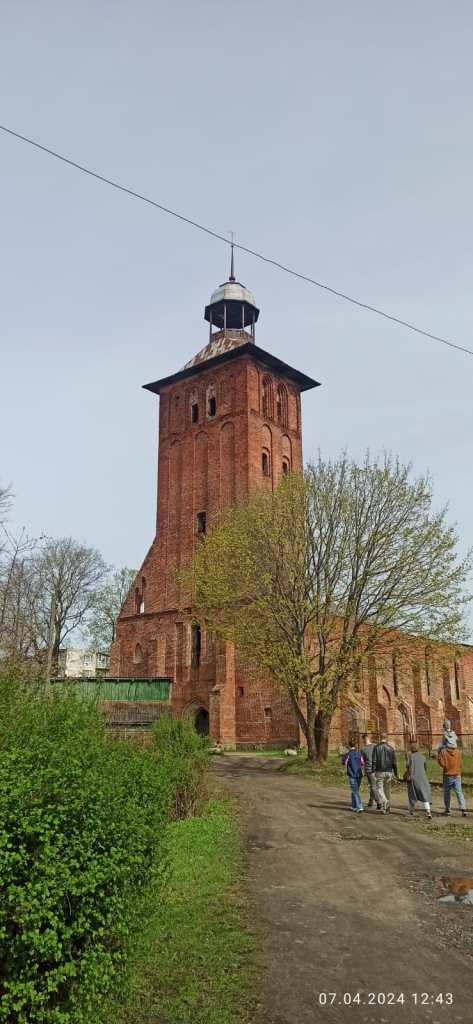
Like so many churches decommissioned by time, St Jacob’s is a shell, but it must have been born with survival in mind, because in 1540 a fire engulfed the town and the church was one of the very few buildings to resist complete destruction. Likewise, in 1945, most of Wehlau went up in smoke, save for St Jacob’s church. It seems that in this world of ours some things are heaven blessed, whilst others suffer the consequences of unmerciful indifference.

St Jacob's church, Znamensk. The cupola can be seen above the rooftops
St Jacob's church, Znamensk, front elevation
St Jacob's Church Znamensk (Wehlau)
Mick Hart expat kaliningrad near St Jacob's church, Znamensk (Wehlau)

St Jacob’s church is often described as the only building of note in Wehlau to have survived the  Second World War, but this is in fact untrue. Rising above the German buildings on the approach to the railway crossing, in all its faceted and Gothic glory, is the lead-crowned tented roof, complete with spire-topped dormer windows, of what easily could be mistaken for the bold, extravagant centrepiece of a medieval castle but which is in point of fact a 1913 water tower.

Standing on an abrupt eminence next to the railway crossing, the tower built according to the Gothic revivalist style cuts an imposing figure, its tall tapering brick arches contrasting with and complementing the railway lines it looks down upon, as they sweep past in opposing directions and vanish quite spectacularly into the distance of themselves.

Znamensk (Wehlau) water tower built in 1913
Railway lines at the crossing in Znamensk

Wehlau tower was love at first sight, which is probably why fate stepped in and prevented me from buying it. ‘You can’t buy love’, the Beatles warbled? And when I inquired is the tower for sale? I learnt the bitter truth that it had been for sale most recently but most recently had been sold.

Thwarted, thus, there was nothing more to be done than to cross to the other side of the tracks and find yourself in an abandoned graveyard.

Between two brick piers, minus their gates, the ground beyond was unkempt, and though not a spinney as such, it was interspersed with far more trees than would otherwise permit it to be described as open land.

Not exactly a stranger to graveyards, on the contrary I have tarried within and walked through many a graveyard in England, most of which are neglected to some degree, and yet I cannot recall witnessing one so complete in its desertion that, like the inmates it accommodates, it had fallen into abject decay.

I assumed this piece of ground was once the town’s main burial plot, dating at least to the mid-19th century, but should my assumption be correct, where was the immediate evidence of legacy German tombstones?

It had been the railing enclosures that first made it known to me that I was walking across a graveyard, and these, as I suspected and later would confirm, were not of German but Russian ancestry. All told, the sight they presented was emphatically forlorn, almost film-set in their sorry spectacle, randomly scattered among the trees, some with trees having grown up through them. The railings forming their compounds were for the most part intact, but with yellow, green and blue paint fading, bleached by the sun, scoured by the frost and the rain. And some of the enclosures lay at awkward angles, pushed up from the ground by tree roots or brought down into hollows by water-logged and sinking soil.

Forgotten grave in Znamensk graveyard

The tombstones, where surviving, were all to an object gnarled and cracked, their inscriptions barely legible. They shared their space with plastic containers, improvised make-shift flower vases, now destitute of purpose and strangled by the undergrowth. All were sad reminders of moments of grief in people’s lives, who, many years long since past had gathered at these gravesides to bid farewell to their nearest and dearest. They had placed their flowers upon the graves and continued with this ritual until, within the relentless march of time, they had either grown too old to visit, moved so far away that visiting was impractical or kept their own appointments with death and now, in turn, were the visited ones and would continue in this way until such a time would come when the reasons I have given would commit them to a solitude even greater than first inflicted. And now, in the here and now, was I, staring down at the graves of the dead-forgotten, among whose number we already belong in the eyes of those who are staring down at us and thinking the thoughts that I am thinking, but whom we will never know as they exist in a future that we have run out of. 

Trees grow through grave compound in Znamensk garveyard

Whilst I was engaged not in what I would define as a reflection of a morbid kind so much as a contemplation of mortality, Olga had gone on a mission, to hide from what I was seeing and not to share in what I was thinking. For a short while, therefore, but who is to say it was not an eternity, I was given free reign to immerse myself in the oddity of it all; to ponder on time’s mysteries and the obsolescence it inevitably brings. Znamensk is that sort of place, you know; it does this sort of thing to you and does it when you are least expecting it.

Suddenly a grating noise, as though Peter Cushing was dragging the lid from Christopher Lee’s sarcophagus, startled me from my solitary reveries. For a split second I knew not what to make of it,  and then I remembered my smartphone ~ yes, I actually had one of those. It was ringing in my pocket, but not with a ding-a-ling-ling or a tune to make you look silly. It was ringing with a customised tone, the guttural sound of the TARDIS in the famous throes of it taking off. How very appropriate, I caught myself thinking.

There are no prizes for guessing who it was who was ringing me. It was not a long-distance call. She was, in fact, ‘next door’, having discovered, as she said, a ‘wonderful Catholic church’.

Orthodox Christian Church in  Znamensk, Rssia

We made arrangements to meet there. Not bad things, these smartphones, ay?

The gardens of the church next door do have an air of wonder about them. They are neatly laid out, formal style, in stark contrast to the graveyard opposite, and the church which they contain alludes to renovation in a period not too distant to the one we occupy now.

I found Olga where she said she would be, sitting on a park bench with the caretaker of the church, whom she had told me was about to lock up and go home but was willing to wait a while to allow us to look around.

Olga Hart in Znamensk churchyard

This church, the deserted graveyard, the gorgeous red-brick water tower, St Jacob’s church, the handful of old town buildings that had refused to give into destruction, the river bridge and near-river scenes, everything, in fact, that constitutes the town that was and the settlement that is, works a kind of magic. I could feel it in the air as surely as I could feel the warmth of the sun upon my body.

Don’t be fooled by what people tell you: There is much to see in Znamensk: much of what was and is. And that which you cannot see with your eyes, if you give in to your inclination, you will see with your mind and your heart, and something, call it imagination, will join the dots between.

Places to visit in the Kaliningrad region

Waldau Castle
 A 750-year-old castle, now under the auspices of a friendly curator-family from central Russia. The castle shares ground space with a fascinating museum.
Nizovie Museum
Once it was a multifunctional retail premise, then a school and now an evocative museum dedicated to local social history, vintage transport and Soviet militaria.
Fort Dönhoff (Fort XI)
One of the 19th century forts that formed historic Königsberg’s formidable ring of defence, now restored to a high standard and offering visitors a labyrinth experience on a scale and of a kind most likely never encountered.
Angel Park Hotel
A rural recreation centre on the site of an old East Prussian settlement set in a beautiful natural landscape replete with timeless mystique.

Copyright © 2018-2024 Mick Hart. All rights reserved.