Архив автора: Captain Codpiece

I've Had My Covid Vaccine!

I Have Had my Covid Vaccine!

I Have Had My Covid Vaccine ~ so many times that I’ve lost count

Published: 28 May 2021

These are the coronavirus vaccine statistics from ourworldindata.org as of 25 May 2021 (not easy to see from this screen grab, but you get the picture):

😉The Covid-19 Vaccine Race from Gaydock Park🤞

Never before in the history of transmissible disease have governments embarked upon and pushed an agenda like this one. But is that agenda honourable or there is a subtext to it that neoliberal global politicians, Big Tech and Big Pharma are exploiting for their own elitist ends?

Coronavirus has polarised the world. There are those who believe everything they are told by the powers that be, and in the process seem to have resigned themselves to a lifetime of lockdowns, mask-wearing, new strains, mutations and an ever-expanding cycle of vaccinations, and those that suspect that as nothing about coronavirus and, more to the point, coronavirus restrictions appear to add up, then someone must be up to something ~ and up to something on a global scale.

The UK is a perfect example of this polarity, divided as it is by those who are falling over themselves in the panic to get the vaccine ~ the same group of people that advocate enforced lockdown and mask wearing ~ and those whose distrust of the establishment’s official vaccination line is only exceeded by their utter contempt for the WHO.

The West’s liberal-controlled media routinely rounds up all coronavirus sceptics and labels and thus discredits them as conspiracy theorists. But what if they are? In the words of Joseph Heller, “Just because you’re paranoid doesn’t mean they aren’t after you.”

The ‘we don’t trust them as far as we could throw them’ camp entertain myriad theories, which when gathered up coalesce into one or another of the big three. These three theories have one thing in common, which is that the perpetrators of the biggest hoax in history are neoliberal globalists. The three scenarios play out like this:

1. Coronavirus restrictions, particularly lockdowns, mandatory mask-wearing and state-enforced mass vaccination programmes are a covert way of reconditioning the collective mind, controlling the masses by fear in preparation for something worse to come. That worse being the neoliberal New World Order.

2. Both the virus and the vaccine are man-made entities (Sorry, let’s be woke here, I mean person-made entries. Hell hath no fury like a woman scorned, so who knows what ‘it’ and ‘others’ can unleash!). Both have the capacity to liquidate, and both have a job to do, which is to reset the world’s population, in other words, to cull.

3. The vaccine is a long-term project which will inevitably pour endless amounts of wealth into the globalist’s coffers through the symbiotic relationship between Big Pharma and the neoliberal mega-rich. Yes, the vaccine may be free now, but as mutations and new strains emerge requiring, so we will be told, new or modified vaccines, someone will have to pay ~ and that will be you and me.

For the sake of argument, let us play devil’s advocate and say that the endgame involves elements of all three scenarios but, neoliberal globalists being what they are, money must figure first and last, so is it proposition number three on which we need to focus, or is all of it just tabloid pie in the sky?

Responsibility for the propagation of distrust, its entrenchment and the vast number of citizens throughout the world who are either unsure of the vaccine or vow they will never accept it, lies in the contradictory messages with which the public has been bombarded since day one of coronavirus. Making sense of it is like trying to put together a sabotaged jigsaw puzzle, the vital pieces of which are missing: nothing fits, nothing adds up and very little is logical.

At the centre of this programme of obscurantism is the liberal media and at the epicentre the liberal-oriented social media, which, instead of upholding free speech, the number-one tenet of democracy, have decided ~ inspired and emboldened by its track record for crucifying dissenters on the altar of censorship ~ to persecute anyone and everyone who dares to contest, question or doubt the rubber-stamped version of coronavirus.

Now, I do not have a Twitter account or Facebook account for obvious reasons, but I hear tell that if you post anything on Facebook that calls into question the official coronavirus narrative, especially as it pertains to vaccination, first your post is blocked and then you are ‘politely’ redirected to a source of information that purports to tell you the truth, the whole truth and nothing but the truth. But whose truth is it?

I am also told by those who use Facebook and other liberal-orchestrated social media sites that if you post anything that challenges pro-lockdown, pro-mask wearing, pro-vaccine enforcement, you run the risk of being banned from such sites for a month or in severe cases, for example if your argument is too cogent or too plausible,  face permanent exile, destined to live out the rest of your unliked days in a social media wasteland every bit as dire as the ironic political wilderness into which Enoch Powell was cast when he told the truth about immigration.

The reality is that apart from liberals, nobody trusts Big Tech. Why should they, when it is the same mega-corporations prohibiting alternative viewpoints on coronavirus that routinely censor and remove the numerous accounts of those who dare to expound the cultural and moral tragedy of state-sponsored social and gender engineering programmes? And don’t forget that this is the same Big Tech that banned the President of the United States and attempted to atom bomb Parler, an alternative social media platform for those who mainstream social media have arbitrarily deplatformed.

The EDL, Britain First, Paul Joseph Watson, Katie Hopkins, Tommy Robinson, all enemies of the neoliberal state, wear the same badge of honour: they have all been banned from either Facebook, Twitter or both, as have a good many other ‘ordinary’ people. According to the social media monopolisers, these individuals and/or groups are guilty of using their squeaky-clean sites to incite racial hatred, religious hatred and call it what you like. But the truth is that this arbitrary definition is a convenient way of silencing anyone who dares to question, contradict, make a stand against or even invite discussion on subjects that run counter to the liberal-left’s world view and to its global aspirations.

And it does not matter how cogent the argument is or by whom it is addressed ~ acclaimed scientists, long-serving public health officials, eminent virologists and so on, are summarily struck down for speaking out against coronavirus protocols which, in their opinion, have a scientific margin of error that render them at best questionable or at worst not fit for purpose. Woe betide you if you post the views of these renegades on Facebook!

These distinguished dissenters ~ doctors, professors, scientists and so forth ~ who, it would seem, have nothing better to do than to incite the ire of the powerful and the media megalomaniacs, are summarily dismissed by the same as misinformation peddlers. Some of these eminent personages question the shaky empirical foundation on which mass vaccination is based; others claim that vaccines are already causing significant harm and that there is evidence of deaths directly linked to the vaccine, but, as any search on Google will confirm, absolute proof of such does not exist [as of 25 May 2021]. All media-owned signposts point in the same direction.

Now, I am not a Facebook subscriber (I wonder why?) but I have been told that pricks ~ people who have had the vaccine ~ have been cajoled and coerced by Facebook to wear their vaccination status with pride. Apparently, once you have been vaccinated, you can change your Facebook profile image using a ‘I have had my vaccination’ template, a circular frame surrounding your mug for all the world to see.

Is it my imagination, or do some of these silly little roundels come complete with frames in limp-wristed rainbow colours? Hmm, when I see such things, I am put in mind of that excellent Orwellian TV programme The Prisoner, in which a spy who has resigned from his post is gassed, abducted and wakes up in a terrifying fantasy world known as The Village, a high-tech concentration camp masquerading as a utopian democracy (sound familiar?).

In this happy realm of many nationalities, the good citizens, those who have been brainwashed and soul-destroyed, do everything they are told to do and say everything they are told to say. They are deliriously model citizens, who, deprived of free will and no longer capable of independent thought, literally dance to their masters’ tune wearing rainbow-coloured clothes whilst toting rainbow-coloured umbrellas (It certainly was a programme ahead of its time!).

I have nothing against taking the vaccine myself, in spite of the fact that I would never allow the likes of Facebook or Twitter to manoeuvre me into taking it and provided that I am not forced to take it under duress and threat of not being able to travel, not being able to get a job, not being able to visit a pub, in fact, not being able to do anything or go anywhere without my vaccine passport. All this smacks of a cheap protection racket: Buy our Brand or else!

But the last mistake I would want to make was to discover all too late that between them they have murdered me and, in the process, have conned me into celebrating the fact that not only was I stupid enough to have bought the lies they sold me but that they have also had my leg up to such an extent that they had me advertise my gullibility in a circular social media frame surrounded by rainbow colours ~ the final insult!

If I was Facebook inclined, I personally would not entertain such a frame. It is not nearly woke enough for my liking, and until they include a clenched BLM fist, preferably certified by Sadiq Kahn, if I were you, I would refuse to use one, at least until you are sure that you have been well and truly exploited.

At the end of the day, it is not up to social media or governments to force you to have something stuck in your arm or anywhere else for that matter, especially when it bypasses the usual strict requirements for vaccine testing and approval and even more especially when Big Pharma, Big Tech and ultimately Big Brother have a get-out clause in the small print which exonerates them from any blame or compensatory comeback in the ‘unlikely’ event that it all goes terribly wrong.

To conclude with the inconclusive, I will leave you in the safe hands of Facebook’s Mr Zuckerberg and his team. Ruminate on their words and then ask yourself the question: are these the words of humanitarians, or is something else at work?

“These new policies will help us continue to take aggressive action against misinformation about COVID-19 and vaccines. We will begin enforcing this policy immediately, with a particular focus on Pages, groups and accounts that violate these rules, and we’ll continue to expand our enforcement over the coming weeks. Groups, Pages and accounts on Facebook and Instagram …” ~ source: An Update on Our Work to Keep People Informed and Limit Misinformation About COVID-19, published by Facebook, 16 April 2020 [my highlights]

The British Medical Journal (BMJ) response to Facebook & other social media censorship:
Covid-19: Who fact checks health and science on Facebook? | The BMJ

I Have Had my Covid Vaccine!

At the close of this article, I have provided three or four links to alternative views: Are these the words of crackpots or of well-informed and enlightened people who genuinely fear for our future and are attempting to shine a light to avert us from the very dark place to which we are being taken?

How will history judge our shepherds? Will they be praised and exonerated as the angels of our salvation, or eventually tried Nuremberg style for crimes against humanity?

Living through history is certainly not the same as reflecting on it, but these must be interesting times indeed for those out there in the future to whom Facebook and its kind are just amusing anachronisms, a spent and obsolescent force harking back to the days when Big Tech, in its naivety and arrogance, mistook its short-lived era for the promise of eternity. I wonder what lessons the new generations have learnt from our coronavirus ‘conspiracy’ era, and what they will do to prevent it from ever occurring again.

“You can fool some of the people all of the time, and all of the people some of the time, but you can not fool all of the people all of the time.” ~ Abraham Lincoln

Alternative Views on the Coronavirus Pandemic, Media Censorship & Why {don’t take their word for it ~ draw your own conclusions!}

Why are we being censored? ~ Professor Dolores Cahill
Dr Reiner Fuellmich, international lawyer has all the evidence that pandemic is crime (rumble.com)
Did some scientists use ‘scare tactics’ during lockdown? – YouTube

I Have Had my Covid Vaccine!

Disclaimer: No animals were harmed in the making of this post, but we are sorry if we have insulted them.

Image credits:
Sheep face: https://pixabay.com/photos/sheep-animals-cute-nature-3727049/
Donkey face: Gilles Rolland-Monnet on Unsplash; https://unsplash.com/photos/Y-gQdCSvMbo
Halo emoji: http://clipart-library.com/clipart/piqKy7qi9.htm
Middle finger: Jonny Doomsday; https://publicdomainvectors.org/en/free-clipart/Man-in-suit-showing-middle-finger/6429.html
Parrot: Christopher Alvarenga on Unsplash; https://unsplash.com/s/photos/parrot

Copyright © 2018-2022 Mick Hart. All rights reserved.

Natural Beauty of the Baltic Coast

The Natural Beauty of the Baltic Coast Kaliningrad

We will find them off the beaches

Published: 20 May 2021 ~ The Natural Beauty of the Baltic Coast Kaliningrad

The Kaliningrad region has two main coastal resorts, Zelinogradsk and Svetlogorsk. When I first came to this part of the world twenty years ago, both were quiet, sleepy and remote, rundown by the destabilising repercussions of perestroika but no less charming and appealing in the history of themselves and the beauty of their location.

Fast forward to the coronavirus summer of 2020, and we open the TARDIS doors onto two highly developed and equally commercialised venues teaming with people, not only bonafide Kaliningradians but Russia’s World and its Wife.

Closed borders, bans on international air travel and a finely tuned and successful alternative ‘holiday at home’ programme have seen tourism rocket, the word on the street being that virtually every hotel in and around the two main coastal resorts and in Kaliningrad itself are pre-booked for the summer season. Last year, a friend of ours who has a dacha in Zelenogradsk that she rents out during the summer season was able to grant us a couple of weeks free accommodation, which we were pleased to accept. This year, her dacha is fully booked. We will have to sleep on the beach.

The natural beauty of the Baltic Coast, Kaliningrad

Kaliningrad Oblast, the Kaliningrad region, is a relatively small piece of land. In fact, locals refer to it as ‘small Russia’ as distinct from the Russian mainland, which is ‘Big Russia’. Although transport facilities have greatly improved, with  good rail connections and upgraded rolling stock together with a spanking new road system of motorway standard, the sheer volume of people that flood here in the summer months and the increasing number of people moving here from Big Russia or, as a friend of ours put it, people with deep wallets who can afford to buy holiday homes, can, when the sun comes out, create if not a logistics nightmare at least a logistics headache.

For beach bums this is a bit of a bummer. The last thing that young, toned bodies eager to exhibit themselves on the best stretches of sandy beach want is to be stuck where they cannot be seen, all hot and sweaty, in a three-mile traffic tailback. What about my new tattoos or my little skimpy bikini! It is at times like these that Kaliningrad ‘O Blast’ really lives up to its name!

But take heart! All is not lost! For those of us who appreciate natural beauty, free from the face- and buttock-lifting Botox of commercialisation, the Kaliningrad region possesses many unique off-the-beaten-track locations that have not yet entered the telescopic sites of the cash-quick entrepreneur.

What these secluded coastal places do not have in terms of grand hotels and expensive restaurants, they more than make up for in timeless quality, and whilst they may be lacking in sandy beaches and ever-rolling waves they are also lacking in hordes of people. In other words, such places are the preferred habitat for the solace-seeking discerning coastal visitor, a haven for the sleepy backwater type who values the natural world above artifice and seclusion above high-density beach bathers.

The Natural Beauty of the Baltic Coast Kaliningrad

It may take a little more effort to find where you are going to than it does when you go to the coastal resorts, but once you have arrived there you will be glad you made the trip.

True outdoor types will marvel at the idyll of small inlets shaped and shuttered by wetland reed beds that form a pie-crust pattern of coves along a rambling scenic coastline unmolested by change, a coastline replete with all kinds of waterfowl, a fascinating ecosystem offering beautiful views across the lagoon including inspiring sunrises and magnificent sunsets.

This chain of small coves is so tucked away from the modern world that as you sit there on one of the water-worn breakers gazing out to sea, Gates, Shutterbugger, indeed the entire Silicon Valley mob, seem as distant and insignificant as second-rate villains in a Marvel Comic (just don’t forget to switch off your mobile phone!).

Baltic Coast Zalivino
The Natural Beauty of the Baltic Coast Kaliningrad

Here, the only connection that you need are those that connect you with the real world ~ your natural senses. Tune your mind to these and sentience just takes over. 

The large boulder that you are sitting on could be one of a group, one of an arched construction that follows the shape of the cove, or an early rock in the long parade that stretches out into the bay. It is a good place on which to perch and contemplate, if it wasn’t, then why would those sea birds mimic you?

Mick Hart & Olga Hart, Baltic Coast (May 2021)

In some places the coves are beaches in miniature, wide enough to lay a blanket and to bed down on for an afternoon’s duration; in others, they are a natural composition of millions of small shells and tubular reed fragments.

Closer to civilisation, extensive gardens of old German and Soviet houses nestle just a few yards away from the waterline, whilst gnarled, split and hollowed out old crack willow trees, which generations of children, before PlayStation came along, made rudimentary playgrounds out of, still support swings and climbing ropes from their strong, low-lying, outstretched branches.

Mick Hart & Olga Hart, Baltic Coast, Russia (May 2021)

Away from the villages, nature takes over completely: on one side, the relatively still water surface shimmers on the lagoon, on the other, tall encompassing reeds, wetland meadows or dense woodland complement the sequestered scene.

The Kaliningrad region has two main coastal resorts, Zelinogradsk and Svetlogorsk. They are well publicised, and rightly so, as much for their beautiful sandy beaches and tantalising seascapes as for their history and their architecture. But the Kaliningrad region also has an evocative natural coastline, an ecological treasure trove that is as near and dear to the heart as it is far from the madding crowd. It is a many jewelled retreat in this extraordinary region’s crown; not somewhere where you go to, but somewhere where you go to be. 

Copyright © 2018-2022 Mick Hart. All rights reserved.

Related Content
Kaliningrad: Secret Holiday Destination
Englishman Chilling in Zelenogradsk with a Bear and a Beer

RECENT POSTS in VISITOR’S GUIDE to the KALININGRAD REGION

Kaliningrad Street Food Festival

Kaliningrad Street Food Festival a Cathedral of Taste

Food festival in the grounds of Königsberg Cathedral

Published: 17 May 2021 ~ Kaliningrad Street Food Festival

On 9th May, after honouring Victory Day by paying our respects at the Mass Grave of Soviet Soldiers and the Monument to 1200 Guardsmen, we were driven by our hosts, Arthur and Inara, to the street food fair, held this Easter in the sculptured parkland and cobbled grounds of Königsberg Cathedral.

Kneiphof Island, as this area was once known and now more commonly referred to as Kant’s Island for the very good reason that it is the historic resting place of the great German philosopher Kant with whose name it is eponymous, has undergone a series of successful gentrification programmes over the past few years, making its long, broad thoroughfare, which stretches from the Trestle Bridge on one side to Honeymoon Bridge on the other, the perfect place for cultural events.

Tourists and the majority of Kaliningradians approve but, as in every sphere of life, pleasing all of the people all of the time is as unobtainable as the Holy Grail, and the food fair, as well as other events held in this vicinity, is not without detractors, its critics arguing that the proximity of the cathedral and the hallowed ground on which it stands should prohibit such acts of sacrilege.

I personally do not hold with this. Reincarnation, as in the case of Königsberg Cathedral as much as in any other, is about breathing new life into something that would otherwise cease to exist, and the historical Phoenix that Königsberg Cathedral most assuredly is, is a good enough argument in my books for holding events nearby that celebrate life and, whilst I myself do not go in for Facebook snapshots of plates of grub, most people would agree that food and drink plays a not insignificant part in celebrating life or is, at the very least, a rather indispensable ingredient of it ~ something very much up there with oxygen and sunlight.

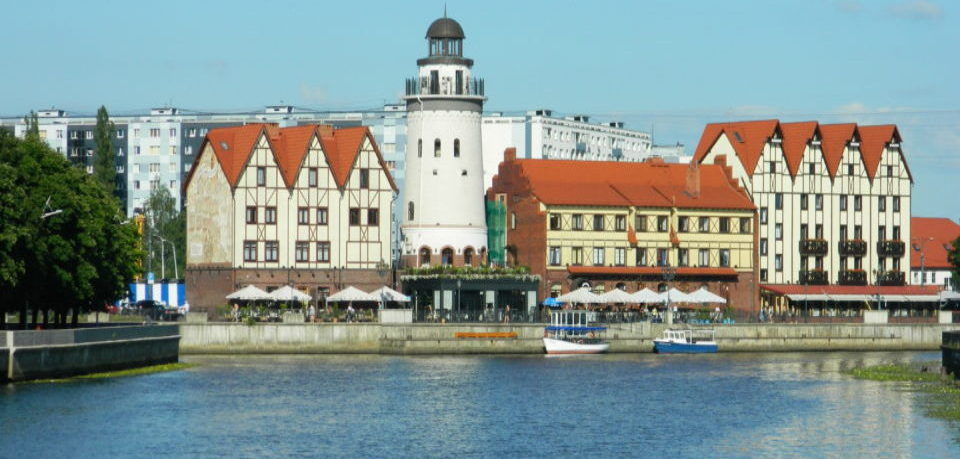
Thus, silently mediating between the cultural polemics by which my actions were guided, I was able to wend my way without a sullied conscience, heading towards the food fair by way of the riverside walk that fronts Kaliningrad’s ‘Fishing Village’ ~ an attractive architectural fantasy of swish hotels and well-appointed restaurants that has nothing to do with fishing but a lot to do with tourism.

Kaliningrad Street Food Festival

Someone, I believe it was my wife, suggested that we rest our weary bones at one of the outside tables and take light refreshment before going on to the fair. This was an odd idea considering that over the other side of Honeymoon Bridge there was about forty or fifty food stalls. But wives, as you know, know best …

Mick Hart & Olga Hart at the Fishing Village, Kaliningrad
Kaliningrad Fishing Village ~ on our way to Kaliningrad Street Food Festival

The first mistake was quickly followed by the second, which was that the spot we had chosen was firmly in the shade and subject to strong gusts of wind; the second mistake was the restaurant/café itself. Foodwise, it had not been a good choice, even for snack standards, although I did enjoy my pint of Leffe!

You might infer that having crossed Honeymoon Bridge we would be plunged into the troubled world of real life, but this was not the case.

The continuous row of brightly coloured stalls and milling crowds was a sight for sore self-isolating eyes, a coronavirus-contagious nightmare for your mask-wearing six-foot distancers, but for me, today, a much-needed carnival atmosphere ~ a cornucopia of pleasing sights, foot-tapping sounds and sizzling smells ~ or, as I put it earlier, a celebration of life.

A giant radio at Königsberg Food Festval

Kaliningrad Street Food Festival

The pink stalls with their colourful, whacky wallpapered fronts, looked well in the sunlit environs, with the hefty walls of Königsberg Cathedral acting as their backdrop. There was food galore, which was not a bad thing for a food festival, but this being Russia it was a foregone conclusion that most of it would be meaty. For vegetarians such as myself, options are rather limited.

Unphased, since I am a ‘baked beans on toast’ sort of person anyway, there was nothing for it but to turn my attention to the beer they had on offer.

Stall at Kaliningrad Street Food Festival
Old Brick Pub Kaliningrad Street Food Festival

Olga discovered one stall selling warm beer; not warm as in ‘Ugh my beer is warm’ (an ironic grumble in England where everyone seems to have forgotten that beer is supposed to be served at room temperature), but warm in the sense of heated. Being nothing but adventurous ~ where beer is concerned, that is ~ I sampled some of this, and I must admit that, contrary to my bigotry, I found it remarkably palatable.

Mick Hart Kaliningrad enjoying special warmed beer
Mick Hart samples heated beer at Königsberg Cathedral Food Fair

At the corner of the pedestrian walk where the cobbled street widens to form the plaza at the front of the cathedral, a group of vintage vehicles were on display, among which was our friend’s, Arthur’s, Volga.

Mick Hart with the Auto Retro Club Kaliningrad Königsberg Cathedral

Speciality warm beer, vintage cars, good company & Königsberg Cathedral: Food Festival Kaliningrad 2021

To the right, the one-time silver refreshment caravan in the shape of an American diner has been replaced by a permanent parade of gift and refreshment cubicles and even a proper restaurant. Again, some people criticise, but I like them. They reflect Königsberg Cathedral’s increasing popularity as a tourist destination and are just enough and not too much.

At this point in the cathedral grounds the land rises, and it is necessary to climb a brief flight of steps to ascend to the higher and wider concourse, on either side of which today food stalls took pride of place.

The variety of food on offer was really quite astonishing, so much so that you would have to be suffering from indigestion, experiencing an attack of consummate vegetarianism, or just being rather peculiar should you not be able to find yourself something to sink your choppers into.

As I fall into at least one of those compromised categories, I continued to stay on the beer, which, like its solid counterpart, offered incomparable sustenance of a most diverse and most diverting kind.

All of a sudden standing went out of fashion. It was fortunate, therefore, that the municipal makeover of our immediate vicinity had pre-empted this condition, a contingency not found wanting in the number, style and seating capacity of the scrolled and slat-back benches dotted around the park.

Being difficult as well as vegetarian ~ same thing? ~ I immediately ignored these, and we eventually came to rest on the well-thought-out and positioned wooden steps that aligns the seated with the magnificent facade of Königsberg Cathedral.

Mick Hart, Olga hart and friend Arthur on steps front of Königsberg Cathedral
Mick Hart & Olga with Arthur (feeding himself) on the steps in front of Königsberg Cathedral (May 2021)

From this spot we refused to move (OK, I refused to move) for the rest of the afternoon, with the exception of forays for food and beer ~ Oh, and Olga’s impulse purchase of a silver and amber ring (good job my beer requirement was not overstretching our budget!)

Said Olga, whilst we were sitting where we were sitting: Have you noticed how the front of Königsberg Cathedral has an unreal aspect about it? It has an ethereality, a lightness that most ecclesiastical buildings do not possess. Cathedrals in general have a formal and officiating presence, commanding deep and unquestionable reverence, but this cathedral seems to hang in the air ~ to float. Now remember, it was Olga saying this and not my beer, but was it the beer that made me respond that it looked from our perspective as if the cathedral could have been drawn on the natural canvas donated by this calm and relaxing day by our friend and artist  Victor Ryabinin?

Some things you can never be sure of and others even less so, but one thing we agreed on was that Kaliningrad’s food festival had given us plenty of food for thought.

Copyright © 2018-2022 Mick Hart. All rights reserved.

9 May Kaliningrad Victory Day 2021 with veteran

9th May Kaliningrad Victory Day 2021

Kaliningrad Honours its Veterans

Published: 14 May 2021

9 May Victory Day 2021, and in Kaliningrad, as in the rest of Russia, young and old turned out in thousands to pay their respect to their forebears ~ those who survived and those who died in the awesome and bloody struggle to deliver their country from Nazi tyranny and to honour the inestimable contribution made by the Soviet Union to the defeat of Hitler’s Third Reich.

Last year Victory Day was a rather muted affair owing to coronavirus, but this year Russia’s second most important holiday after Easter was firmly back on track, led by the traditional Victory Day parade in Moscow and marked elsewhere throughout the country with celebrations and remembrance services.

9th May Kaliningrad Victory Day 2021

At 12pm, Olga and I rendezvoused with our friends, Arthur and Inara, at the Home for Veterans on Komsomolskaya Street, Kaliningrad, a large complex of buildings which, as the name suggests, provides homes to veterans who no longer have kinfolk to support them.

Although the service is a private affair, held behind closed gates, it was still possible to see something of the formal ceremony and the cadets of various denominations who took part in acknowledging the debt that is owed to one of the most remarkable generations in modern history.

From the Home for Veterans, we walked the short distance to the Мass Grave of Soviet Soldiers and placed red roses on the eternal-flame-lit monument, before driving to the city’s foremost WWII remembrance site, the Monument to 1200 Guardsmen, an impressive obelisk and statue-flanked shrine to the soldiers of the 11th Army who died in the assault on Königsberg.

9th May Kaliningrad Victory Day 2021
Mass Grave of Soviet Soldiers
Mick Hart & Olga Hart Victory Day Kaliningrad 9th May 2021
Mick & Olga Hart placing flowers at the Mass Grave of Soviet Soldiers, 9 May 2021
9th May 2021 Kaliningrad: British & US flags fly with Soviet flags
Russians do not seem to have the same problem that Brits and Yanks have
when it comes to remembering their allies!

Victory Park, an elaborate, grassed, landscaped area criss-crossed with winding pathways and studded with series of steps, lies at the foot of the Monument to 1200 Guardsmen.  Today, it was a sea of people, many of which were family groups,  proudly carrying the national flag, and also in many cases the flag of the USSR, along with placard-mounted portraits of their relatives who had taken part in the battle of Königsberg or the wider conflict.

As well as photographs, flags and flowers, numerous participants wore medals and many more were wearing the black and orange striped Georgian ribbon, one of Russia’s most powerful symbols of national pride and patriotism.  Some children were dressed in the type of military uniform that their grandparents would have worn during WWII, or, as the Russian’s refer to it, the Great Patriotic War, and both children and adults alike had in some instances donned the Soviet army side-cap, the olive-green pilotka, with its red or green-painted Soviet star badge.

Russians wearing the George Ribbon as a mark of Victory Day respect 2021
Olga Hart & friend Inara place roses at Soviet war monument 9 May 2021
Olga Hart & Inara place roses at a monument in Victory Park, Kaliningrad (9 May 2021)

Sadly, but inevitably, with each passing year the veteran population diminishes, but today we were fortunate to meet a 91-year-old lady veteran, who had braved the crowds and temperamental weather to attend the annual ceremony.

WWII Lady Veteran Kaliningrad Victory Day

During the Second World War, she had contributed to the war effort by providing vital work in the Soviet munition factories. Today, she wore her medals with pride.

Her husband had been amongst those Soviet regiments that had fought their way across the East Prussian region, a punishing military campaign that had culminated in a ferocious artillery assault on Königsberg followed by gruelling street-by-street close-quarter combat in and out of the web of ruins.

One of the lady’s granddaughters, who spoke perfect English, told me that in recognition of her grandfather’s bravery during the Königsberg campaign, not only had he been highly decorated but also a street had been named after him in one of the region’s outlying towns.

It was an honour and privilege to have met and talked with this veteran and her family today and to have had the opportunity to witness such a profound and open expression of respect and patriotism here in Kaliningrad extending across the entire generational spectrum.

Monument to 1200 Guardsmen, Kaliningrad, Victory Day 2021

RELATED POSTS
9th May Victory Day Kaliningrad (2020)
Immortal Regiment Alexei Dolgikh
9th May Kaliningrad Social Distancing (2020)

Copyright © 2018-2022 Mick Hart. All rights reserved.

London Woke Up to Khan

London Woke Up to Khan

London Woke Up to Khan ~ one day it might just wake up!

Woke Watch PC UK! {Case 2}

Published: 11 May 2021

On 8 May 2021, London Woke up to a new dawn of nothing new ~ another 3 years of Sadiq Khan as mayor. Another 3 years for the usual suspects to contextualise his re-election as a great day for inclusivity ~ never mind the downside!

As predicted, London, which the last national census of 2011 revealed is 55.1% non-white British (one can only imagine what it is now!) chose to ignore Khan’s abysmal record of mayoralty and instead, following their woke instinct, ticked the box next to the man under whose mayoral tenure the capital city of England has earnt itself the dubious accolade of being Stab Fest City of the World.

During Khan’s 5-year reign, serious crime in London has spiralled out of control: deaths by stabbing are at an all-time high; rape prosecutions have dwindled: nobody feels safe upon the streets anymore.

Political activists such as Laurence Fox, himself a candidate for the London mayor’s office, called upon the Metropolitan Police to ‘free up officers to police streets not tweets’, a reference to the disproportional importance that the Metropolitan Police under Khan’s stewardship seems to put on their politically correct credentials at the expense of combatting crime in the real world.

An insight into the extent of Khan’s wokeyness can be gleaned from a Spectator article headlined, ‘Revealed: the cost of Sadiq Khan’s woke army’:

“The number of staff at City Hall has swelled by 45 per cent in just four years, rising from 817 in May 2016 to 1,190 in April 2020. Among these include no less than nine staff tasked with responsibilities for inclusion, diversity and fairness – a ratio of one per 132 total employees.

“Posts include a Programme Director for Economic Fairness who earns between £70,241 and £76,029”

And if that does not convince you, The Spectator article goes on to mention Khan’s planned ‘commission for diversity in the public realm’, an exercise in pure woke that is expected to cost the taxpayer more than £1 million.

London Woke Up to Khan

Among the tasks that Khan’s commission has been charged to oversee is a review of London’s statues and street names in capitulation to the Black Lives Matter riots last year (2020). Now that really is money well spent! Apart from “Goodbye Piccadilly, farewell Leicester Square”, how on earth will London’s cabbies cope with all those foreign ooboogoogoo street names and disposed heritage landmarks? And what chance do we have of selling Churchill’s statue to the yanks for as much as it costs to fund a diversity manager, now that Biden has been string-pulled into office?

At least this proposed scheme goes some way to explain why the black gentleman, Shaun Bailey, the Conservative candidate for mayor of London, failed to cut the mustard, that and the £1.5 million Khan disposed of on a New Year’s Eve firework display in which he chose to illuminate London’s skyline with the paramilitary BLM emblem of the raised, clenched fist. I think the word is ‘pandering’ or is it just ‘sick’? Perhaps, when you stop to consider that this act alone provides a clue as to why violent crime in London goes unchecked, a better word would be ‘sickening’. One million quid spent on renaming streets and replacing statues is a lot to shell out to blackmailers. The money would be better spent on training and equipping a viable London riot squad or used for funding a long overdue addition to the UK’s national curriculum called Respect for the Host Country.

The BBC (which the Mail Online informs us backed Khan’s inappropriate but self-revealing firework display [Tories slam Sadiq Khan’s £1.5million New Year’s Eve light show | Daily Mail Online) tells us that “the mayor [of London] officially acts as the police and crime commissioner for London, which means the mayor has a role in setting out how London is policed and staffed.” Oh dear!

“The mayor appoints the Metropolitan Police commissioner, who is in charge of the day-to-day running of the police and holds them to account.” Oh dear! Oh dear!

“Finally, the mayor also works with different agencies and government departments to make sure London is prepared for … terror attacks.” Oh dear! Oh dear! Oh dear!!! [London elections 2021: What can the mayor of London do? ~ BBC (accessed 9 May 2021)]

The Metropolitan Police commissioner whom Khan ‘holds to account’ is one Cressida Dick ~ she must have had a hard time of it when she was at school, but then she became a police officer.

So, London has an Asian mayor and a female Metropolitan Police commissioner called Cressida Dick ~ and you and I wonder why mean tweeters are more at risk of being brought to book than serious street crims. Although, in case you need to know, the Stay Out of Jail Free card for mean tweeters is liberal affiliation and espousing liberal causes. No matter what you say or how you say it, you are guaranteed immunity.

When you read that the role of London mayor has the largest personal mandate of any politician in the UK and that Khan is the recipient, that is scary stuff indeed. But, before we write the UK off completely, let us not forget that London is a state within a state, a woke liberal enclave surrounded by a far greater real British population than the one that has yet to evacuate London, and that this same majority living in the provinces excommunicated London many decades ago. I suppose the day will finally come when we can leave multicultural London to its renamed streets and statues of a different hue and simply move the seat of government somewhere else ~ like Scunthorpe, for example ~ then campaign for LEXIT, set up a hard border and encircle it with a moat.

Whatever our opinion is of Mr Khan and his mayoral iniquities, we must concede that his re-election is merely grist to the woke mill. Laurence Fox, actor, political activist, victim of wokism and a mayoral candidate, never believed he would oust Khan in the London election for mayor, but by standing against Khan in the knowledge that he never represented a serious threat to Khan’s fifedom let alone pull his mayoral chain and flush him away, he effectively proved his point, that London is unequivocally the UK’s ‘Cathedral of Woke’. And there, as they say, you have it.

The beauty of living in a democracy (the UK’s kind of democracy) is that whilst you hardly ever get what you want, you often get what you deserve. So, let that be a lesson to you, London! Pass the vest and let’s all hold hands …

A T-shirt featuring the mayor and police commissioner hugging, with the emblematic BLM fist superimposed on the back, can be purchased from The Commission for Diverting Your Attention in the Public Realm, Blackhall, West Monrassa SW1A (turn hard and extreme left at Churchill’s empty statue plinth). Also on sale, 2021 mayoralty stab vests and candle-lit vigil kits, plus the Handbook on Mean Tweets ~ how to be liberal and avoid conviction.

Woke Watch PC UK!

😉Woke Watch PC UK ~ An introduction to UK Woke

Copyright © 2018-2021 Mick Hart. All rights reserved.

1930s Buick at Fort XI Kaliningrad

See 1930s Buick at Fort XI Kaliningrad

Running boards ~ and the rest!

Published: 7 May 2021 ~ See 1930s Buick at Fort XI Kaliningrad

On the 29 April 2021, my wife, Olga, and I were invited to attend the Kaliningrad Retro Car Club’s classic car rally, which was being held at Fort XI (Fort Dönhoff), the best preserved fort of Königsberg’s outer defensive circle. I wrote about Fort Dönhoff in an earlier post, and one of the attractions of revisiting it was to see to what extent it had  developed in terms of restoration and as a regional tourist attraction.

Needles to say, whilst there we snapped a good many photographs, both of the fort itself and of the cars exhibited.

One car that we photographed was not included in the photographic ensemble depicted in my last post, as it is not, as far as I can ascertain, owned by a member of the Retro Car Club and, besides, it is such an unusual vehicle to be stationed in this part of the world that I think that it deserves a post of its own.

See 1930s Buick at Fort XI Kaliningrad

As you will see from the photographs provided, the car in question is a 1930s’ American Buick ~ a must for anyone fascinated with early-to-mid 20th century American automobiles and the history of the period from the prohibition to the pre-war era.

I confess that I haven’t done my background work on this vehicle, but I am sure that there are any number of vintage automobile enthusiasts out there who will know exactly what model it is and its year of manufacture (most likely 1938?).

I did ask one of the Kaliningrad Retro Car Club members and received the indignant snort that “it [the car] is only a shell!” From which I understood that it is minus its engine. But even so, what a shell!

Posing next to it I wished I had worn my 1930s’ suit and Fedora and that I had retained a 1920s’ Thompson submachine gun from the days when I dealt in that sort of thing (deactivated, of course!). But without these props it was gratifying enough to be told that with the car in the background my wife and I could pass for Bonnie and Clyde.

Hmmm, I’m not sure whether our flatterer meant that we looked like the Bonnie and Clyde or the owners of Bonny’s Chip Shop in the Port of Barrow near Clyde?

But what the heck! Even a back-handed compliment is better than no compliment! And anyway, who could hope to upstage such an epoch-making vehicle as this!

1930s Buick at Fort XI

See 1930s Buick at Fort XI Kaliningrad

1930s Buick at Fort XI Kaliningrad
1930s Buick Kaliningrad rear view
1930s Buick at Fort XI Kaliningrad
Dashboard 1930s' Buick
Horn & headlight 1930s' Buick
Rear light fitting 1930s' Buick
Mick Hart & Olga Hart with 1930s Buick Kaliningrad

*****************************

Essential details:

Fort XI Dönhoff
Ulitsa Energetikov
Kaliningrad
Kaliningrad Oblast 236034

Tel: +7 4012 39 04 61
Web: https://fortDönhoff.ru/en/

Opening times:
The fort is open every day:
Summer from 10am to 6pm; Winter from 10am to 5pm

Admission:
300 roubles
Discount tickets 150 roubles (pupils and students, retirees, veterans of the Great Patriotic War, the disabled)
Free admission for children under 7 years old

Sightseeing tours:
Tours are provided free of charge
On weekdays tours take place daily at 11am, 1pm, 3pm and 5pm
At weekends and holidays at 11am 12 noon, 1pm, 2pm, 3pm, 4pm and 5pm
Approximate duration of tour is one hour
For groups of more than 10 people, advanced booking is required. Tel: +7 401 239 0699

Fort XI Website: https://fortDönhoff.ru/en/

For more background information on Fort Dönhoff, see my earlier post: https://expatkaliningrad.com/fort-donhoff-kaliningrad/

Copyright © 2018-2022 Mick Hart. All rights reserved.

Fort Donhoff Kaliningrad

Fort Dönhoff, Kaliningrad

A Trip to Fort Dönhoff

Updated: 3 May 2021 | originally published 24 January 2020

Königsberg, the former East Prussian capital which preceded Kaliningrad, was heavily fortified by two formidable rings of forts and interconnecting walls punctuated with bastions and other defensive structures. Today, these forts exist in various states of repair and disrepair, some extensively damaged as a result of military action in WWII, others being cared for by people who are renting them on a lease basis.

In 2015, we learnt that one of the forts belonging to the outer belt was being meticulously restored with a view to opening it as a tourist destination. Then, as now, a good friend of ours arranged for us to visit the fort. In January 2020, we were introduced to the entrepreneur who had taken on this ambitious restoration project. We were to meet him again at Fort XI to see how things were developing.

Fort XI (Fort Dönhoff), one of Königsberg’s forts within the outer defensive ring, is currently undergoing an extensive renovation programme. Already welcoming tourists, the massive and intricate structure is being painstakingly repaired, brick by brick, wall by wall, room by room. As I said to Arthur, the man behind the plan, “You’ve done a lot since we were here last in 2015.” Said he, with more than a touch of irony, “There’s still a lot to do.”

Having turned off the main highway, you arrive at the fort after travelling down a long narrow road that opens up into the visitors carpark. At the end of WWII and until recently, the fort was requisitioned and used as a munitions and armaments store. This explains why the perimeter of the fort is ringed with barbed wire fences, coils of barbed wire and a secondary metal gate, and why there are rusting warning signs and spotlights stationed in the trees. At this point you have not entered the red-brick fort. You are not in 19th century Königsberg, or Königsberg World War II, but atmosphere-wise you are very much back in the Cold War era.

Fort Dönhoff, Kaliningrad
Soviet entrance to the fort (summer 2015)

Where’s James Bond when you need him?

Not looking at all like James Bond, any of us, our friend Venzel, Olga and I pass through the Soviet military gate, which is now on the skew and decidedly rickety. We pass a portable cabin, which, for the time being, functions as a front office, pay-desk and souvenir shop, and walk the short distance to the fort’s gate proper.

The main entrance to the fort, built, as with the rest of the structure, in Neo-Gothic form, stands a few metres away from the later entrance, the banks on one side and the flatter terrain on the other still protected with military fencing.

The two tall pillars of the entrance continue to support the original iron gates to the fortress. They are awesome in every respect, thick and heavy with hinges and handle to match. What an excellent logo they would make for border control in Britain when we finally leave the EU. Hmmm, I think I should copyright this one.

Fort Dönhoff Kaliningrad
Mick Hart at the entrance to Fort Dönhoff, Kaliningrad, Russia

Inside the compound, immediately inside, nothing much seemed to have changed from our last visit: small building on the left, small shed-like building to the right. But this position does give the visitor a commanding view of the front of the fort: the hardstone track crossing the moat to the great arched doorway; the side walls of the fort fanning out to form the open end of a chevron.

Our host, Arthur, the fort’s lease owner, greeted us, and we walked together towards the fort entrance. As we crossed the narrow bridge, I could see immediately that repointing and cleaning work had been undertaken and that the old windows had all been replaced with wooden-framed double-glazed units. The overgrowth, and the rubbish that it contained, along both outer walls of the fort had been cleared, the grass on both sides of the footpath in front trimmed and the vegetation stripped from the moat. Arthur explained that they had managed to lower the level of the moat by one metre, which must have had a beneficial effect in combatting rising damp inside the fort.

Rare bits and rabbits

The mown grass banks that slope gently down towards the moat side contain a small profusion of little wooden houses. These were not homes for a rising population constructed on a green belt, but executive homes for rabbits. Arthur explained that they had a number of resident rabbits, curious and exotic species, half-a-dozen of which could be seen bobbing around munching the grass.

Gathering outside the entrance to the fort to discuss what had been achieved since we were here last, I observed that an outer door had been added. This new door followed the original contours of the arch. The frame was black steel, the inner criss-crossed with vertical and horizontal struts in the manner of a portcullis, the intervals between the squares infilled with double-sided, ribbed, translucent plastic. This theme, I would soon discover, had been adopted throughout the fort. The portcullis effect was highly suitable to the surroundings in which it had been employed, whilst the translucent plastic served two fortuitous purposes: letting in light whilst retaining heat.

Fort Dönhoff Kaliningrad: retro stove

And heat there was, not in every room and corridor, but certainly in the rooms where renovation was complete. The heating of choice, and it could hardly have been any other bearing in mind the fort’s location, is wood burners. Nothing more, except for open fire hearths, would be appropriate. The stoves have a retro-look about them and fit well into the backdrop of red-brick walls and vaulted Gothic ceilings.

We passed through two ante-chambers containing relics from World War II: munition shells, military helmets, various items of field gear all discovered either in the fort itself or in the grounds surrounding it. The walls are interspersed at regular intervals with printed and pictorial information boards depicting the history of Königsberg’s defenses, the particular fort we were in, and the RAF bombing raids and subsequent battle which saw Königsberg reduced to ruins.

I would have liked to have lingered longer here, but Arthur was calling us into what was effectively a suite of rooms, three interconnecting chambers that flanked the main entrance which, with their tall archways and multiple vaulted ceilings, were deliciously Königsberg Gothic. In here, the wall displays and glass cabinet containing both German and Soviet firearms from WWII, were augmented with a large wall-mounted monitor on which a video of the battle for Königsberg was running. From the presence of a longish conference table, complete with modern chairs, their back supports decorated armorial style, it would appear that this room was used for business meetings and educational purposes. Arthur was particularly proud of the real wood floor which, he surmised, would have been the status quo at the time when the fort was constructed.

Meeting table at Fort Dönhoff Kaliningrad
Fort Dönhoff: Conference table

It was explained to us before we continued our tour, that the two front radial arms of the fort had been the soldiers’ barracks, their living quarters.

When you first visit the fort, it is hard to visualise the layout, even with the help of plans which are dotted about on large display boards. For the novice visitor and us, effectively on our second visit, the initial and lasting impression is one of being swallowed up within a vast maze of corridors and arched-roof chambers. Obviously, electric lighting has been installed, but some areas are dimmer than others and others really quite dark. For the time being, however, the route we were on was figurable. On either side of the main entrance, long corridors run the length of the fort behind a series of arched rooms, the windows of which look out over the grassed bank and moat beyond. This would have been the view that the troops stationed here from the 19th century to the end of WWII would have had on a daily basis.

Long passageway: Fort Dönhoff Kaliningrad
Passageway running the length of the barracks, Fort Dönhoff, Kaliningrad, Russia

As we walked, Arthur explained that these rooms were at the forefront of the renovation process and would eventually be rented as commercial units. All of the rooms were of the same proportion, except for the first, this larger space having been arranged to accommodate parties over the festive season. The main feature herein was the huge open fireplace with its solid oak mantle beam.

Function room: Fort Dönhoff, Kaliningrad
Function room at Fort Dönhoff, destined to become the fort’s cafeteria

A unifying theme of both the left and right sections of this area of the fort, and, indeed, throughout, was the application of the portcullis-style doors, which fitted handsomely into the original archways and were used to good effect in dividing the length of the corridors.

I asked Arthur how the entrance to each room would have been originally, and he was able to show me, as one of the rooms was being restored in order to demonstrate the original design. The arches to the front of each room had been brick to the point where the verticals curved, with a conventional door at the centre. The arched upper section would have been filled with a wooden frame and windows.

Fort Dönhoff Kaliningrad
Recreating the barrack-room experience! Soviet re-enactors’ beds

The chambers on the opposite side to the one we had first visited were a mirror image, and, once again, contained relics and artefacts associated with the history of the fort and Königsberg in general. The first room had a giant plan of the fort on one side of the wall and, on the other, a circle of ceramic plaques showing the outer circle of forts, including Fort XI, with Königsberg at their centre.

Konigsberg fort plan: Fort Dönhoff, Kaliningrad
Konigsberg’s outer ring of fortifications

The main suite of chambers here contained a modern, but refectory-style, table, and, if I remember correctly, recently these rooms had been used for holding parties.

Fort Dönhoff Caféteria

The design of the Königsberg forts was such that both sides had been constructed to include open yards. To get to these you have to pass through big, heavy iron doors. In fact, to get to anything here it’s big heavy iron doors! The yards are sunk well-like at ground level; they are valleys, with the ramparts of the superstructure rising precipitously above them on all sides. To get to the higher levels, you need to negotiate steep stairways or grassed tracks that rise gradually, but precipitously, along a lengthy incline. These yards are fitted with outbuildings sunk into the side of the banks, the exposed portions of their roofs grassed over, as is the fort in its entirety, making it look from the rooftop more like a giant mound covered in hills and valleys than a building. We would ascend to the roof in good time, but first it had done my chilled fingers and toes a power of good to see that in the corner of the yard was the welcoming sign of a café.

Naturally, written in Cyrillic (isn’t my Russian improving!), I was heartened to see that in keeping with the historical tenor the sign was perfectly suited. It had been written, or painted, in hand and the wooden frontage and doors below had a rough-hewn plank effect.

Inside, the accent was on basic; just as it should be. The natural stone floor and seats arranged down one side as a series of wooden box-frame units, painted to look distressed, ostracised any attempt at modernity, making for a completely inline atmosphere.

Fort Dönhoff, Kaliningrad: cafeteria
The interior of Fort Dönhoff’s atmospheric cafe

Before ordering something warm to drink, and a snack to go with it, we were advised that quality and exotic coffees were the specialities of the house, and I have to say that my choice, coffee with real ginger, was superb.

Refreshments in Fort Dönhoff, Kaliningrad, 2020
Fort Dönhoff’s cafe: some of the most exotic and tasty coffee I have ever tasted!

Suitably replenished, we followed our guide into a long passageway set into the side of the bank. He asked us to close our eyes and imagine this as a street, with retail units of various kinds on either side. So, I put on my architect’s head and what do you know, it worked!

Aren’t your toilets wonderful!

From this point onwards the exact route that we took becomes a little blurred. We returned to the fort interior, checked out the long, arched powder rooms, entered several narrow walkways, popped out again into the open air, this being the opposite yard where in 2015 I had been filmed by Moscow television coming out of one the historic toilet blocks and all I could think of saying was, ‘the toilets are really wonderful’, returned inside, climbed a very steep flight of steps and came out on the upper level overlooking the entrance.

At this juncture, Arthur drew our attention to various scratched inscriptions in the walls and ceilings just behind the doorway. The names and their attendant dates largely belonged to the 1950s, and it was Arthur’s opinion that they had been incised there by a succession of lonely guards who, when the fort had been employed as a munitions store in Soviet times, would have been standing here in this doorway, rifle in hand, wracked with boredom.

Our excursion was now becoming more labyrinth-like by the minute. We traced our steps, literally, to a lower level, and then climbed a spiral staircase that brought us out on the top of the fort a few yards away from the main entrance. Wooden decking had been laid here, on which there were two park benches and, looking out towards Königsberg, a pair of coin-operated binoculars raised on a metal stanchion.

Fort XI, Dönhoff, in World War II

From this point you could just make out using your own built-in optics a distant Kaliningrad. Said Arthur, “The fort garrison could clearly see from here the city of Königsberg going up in flames. The Soviet artillery was placed not much more than a metre apart and firing was so intense that some of the barrels were melting.” It was not surprising, therefore, that the morale of the German forces occupying the fort had, like the once grand city before them, disintegrated.

Grave of Soviet soldier

Not all of Königsberg’s ancient forts had been this fortunate: some saw heavy fighting during the battle for Königsberg, and some were reduced to rubble. Later, as we were walking back through the main tunnel, Arthur said with an ironic sigh, “Ahh, all this material and work ~ for nothing!” He referred to the fact that by the time Königsberg’s legendary fortifications had been completed, they were already out of date. Developments in artillery meant that the massive walls and ramparts offered little or no effective resistance and, of course, come aerial warfare they were all but perfectly redundant. The crowning irony has to be that whilst large swathes of Königsberg were wiped off the map in WWII, much of its fortifications survived the onslaught.

Back in 2020, on the grassy roof of the fort the Germans had bequeathed us, I marvelled at the garrison of chimneys marching across the skyline. Each red-brick chimney block, capped against the wind and rain, seemed to contain several flues. It was good to see one or two of them smoking. Arthur had informed us that they had undertaken assessments of all the flues in the rooms that had been earmarked for later use and all were in functionable order.

Since we were here last, in 2015, the trees, bushes and undergrowth sprouting from the roof of the fort had been done away with. It was now possible to stand on the entrance peninsular and look out over grassed areas that were not too far from golfing-green standard, except for the presence of tree stumps, and when we climbed to the highest point, and took up position at the base of the flagpole flying the Russian flag, the hills and dales of the rooftop landscape traversed with wooden walkways really was a sight to behold.

We ventured to the furthest extremity of the roof and looked out on the other side of the fort, where, extending from and behind the massy walls of the moat, more buildings were waiting among the trees to be renovated.

Gun emplacements: Fort Dönhoff, Kaliningrad
Gun emplacement on far side of Fort Dönhoff

Machine-gun post

At this moment, we were standing next to a great slab of concrete. It protruded from the ground at not much more than calf height and contained a pillar-box split, just wide and deep enough to peer through from the inside using a pair of binoculars or through which to mount a machine gun.

Arthur took us back into the fort so that we could see what this look-out/machine-gun post was like for the men who once were stationed here.

Our route took us past a peculiar tunnel, the walls and floor of which were almost smooth, that ran at a steep diagonal downwards. Apparently, it had once been a staircase, but some kind of high-powered incendiary device had been tested there, the heat from which had been so intense that it had literally melted the brickwork. The effect could clearly be seen and touched at the farthermost point of the ceiling, where the bricks resembled petrified jelly!

Napalm tunnel ~ Fort Dönhoff Kaliningrad
Incendiary experiment = brick meltdown! ~ Fort Dönhoff

We also passed some large oval iron plates in the floor. These were trapdoors, which, when opened, would have allowed ammunition to have been hoisted up from the floors below.

Ammunition hatchways in Fort Dönhoff, Kaliningrad
Trapdoors for elevating munitions to the upper storeys ~ Fort Dönhoff

We made it to the machine-gun nest, the last leg of the journey necessitating a short climb up a vertical ladder. Inside it was damp and claustrophobic, but those stationed inside would have had a narrow but commanding view over the moat. With a heavy machine gun trained on them from this elevated position many lives would need to be sacrificed before the fort could be stormed at this point.

We wended our way back from here to the lower level, where we were shown the fixtures and viewing windows to the right and left of the moat, where some kind of heavy cannons would have been trained, making any attempt to bridge the fort by boat a costly if nigh impossible one, and then we made our way back through a narrow corridor closer to the front of the fort.

I’ve never seen one as big as this before!

We had been talking about horses and stables when I thought I could smell hay and, hey presto!, at the end of the corridor in which we were standing was a room full of hay bales. Tempted to revert to my Judge Dread and Ivor Bigun upbringing, I won’t say it after all, but the occupant of this room was a large one ~ one of the biggest and most self-confident cockerels that I have ever clapped eyes on. He looked at us as if to say ‘follow me’, and led us through an open doorway onto the chilly embankment outside.

A big cock.
What a beauty!

We emerged about three-quarters of the way along the moat side, which put us in Funny Bunny country. Whilst Olga conversed with the cockerel, I observed three or four species of rabbit, the likes of which I had never beheld. I won’t dwell on this too much, as I have a friend in England who cannot stand rabbits. He claims that they were introduced to England by the ‘bloody Normans’, and that this was when for England ‘it all went wrong!’.

We had spent a splendid afternoon at Fort XI (Fort Dönhoff) and look forward to returning later in the year to see how things are progressing there. It is truly a marvelous and atmospheric place, particularly if, like me, you are only too pleased when the past catches up with you!

Fort XI Dönhoff Kaliningrad
Venzel, Arthur & Mick in Arthur’s fort. Boys will always be boys!

When you visit the Kaliningrad region, put Fort XI (Dönhoff) high on your itinerary of must-see places. I assure you, you won’t regret it!

Tourist INformation NBoard, Fort Dönhoff, Kaliningrad
TOURIST INFORMATION BOARD Fort Dönhoff

*****************************

This article was originally posted to my blog on 24 January 2020 and revised on 4 May 2021. To preserve the historical integrity of this piece, the editorial revisions that I have made have been essentially confined to practical details, ie opening times, costs etc. For an update on Fort XI, please refer to my March 2021 post: Kaliningrad Hosts Retro Car Club Day.

*******************************

Essential details:

Fort XI Dönhoff
Ulitsa Energetikov
Kaliningrad
Kaliningrad Oblast 236034

Tel: +7 4012 39 04 61
Web: https://fortDönhoff.ru/en/

Opening times:
The fort is open every day:
Summer from 10am to 6pm; Winter from 10am to 5pm

Admission:
300 roubles
Discount tickets 150 roubles (pupils and students, retirees, veterans of the Great Patriotic War, the disabled)
Free admission for children under 7 years old

Sightseeing tours:
Tours are provided free of charge
On weekdays tours take place daily at 11am, 1pm, 3pm and 5pm
At weekends and holidays at 11am 12 noon, 1pm, 2pm, 3pm, 4pm and 5pm
Approximate duration of tour is one hour
For groups of more than 10 people, advanced booking is required. Tel: +7 401 239 0699

Fort XI Website: https://fortDönhoff.ru/en/

For more background information on Fort Dönhoff, see my later post:
https://expatkaliningrad.com/fort-xi-kaliningrad-hosts-retro-car-club-day/

Copyright © 2018-2021 Mick Hart. All rights reserved.

Fort XI Kaliningrad Hosts Retro Car Club

Fort XI Kaliningrad Hosts Retro Car Club Day

Fort XI (Fort Dönhoff) Revisited

Published: 29 April 2021 ~ Fort XI Kaliningrad

The classic cars had been assembled in two parallel lines. Even though there were as many as 15 or 20, they were lost, engulfed by the vast piece of open ground on which they were parked in front of a landmark that has earnt itself the dubious reputation of being Kaliningrad’s most ugly whilst, ironically, most iconic post-war building.

I am referring, of course, to that concrete anomaly that replaced the beauty that was Königsberg Castle, the House of Soviets ~ a building much loved by western journalists in their quest to mythicise Russian austerity, and for all those who earnestly believe that nothing ever changes for the better, a reassuring reminder that their nihilism is not unfounded.

House of Soviets Kaliningrad
‘H’ for House of Soviets ~ it has the same ambiguous appeal as Marmite

Fort XI Kaliningrad: Retro Car Club Day

The classic cars lined up on the paved expanse belonged to members of the Kaliningrad Retro Car Club. The cars were standing in front of the House of Soviets as a prelude to being driven cavalcade fashion on to Fort Dönhoff, the eleventh of the twelve forts that form the outer ring of the city of Königsberg’s nineteenth century defence system.

As we were a few minutes early for kick-off, I used the time available to snap a few pictures, both of the cars and the House of Soviets. Rumour has it that after 50 years of non-occupation due to its having been constructed on ancient tunnels that rendered it unsafe the moment it was built (and yet it is still here?), the days of the controversial House of Soviets may be finally numbered. I can hear Elton singing “I’m still standing” and Leonard Cohen reminding us that “You hear these funny voices in the Tower of Song …”

Camper Van Kaliningrad Retro Car Club

How chilly it was on this late April day can be calculated from the thin blue palate of the sky and the fluffy white clouds skating across its surface. The breeze was slight, but whenever the sun disappeared behind one of these cotton-wool splodges, the 8 degrees that we had been promised by the weatherman dipped, and the chill factor bit home.

Nevertheless, after twelve months or more consigned for the most part to barracks on account of coronavirus, it was good to be out and about again, even quite amazing to be standing there permissibly in such an open and public space, with the tall buildings of the city in the background, the traffic bustling past and on the near horizon the always edifying and noble turret of Königsberg Cathedral.

Königsberg Cathedral view from House of Soviets
Königsberg Cathedral as seen from the former castle site ~ Kaliningrad, April 2021

Now that all the crew had arrived, it was time that we set off, and today we were in for a treat. We would be travelling to Fort XI in our friend Arthur’s Volga.

I have had the opportunity to ride in two or three Volga classics since moving to Russia. I love the typical 1960s’ interior — the low-slung front bench seat, the colour scheme that replicates that of the car’s exterior, the busy chromium dashboard, column-change gear stick, and, most of all, the arched transparent speedometer which, in its hey day, was as space-age chic as Sputnik (see first image in this post).

Unfortunately, Arthur’s speedo has the irritating tendency when the car is in motion to chatter a lot, and as we accelerated on the outskirts of the city, the chattering  increased with such velocity that Inara, Arthur’s wife, in a refreshing moment of complete indifference to the repressive nature of political correctness, made as if the noise was coming from a car-mounted submachine gun. For a fleeting second it looked as though she was wearing a small moustache and was that a wave she was giving or a rather silly salute?

Despite this fantasy, there was little doubt that we were not travelling in a 1939 Mercedes-Benz 770 Grosser Offener Tourenwagenas, not least because I have it on good authority that the suspension on this particular vehicle has a solid retaining quality, whereas, in my opinion, the Volga’s suspension is spongey, tending to rock the car about on Kaliningrad’s variable road surface like an afternoon romp on a waterbed.

From consideration of the vehicle’s suspension, I then found myself asking did Volgas, indeed any Russian cars of this period, have powered steering? I ask this question as it is a mystery to me whether our driver, Arthur, wrestles with the steering wheel because he has no choice, because it is required, or simply because it is his adopted driving style?

I do know that other drivers were pleased to see the old girl on the road ~ and I don’t mean my wife. Numerous cars tooted respectfully at the unusual sight of the senior citizen bouncing across the city ~ and I do mean the car, not me.

Fort XI Kaliningrad by retro car

We were jolting along the approach road to Fort XI, when our hitherto uneventful journey took a dramatic turn for the worst. Suddenly, Arthur switched off the engine, and we coasted the last few metres, arriving at the side of the carpark under a cloud of steam.

Thankfully, the fault was not a serious one. The articulated radiator screen, which should have been open, had closed itself, either because of a broken piece of wire or for want of a screw (steady!). Whichever it was, willing helpers from the car club were immediately on hand and the problem was resolved within minutes, demonstrating how, when cars were honestly mechanical, not stuffed with computerised gismos as they are today, all it would take was a little know-how, a spanner and a screwdriver and a quick-fix would be implemented.

Kaliningrad Retro Car Club

Arrival at Fort XI Kaliningrad

As we rolled past the perimeter gate of Fort Dönhoff, with the soldier’s grave to the left and the Soviet barb-wired emplacements to the right, I recalled my first visit to this heritage site back in 2015 and our last visit, which took place at the end of January 2020.

I wondered how this massive conservation/renovation programme had fared during the past 15 coronavirus months and how badly if at all the pandemic restrictions had affected business. Taking into consideration Russia’s nationwide policy to boost home tourism, whatever the downside, I reasoned, it had to be a good deal less dramatic than the impact Covid restrictions is having on business in western Europe.

Once the cars had been lined up exhibition fashion in front of the left arm of the fort, Olga and I decided to go and see what changes had taken place since we were last here.

Fort XI Kaliningrad Hosts Retro Car Club Day
Cars in the process of being lined up at the front of the fort
BMW Outside Fort XI Kaliningrad
Bring on the BMWs!
Olga Hart with Volkswagen Fort XI Kaliningrad
A German fort has to have a Volkswagen

I recalled Arthur ~ not Arthur of Kaliningrad Retro Club fame, but Arthur the man in charge of Fort XI’s reincarnation ~ saying on our last visit that he visualised one corridor inside the fort becoming a trading and exhibition street, so we decided to check this out first, stopping off on the way to rekindle some warmth over a cup of tea in the fort’s cafeteria.

Fort XI Kaliningrad developments

The vison of the ‘street’ had indeed been brought to fruition and atmospherically so. On our previous visit, you had to appreciate the vision with little vision, as the tunnel was lightless. But now illumination there was, set just at the right level so that you could see what you needed to see without compromising atmosphere.

I apologise to anybody if I have omitted them and their enterprise from this list, but, working from memory, on one side of the street the chambers leading from the main tunnel housed an antique shop, a coffee shop, a jewellers and amber specialist’s shop, an exhibition of military items leading to an evocative display at the base of the melted staircase (see my previous post on Fort XI Dönhoff) and a ‘rifle range’. On the opposite side the vaulted rooms had been opened up to allow access to the curious: one long, arched chamber contained haunting images of Königsberg as it had been before the war and as it was later, after the RAF had bombed it and after the battle for the city; whilst another room, judging by the cumbersome apparatus contained within it, appeared to be the fort’s original boiler house.

  • Fort XI Kaliningrad
  • Trading Street Fort XI Kaliningrad
  • Antique Shop Fort XI Kaliningrad
  • Cafe Fort XI
  • Branch Tunnel Fort XI
  • Grid Iron Doors Fort XI Kaliningrad
  • Shooting Range Fort XI Kaliningrad

Each room in the fortress is lovingly festooned with educational wall boards, which no doubt inform you of each exhibit and the interdependence that each room had to the fort’s military effectiveness, but, alas, as my ability to translate Russian is not as good as it should be I had to rely for the most part on my own perspicacity. And, it would seem, as my eyesight is not as good as it once was, I completely failed to notice that the newly erected ‘you are here’ boards, strategically placed in the tunnels and corridors, are all equipped with English translations. So, like the explorers of old, I plotted my course with vicissitude!

The past’s presence in Fort XI Kaliningrad

Standing once again in the main tunnel, taking my photographs, I became aware of the strange hush that descends on visitors once they have been swallowed up inside the fort’s subterranean maze, the possible joint consequence of acoustic absorption by the high, arched ceilings, the awesome madness of the construction in terms of sheer size and scale and the impenetrability of trying to imagine what it would have been like to have been a soldier stationed here, sentenced to serve and live in the echoing twilight of this vast brick warren.

Atmospheric Fort XI Kaliningrad
Relics of War Fort XI Kaliningrad
Relics of war …

Consulting my inbuilt compass, which seems to work on the principal of a magnetic attraction to vodka, I returned to the comparative warmth of the outside world and on the way met Arthur, architect of the fort’s restoration.

We had ‘bumped into’ him and his wife earlier in the café where we had briefly discussed ‘work ongoing’ and, meeting with him now, were privileged to be offered a tour of some of the other parts of the fort that we had visited last year, to see the changes that had been made.

The rooms and associated area focusing upon Königsberg’s war-time history and the fort’s involvement in the siege of Königsberg had undergone a rationalised re-configuration. The cabinet and wall displays of WWII Soviet weaponry, uniformed mannequins and such had been added to and re-assigned, and a wheel-mounted machine gun ~ possibly a DShK 1938 ~ took pride of place in the centre of the room (the sight of such a weapon would be enough to throw our British-Soviet re-enactors into uncontrollable raptures!). Likewise, the study area, complete with white board and electronic visual and auditory equipment, had been tweaked and moved to a better location. Last year these rooms had been good; now they were professional.

Our next stop was a large room, composed of three or four chambers, which, I seem to recall from our last visit, had been used for social functions. Indeed, this spacious room, with its grand open fireplace, would seem to make the perfect place for venues. However, we learnt today that it had been reassigned as a museum of fortification, whose educational resources were to be augmented using state-of-the-art virtual-reality.

As exciting as this promised to be, I have to admit I was disappointed. I suppose because I saw this room as the right place for a Wetherspoon’s pub ~ but, hey now, isn’t that typically me!

Fireplace Fort XI Kaliningrad

What our small party agreed on was that the rooms and corridors into which we had been shown were nice and warm, but lordy! — imagine how difficult and how expensive it must be to heat something of this magnitude!

From this suite of rooms we were taken outside across one of the interior grassed quadrangles, along a block-paved path to a door in one of the adjacent banks. I could see as we approached that this entrance had been tidied up and, indeed, fitted with one of Fort XI’s signature gridiron doors, two in fact, the interior one serving as an airlock to keep in the warmth from the central heating.

Inside, electric lighting clearly testified to the fact that a great deal of work had been undertaken in restoring the brickwork both in the walls and the floor. Apparently, each brick had been painstakingly cleaned by hand.

A spiral staircase inset in the wall led into a long chamber, wide enough to hold two tiers of desks. Above this chamber, accessible by the same staircase, lies a second chamber of identical proportions. And in each, as in almost every room in the fort, there are professionally designed and attractive wall-mounted information boards.

It looked like a school, and it was. Once complete, this combination of rooms is destined to facilitate Fort XI’s Spy School ~ an educational experience from which one will eventually graduate knowing all there is to know about the art, science and history of spying. Call me Maxwell Smart, I thought, as we descended the spiral staircase.

On our way back to base, I praised Arthur for the sterling work he and his crew had achieved in the past year, to which he graciously but wryly responded, as he did last year, there is still a great deal to do, adding that his reward for orchestrating the never-ending project lay in the cultural service that he was providing.

That is the joy of spending time with time travellers and historians. It is not just their knowledge that attracts but their love of the past in whatever form it takes to float their boat, and that obviously goes for cars as well.

Russian classic car enthusiasts are no different from their British counterparts in this respect, although, needless to say, in Russia the social dimension shines. The car club is just that: a club. The people all club together, muck in together, bring food, tea, coffee and picnic tables to each venue that they inhabit, ensuring that the day becomes an enjoyable social occasion.  

On this occasion, music was also provided courtesy of a vintage USSR radio, and for those of us who were passengers, and thus relieved of the responsibility of being behind the wheel, vodka was also at hand. Don’t drink and drive! This is how the slogan went. Wise words indeed. Could this be the reason why I gave up driving years ago?

  • Group Photo Kaliningrad Retro Car Club
  • Mick Hart with Kaliningrad Retro Car Club
  • Mick & Olga Hart Kaliningrad Retro Car Club
  • Mick Hart Kaliningrad Retro Car Club
  • Mick Hart Kaliningrad Retro Car Club
  • Olga Hart & Inara Kaliningrad Retro Car Club

After Arthur’s tour, we made our way back to our retro club friends, who were enjoying the sunshine in spite of the chill that its presence had failed to entirely eradicate.

Some of the car owners had brought along Soviet-era samovars: big, nickel-plated kettles with chimneys on the top. This would be the first time that I would get to see them in action.

Olga Hart with samovar Fort XI Kaliningrad

Olga and I have always wanted a samovar, so that we can react the counting-the-stars scene in Hedgehog in the Fog.

At present, we only have a couple of plug-in electric samovars, which are all well and good as curiosity pieces, but to enjoy the real experience of tea-making using a samovar you really do have to feed it with made-to-measure kindling wood, then stand back whilst the water boils and watch as the chimney smokes!

The carnival atmosphere around the car and picnic tables also seemed to appeal to the fort’s four legged critters. It brought out the resident funny bunnies and, not to be left out, even a duck got in on the act.

Teased by the sun and a sporadic stiff breeze, the day had all the makings of being a cold one, but the warmth of human interaction, good company and a genuine sense of camaraderie ~ all of the human values that coronavirus restrictions have threatened to deprive us of over the past 12 months ~ proved their vital importance, reminding us in timely fashion that there is only one true normal, which if taken away leaves nothing.

The historic setting added its own unique ambience. Fort XI is an inspiration —the perfect place to realise that there is no time like the past. It is a true gateway into Königsberg and its region; an ongoing restoration project of no small magnitude celebrating history even as it continues to be history in the making.

On the subject of time, I am not sure what the soldiers billeted here in their past-present thought of our antics today, but with history being so vibrant and so alive within the walls of Dönhoff, you feel you can almost ask them? Perhaps when you visit you will?

Fort XI Kaliningrad uniform display

*****************************

Essential details:

Fort XI Dönhoff
Ulitsa Energetikov
Kaliningrad
Kaliningrad Oblast 236034

Tel: +7 4012 39 04 61
Web: https://fortDönhoff.ru/en/

Opening times:
The fort is open every day:
Summer from 10am to 6pm; Winter from 10am to 5pm

Admission:
300 roubles
Discount tickets 150 roubles (pupils and students, retirees, veterans of the Great Patriotic War, the disabled)
Free admission for children under 7 years old

Sightseeing tours:
Tours are provided free of charge
On weekdays tours take place daily at 11am, 1pm, 3pm and 5pm
At weekends and holidays at 11am 12 noon, 1pm, 2pm, 3pm, 4pm and 5pm
Approximate duration of tour is one hour
For groups of more than 10 people, advanced booking is required. Tel: +7 401 239 0699

Fort XI Website: https://fortDönhoff.ru/en/

For more background information on Fort Dönhoff, see my earlier post: https://expatkaliningrad.com/fort-donhoff-kaliningrad/

Copyright © 2018-2021 Mick Hart. All rights reserved.

Czech Recipe Beer in Kaliningrad

Czech Recipe Beer in Kaliningrad

Mick Hart’s totally biased review of bottled beers* in Kaliningrad (or how to live without British real ale!)

Article 13: Czech Recipe Beer

Published: 26 April 2021

Hitler may have referred to England as a nation of shopkeepers, but back in the day when England was England, before it became what it is today (R.I.P. England), I, and many of my contemporaries, considered England to be not only a nation of beer drinkers, but the nation of beer drinkers. So, it might surprise you to learn that it is in fact Czechoslovakia that holds the official title of being the most beer-sodden country in the world.

Previous articles in this series:
Bottled Beer in Kaliningrad
Variety of Beer in Kaliningrad
Cedar Wood Beer in Kaliningrad
Gold Mine Beer in Kaliningrad
Zhigulevskoye Beer Kaliningrad Russia
Lidskae Aksamitnae Beer in Kaliningrad
Baltika 3 in Kaliningrad
Ostmark Beer in Kaliningrad
Three Bears Crystal Beer in Kaliningrad
Soft Barley Beer in Kaliningrad
Oak & Hoop Beer in Kaliningrad
Lifting the Bridge on Leningradskoe Beer

According to official beer-drinking records, the boozy Czechs knock back more beer per capita than anybody else, anywhere else. But take heart dear Brits! As beer in Czechoslovakia is, like everywhere else on the opposite side of the Channel, lager, and in Czechoslovakia dominated by Pilsner lager, we Brits can still claim with pride and satisfaction that the UK is the only country in the world in which two great institutions, real ale and the public house, have come together over the centuries to form a unique drinking culture. (Spirit-lifting background music of ‘Real Ale Britannia, Real Ale rules the craves, thanks to Fox and Farage Brits will never be PC slaves!’)

“Good evening landlord, a pint of Farage please.”

“Would that be a pint of ‘Farage Best He Made Them Bitter’ or a pint of ‘Farage Patriot’?”

But we are not here today to talk about national institutions, history and how the unholy trinity, Politics~Globalism~Pandemic-scare, are out to eradicate them, or to dwell forlornly on poor cold, wet and shivering Brits sitting in pub beer gardens six feet apart from one another sipping ale through a useless mask. No, we are here today, in the here and now, to consider the merits/demerits of a Russian beer known as Czech Recipe. Whether the recipe is Czech or simply called Czech Recipe, as Czechs and beer go together like volume and ringing cash registers, I will leave to your discretion.

Nowhere near as exciting by name as Farage’s ‘EU Looking at Me!’ bitter, or BLM’s ‘Churchill Still Stands’ jet-black porter, Czech Recipe might sound like a cake mix, which comes in a bottle just short of 1.5 litres, has a green label and the name in olde worlde script, but contrarily this light, filtered, live beer produced by the Lipetsk brewery is quite a tasty brew.

Green in colour, until you take the top off the bottle and pour it into your glass, Czech Recipe has a pale golden hue, a faint aroma of no particular kind (so forget about all those pretentious beer reviews that compare it to Elton John’s piano, with ‘notes’ of this and ‘notes’ of that) and a foamy head that could not recede faster were it wearing a loose-fitting toupée.

Sip ~ it’s zesty.

Sip ~ it’s tangy.

Gulp ~ it’s crisp.

Gulp gone ~ it is very refreshing …

Czech Recipe is all these things, and it is also 4.7%.

Czech Recipe Beer in Kaliningrad

The aftertaste, which is so important whatever beer you are quaffing, because it is this that keeps you quaffing, is dry. In fact, it is very dry. ‘Nuts!’ you say, and you are right. The dry, crisp aftertaste is what makes it the perfect complement to nuts and other snacks. It teases the palate, without raping it, and offers a flirtatious relationship free from guilt ~ even though it is not real ale. It is, in fact, the sort of Czech you could easily take home to meet your mum. Strong to a degree but, as Leonard Cohen sang (I don’t know whether he drank it?) ‘It’s light, light enough to let it go …’

Czech Recipe Beer in Kaliningrad

The world’s perception of Czech beer is Pilsner and, since I am no great fan of Pilsner, I get all suspicious and cautious about buying it. Usually, I will stand there in the shop staring at it, thinking ‘dare I’? Czech Recipe could have been a recipe for a taste disaster, but it bucked the trend (yes, I have spelt it right) and once sampled left me feeling as happy as a pig in … a large grass field.

A lot of the beers that I have been drinking in Kaliningrad ~ not that I have been drinking a lot, you understand, it’s just an expression ~ is much stronger than the 4.2 percent I would normally go for was I drinking in England (voice in the two and six pennies, “Yeah, leave it out …!”). But, I have found that often the lighter strength beers here are light on taste and flavour, and you need to buy something with a bit more welly to compensate (same voice, “Strewth, I’ve ‘eard it all now!”).

Czech Recipe fills the gap in the market and fills it nicely. It is a reasonably strong beer, but one that is more concerned with delivering taste than with blowing your pants and socks off ~ and that’s fine by me, for the last thing that I want is to be left standing there with a Czech in my hand wearing nothing but my cravat.

Well, my bars nearly open, so note the essentials below, put your trainers on and hot foot it down to the shop. Buy yourself some of the Recipe and see for yourself.

 If my appraisal is wrong, I’ll let you buy me a bottle.

😁TRAINSPOTTING & ANORAKS
Name of Beer: Czech Recipe
Brewer: Lipetsk Brewery
Where it is brewed: Lipetsk, Russia
Bottle capacity: 1.42 litres
Strength: 4.7%
Price: It cost me about 147 rubles (£1.41)
Appearance: Pale golden
Aroma: I haven’t decided
Taste: Zesty, refreshing, hoppy with dry aftertaste
Fizz amplitude: 6/10
Label/Marketing: Old School
Would you buy it again? I have done
Marks out of 10: 6.5+

>>>>>>>The Lipetsk Brewery Russia

Copyright © 2018-2021 Mick Hart. All rights reserved.

*Note that the beers that feature in this review series only include bottled beer types that are routinely sold through supermarket outlets and in no way reflect the variety of beer and/or quality available in Kaliningrad from speciality outlets and/or through bars and restaurants.

Architectural Surprises on the Zelenogradsk Coast

Surprising but true

Published: 22 April 2021 ~ Architectural Surprises on the Zelenogradsk Coast

The following photographs were taken whilst walking the Zelenogradsk coastal route, starting from the promenade end and heading away from the town. To the left lies the land; to the right, on the other side of the hedge, the Baltic Sea.

See: An Introduction to the Zelenogradsk Coastal Route

The route is divided into two sections, as indicated by different shades of block paving. One of these is the pedestrian walkway; the other accommodates all manner of locomotion. Which one is which is given away slightly by the presence of broken lane markings that run along the centre of the narrower strip.

Whilst this ‘road’ is closed to conventional vehicular traffic, among the roller bladers, skateboarders, bicycle and electric-powered scooter riders, small open-sided ‘buses’ can be seen trundling past at regular intervals crammed with tourists and those just unwilling to walk the not insubstantial distance that lies between the end of the prom and the white sandy beaches beyond. From one end of this route to the other is quite a trek, so if you are not much of a walker, all you need to do is hop onto one of these charabancs and away you go.

Architectural surprises on the Zelenogradsk coast

The first building to be photographed was this modern hotel peeping through the silver birch trees from behind a rather impressive wall of brick and granite construction, which has a wrought-iron railing top backed by translucent polycarbonate privacy panels.  Such screens are ubiquitous in this part of the world, as is block paving. Whoever it was who introduced them it was not me, but, from a commercial viewpoint, I sincerely wished it had been.

Architecture Coastal Route Zelenogradsk
Photograph 1: First hotel on the Zelenogradsk coastal route

I suppose as modern buildings go, from the angle of this first photograph it all looks fairly prosaic, the functional attraction lying in those long, sweeping, curved balconies, which, I should imagine, guarantees discerning hotel guests a magnificent sea view.

Moving along a little, it soon becomes apparent that what we have been looking at a moment ago is merely a wing extending from the main body of the building (photo 2).

Hotel on Zelenogradsk coast
Photograph 2: A wing of a very capacious hotel

Photograph 2 is a shot looking back at the wing, detailing both the curved balconies mentioned earlier and, above them, in the roof, recessed balconies of the sort that feature extensively in the design of the Hotel Russ, Svletogorsk’s premier hotel, which, sadly, if my informants do not deceive me, has recently closed.

Grand Entrance Hotel Zelenogradsk
Photograph 3: Hotel entrance

Photograph 3 reveals the front of the hotel, a solid-looking establishment with large arched windows, a tier of ‘porthole’ windows above and a grand entrance extension, the curved top an enclosed balcony in glass and below a recessed entrance hall fronted by a colonnade which supports the upper balcony.

The fourth photograph shows the cloistered effect achieved by the colonnades and gives some indication of the not inconsiderable space occupied by this building.

Architectural feature of Zelinogradsk hotel
Photograph 4: Side view showing the cloistered extension of the entrance

Photograph 5 is taken looking away from the corner of the last building depicted. The brick pier wall continues and behind a solid gate, accessible via intercom system only (they like that sort of thing here, as well), sits another hotel, set back from the road, its central tower and turret paying appreciable homage to the architectural Gothic legacy from which it is descended, a striking feature reflected in and harmonised by the pitched window gables surmounting the rooftop balconies.

Modern Gothic on Zelenogradsk coastal route
Photograph 5: In the Gothic style ~ Architectural Surprises on the Zelenogradsk Coast

As in the first hotel, the second design also favours roundel windows, and these are apparent yet again, but on a much larger scale, in the massy and incomplete edifice looming out of the background.

Vast Arcade of Windows Zelenogradsk Hotel
Photograph 6: Windows aplenty through which to see the sea

Photograph 6 depicts the curvilinear glass and steel structure of the furthermost point of the first hotel, whilst 7 gives you a fuller perspective of the Gothicised structure as seen above the entrance gate.

Modern Gothic Zelenogradsk
Photograph 7: Closer look at Gothic styling

The hulking monolith captured in photograph 8 reminds me of the J-hangar still resident on the site of Polebrook Aerodrome in the UK,  a former US air base left over from World War II.

Hotel Svetlogorsk Coast like an aircraft hangar
Photograph 8: Big and yet unfinished ~ Architectural Surprises on the Zelenogradsk Coast

In this picture, the building takes on the appearance of two half segments of a giant arch but as a later photo reveals (photo 11), taken from the opposite end of the building, the effect is an illusory one, as the unfinished project is missing its central vertical section which, had it been in place, would have completed the visual aspect of single-span uniformity.

From the distance, it appears as if the hulk is wearing my Uncle Son’s string vest, but at closer quarters it looks the same. The green string undergarment, which must have once been used, I presume, to screen the unfinished structure, is somewhat tattered and torn and now simply hangs there, adding to the forlorn neglect with which the building is heavily imbued. There is little doubt from the round tower, half risen at the front of the building (photo 9), that at its conception ‘big’ had gone hand in hand with grand, but unless something dramatic happens and happens fairly quickly, call me presumptuous if you will, I feel that there is little chance of booking a room in this hotel at any time in the near future.

  • Unfinished Hotel in Zelenogradsk
  • Incomplete Hotel in Zelenogradsk

After this cavalcade of large and impressive, it is odd and oddly reassuring to discover that the landscape suddenly changes, revealing two normal-sized single residences, both senior in years to the previous buildings, sitting favourably in decent-sized plots behind a lush, green privet hedge.  (photo 10)

German Houses on Zelenogradsk Coast
Photograph 10: Houses of some age along the Zelenogradsk coastal route

The first house has had a recent makeover. Its original terracotta pantiled roof, which may have been replaced after the war with asbestos, as is the case on the house adjacent, having been fitted with a metal roof of tiled terracotta profile. Note the use of pretty carved edging boards, picking out the gradient of the Dorma windows and the nuanced roof levels, a theme accentuated by the blue and white fascia boards that run along the recessed gabled ends and emerge again in the blue window shutters, all of which make for an attractive cottage effect.

Large Hotel Small Cottage on Zelenogradsk Coast
Photograph 11: Different scales, different times: cottage & hotel

Photograph 11 also gives you an accurate idea of the scale differential between the J-hangar and the house I have just described.

The next house along (photo12) is obviously nowhere near as quaint and fetching as its neighbour, and may in fact be flats, but the roof format is novel and so far the building has survived land grab for development.

Photograph 12: A residential property overlooking the sea in Zelenogradsk, Russia

We now come to that part of the coastal route where a conglomeration of different buildings vie for visual attention, the scene dominated by one incredibly large but incomplete hotel, which out-scales everything else around it (photograph 13).

Massive Unfinished Hotel Zelenogradsk
Photograph 13: One of those ‘you can’t miss it’ hotels ~ Architectural Surprises on the Zelenogradsk Coast

Disequilibrium of scale is nowhere more easily demonstrated than in the stark juxtaposition of the towering grey colossus with its single domicile rectangular neighbour (photograph 14).

Modernist house on Zelenogradsk coastal route
Photograph 14: Built in the Modernist style

Built in the contemporary Modernist style, David is to Goliath what light is to dark, and whilst I am only guessing mind, since the owners have not asked me round to consider the finer points of their property, from ergonomics to materials used, in fact everything about this house, speaks to me of ‘smart home’. Take the precedence, for example, of the cut around in the fence to make way for the pampered bough of that tree (photos 15 & 16). How many trees either have their more assertive branches lopped off or have to wait a100 years or more before they can force their will upon a constraining fence? Not many trees can boast the patronage of such an ecologically enlightened owner as the one who designed, planned, built or simply resides and enjoys this light, airy, modern abode.

  • On Zelenogradsk Coastal route

Three paragraphs back I used the phrase ‘conglomeration of different’ buildings, and you can see what I am getting at in photographs 17 and 18. Photograph 17 reveals a building defined by steel, glass and cladding, which mixes its angles with its curves in such a way that it would not be out of place situated among the first of London’s Dockland’s building’s that popped up futuristically above the lines of Victorian terraces during Maggie Thatcher’s reign.

Architecture Zelenogradsk coast
Photograph 17: Not London Dockland’s but a building on Zelenogradsk’s coastline

The commercial building in photograph 18 follows the lines of the former, but the brick fascia softens and traditionalises the general impression, and the pale colour scheme, quite by chance I am sure, falls satisfactorily into the company by which it is overshadowed.

Surprising architecture Zelenogradsk coastal route
Photograph 18: A gallery of windows from which to see the sea

Putting things into perspective, photograph 19 provides a view of the commercial building framed against the back of its ‘Dockland’s’ neighbour, whilst the long shot in photograph 20 freezes two people in time on their bicycles and pins down the scale differential of the adjacent buildings.

Architecture Zelenogradsk coastline
Photograph 19: New-builds in relation to one another
Architectural Surprises on the Zelenogradsk Coast
Photograph 20: Putting it into perspective

Next on the list, photographs 21 and 22 spell tasteful. This house, houses, apartments ~ what do you think? ~ synthesise modern lines with a diamond-shaped brick-infilled frieze, the type of which is evident on a number of Königsberg buildings extant in Kaliningrad.

  • Architectural surprises on Zelenogradsk coastal route
  • Architectural surprise on Zelenogradsk coastal route

The overall impression is an amalgamation of the past and the present; bold but not brash; and you have to like the look and feel of those three-section big arched windows.

Whilst there is no shortage of different, alternating, archaic, modern, breathtaking, surprising, lavish, opulent, historic and ‘you name it, it’s here’ type of architecture in and around Kaliningrad, what is surprising, given the rest of the prolificity and sweeping variation in design and style, is the indisputable fact that the region as a whole finds itself extremely fence-challenged ~ more about that in a later article.

I would like to think that the old, tin, corrugated fence that encloses the properties in photograph 23 is not a woeful misjudgment made both by restrictions of budget and limited DIY skills but is merely a temporary fixture, knocked up to conceal ongoing building or garden work. This may well be the case, although whilst construction site hoarding in this part of the world is commonly metal and corrugated, it is usually identified by rather garish alternating blue and white panels, whereas home-owners’ fences can be anything in the same material from glistening silver to chocolate brown. In this instance, along this exclusive stretch of beautiful coastline, let us pray for respect and sanity and keep our fingers crossed!

Surprising architecture in Zelenogradsk
Photograph 23: Lovely houses ~ shame about that fence!

The first house that rises in tone as well as substance above the offending fence is not the heretic that you might think it is. It could be a remodelled German house or a new-build that has been given the half-timbered look, either by adding the requisite woodwork or painting it on to achieve the desired effect (photo 23). Along this coastal strip it is, by virtue of its standalone difference, yet another example of the energised eclecticism that devolves to the individual if left to his own devices, free, that is, from the overwhelming behests and underwhelming mediocrity imposed by stolid planning restrictions.

Whilst this may be the only example of a love affair with medievality on this particular route, it is not alone. A number of revamped and new-build properties in and around the Kaliningrad region are in receipt of half-timbered dressing, and even high-rise tower blocks have not been deemed exempt.

The house depicted here wears it well, and heralds at this point on our route a return to in-scale housing, as illustrated in photographs 24 and 25.

  • Attractive Architecture on Zelenogradsk Coastal Route
  • Surpising arcitecture on Zelenogradsk Coastal route

Admittedly, the intervening presence of a compact castle, built of or faced with red brick, intrudes somewhat (photograph 26), but for me and all like me who went Gothic when Goth subculture and steampunk were just a twinkle in a fad-fashion eye, the question what is not to like about a building overlooking the sea which has a tower to the front and flanking turrets on all four corners is one that need not be asked. One presumes, however, that the roofline has yet to be finished, and one would hope that such completion will entail the suitable erection of conical rooves on top of the central tower and the four adjoining emplacements. Photograph 27 shows the ‘castle’ from the return direction of the coastal route with the half-timbered residence to its left.

  • Reprised architectural grandeur Zelenogradsk coastal route
  • Surprising architecture on Zelenograsdk coastal route

To end this tour, I include for your delectation three more photographs exemplifying the widely contrasting nature of architectural genres with which this magnificent stretch of the coast has been populated.

The first (photograph 28), is what I think of as the route’s halfway house. It is a hotel/restaurant/bar, whose architectural style is a flamboyant composite, a self-contained contrast that reflects the divergent compositions of which it is a part. For example, the balconies on the first floor could have mirrored those above them, not only in style but also in materials, but why not have Art Deco curves made from masonry on one level below a platform base supporting angled wrought-iron fencing on the next? More angularity is achieved in the vertical triangulated stairwell window, which is escorted on either side above eaves level by a pair of Gothic parapet piers surmounted with sloping tiles, whilst the roof itself manages a low pitch profile thanks to the two hulking chimney stacks that rise up from the back like mighty sentinels.

Architectural Surprises on the Zelenogradsk Coast
Photograph 28: Working out the angle ~ Zelenogradsk’s coastal route’s halfway house

The penultimate photograph (29) shows what happens when true juxtaposition is given free reign. The neoclassical addition in the background, which rubs shoulders with the angular pastiche in photograph 28, is yet another surprise on the architectural catwalk along which we have walked together. It is referred to in a previous post: An Introduction to the Zelenogradsk Coastal Route.

Architectural Surprises on the Zelenogradsk Coast
Photograph 29: Architectural Surprises on the Zelenogradsk Coast

And the last photograph in this post (30) is reserved for what used to be and thankfully still is — a survivor of the ever-changing present. It even has a proper wooden fence!

Architectural Surprises on the Zelenogradsk Coast
Photograph 30: Architectural Surprises on the Zelenogradsk Coast ~ my kind of place ….

Copyright © 2018-2021 Mick Hart. All rights reserved.