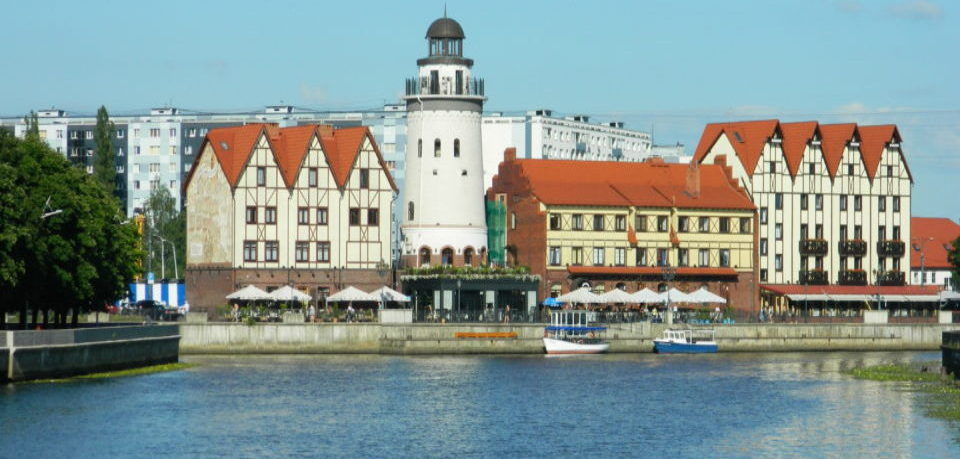
Diary of a Self-isolator: Day 310 [18 January 2021] or Business as Usual
Published: 18 January 2021
There is no lockdown in Kaliningrad, Russia. In fact, I think I am right in saying, and I am sure someone will correct me if I am wrong, that there is no lockdown across Russia, and it would be deceitful of me if I did not say that when I see what is happening back home that I breathe a sigh of relief that I left the UK when I did.
I am not talking about the numbers, the figures, the statistics the doom and gloom wreaked by the UK media’s representation of how bad the virus is supposed to be, but about the lack of transparency, unambivalent information and, of course, the notorious punitive measures which no one in authority seems able or willing to say are actually making a difference, apart that is from ruining people’s livelihoods and subjecting many it seems to psychological and emotional duress.
No Lockdown in Kaliningrad, Russia
Here, for better or for worse, things continue to be pretty clear cut. We wear our masks, some of us reluctantly and others with zealous intent, where we are told that we are supposed to wear them ~ some of us ~ and we try to avoid large crowds and crowded places ~ some of us ~ and some of us self-isolate.
Bars, restaurants and shops are predominantly open as usual. Hospitality outlets appear to be implementing a table-distance rule, and some establishments close early. Masks are required inside public places, such as in shops, the working environment and on public transport. Also, when I travelled by train last week from Kaliningrad’s main railway station, I was subjected to an electronic temperature check before passing through the security gates.
I am able to report that among our social circle we know about eight people who have had coronavirus, both here and in the UK, or, to rephrase that for accuracy, have had a seasonal respiratory illness that has been classed as coronavirus, and, I am glad to say, whatever it is they have had, they have had it mild.
So far, I know of no one here, in Kaliningrad, Russia, who has had the vaccine and only my mother, in the UK, who is no spring chicken, and a friend of ours around the same age also in the UK, who have had their first jabs.
No Lockdown in Kaliningrad, Russia
The situation here regarding voluntary take-up of the vaccine, and not just the Russian vaccine but any vaccine, is no different than it was when I wrote about it last month: lots of recalcitrants and one or two wait-and-sees. Me? The jury’s out. My wife? No.
So, for the time being, at least, its Carry On Mask Grumbling and keep on taking the homemade vaccine: a combination of quality beers and vodkas. Come to think of it, I must be about due for my follow-up treatment.
Updated: 16 January 2021 ~ Katie Hopkins Life After Twitter!
Katie Hopkins proves that their is life after Twitter! The liberal Twatterati have missed their old sparring partner. Thank you UKIP!
Katie Hopkins is a trained economist, graduate of the Royal Military Academy Sandhurst, Intelligence Corps bursar and qualified marketer, who spent 15 years working for a Global Brand Consultancy in UK, Tokyo and USA, and a media personality and former columnist of The Sun and Mail Online.
She is also regarded by the neoliberal British establishment as Public Enemy Number 1 because of her outspoken views on UK politics, social class, migrants and race. She has successfully weathered all kinds of authoritative harassment and continues to be a thorn in the side both of the Islington set and its liberal adherents by saying “what other people think but are too scared to say”, whilst simultaneously deflecting a relentless barrage of insults like the proverbial water off a duck’s back and always giving her enemies much better than she gets.
Indeed, described by the UK liberal media as a ‘far-right provocateur’, and worse, and by herself as a ‘conduit for truth’, Katie Hopkins takes each and every vilification thrown at her, effortlessly remints them and wears them as a collective badge of honour. I am tempted to say that the reason why liberals love to despise her is not just because she exposes them for what they really are, but because she speaks their language and confronts them on their terms.
Katie Hopkins Life After Twitter!
In June 2020, it could be said, depending on which side of the political fence you stand on, that Katie was officially inducted into the pantheon of patriotic resistance when she became yet another victim of what appear to be Twitter’s ideologically motivated hatchet jobs. Her Twitter account was permanently suspended for what Twitter describe as ‘violations of our hateful conduct policy’. A policy which critics say is hateful alright but only insofar as it is predominantly one-sided, allowing liberal-owned Big Tech to censor, castigate and shut down free speech at will, ie reference Trump and Parler.
The joy of closing down free speech is eerily echoed in the choice of words from the The Daily Mirror, that doyen of the British leftist tabloids, which gloated in June 2020 ‘Katie Hopkins appears to have been silenced once and for all on social media after her Twitter account was removed for good’. This week The Mirror will either be scowling or celebrating on hearing the news of Katie’s arrival in the UK’s political arena. It is not what their brand of politics wants or needs, but it will certainly give them something juicy to write about.
The Mirror was not alone last June: On hearing that Katie had been banned from Twitter, the leftist media fell into a wild paroxysm of orgasmic ecstasy. ‘Permanently suspended‘, ‘downfall’, ‘banned’, ‘hateful’, ‘hate speech’, they wailed, with some media groups, notably The Mirror, making the wild and embarrassing prediction, and in the process sounding like gangsters from a bad B movie, that she, Katie Hopkins, had ‘been silenced once and for all’, which only goes to show ~ and please note those that think it’s all over for Trump ~ that there is life after Twitter. Indeed, plenty of it and of better quality and usefulness.
We do not have to agree with everything Katie Hopkins says or even condone how she says it, but if liberals really believe free speech is sacrosanct and worth defending, and I do not believe for one moment that they do, then they must learn to accept without reservation opposing points of view, no matter how painful it is to them, and not revert to misnomers and euphemisms as a censorship means for political ends.
On the broader canvas, with neoliberalism already forced on the back foot through Brexit, the splintering of the European Union, Donald Trump & Co opportunely given the chance to do to them what they have been doing to him for the past four years, ie snipe, harass and delegitimise, Big Tech looking more and more suspect as a neoliberal control mechanism and coronavirus tyranny eroding all faith in the old political parties, Katie Hopkins accession to UKIP will be seen as a welcome ally for those who vow that they will not be silenced and as a redoubtable foe for those who want to silence them.
As they say in Rushden, Northants, “Go for it gal!”
Published: 15 January 2021 ~ Amazed at the Museum of Skulls & Skeletons
To see it, especially from a distance, you would think that it was just another modern apartment block. Besides, your eyes would be led away by the nearby proximity of a far more interesting building ~ the Zelinogradsk (formerly, Krantz) water tower. Only when you draw closer do you get to see the hotel sign, as large as it is. This is the intriguingly named Boutique-Hotel Paradox; the first paradox being that entombed within this building lies the Museum of Skulls & Skeletons; the second, that it is not really a museum at all but more like an art centre, or exhibition centre, of skulls and skeletons. But you won’t know this until you get inside.
Once on the forecourt shared by the Boutique-Hotel and water tower, you will be unable to miss the directional sign for the museum. It is a large ~ larger than life ~ skeleton made of metal, steampunk style.
My wife, Olga, and I visited the museum on the 21 December 2020.
Here is an extract from my diary:
As we climbed the steps to the entrance of this building, the thought materialised that it was an odd building in which to have a museum. For a start, it was plainly modern, and for a second and last it was more or less nondescript, looking like a large block of flats with one of the lower walls in glass, through which it appeared was a bar or restaurant.
The entrance led us into a foyer, which, in keeping with the building’s general appearance, was office-like. Olga paid the girl sitting at the desk in one corner the skelet museum’s entrance money, and off we went, through some large glass doors and up a staircase, which was, well, office-like. And when we emerged into an identical landing on the second floor, where there was a long counter/reception desk, it felt as if we had come for a job interview.
To our right, there were two large, double, glass doors, and it was in here where the skeletons were lurking.
I am not exactly sure what it was that I had been expecting. Olga had spoken of the museum a year or so ago when she visited it whilst I was in England, and we had posed for a photograph next to the metalwork sculpture of a skeleton outside the front door on the concourse one night last year [2019]. This particular skelet had a bronzed, distressed finish, classifying it in my mind as steampunk, so I imagined that this was how the rest of the museum would be. I did not expect it to be a museum in the traditional sense, full of dusty, old, real bones, which was good, as it was not like this at all. No, Zelenogradsk’s skelet museum is, in fact, a brightly illuminated showroom containing a vast number and range of skelet art pieces of all shapes and sizes made from lots of different materials.
Amazed at the Museum of Skulls & Skeletons, Zelenogradsk
The desk to the left of the entrance, the shelves behind and other surfaces and the display units to the front and side were bristling with every conceivable skelet artefact in miniature or medium. On, within the glass-frontage and around the desk, the smaller items were souvenirs, waiting to be bought as mementoes of your visit. In front of you, and in the centre of the room, there was a large motorbike, possibly a Harley ~ they like Harleys in this part of the world ~ complete with flag, possibly one with a skeleton imprint ~ on which one could sit and have one’s photo taken. In fact, Olga suggested that I do just that, but I declined on the basis that I was not a motorbike sort of person.
I was, however, the sort of person who would be quite ready and willing to stand next to a ‘vintage’ wardrobe containing various skeleton pieces and which spoke to you in English when you opened the door. Olga snapped off three or four pictures of me in front of this, including a most arty-farty one, in which my face appears in the inside door mirror looking quizzically at a white bust of Putin.
Hello, fancy meeting you here
Amazed at the Museum of Skulls & Skeletons Zelenogradsk
The next experience was an unlikely one for us and one, moreover, which Olga placed great symbolic store on later. At the side of us, next to the wall, there was a doorway with multicoloured plastic streamers hanging vertically from the ceiling. A couple of yards away to the right there was an identical door furbished in the same manner. Above each door, on brightly coloured card, I was able to read, in Russian, the words ‘entrance’ and ‘exit’. I asked what this was, and Olga said it was a maze.
Amazed at the Museum of Skulls & Skeletons Zelenogradsk
“A maze!” I snorted.
I just had to step inside and in so doing was immediately and utterly overwhelmed, smothered by the sheer volume of the multi-coloured hanging plastic strips. I pushed my way through them until I reached the back of the cabinet. It must have been almost two yards deep. The density of plastic trailers made it impossible to see what exactly lay at the back of this cabinet, but I could feel a textile wall ~ and that was it. I felt my way back to the entrance, saying, as I almost emerged, “But there’s no way through; it is solid.”
“No,” Olga contradicted, “It’s a maze. It says so on the sign.”
I was just about to question the veracity of this statement when I realised that the vertical strut I was holding was not in fact adjoined to the outside wall.
“There,” said Olga at the same time as I discovered it, “is an entrance.”
Indeed, there was. It was narrow, about one slim person wide, tall, obscured by the crowding nature of the hanging tapes and the dark interior beyond but most of all by the assumption that no doorway would lie at right angles to the entrance.
By now I was curious and made to move inside. Olga was nervous and attempted to hold me back.
“Come on!” I laughed. And off we went.
No sooner had we stepped inside than we were overcome both by the darkness, which was now black as pitch, and by the obstructive density of the dangling ribbons. We had not gone three feet, I imagine, before our voices lowered and our pulses began to race. I edged forward, feeling the wall as I went, until my hand dropped into space. Another right-angled turn. I urged Olga to follow me.
As I entered into a wider void, I heard Olga’s voice in the darkness call out, “Hold my hand! Hold my hand!” I did, pulling her gently behind me. I was feeling for where I suspected the next opening in the maze would be, but it was not. The ribbons seemed to be growing in profusion, but I found another gap and proceeded through it, a frightened Olga clinging to my hand and calling in an alarmed voice, “I don’t like it”.
Into the next compartment we went, with Olga calling, “Let’s go back.”
It seemed to me that this part of the labyrinth was larger than the previous, and when my hands hit solid wall, and with Olga crying to get out behind me, I must confess to experiencing a paroxysm of panic, quite foolish and illogical I know, but panic all the same. I was on the cusp of saying, ‘you’re right; let’s retrace our steps’, when a science officer Spock-like rationale kicked in. “Don’t be so silly,” said a still, calm voice, “you’re only inside a cupboard.”
[I have omitted the next paragraph as it contains the secret to identifying where the ‘doorways’ are, and I would rather you go to the museum and get lost in the maze yourselves!]
Applying this simple science, we did a quick sharp turn and there, lo and behold! through the ribbons that hung like fog, the lights of the larger room penetrated.
As we emerged, I had to laugh, both at our fears and our appearance. My hat was all skew-wiff, making me look like Captain Mainwaring in one of those scenes when the entire Dad’s Army troop cram into the verger’s office, and Olga was as red and dishevelled as a beetroot fired from a cannon.
The difference was that whereas I had enjoyed the experience, she had not; and whereas I recovered instantly, she did not. She was still talking about how much it had disturbed her on the way home and, in fact, throughout the following day.
Made of sterner stuff, however, including a built-in denial system that allowed me to bury quickly any further thought of the spasm of fear experienced and certainly not to discuss it, I moved on to the exhibits, which were many and varied and laid out in large shelving units glazed front and back. My favourite was the excavation scene: a skeleton lying on its side in a shallow hole, its legs bent at the knee and one of its bony hands clutching an empty bottle of vodka. The red earth around the skeleton was caked, cracked and littered with the detritus of our modern age, suitably weathered and tarnished as though it had been there for some considerable time. There was a battered coke tin, a scrunched-up plastic bottle, a squashed memory stick, part of an old music cassette, a CD, a shattered ballpoint pen, a condom (still in its packet, I am glad to say!), coins, a battered mobile phone and other bits and pieces testifying literally to life in the throwaway age.
This exhibit was not, of course, a shelf one. It was contained in and presented through a large flatbed cabinet, tilted at an angle and raised on supports. It stood in front of a window, the closed strip blinds of which had one edge stencilled with the image of part of a skeleton, connected visually to the rest of its skeletal body, which was solid state, pinned above the blind fitting. Two similar designs were repeated in the second half of the room: one, with the skull and two hands of a skeleton mounted above the blind rail and the complete body of the skeleton stencilled beneath it; the other, one side of a skeleton in solid state with the skull, rib cage and one arm stencilled onto the fabric.
In the centre of the room where I had been studying the excavation scene, there was a table-mounted stretcher, on whose surface lay a skeletal leg and, standing next to it, a skeleton doctor, dressed in a white coat with a stethoscope around its neck. Hmm, not only was he not wearing his muzzle (mask), but he had also forgotten to put on his trousers.
The glass-fronted shelving units contained a profusion of artistic sculptures all designed around the theme of skulls and skeletons. My favourites consisted of: (1) a ‘giant’ Zippo lighter, with two skelets standing nearby, one holding the body of the lighter and the other supporting its top; (2) three skeletons together on a beach with a large jug of beer next to them, one of the skeletons is lying drunk on his back and next to him is the proverbial tall story ~ a giant fish; (3) three different tray and skull designs, each profusely decorated ~ one in blue & white motifs; the other deep red with abstract, almost psychedelic ornamentation; and the third in traditional Russian lacquer-work. I also liked the open-sided computer tower with a gold skull inside, and the skulls with green moss clinging in patches to the side of them. One of these had a small graveyard scene modelled on the skull’s cranium, complete with tumble-down picket fence and skewed tombstones.
Amazed at the Museum of Skulls & Skeletons Zelenogradsk
Of the numerous artefacts on display, if I was asked to choose my favourite, it would be without hesitation a figural piece, which was both touchingly symbolic and at the same time macabre. The composition is that of a long-haired female skeleton sitting on the knee of her skeleton male lover, the two are embracing and kissing, and the piece most aptly named, ‘True Love Never Dies’.
I would have purchased this without a second thought, but, alas, none of what we could see before us was purchasable. There were skeleton-themed items that you could buy, but they were cheaply made and overpriced. There were other pieces that I did not care for, mainly those skulls that looked as though they belonged to computer-game software and Halloween-type products: skulls and skeletons with glaring, gobstopper eyeballs. There was even a wall-hanging skeleton with the parched remains of brown flesh clinging to its bones. If this was available for purchase, would I have bought it and hung it on my wall …?
In the end, we settled for a skeleton pen, with two articulated arms. There are a couple of buttons at the back of these little devils and when you press them the arms move, as if they are boxing, oh, and the eyes light up.
I would have bought the skull lamp, but I thought it a tad expensive at thirty quid, and besides I was not sure whether our skelet, the one we have at home who is a member of the family, would be pleased. Skelets, like the human beings that they partly are, can be exceptionally jealous.
Essential details:
Museum of Skulls & Skeletons Saratovskaya St, 2A Zelenogradsk 238326 Russia
Is the reaction to coronavirus just another symptom of liberal malaise?
Published: 12 January 2021
I hear tell that Joe Biden is destined to become the fraudulently elected President of the United States. I have also been told to believe that the crowd that gate-crashed Capitol Hill were a ‘mob’, whereas, in a bizarre comparison, Black Lives Matter are peaceful, praise-worthy protestors. There are even pictures to prove it, according to The Guardian and, of course, the BBC.
As intelligent readers you will not have failed to recognise the inequality and discrimination at work in these remarks and thus the tittersome irony.
We are told these things. But what do we believe?
‘DC police made far more arrests at the height of Black Lives Matter protests than during the Capitol clash’ ~ CNN Investigates
‘BLM v Washington DC riots: How were the police responses different?’ ~ BBC
So, Capitol Hill was a ‘riot’; BLM was a ‘generally peaceful protest’.
“Yeah, right …”
Ignoring for the moment that the unfortunate incident at Capitol Hill is being distorted in the most cynical way to cast fresh and potentially provocative aspersions on US law and order (Maxwell Smart: ‘Ahh, the old deflection trick, chief!’), we do know unequivocally that Big Tech unilaterally banned President Trump from Facebook and Twitter. This peculiar, but hardly unexpected, turn of events prompted this response from that bastion of free speach, my personal friend, Lord Wollocks:
“We all know that Facebook and Twitter have been ruthlessly implementing a partisan censorship programme in which anybody who rocks the neoliberal boat is given the big heave-ho. Nobody, not even the ‘useful idiots’, really believe that this ideological deplatforming is anything but censorship, even though it hides behind sanctimonious catchalls like ‘banned for inciting racial hatred’, ‘banned for inciting religious hatred’. As the old saying goes, ‘One man’s terrorist is another man’s freedom fighter’. And mark my words: Arsebook and Twatter would take that comment down faster than a pair of a trousers on a self-proclaimed man.”
We do know that Black Lives Matter is not banned from social media platforms.
We don’t know what’s happening with coronavirus, or rather the way in which both the British establishment and the ‘sshhh, you suspect who’ State in America is managing it, mismanaging it or even stage managing it? But it is certainly disturbing that the two countries that pride themselves on being the world’s beacons of democracy are pissing on their own wicks, and that fewer and fewer people are inclined to believe that it is an accidental up-wind blowback but rather that what is being done to us is being done deliberately and with malice aforethought.
(Image credit: http://clipart-library.com)
Certainly, hitherto unprecedented draconian police-state measures enacted in the name of controlling the Covid-19 virus are casting a long, dark shadow over the freedoms and so-called democratic rights of the beleaguered people of these two nations. In the UK, social distancing, muzzle wearing, lockdowns, limitations on the number of people who can mix together, even in their own homes, bring disturbing reports on a daily basis of police who are far too ready to exceed their celebrated policing-by-consent authority, and in some lackaday instances are acting in a brute-force manner not unlike the Stasi (see this video by Nigel Farage Say NO to a Police State).
Is Big Tech censorship a coronavirus clue?
So, we ask ourselves the question, and many people are asking this question? Are these punitive practices all part of a neoliberal globalist plot. Has Trump’s Presidency, Brexit, the imminent disintegration of the EU, all of which are symptoms of an increase in the shift away from liberalism to patriotism, triggered such a shit-fit among the neoliberal political elites that they have been forced to play their hand, to strike when coronavirus is hot! Ahh, the last resort of scoundrels!
Those who subscribe to the theory that the Kalergi Plan is an essential pillar of liberal hegemony, but one which has quite unexpectedly buckled beneath resilient patriotism, may well be of the opinion that as long as Hungry and Poland continue to hold out against intimidation from the Brussels’ mob who want to force them to open the migrant floodgates, dissatisfaction with the Federalist project in Spain, Italy and Denmark and the gathering traction for Frexit, indicates that the game in Europe is almost up. Is this then where the intervention of unbelievable philanthropic billionaires, Big Tech, the media and social control comes in?
Richard von Coudenhove-Kalergi (image attribution: see end of article)
Now it would be easy for me at this point to force-feed you my opinion, but why resort to mainstream media tactics when opinion on social media, that heaving crust on a hot volcano ready to erupt, offers a far more accurate insight into the mood of the people. I like nothing better than to wassail around on the internet ignoring mainstream media but dipping into it now and then to read the comments of readers. I am also more inclined to go looking for the truth, or the best thing to it, in the journalism provided by independent, alternative media outlets and only resort to Twitter and Facebook in search of those endangered species, the brave few struggling to speak their minds before they are caught in the dragnet of liberal censorship.
For example, here is an interesting comment posted recently on Facebook (Note all quotes from other sources here have been copied verbatim and with no censorship on my part):
‘Over 70 billionaires got together on Trumps inauguration day to determine the future (& to make certain it wouldn’t be trump). They each pay dues of 250 million a year to a Soros organization (he has over 100) They meet annually. They will only get richer & control us more. They are all, every last one of them, in bed with the Democrats. Their goal = power. control, $$$$, and to supplant america with their values, their desires, their economics, their health system, their business methods, banking systems. etc..& put in an overwhelmingly large bureaucratic government that can be transitioned into a global one when they are ready. This sounds like science fiction, or a conspiracy theory, but sadly it is not.’
The following quotes have been taken from the ‘comments’ section of the above article:
‘They [UK/America] allowed socialism and feminism to ruin their society and family values. Now they pay the price.’
‘The big tech is already a branch of the “Shadow Government/Deep state” that has complete control of Congress overall. The big tech social media have been infiltrated by the CIA just like the major corporate news have been for some time now. Read the book “Press-titutes Embedded in the Pay of the CIA”(2019), by Udo Ulfkoette. Stay away from Facebook, Twitter and such. I have never used them. Find other alternatives. We cannot allow freedom to perish. Peace.’
‘Wait till the Democrats pass their ‘hate speech’ laws. Say the wrong thing, you get canceled, lose your job, hell, they may even take your children away from you. That is how insane this is becoming.’
Well, I don’t know about that, but certainly, Big Tech seems to have made one of the biggest blunders of their electronic existence:
“We will not be SILENCED! Twitter is not about FREE SPEECH. They are all about promoting a Radical Left platform where some of the most vicious people in the world are allowed to speak freely.” {quote taken from article cited above in which it is attributed to Donald Trump}.
I have the distinct feeling that Trump is not the sort of person to be bullied or censored into submission, and neither are his 75 million US voters. The trouble with ‘push is ‘shove’.
(Image credit: http://clipart-library.com)
Within this nightmare world of a panic-stricken globalist movement that will stop at nothing to preserve its disintegrating one-world government dream, it is, I admit, most tempting to imagine coronavirus, as imperfect as it is, as an ill-conceived or ad hoc smokescreen, barely functioning for the insidious purpose for which it was invented and inevitably doomed to failure, but nevertheless, for the moment, a powerful force for division, diversion and control, a force that offers a shortcut to the social instability that diversity was meant to procure but which, in spite of the efforts of NGOs and craven complicit governments, has been too long in the making to retain its viability.
The part played by Big Tech in this Orwellian scenario reveals itself in those blocks you get on Facebook when you try to post anything on coronavirus that does not conform to the official narrative and where you are peremptorily redirected to a page that purports to contain the truth. A very fine thing indeed, except that it is their truth ~ or so many of us suspect.
The internet, however, is an unwieldly beast, as its frightened proprietors are beginning to discover, and no matter how these contemporary Citizen Kanes ~ the Mr Zuckerbergs, Sundar Pichais and Jack Dorseys of this world~ attempt to rein it in, it will eventually break away from them, as it is doing now. Truth will always out in the end and when it does comes casualties …
Is Big Tech censorship a coronavirus clue?
Is this a fragment of that truth or not? I found this article which exists in the asteroid belt on the other side of the mainstream media suspicious enough in content for it to raise an eyebrow. It is published in The Daily Expose, a media outlet I must confess with which I am not acquainted, but am somewhat relieved to discover that in spite of its provocative name the temptation has been resisted to choose as its logo a man in a mac.
In this video (quick, before they ban it!!), its protagonist, Dr Shiva, who describes himself as a ‘scientist, engineer and educator’ and is summarily dismissed by the mainstream media as ‘a conspiracy theorist’ (he and the other 75% of the West’s population who have been railroaded into this concentrated camp and where the figure is growing exponentially) looks at the bigger picture: the ‘where we are now and what is to be done if we still want to be a free people’.
The political classes, mainstream media, Big Tech, big business corporations, the mega-rich and, alas, a gaggle of untalented and overpaid celebs who will jump on any bandwagon for a bit of free publicity, universally condemn these ideas as conspiracy theories, but the problem with all of these institutionalised factions is that they are wide on criticism and short on answers.
Take coronavirus, for example. Of all the respiratory diseases known to man (its & others etc) no one can deny that Covid-19 is one of the most, if not the most, eccentric and improbable of viruses. Not only is there no consensus about how and why it effects people differently but there also appears to be scant agreement about the measures required to contain and address it. Thus, until it is proven otherwise, you cannot blame a groundswell of people for believing that fraudulent viruses are as credible as fraudulent elections or even that the two go hand in glove.
In the last analysis, Big Tech and Big Media are owned by the sort of people who tell us what they want us to know and to believe what they want us to believe. Big media no longer reports the news, it creates it according to its own political, economic, ideological bias etc, leaving Big Tech to filter out all opposing variants and sell it on as gospel.
There is a lot of good, quality and more reliable reporting out there in the non-mainstream media, and if you take a moment to look around you will be surprised what you will find. Of course, you may have to put up with being labelled a conspiracy theorist, a member of the Far Right, a Fascist by the likes of The Guardian, The [not so] Independent etc, and you can be sure that those liberal pseudo-moral high-grounders Twatter and Arsebook may block your comments and posts, they might even deplatform you, but if that does happen console yourself with the fact that not only must you be right today but on the right side of history forever. Moreover, such violations of freedom of speech and democracy grant you, the victim, lifetime membership to an exclusive but rapidly growing club that is destined to change the world we live in and change it for the better. So wear your deplatformed badge with courage and also wear it with pride!
Wherever they think they are taking us and wherever we want to go, It is going to be a bumpy ride, the road to the truth usually is, but hang on in there, fight back when you have to and continue to take the knocks. In the end it will all be worth it:
Photograph attribution for Richard von Coudenhove-Kalergi: [Unknown photographer – ÖNB, Bildarchiv Austria, Inventarnummer Pf 3944:B(2)(https://www.bildarchivaustria.at/Pages/ImageDetail.aspx?p_iBildID=20223510), Public Domain, https://commons.wikimedia.org/w/index.php?curid=69147423]
Published: 7 January 2021 ~ Orthodox Christmas Day in Russia❤: Support the Restoration of Zalivinio Lighthouse
You might think that the last place you would want to be on a freezing cold winter day, with the wind whistling round the Baltics and shivering your timbers, would be perched on top of a derelict lighthouse. You might feel the need to ask why? Why would anyone in their right mind want to do this? And you might believe that the answer lies notably in the psychological reference above ‘in the right mind’. But there are at least two other factors that need to be considered: one, history and a love of it; two, that in the right mind or not, we happened to be in the right place ~ I think it is called nearby.
Zalivino lighthouse is located in Zalivino ~ where else? Ahh, but it is not that simple. Zalivino is a village nestled against the Baltic Coast in Russia’s Kaliningrad region. Now, if you were to conduct a search on the internet for the exact location of the lighthouse, you might find that lighthouse or no lighthouse you run aground on the rocks of all sorts of name changes and district alterations, so, for the sake of simplicity, let us say that the original (German/ East Prussian) name of the village was Labagiene, which, after the Second World War, when the region fell into Soviet hands, then became Zalivino.
The lighthouse, however, is named Rinderort, after Labagiene, renamed as Haffwinkel, merged with the settlement of … and if that has not confused you, I do not know what will.
But moving swiftly on: The first lighthouse to be constructed on this spur of land at the edge of the Curonian Lagoon was made of wood. Erected in 1868, it was illuminated by a simple kerosene lantern. The brick tower that replaced the wooden structure was built in 1908, extending upwards to a height of 15 metres, with a cottage appended for the lighthouse caretaker. In the intervening years, between the tower’s construction and World War II, subsequent modernisation was sporadically enacted.
After the war, when the former East Prussian region passed into the hands of the Soviets, the lighthouse and the land it occupied fell under the auspices of a local fish farm, and the ruined building next to the tower was an occupied dwelling. From what people say, the lighthouse continued to function during this period, but ceased to do so in the post-Soviet era.
Whilst some of the dilapidation evident today has accrued from common disuse and neglect, rumour has it that in the 1990s the building was cannibalised. Bricks, always a sought-after commodity, went missing as did the bronze lantern and other metal parts from inside and around the dome of the tower. Inevitably, as the tower and surrounding buildings fell steadily into ruin, it soon attracted the unwanted attention of vandals, among whose number were also arsonists.
By the end of the first decade of the 21st century, lighthouse romanticists and those interested in the history of the region in which they lived had seen their numbers swell substantially, as tourists, both from further afield in Russia and from other parts of the world, travelled to Zalivino to pay homage to the lighthouse. In 2020, this influx received greater impetus by the closed-border restrictions caused by coronavirus and the Russian government’s related incentive to boost domestic tourism.
In recognition of the site’s heritage status and its destination as a tourist attraction, in July 2020 it was acquired by the Museum of the World Ocean, whose remit it is to preserve, conserve and renovate the structure as a place of historical interest. The renovation will include restoration of the bronze lantern, the tower, caretaker’s cottage and the rare weather mast.
The estimated cost of renovation is somewhere in the region of 18 million rubles (approximately £179,575.47), and a fundraising campaign is already underway.
Support the restoration of Zalivinio Lighthouse
When we arrived at the lighthouse site on this very cold day, we found the lighthouse and its associated buildings at the end of a winding track. We parked up in front of some long, old, German buildings, which I presume were once part of the fish farm complex, and then walked the short distance to the rickety gate and compound fencing behind which the tower resides.
A large banner, pictorial and text-laden, told me in Russian all I wanted to know about the future plans for the site, and had my command of the Russian language been better, I would have been well informed.
As we approached the compound two people donned their coats and emerged from a little blue mobile hut. These were the caretaking staff and representatives of the World Ocean Museum.
If we had been in England this site would have been strictly out of bounds due to the ongoing process of renovation, coronavirus and the fact that it was winter and therefore out of season and off limits, but we were not in England so we were not told to bugger off! Instead, we were cordially welcomed, and, after five minutes of jumping up and down on the spot to keep the circulation going, we were taken on a tour of such as there was to see.
First, we were invited to contribute something to the renovation fund, which was a bit embarrassing as we had to have a whip round. We were carrying plastic, naturally, but otherwise we were cashless on the Curonian Spit. It was not much, our 500 roubles, but as the old lady says, every little helps (That is a saying, by the way, not a reference to my wife!).
The roubles having been procured and placed for safe keeping into a very attractive antique lamp placed on top of the sites’ well, the guide began her talk. The historical background of which she spoke is augmented and illustrated by four or five display boards attached to the wall of the larger of the domestic buildings. Alas, however, these signs are all in Russian, but, with the timely assistance of my wife, I was able to capture the tour guide’s gist.
History boards at Zalivinio Lighthouse Kaliningrad region, Russia
Moving around to the bay side of the buildings exposed us to the full frontal of the rude breeze, where, to tell you the truth, we had difficulty concentrating. I hopped around on one foot, and my wife’s nose had turned so red that it could easily have stood in for the lighthouse lamp. However, I refrained from suggesting that my wife’s nose would make an excellent money-saving alternative to a replacement lantern out of concern for my personal safety, that and the fact that my teeth were too chattery to formulate the words.
Olga Hart feeling cold in front of Zalivinio Lighthouse (Jan 2021)
Olga Hart feeling colder a few feet from Zalivinio Lighthouse next to the sea
Although the outbuildings offered little in the way of shelter, much of the roof is missing and the doors and windows have gone the same way as a substantial proportion of bricks, inside proved kinder for our bones than shivering outside on the water’s edge.
Zalivinio Lighthouse Kaliningrad region: much work to be done …
For all the ravages of time and misappropriation of materials, the building itself appears to be quite sound and the massy wooden beams strong and durable, and, with a little imagination ~ a lot, if you have not got much ~ it was not difficult to envisage these rooms reconstructed and reinstated to their former glory.
I did not expect that we would have access to the tower in its present condition, my conclusions based once again on precedent in my native country, England, where Health & Safety and all that jazz would most likely have stymied any such fancy, so imagine my surprise as well as untrammelled delight when the question was put to us, ‘Would you like to climb the tower?’
The guides warned that the last stretch of the staircase was almost vertical, so be careful, and that was it, off we went. It was so refreshing to be allowed to do something that relies for safety on your own common sense.
Climbing the tower of Zalivinio Lighthouse (Mick Hart, 2021)Out of the window all at sea
The lighthouse tower is by no means wide, and the mode of ascension is by a stone-stepped spiral staircase. Windows at regular intervals permit you to gaze out at the increasingly elevated scene as up you excitedly go. Suddenly, you feel the cold breeze on your face, alerting you to the fact that you are almost at the top, and there, in front of you, is a short metal ladder. To gain access to the lamp room and viewing tower, it is necessary to climb these steps, so, although I am not a great fan of heights, it had to be done and up I went.
Metal ladder leading to the lighthouse dome and viewing platform (January 2021)
Where better on a freezing cold day? Mick Hart, top of Zalivinio Lighthouse (Jan 2020)
Already inside the dome was a gentleman dressed in a woolly hat, overalls and thick white gloves. He was busy wrapping webbing around his body and adding and fastening buckle attachments to a series of belts. Surely, I thought, he is not … But he was.
He looked up at me looking at him, and I said, in my best Russian, “Stratsveetee,” to which he replied with the same. He gave me a lingering look and smiled, as if he had worked out what it was I was thinking: “Rather you than me!”
Heritage restorer at Zalivinio Lighthouse Over the top on a cold day
The dome, which is windowless and open to the elements, can easily accommodate three people. In its centre stands a solid brass or bronze stanchion, which would, I surmised, once have supported the warning lantern. Some of the dome’s outer wall panels are absent, nicked, I imagine, but the decorative metal railings that encircle the platform looked present and correct enough.
To say that the view from the top is breath-taking, particularly on a day like today, would be as predictable, I predict, as coining the phrase that Zalivino lighthouse is located in Zalivino, but look at the photos and judge for yourselves.
Zalivinio Lighthouse, Kaliningrad region, Russia. View from the top (January 2021)
Whenever I visit a conservation/restoration site, I never fail to be impressed by the commitment and dedication of the people involved, and today was no exception. Many would have taken one look at that fellow hanging on his harness doing whatever it was he doing at a height of 15 metres in temperatures well below freezing and their response would be, rather you than me Gunga Din.
Just hanging around at Zalivinio Lighthouse Kaliningrad. (Mick Hart, Jan 2020)
I am sure that the suspended man’s name was most likely Valordia, Sergey or Vladimir, but all the same in my estimations he was up there all right and doing it ~ whatever it was he was doing. I bet not even Gunga Din himself would have left his Indian restaurant in Bethnal Green to do such a thing as that!
Support the restoration of Zalivinio Lighthouse
Eighteen million rubles is a lot or rubles to muster, so if you could see your way to donate to this worthy cause it would be most appreciated. Not only will you have the satisfaction of knowing that you have done your bit to preserve an important heritage site, but through the donation incentivisation programme you will be eligible for certain rewards, which include tours of historic places and other cultural and entertainment benefits.
Please click on the following link for more details on how to donate and for further information on the restoration programme: Old Lighthouse Zalivino
Outline of the lighthouse restoration programme
Restoration of the bronze lantern
Restoration of the lighthouse tower and caretaker’s house
Restoration of the weather mast, complete with navigational signs
Repair the pier and undertake dredging work along the coastline
Improve the quality and appearance of the grounds around the lighthouse
Create an exhibition of the history of navigation and business in the region.
A regular report on the collected funds and completed works of the Museum of the World Ocean in conjunction with the foundation Beautification and Mutual Assistance will be posted on the official website of the museum: www.world-ocean.ru
Examples of donation rewards
Donation: 1,000 rubles Exclusive tour, with a tea party for 2 people. Choice of one of the following destinations:
Royal Gate Friedrichsburg Gate
Donation: 5,000 rubles A collective tour on a fishing boat, a ‘Rusna’ kurenas (invitation ticket for 2 people), approximate duration 2 hours. This service is available in summer from 1 June to 10 September.
Exclusive tour, with a tea party for 2 people. Choice of one of the following destinations:
Lighthouse in the village of Zalivino Royal Gate Friedrichsburg Gate Maritime Exhibition Centre (Svetlogorsk)
Donation: 50,000 rubles A collective tour on a fishing boat, a ‘Rusna’ kurenas (invitation ticket for 2 people), approximate duration 2 hours. This service is available in summer from 1 June to 10 September.
An exclusive tour for 2 people of the ‘Depth’ exhibition, with a visit to the GoA ‘Peace-1’ accompanied by a hydronaut.
Exclusive tour, with a tea party for 2 people. Choice of one of the following destinations:
Lighthouse in the village of Zalivino Friedrichsburg Gate Royal Gate Maritime Exhibition Centre (Svetlogorsk)
Donation: 500,000 rubles The opportunity to hold two corporate events at the Museum of the World Ocean (up to 30 participants; maximum duration 3 hours each), choosing from the following venues:
Sea Hall NIS Vityaz Royal Gate Friedrischburg Gate Warehouse Maritime Exhibition Centre (Svetlogorsk)
The opportunity to stay in a guest cabin on the NIS Vityaz (invitation for 2 people) (1-day duration).
A collective tour on a fishing boat, a ‘Rusna’ kurenas (invitation ticket for 2 people), approximate duration 2 hours. This service is available in summer from 1 June to 10 September.
Exclusive tour, with a tea party for 2 people. Choice of one of the following destinations:
Lighthouse in the village of Zalivino Friedrichsburg Gate Royal Gate Maritime Exhibition Centre (Svetlogorsk)
An unlimited number of free visits to the lighthouse exhibits in the village of Zalivino.
Awarded the Beacon Friends Club sign.
Invitation to the annual ceremonial meeting of the members of the Beacon Friends Club (June 8, the day of the Lighthouse Service, on the territory of the lighthouse in the village of Zalivino).
Addendum Have you spotted the deliberate mistake? Zalivino Lighthouse is, of course, in Zalivino and not ‘Zalivinio’ as it sometimes appears in this text. I apologise unreservedly to anybody to whom this mis-spelling may have caused inconsolable and even terminal distress, especially to those who may have incorrectly assumed that Zalivinio is somewhere in Italy (is it?) I know of many wordsmiths who sadly may never recover ~ shame that … I wrote this piece whilst I was perfectly sober, which might go some way towards explaining why I have got my words in such a mucking fuddle. However, after careful consideration, I have resisted the desire to rectify the mistake on the grounds that it may incriminate my permalink, an occupational hazard of blogging that fellow bloggers are sure to empathise with even if the rest of the universe will forever stand in judgement. Er, sorry.
Diary of a Self-isolator: Day 292 [31 December 2020] or Goodbye 2020, if I never see you again will it be too soon?
Published: 31 December 2020 ~ 2020 Memories are made of this
The End is Nigh! Well, you would think so from the aggregated hype bubbling furiously over the past 12 months in the cauldrons of the western media. Never before in recent history has the press had the opportunity to indulge itself in a Groundhog Field Day like the one that has been handed to them by the pandemic (or is that scamdemic?). But enough of the soothsaying and a tad more soothing-saying, if you don’t mind. The end is nigh for 2020: Time to reflect on the past 12 months.
My period of voluntary self-isolation began back in March 2020, and like most people I have evaluated the quality of my life during this epoch as a series of stops, starts and checks. However, on looking back I realise that although the impediment of coronavirus fear and its attendant restrictions have cast a long shadow over our social life, it never succeeded in inflicting a total eclipse. As my wife is fond of saying, “Humans can adapt to anything in time”, and whilst in my books I have committed the cardinal sin by steering clear of bars and other places where people tend to congregate, in retrospect 2020 was far from totally written off. Indeed, in spite of muzzle-wearing and fetishistic hand-sanitising, we did still have a life ~ we met friends, took several trips to the coast, visited art galleries and places of historical interest, entertained at home and, most importantly, used the extra time that we had at our disposal in the most constructive ways.
We certainly managed to get more done around the house and in the garden ~ especially in the garden. This is Olga’s pet project: converting what was a slab of inherited concrete into a proper, functioning outdoor area, where she can enjoy the flowers and trees, and I can enjoy a pint.
Years ago, in the mists of a different time, I worked on a magazine called Successful Gardening, from which I learnt that my greatest contribution to any practical endeavour in this field would be to make myself scarce, which is exactly what I did. So, I have to confess that the lion’s share of the work was done by my wife. Yet, I feel no need for excuse making. Gardening is a sport, and like any other sport, some you participate in; in others you are a spectator.
Where coronavirus is concerned, it is for my family and friends back in the UK that I feel the most sorry. The UK media has not had the opportunity to be this gory and ghastly in its coverage since Jack the Ripper terrorised Whitechapel. Not even brutal acts of terrorism, which are officially swept under the carpet by deflection techniques that focus on holding hands and candle-lit vigils, come close to the penny dreadful coverage that coronavirus receives. It would not be half so bad if 1 + 1 = 2, but nothing about the measures being taken to combat coronavirus in the UK ~ the draconian measures ~ seems to add up, and, as with Brexit, the country appears to be split yet again, and uncannily yet again, as with Brexit, the fault lines are political and a peculiar inversion of the status quo.
In complete contradiction to the overt emphasis placed at any other time on civil liberties and the evils of the so-called surveillance society, 1984 and all that, it is the left that appears to be screaming for lockdown, mask-wearing and any other hard and fast rules. Indeed, they do not seem to be able to get enough of it, and, with the illiberality that is customary with liberals, are spitting tar and feathers at anyone who is impudent enough to advocate liberty above home slavery. The megaphone message is: Do as you are told! Stay in! Don’t go anywhere, or we are all going to die!!.
Admittedly, there are a lot better things to do with your time than dying but is being bolted and barred in your home for what little there is left of your life it? The older we become the more precious life becomes, but so does living your life. It is the Bitch of having been born at all.
The problem, or at least one of the salient problems of getting old ~ and for some inexplicable reason we all tend to do it, get old, I mean ~ is that you reach the stage where you think you can hear each grain of sand dropping into the hour glass, and whilst it is normal on the push-penny arcade machine of life to brace yourself for the moment when inevitably your turn will come, when you will be bumped off down the chute, the media over the past 12 months has not missed a trick in reminding us that the man with the cowl and scythe is busier than he has ever been pushing coins into the slot.
No one can deny that there has been a lot of death about, and sadly we were not spared. Our good friend, Stanislav (Stas) died in November 2020. Immediately, rumours abounded that he had died of coronavirus, the majority of people having become so obsessed with the virus that it has become almost impermissible to die from anything else. Stas did not die from coronavirus. But he did die, and with his passing we lost a very good and much-loved friend.
Without doubt, one of the most perplexing things about getting older is that not only do you have to come to terms with your own mortality, you also have to come to terms with the loss off those who are nearest and dearest. Each loss tears a hole in the fabric of life that can never be repaired.
But enough of this morbidity. Like everything in life, what some people lose on the swings others gain on the merry-go-rounds, and whilst we can conclude that whereas it has been a troubled year for most of us, especially those on the frontline ~ doctors, nurses, paramedics and the rest ~ if you have the good fortune to be a mask producer, the director of a pharmaceutical industry, a media magnate, I do not suppose that Mr Coronavirus seems such a bad fellow after all, and this is without mentioning the increased yields experienced in the funeral industry.
Enough said: In a consummately original and unplagiaristic moment, my valediction for the year 2020 is that it was ‘the best of years, ‘t’was the worst of years’.
Think of 2020 as a painful tooth that needs to be extracted by the dentist: you might miss it, but you will certainly be glad it has gone …
Published: 29 December 2020 ~ Out of 2020 Out of the EU
A most wonderful thing is about to happen! At midnight on the 31December everywhere, it will be the end of what has been unarguably (unless you are one of the elite, perhaps! Subscribe here for my conspiracy theory!) one of the worst years in modern history.
But it is not just the end of 2020, for lucky Brits it is the day on which all of Nigel Farage’s hard work pays off. Having defeated the machinations of the left, he has almost single handedly provided the UK with an escape route from the collapsing agenda of the EU New World Order ~ soon to be rebranded by history as the EU New World Disorder.
Whilst no one can be naïve enough to believe that the UK will completely pull the plug on the EU experiment ~ I mean, it just does not happen like that, does it! ~ hopefully, the cables will have been wrenched enough to disable the worst of the EU’s ideological influence as the powerhouse of liberal control and, once disconnected from this self-serving force, Britain can truly begin to move forward into those bright sunlit uplands of which Churchill spoke so optimistically when Fascism was vanquished in 1945 ~ sigh, little did he know …
And, with 2001 forecast to be the Year of Vaccination, or more likely the Year of Vacillation, whatever we will continue not to believe, for none of us believe everything, especially everything we are told to believe, let us make the most of it, and on 31st December at midnight exactly all join together, wherever we are, whether locked away in the bog on our own with our mask on our chin or breaking social distancing rules, and give this miserable year 2020 the resounding kick up the arse which it so richly deserves!!
✔✔✔ Happy New No More EU, Nigel, and a Better New Year for the World! 😊😊😊😊
We all know a lot less than we think we knew when all this started
Published: 29 December 2020
So, here we are, coming to the end of the first year of the Coronavirus Age and my first 9 months of being a coronavirus self-isolator. Time for reflection, or, as Eric Morecambe and Ernie Wise the comedians used to say, “What do you think of it so far?”
In 1992 the alternative rock group REM produced a hit record the chorus of which went, “If you believed they put a man on the moon … If you believe there’s nothing up his sleeve, then nothing is cool.”
The question today is ‘Do you believe that lockdowns, mask-wearing, social distancing and a worldwide coercive mass vaccination programme using vaccines which scientists and public health officials admit have been fast-tracked into existence and therefore, one presumes, not as rigorously tested as they would normally be, are manifestations of global humanitarianism or a totalitarian globalist agenda in which economic reset and culling the world’s population are two primary objectives? And apropos of this, do you believe that the misinformation and disinformation at the centre of public confusion is just a byproduct of the gabbling information age in which we live, the bungling inefficiency of the ruling elites or a carefully and meticulously orchestrated web of deceit and deception.
Take my word for it: I don’t know.
But there is no doubt that the traction gained by conspiracy theories is beginning to make them look and sound a lot less infeasible than the obfuscating quagmire into which the official narrative, in its failure to provide conclusive answers or even address people’s fears, sinks a little every day.
So, this is where I come to my What Do You Make About That? section ~ where I air alternative views to those presented in the authoritative script and leave you to make your own minds up: ‘Trick or Treat’?
Coronavirus Truth or Trickery Trick or Treat?
In this video clip taken from the Brexit party’s Facebook page we learn that the Nightingale Hospital at the ExCel Centre in London has disappeared. It has been dismantled, which is a mite odd as we are told that London is supposedly locked down tight, sinking into the abyss of yet another onslaught of virus virulence and, moreover, threatened by a mutated strain of Covid-19.
This clip is taken from www.bitchute.com {link inactive as of 12/04/2022} an alternative social media platform to Facebook. It sees controversial investigative journalist Gemma O’Doherty ‘proving’ that proof exists that coronavirus does not ~ in the most official sense ~ and, it would seem, that the efficacy of every preventative measure and precaution taken to limit the spread of this ‘non-existent’ disease has no basis in fact.
Here is a Gemma O’Doherty’ quote: “As part of our legal action we had been demanding the evidence that this virus actually exists [as well as] evidence that lockdowns actually have any impact on the spread of viruses; that facemasks are safe, and do deter the spread of viruses – They don’t. No such studies exist; that social distancing is based in science – It isn’t. it’s made up; that contact tracing has any bearing on the spread of a virus – of course it doesn’t. This organisation here – is making it up as they go along.” — Gemma O’Doherty
The article which claims that the British government ‘know what they are doing’ ~ “One should be wary of caricaturing Boris Johnson and the rest of his cronies perpetrating this crime on the people as ‘Grinches’. They are nothing so amusing or cuddly. They are far, far worse than that, and make no mistake about it, they know full well what they are doing.” ~ is strangely reassuring for, from the average Britisher’s viewpoint, they don’t.
So, here we are, coming to the end of the first year of the Coronavirus Age. Whether you believe that what is happening in response to coronavirus is all part of a well-orchestrated plan by the usual neoliberal suspects or just another example of where are the world leaders we used to have when you need them, one thing is universally certain, we will all be glad to see the arse of 2020 well and truly booted out. But, as one life and soul of the party said to me recently, do you really think that things are going to get better in 2001?
That is a tough one to be sure. If 2020 was the year in which a new disease was unleashed on us, and the year when all respect and trust in authority and the media died, 2021 looks set to become the year in which Big Pharma faces its greatest test of veracity and confidence since Charles Forde & Co beguiled us into believing that Bile Beans cured everything.
In 1979, The Police, no, not those ones who are told to look the other way when statues are being defaced and to arrest people for not eating Christmas dinner in a small room papered with old copies of The Independent (They don’t produce a print version anymore, do they. I wonder what their readers do for toilet paper?) —The Police rock group released a record called ‘Message in a Bottle’. Perhaps, this is where the answer lies, and we will not know the truth for certain until it comes rolling in on the tide of time.
Travelling for the first time from a small railway station tucked away in Kaliningrad, my wife, Olga, and I recently visited the coastal resort Zelenogradsk. It was a wet, cold, overcast day, and it was also Monday, so we had the pleasure of travelling on a very sparsely populated train. Even though we were the only ones sitting in a carriage that could hold 60 people effortlessly, we were still obliged to obey the mandatory mask-wearing rule, aka ‘muzzles’, as Olga calls them.
Zelenogradsk! Lit up like a Christmas tree
Cutting out the rail journey across town, the trip took about twenty minutes in total. First stop, Love café, for a bowl of piping hot mushroom soup, potato pancakes and a couple of carafes of vodka. Thus fortified against the inclement weather, we were better able to appreciate the delights of Zelenogradsk’s festive decorations. The upper end of the High Street was positively festooned with them, and there was no shortage for my paparazzi-minded wife to snap her mobile phone at, prior to uploading them onto Facebook.
Mick & Olga Hart in Love café Zelinogradsk, Russia, Christmas 2020
Although the lower end of the High Street was less profusely decorated, I was much taken with the latest socio-cultural symbol, which speaks volumes about our modern-day society. It takes the form of a bronze statue, modelled after a shapely young woman trouncing across the road. She is towing a case on wheels and, oblivious to everything around her but herself, is taking a selfie on her mobile phone. With her arm outstretched and her head tossed back, she is so completely self-entranced that when I put my arm around her she did not blink an eyelid. Thank you lady for that, but do watch out for the traffic now!
We took a stroll along the deserted beach, which only five months ago was a sardine tin of sun loungers, and then retraced our steps from the park, detouring in the direction of the Cranz water tower. My wife, knowing that I have a skeleton fetish, had steered me toward the Skeleton Museum, a truly novel establishment which I intend to write about later.
Then, it was back along the High Street, allowing Olga to indulge herself in her fetish ~ more photo-taking for Facebook. This made me grumble a bit. This never-ending compulsion to phone-photo everything for Führer Facebook has the irritating tendency to subjugate life to a series of fits and starts, placing real time in abeyance, putting it on hold in the most obtrusive and disjointing way. The inconvenience righted itself, however, when Olga, in order to placate me, suggested that we stop for a drink in the Telegraf restaurant, a capital suggestion with which it was inconceivable not to agree and which most mysteriously seemed to alter my point of view about photos. After all, I reasoned, over a nice refreshing ‘pint’, I would need the photographs for my blog.
Mick Hart’s Christmas Message from Russia (Not to be confused with the Queen’s Speech)
Published: 23 December 2020
When I see and read about the mushrooming angst as my fellow Brits try to come to terms with the first coronavirus Christmas in the UK, I breathe a sigh of relief that I am out of it. Lockdowns, tiers, enforced mask wearing, has any of it been proven to work? Is it just too complicated? Is it really a neoliberal plot to ‘crash the economy’? Most people that I know in the UK are following the advice of Frank Sinatra and doing it their way.
Here, in Russia, Christmas is not celebrated on the 25 December, it is celebrated on 7 January, since the Russian Orthodox Church uses the old ‘Julian’ calendar for days of religious celebrations. Under the Soviet Union, Russia was banned for the greater part of the 20th century from publicly celebrating Christmas. Christmas trees were singled out for special treatment. They were banned until the mid-1930s, at which time they made a comeback but rebranded as New Year Trees. Nobody thought to ask the trees what their opinion was.
This will be my first Christmas abroad, and the first time that I do not have to worry about how I should be celebrating it. I say ‘should’ be celebrating it as over the years I have reached the conclusion that Christmas is something that you have to celebrate, that you have to enjoy, that there is an onus on you, an unwritten but widely reinforced prejudice that Christmas must be enjoyed at all costs!
It is not dissimilar to the rules of any other party. You know the scenario: you are sitting in the corner quietly enjoying a drink and some life and (R)soul of the party rushes up to you and says: “Come on, cheer up, it’s a party!”
Not that I am averse to Christmas. Looking back to my youth, up until about my 18th birthday, we had some wonderful family Christmases. Indeed, when I was young, and right up into my teens, I looked forward to it, and not just Christmas Day but the lead up as well.
Coronavirus & The Ghosts of Christmas Past
When we were children Christmas was celebrated in the grand Victorian style. It kicked off at primary school, with Christmas carols and discussions about the meaning of Christmas from our esteemed headmaster, Ben Rowbottom, a man who clearly enjoyed Christmas himself. We made Christmas cards out of bits of cardboard, waterpaint and tinsel, and sometimes an Advent calendar, which we could proudly then take home.
As a member of the church choir, I would have been warbling Christmas carols for at least a month before the Christmas festivities commenced. One year we also performed a nativity play in church, which was received with such accolades that it was impossible not to concede that I was a second Laurence Olivier in the making.
We would decorate the school, decorate our home, choose and buy a Christmas tree ~ a real one, of course ~ sit down night after night to write our Christmas cards and even look forward to the not insubstantial task of Christmas shopping. Ours was a large family, and when friends and friends’ families were factored into the present-buying equation, Christmas shopping became a laborious task, but in those days it was looked upon as a labour of love, which, indeed, it was.
One of the most exciting moments in the run-up to Christmas was going to the supermarket to buy the Christmas booze. As I have said, ours was a large family and over the Christmas period three or four family parties would be thrown. I had no problem with this: family parties were enjoyable, others, alas, were not. Besides, Christmas was the only time of the year my father really pushed the boat out; for the other 364 days the boat was on a tight rope and very secure in its mooring.
Everything was so simple and so enjoyable then, so much so that it was easy to believe that Father Christmas would continue to drop down the chimney, eat the mince pie and swig the glass of sherry left for him, before depositing our main presents around the tree in the front room and the rest in boxes around the bed, until I was 65. All we had to worry about in those days was trying to sound convincing when we opened the Christmas presents: “Just what I have always wanted! (Sorry? What did you say? I can’t hear you over the noise of this very loud Christmas jumper)”.
Although Father Christmas stopped plummeting down the chimney at about the time we started to drink in the village pub, at the age of 14, looking forward to Christmas carried on until and into my teen years. As a teenager, I would spend Christmas Day with the family and Boxing Day (appropriately named) with my Rushden friends, a dodgy salt-of-the-earth lot if ever there was one, drinking over the odds at The Welcome pub.
The landlord of The Welcome, Ernie, was a cheerful soul. I can see him now standing on the elevated platform behind the bar, which made him look twice as intimidating as he really was, peering at the occupants of the bench seats that ran along the window. Old people used to sit there, and it was fondly referred to as Death Row. Said Ernie, cynically, eyeing the people seated on Death Row. “I hope they enjoy their Christmas. I wouldn’t bother if I was them booking a summer holiday.”
Coronavirus & The Ghosts of Christmas Past
These were the heydays of Christmas for me, after which, I am sad to say, it was all downhill. Then I entered a period of truly lack-lustre Christmases and even more appalling New Year’s Eves. However, I did get a perverse pleasure out of the office Christmas parties whilst I was working in London. At this time, I was skiving in the publishing industry, living my life in my own soap opera.
Let me say immediately, however, that office Christmas parties are truly the pits. After an entire year incarcerated together on No-Love Island (the office), all those people, who on any other day cannot wait to get away from one another, are now concentrated in one room along with their oppressions, petty grievances, festering confrontations, envy, resentment and old scores to settle, together with unlimited supplies of the Demon Drink. It is bound to go horribly wrong. How could it not?
There are many tales that I could tell on this subject, but my favourite has to be the one when after throwing a lavish Christmas office party with no expense spared, ie our boss hired out the function rooms at London Zoo with pre-dinner drinks in the reptile house (no comment), the following day at work both my friend, who was the production manager, and I, were summoned to the boss’ office, wished a cheery Happy New Year and then peremptorily sacked. My friend’s behaviour at the Christmas party had not gone down too well, particularly when the paranoid management thought that he was reaching into his inside jacket pocket for a gun when in fact he was about to submit his written resignation. He always did like a drama!
All’s well that ends badly, as they should say, and it was good, in hindsight, that this door slammed shut. Sometimes, especially in the early days of your career, you need to dust the boot marks off the arse of your pants to find that new direction.
Coronavirus & The Ghosts of Christmas Past
In later years, my Christmases followed the downhill trend. I never had much time for New Year’s Eve in England. It is a cattle market.
Once, whilst in London, I went out on New Year’s Eve day, and started drinking early in the pubs around Borough Market, the idea being that I would have had enough by six o’clock, would go home, crash out and miss the midnight hullabaloo. All went well at first. I was in bed before midnight as planned, but at midnight sharp a firework display at the Working Men’s Club at the rear of our house woke me up. The daytime booze had worn off, and I was unable to get back to sleep until five o’clock in the morning: Bah Humbug & Bugger!
Fast forward to the early 20s of the 21st century. My wife had been invited to go to Paris for Christmas, and I did not want to go. I tried to explain to her that the Paris that she was dreaming off, the Paris of high culture, of little Parisian cafés and atmospheric nightclubs with cabaret and table service had been sentenced to death by Adolf; it limped on into the 1960s and had since been swept away by the EU’s culture-destroying multicult tsunami. In short, the Paris of the past was no more. Like many other capital cities in the western world, it had been stripped of its heritage character and consigned to a predictable, unpleasant and ironic homogeneity. My wife learnt the hard way and wished she had never gone.
Nevertheless, off she went leaving me to spend Christmas Day alone (nice thing to do to your husband, isn’t it!). I spent it sitting in our antique shop office, watching through the security cameras as families and friends rolled up at our neighbour’s for Christmas. It was a surreal experience, made more so by the beans on toast I had for Christmas lunch. It felt as if the world was having a Christmas party and I had not been invited. In a word, it was blissful.
This time last year I was in England, staying with a friend. It was just the two of us. Christmas day brought brilliant sunshine. We went to the pub. The streets were deserted and even without coronavirus constraints the Banker’s Draft in Bedford was exceedingly quiet.
Mick Hart, Christmas Day 2019 in the Banker’s Draft, Bedford, wondering whether he had travelled forward in time to Christmas 2020?
The pub shut promptly at two o’clock, and the only people on Bedford’s High Street were two young Polish workers. I knew that look and that feeling: They had obviously had a damned good drinking session the night before, were well hungover and in need of a fix.
When they asked us which pubs were open, this was a tough one. After all, this was England, the land of childlike opening hours. It had not been that long ago when we had been led to believe that British pubs would be adopting continental opening hours. Pubs, we had been told, would be open all day and, as a result, the country would sink into the abyss of chronic alcoholism, anti-social behaviour and unspeakable depravity. It never happened, possibly because with or without the extension to the licensing laws, it already had.
The pub we had just exited from was on the verge of closing for the day, and the Polish lads had posed us a difficult question, but then good old Wetherspoons sprang into my mind, and the Polish lads were saved.
Bedford High Street, Christmas Day, 2019. Was this a rehearsal for this year’s Christmas lockdown?
My friend and I walked down to the Embankment in the hope that there might be some life there, but this wonderful old pub/hotel was as dark as Kipling’s chocolate cake, so there was nothing left to do but return to my friend’s house for a makeshift Christmas lunch. Luckily, our last bid gambit paid off. The nearby Ship was open, and open until 5pm.
Embankment Hotel, Bedford (2019).
I must confess that, with the exception of when I was young, Christmas has always been problematic for me. I’m not a Knees-up Mother Brown type, loathe loud, vulgar and jostling pubs and avoid parties like the plague.
In the run up to Christmas, the UK becomes a truly awful place. The pubs are packed, usually with a surfeit of people who, thankfully, you never see at any other time of the year. Drunken hysteria sets in, anti-social behaviour rockets, every street corner has a pool of vomit on it and all sense of dignity and social etiquette ~ what is left of it ~ runs for cover. I have never been able to fathom whether this Bedlam, this parody of a Victorian lunatic asylum, is the product of mass excitement leading into Christmas Day or mass despair as the anti-climax approaches. There is little doubt, however, that the hysteria stems from 12 months of wage-slave institutionalisation. At the end of the year, those who have slaved to make money for their bosses are given a two-week holiday to spend the money that they have managed to save in a bumper spending spree that will line the pockets of a privileged few. What does it matter if the masses all drink more, too much, and what is a bit of bad behaviour as long as it oils their purses and wallets and keeps those Christmas tills jangling!
This year even the Bah Humbugs have been deprived of their anti-pleasure. By all that is written and read, this year Brits face a Christmas so monstrous, so unbelievably harsh that even Scrooge himself would welcome the ghost of Christmas Past.
I know that you won’t believe this, but I am often accused of being one of that fraternity who regards half a glass of beer as being half empty and not half full, but I would argue otherwise. This festive season, for example, with its tiers, lockdowns, bubbles, restrictions, limitations … is truly a Christmas with a difference. It is the first Christmas of its kind, and may we hopefully say the last, so just try to look at it this way: You are taking part in history. You are living through an event which will be a source of nostalgic fascination and intellectual examination by generations to come. You are a living piece of history about which someone, somewhere out there in the future even now beyond your grave is already examining, re-examining and writing about ‘that difficult time’, the 2020s. They are digging for the truth and History will judge …
Thus, this is not just any old Christmas — it is the contentious coronavirus Christmas of the Year of Our Lord 2020. And when you think of it like this, somehow it seems to put everything clearly into perspective …
Feature image: ‘Marley’s Ghost’ in the Public Domain [https://commons.wikimedia.org/wiki/File:%27Scrooge_and_the_Ghost_of_Marley%27_by_Arthur_Rackham.jpg] {Link inactive as at 12/04/2022]