Архив автора: Captain Codpiece

Kaliningrad: Secret holiday destination

A City of Contrasts

Preamble

Before going anywhere today, the first thing we do is consult the internet. If you undertake ~ or have already undertaken ~ an internet search of ‘Kaliningrad’ chances are that you will turn up, or have already turned up, a disproportionate amount of negativity. This is especially true of UK media articles, that is articles disseminated by the mainstream UK press, particularly articles written prior to and up to 2018, when Kaliningrad hosted the World Cup tournament in which England played against Belgium.

In the months leading up to the World Cup the concerted vitriol reached its apotheosis, which was rather unfortunate for the British press as, almost without exception, the majority of British fans who were not dissuaded from coming to Kaliningrad agreed that they had enjoyed themselves in Russia and in Kaliningrad in particular. So, it was a warm welcome for the British footer fans and a red face for the British media.  

Since 2018, there has been a noticeable change in tone, with some, though not all, journalists adopting a more honest appraisal of Kaliningrad’s status as a tourist destination. Leading travel guides for English-language readers blaze the trail, using such words to describe Kaliningrad as ‘exciting, vibrant, a city and region of contrasts, fascinating, quirky and historically unique’.

Indeed, our late friend Victor Rybinin, artist and historian, defined its unique character as the combination of two cultures, first German and then Russian, and it is somewhere between this polarity that its fascination resides.

Königsberg: a city that refuses to die

Kaliningrad’s duality really begins at the close of WWII. Until that time it had been the capital of East Prussia, an imposing and noble city, boasting an architectural composition of Romanesque, Baroque and Gothic designs. Originally known as Königsberg, the city changed names when it changed people and country in 1946, the historical city of Königsberg having been all but extirpated from aerial bombing in 1944 and the Soviet siege and battle of 1945.  From 1946 onwards, Königsberg, now renamed Kaliningrad, and the territory surrounding it, was absorbed by the Soviet Union.

Home to the Baltic Fleet, and of strategic geo-political importance, the area became a closed domain and remained this way until the collapse of the Soviet Union. The dissolution of the satellite Baltic states in the 1990s and their subsequent harvesting by the European Union created a physical and psychological barrier ~ physical in that the Kaliningrad region is separated by countries unallied to Russia, psychological in the sense that this little piece of land, the westernmost outpost of the Russian Federation, has become a political/military bogeyman for the West to rattle its sabres at ~ little wonder, therefore, that it is ringed with NATO bases! Never mind, it does not worry the locals, so it need not worry you.

History is Kaliningrad’s speciality

For the history buff, especially those interested in WWI, WWII and the Cold War, Königsberg-Kaliningrad has plenty to offer. The city contains a number of wartime monuments and museums and so many underground shelters that I have often amused myself whilst travelling from one side of the city to the next by taking part in my own spot the bunker competition. One of the bunkers, the aptly named Museum Bunker, is open to the public. It is very Nazispheric and replete with military history exhibits.

Kaliningrad: Secret holiday destination
Spot the German bunker competition

The most obvious examples of Königsberg’s military history predate the conflicts of the 20th century, although, like every building in the beleaguered city of 1945, they played a not inconsiderable defensive role in the final battle for Königsberg.  

Königsberg was a fortress city, which, by the middle and the late 19th century, was heavily defended by two continuous rings of red-brick forts joined by an elaborate network of slit walls, bastions, gates, ramparts and crenelated towers. A prodigious proportion of both defensive rings is extant today, thanks to their solid construction, the determination of local history groups to conserve them and considerable restoration investment. Some of the forts now house museums; others are work in progress.

Königsberg fort
One of Königsberg’s inner circle of forts
Moat surrounding one of  Königsberg's  forts. Kaliningrad: Secret holiday destination
Moat surrounding one of Königsberg’s forts in the outer ring

Smaller relics both of Königsberg and from its military past can be found in any one of the city’s antique shops and ~ joy of all joys ~ at the city’s central street market. This haven for collectors has evolved into a boot fair/flea market hybrid, selling all manner of WWII and Soviet relics along with remnants of Königsberg itself.

One of the most atmospheric, or should that be claustrophobic, reminders of the Cold War is the Soviet submarine which is moored at the side of the Pregolya (German: Pregel) River on a bankside development mainly devoted to other marine vessels, museums and education centres under the auspices of the World Ocean Museum.

Soviet Submarine. Kaliningrad: Secret holiday destination
Soviet submarine, Kaliningrad

Kaliningrad’s Amber Museum is possibly the most well-known museum in the city and its territory. It was established in 1972 and occupies one of the inner-circle forts on the bank of one of Kaliningrad’s lakes (the correct terminology for which, I am told, is ‘pond’ ~ which makes it a very big one!) This, incidentally, is the same tower depicted in various YouTube videos, on which victorious Russian troops hoist the Soviet flag high across the war-torn landscape which, in 1945, is all that remained of Königsberg ~ at least in its physical form.

Kaliningrad amber

The Amber Museum, Kaliningrad
Amber Museum, Kaliningrad, Russia

Established in the richest amber-producing area in the world, the Amber Museum holds impressive and ornate examples of artisan craftsmanship, and both the city and coastal resorts are dotted with specialist amber shops, supplemented by market stalls specialising in every conceivable manifestation of amber-work imaginable and in all its various hues ~ jewellery, souvenirs, framed pictures, clocks, statues, household goods … the list is seemingly endless.

Coastal resorts of the Kaliningrad region

The largest coastal resorts, Svetlogorsk and Zelenogradsk, are respectively a mere thirty and forty-five minutes away from Kaliningrad city centre by car, train, taxi or bus. As both towns are extensively populated with shops and stalls selling amber, and as the amount and range of goods for sale is little short of amazing, amber hunters visiting these resorts can combine their shopping expedition with a relaxing day by the sea.

Svetlogorsk (German: Rauschen) is a traditional coastal spa resort nestled on an undulating headland, sprinkled with fir and beech woods, in which quaint German houses of Hoffmanesque character peep out from within small enclaves of trees.

High Gothic. Kaliningrad Holiday Destination
High Gothic, Svetlogorsk, Russia

In recent years, renovation and large-scale investment has, like Kaliningrad, made this a place of contrasts and with it evoked controversy. Lavish and extravagant villas, high-rise buildings, even an entire street reconstructed in retrospective styles, have inevitably been precipitated by its growing popularity as a well-appointed, attractive coastal retreat.

The, in my opinion, outsized multicomplex theatre and shopping centre, constructed in Svetlogorsk in 2015, seems to have been accepted, but there is decidedly less tolerance for what many see as a disproportionate extension to the  seafront promenade, an enormous elevated walkway that has robbed Svetlogorsk of some of its little sandy beach and is destined to serve as the frontage for a parade of grand hotels and exclusive sea-view apartments. This notwithstanding, the older parts of Svetlogorsk are resolutely anchored by firm historical roots which, at the time of writing, continue to nurture the fairy tale.

Entertainment centre, Svetlogorsk, Russia

Zelenogradsk (German: Cranz) is by far the better option if sandy beaches are your thing. In German times, Cranz was considered to be the first resort and Rauschen the second, a position reversed in Soviet times and persisting to this day, but my prejudice is gradually moving in favour of Zelenogradsk. With its broad, golden swathe of beach, wide service-filled promenade, interesting beach-side cafes and restaurants offering unobstructed views of the sea, and its calm and easy serpentine high street containing many fine old buildings, some tastefully renovated others honestly gnarled and time-weathered, and not forgetting its awe-inspiring sunsets, a heavenly fusion of the sublime and surreal, Zelenogradsk for me is the perfect seaside retreat.

As stated previously, Svetlogorsk and Zelenogradsk are the two main regional coastal resorts, but they are not the only ones along this stretch of the Baltic coastline. Smaller and more secluded places await the intrepid traveller!

Secret Holiday Destination ~ Kaliningrad
Sandy beaches hidden away on Kaliningrad’s Baltic coatline

For nature lovers, and lovers of the great outdoors, the Kaliningrad region’s jewel in the crown is indubitably Korski Spit (the Curonian Spit) ~ a long (98km) narrow sand dune that arcs from the  Kaliningrad region into south-west Lithuania, with the Curonian Lagoon on one side and the Baltic Sea coast the other. Carpeted with pine forest, and intricately laced with white sandy dips and hollows, this Unesco World Heritage Site is a phenomenal natural landscape and a natural habitat for a multitude of bird, animal and plant species. Wooden pathways constructed by volunteers permit the traveller to enjoy the natural beauty of the Curonian Spit whilst preserving the fragile ecosystem. It is along one of these that you are invited  to walk to the Dancing Forest ~ so named because of the coiled and twisted nature of its trees. Visitors to the Spit will find viewing platforms from which to appreciate the beauty of both land and seascape, level cycle trails, and cafes tucked away in quiet little woodland glades. As for guest houses in this protected part of the Kaliningrad region, such are not prolific, although you may be lucky and find one in one of the two small secluded settlements hidden away on the Spit.

Meanwhile, back in Kaliningrad, no reference to its historic past would be complete without acknowledging the enduring presence of Königsberg Cathedral. A mere husk after the war, sterling work, much effort, considerable investment and skill has seen this fine specimen of 14th century Gothic architecture restored to an unbelievable standard. In the daytime its unmistakable profile hints at the glory of what once was; in the twilight its silhouette is an eerie reminder of total war and the obliteration that still haunts this city.

Kaliningrad: ‘City of Contrasts’

Victory Square Kaliningrad Russia
Kaliningrad: Victory Square

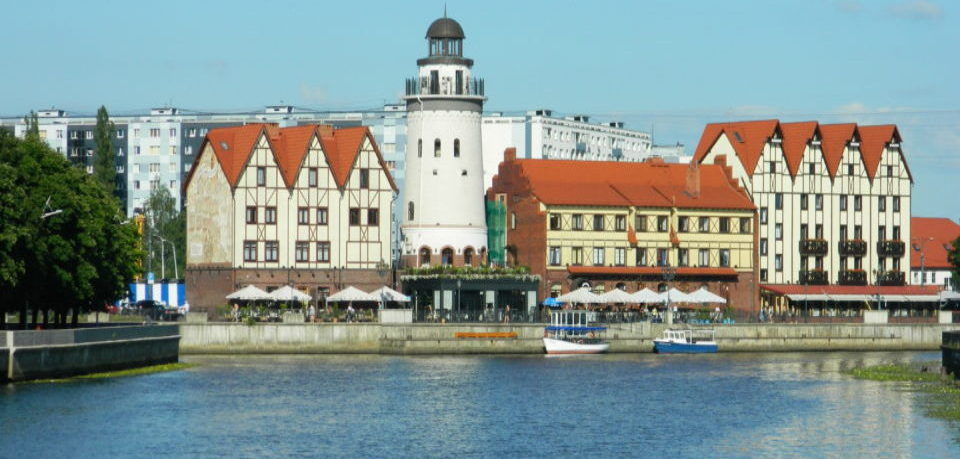
The label a ‘city of contrasts’ is as good as one as any to try to hang on a place which is as enigmatic as it is ambiguous. Modern-day Kaliningrad is vibrant and bustling ~ new apartment blocks, expensive reconstructions cast in the mould of its Königsberg predecessors, an eclectic array of bars, cafes, restaurants and clubs, brand-spanking international hotel complexes rub shoulders with down-at-heel swathes of Soviet-era concrete flats, all sharing the same physical and spiritual space as the monuments to and memories of the ruins from which they have grown ~ Königsberg.

Original Königsberg  building, Kaliningrad, Tourist Destination
Original Königsberg building, Kaliningrad

Epilogue

When I began writing this article, I had envisaged a succinct work of some 500 to 600 words. The fact that I have greatly exceeded that is testament to the great variety of things to see and do here, within Kaliningrad itself and its outlying region, and whilst I have deliberately focused on some of the more prominent, more defining features unique to this special place, those that I have not mentioned ~ of which there are many ~ less known, perhaps, but equally deserving, are urging me to write about them and, more importantly, for you to come and discover them for yourself.

Tour Guide/Accommodation

English-speaking visitors to this region are welcome to contact us on email Königsbergmick@mail.com. We provide a friendly, personal tour guide/interpreter service tailored to your requirements. We also offer accommodation (maximum two people).

Copyright © 2018-2021 Mick Hart. All rights reserved.

Hotel Russ Svetlogorsk Russia

New Year’s Eve at the Hotel Russ, Svetlogorsk

New Year’s Eve at the Hotel Russ

31 December 2019

Note: Rumour has it that the Hotel Russ has not only closed but in 2021 was demolished to make way for a brand-spanking new development complex. I am glad that I had the chance to visit this iconic building before it was consigned to history! R.I.P. Russ!!!😪

Every year it’s the same: what are we going to do, where are we going to go on New Year’s Eve? I was in England over the Christmas period when my wife telephoned to discuss where we should see the New Year in. Such a question would have been unthinkable, and quite unnecessary, in Kaliningrad when we were younger, as there was always someone holding a party somewhere, but the years have taken their toll and most of our friends and associates, we included, have reached the age when raucous reverie no longer holds the attraction that it once did. To paraphrase the Ouse Valley Single Club’s record, ‘We’re not as young as we used to be’. However, life is full of surprises, and just when I was thinking that it would be a night in with my old Kenneth McKellar Hogmanay tapes, here’s my wife suggesting that we return to the Hotel Russ!

New Year’s Eve at the Hotel Russ

Now, it had been almost 20 years ~ New Year’s Eve 2000-2001 to be precise ~ since we last celebrated New Year at the Russ (see my diary entry on this blog, when I get time to write it!), and when I divulged our decision to my brother, who had been with us back in the day, all he could chortle was, “Oh, no! You’re joking! Remember what it was like then. I bet it hasn’t changed!”

I wondered.

In my previous article on the Russ I had promised that we would return at some point in the future and review the Russ again, and as this occasion seemed as good a time as any, New Year’s Eve at the Russ it was.

Although Kaliningrad, where we live, is only 1000 rubles (about £11) by taxi away, we decided to make a short break of it, booking in for two nights. The New Year’s Eve party tariff was, approximately, £60 per person; the hotel tariff, £40 per night for a double room. For your 60 quid each person received a meal of 9 courses and a choice of two bottles from three options, which comprised wine, champagne and vodka. Fruit juice, in copious amounts, was thrown in and, of course, the fee included the cost of entertainment.

Not being altogether sure what time the event started, we had arrived early at 8pm, giving us time to patrol the Russ to spot the deliberate changes. We had returned to the Russ on three or four occasions since our first visit in 2000, not to stay there, but for a drink at the bar, so we were aware that the hotel had changed hands a number of times and of the changes made under different ownerships.

Related: The Hotel Russ, year 2000

The ‘sun lounge’ extension to the dining room, for example, which had not been there on our first visit, had been instigated some several years ago and, naturally, the hotel’s interior decoration, paintwork and such, had passed through various stages of transformation. Nevertheless, in terms of construction and overall layout, alterations were few: the approach to reception and reception area itself was as good and as true as yesterday; the ship-shape bar area, the overhang of which was distinctly reminiscent of a 1920s’ ocean liner, was perfect in its preservation; the sweeping twist of the spiral staircase unmolested by time; the split-level pitch of the bar lounge unspoilt in all its high-ceiling glory; the square-section colonnade marching along the centre line as sturdy and impressive as the day I first set eyes on it. However, needless to say, there had been some changes.

As one of the photographs we took in the year 2000-2001 reveals, the original Russ bar had been a rather small affair, a little curved thing which would not have looked out of place (although they all did) in a 1970s’ British council house front room. Gone!  This had been replaced by a big job: a long, solid, dark-wood structure, extending almost from one end of the room to the other, and better in proportion to it. Gone, too, were the drop-down cluster lights, the ceiling-hoisted tapestries and the curved low walls at the foot of the pillars with their water feature. The main lighting source, at least at the bar, consisted of three long rows of sunken downlighters; the low walls and water features had been replaced by width of space and the tapestries had, well, they had just gone somewhere.

In the lower level, the lighting was dimmed, especially for this occasion, and restrained to roving beams and three or four table lamps, these to cosy the atmosphere. I focus on lighting at this juncture because if I have any reservations about our evening at the Russ, it would have to be the lighting, that is the lighting in the bar area where our table was located. On the lower level, the lighting was just right; on the upper it was all wrong ~ far too bright. When we returned to the bar the following evening two of the three downlighter series had been turned off ~ then, but alas, too late, the lighting was near enough perfect.

It is not possible to comment on any other difference within the ground-floor area, except for a slight variation in the fireplace surround at the end of the lower level, as this section had been set out with party in mind and to accommodate as many guests as possible. In 2000-2001, the New Year’s celebrations had been confined to the main dining room; then, the upper bar area had, presumably, been left untouched, likewise with the lower level, which was then sprinkled luxuriously with leather divans and armchairs.

On this New Year’s Eve, we did not immediately take our seats at the table we had reserved. Apart from the hotel staff, we were alone, and the empty legions of tables, hollow space devoid of human existence, background music ~ which only we could hear, echoing throughout the people-less places, roaming empty rooms and haunting lofty halls ~ put me in mind of scenes from The Shining ~ all we needed now was a heavy fall of snow!

Before the guests arrive

We purchased a couple of drinks at the better, longer bar and took the same slim lift into which we had squashed with Mincer and our Sausage back in 2000. We got out on the second floor, although our room was on the third, simply because we wanted to see if we could remember which room we had occupied, and which room had been my brother’s 19 years’ ago.

Russ bar & staircase from the balcony

In this quest we had marginal success, but this little bit of time travelling had revealed that the railed centre of the broad corridor was no longer an open vista to the ground floor and that even had we returned to carry out my brother’s threat all those years ago, to hang underpants on the top of the Christmas tree, the chance had passed us by. Possibly because our rooms had been bugged back then and someone knew of our plan, the two gaps in the ceiling had been effectively plugged, allowing subsequent management to turn the corridor below into a multipurpose function room and, indeed, this was the very location for the New Year’s entertainment tonight.

Fish & the billiard table

At the top of the spiral staircase, on the veranda where the lift came out, the full-sized billiard table, over which Mr Fish had cursed boredom and chucked pistachio shells noisily into an ashtray whilst contemplating his prostitute of choice, had vanished, replaced instead by lots of open space and around the perimeter in part a combination of settees and armchairs in a sumptuous off-white fabric into which one could gratefully sink to savour one’s choice of beverage whilst pondering on the efficacy of yonder massage chair, with its various change of positions and strategically thought-out vibrating parts.

We discovered later, much to my nostalgic joy, that the famous billiard table had not been given the heave-ho but merely relocated to the third floor.

The famous Mr Fish billiard table!

Our room at the Russ

I am not altogether certain that the room we had booked had been described as a double or a room for two persons. Although, alas, there was no signs of rope bondage as there had been years ago, a practice, no doubt, that just did not catch on, the sleeping arrangements may have constituted two single beds artfully conjoined by the simple but effective use of a stretch-fitting base sheet.

Beds at the Hotel Russ

Whatever it was, the bed was comfortable, and the room, with its light wood trim, light sandy wall colouring and matching hard and soft furnishings was pleasant on the eye and on all the other senses. Good use had been made of compacting the space available and maximum storage capacity had been exacted in terms of wardrobe fittings and shelving. The shower room was, as they would have said in the 1920s, blissful, and was well equipped: it had a voluminous sink unit, large circular wall mirror, a profusion of hooks and racks, all the shampoos, conditioners, soaps and the like you could wish for, disposable tooth brushes with toothpaste included and a wall-mounted hair dryer, a nice touch eliminating the need to search for it amongst your shirts and smalls. Without question, however, the jewel in the crown had to be the walk-in shower room. Big enough to hold an orgy, this spacious facility with its mosaic floor was just the job for a good rinse down when, on returning from the beach, you might need to evict the sand from your toes.

Russ Balcony 2020

Another appealing feature of Russ bedrooms, at least the ones we have stayed in, is the balcony. Russ balconies are recessed into the broad sweep of the roof. They are as deep as they are wide, providing excellent suntraps in sequestered privacy.

Too cold to go nude on this occasion, even whilst wearing my cravat, we elected instead to return to reception, collect our belongings and prepare for the evening.

New Year’s Eve party at the Hotel Russ

Being a bit long in the tooth, we had chosen our table deliberately, putting a respectably less noisy distance between us and the entertainment hall. As I mentioned earlier, our only reservation was the lighting, which made us wish that we had booked a table in the more atmospheric lower level, but being close to the bar had its compensations ~ for example the attentive waiter, who could not have replenished our glasses quicker had he been beamed down specifically for that purpose.

Drinks wise, I have no complaints; as for the food, well, I am not a foodie person, by which I mean not one of those gluttons (or is it gourmets?) who vacillate from orgasmic to anti-climactic dining experiences, eating at one restaurant whilst comparing it with another, waxing lyrical on this gastronomical campaign whilst deprecating that one and scoffing down one meal in the midst of planning their next. As my old primary school teacher used to say, “There are those who live to eat; and those who eat to live.” In my humble opinion, the Russ repast was good. In quantity, there was too much for me; but I have no beef with the quality. In fact, being non-carnivorous, I had no beef at all. This should at least provide some reassurance to vegies who may have read elsewhere ~ and, indeed, in my own articles on this blog ~ that vegetarian fare can be hard to find in Russia.

My good lady wife, who neither shares my predilection for non-meat fodder nor condones my beans-on-toast palate, seemed well pleased with her meal(s). Had she not, I am almost certain that she would have complained!

The Russ breakfast

I will say, however, that breakfast the following morning was generous both with regard to the variety of food on offer and in quantity. In respect of the latter, it would have been impossible not to be, since food was served buffet style and, if you wanted more, you simply helped yourself. There were different cheeses, poached eggs, omelet squares, sausages, fish, potato wedges, small buns containing meat, croissants, bread, fruit, yoghurts, a range of cereals, a cavalcade of fruit juices and much more than my hangover-impaired memory can properly recall. One delicacy was more indelible, however, and that was a traditional Russian dish called ‘Herring Under Fur Coat’. Believe me, I kid you not.

‘Herring Under Fur Coat’

On the quality of the entertainment this New Year’s Eve, I am not really qualified to comment, as we spent most of our time at our table. We did watch and listen to President Putin’s speech and raised a glass to Moscow’s New Year, which came in one hour ahead of time than that of Kaliningrad’s, and raised a second toast at the end of the Russian National Anthem, probably one of the longest but most uplifting national anthems of all time. At Kaliningrad’s midnight, we joined the throng in the entertainment hall, where champagne was being served in preparation for the midnight hour, the countdown preluded by a New Year speech by the Governor of Kaliningrad, Anton Alikhanov.

In the lift Olga had spoken to a man who had asked her if she was partying until 6am, the official closing time of the Russ party. When she replied in the negative, excusing us from this commitment due to our age, the grey-haired man replied, “I’m not as young as I used to be [now, where have I heard that before?] but I’m going to party anyway!”

Young and old and in between, the Russ continued to rock until daybreak. Much was drunk; but all was civilised!

In summary, our return to the Hotel Russ had been disappointing: the service was excellent, the staff extremely efficient and friendly, the bar well stocked, the food ~ like Trump ~ unimpeachable, the interior design architecturally fascinating, the hotel rooms clean, comfortable and well-equipped, and it was all that you wanted and all you could ask for. Although I did not have so much to laugh about as I did 19 years’ ago when last I stayed at the Russ, what the Russ had lost in slapstick comedy it had more than made up for in professionalism, atmosphere and a sense of bon ami.

At a time when hotels are popping up in Svetlogorsk like a bad rash, should you be looking for  reclusive (ie away from the increasing hustle and bustle of the seafront) and exclusive accommodation, you would do much worse than opt for the Russ. From relatively humble but entrepreneurial beginnings, it has attained a level of maturity seldom encountered in the hospitality trade.

The Hotel Russ, Svetlogorsk, Russia: a 4-Star Hotel with 6-Star Service!

Essential Details:

Russ Hotel
Ulitsa Vereshchagina, 10
Svetlogorsk
Kaliningrad Oblast, 238560

Tel: +7 (4012) 777 787

Copyright © 2018-2022 Mick Hart. All rights reserved.

Exploring Svetlogorsk

Exploring Svetlogorsk

28 December 2000

“… and then, to top it all off, they passed the bill to me!” This was Joss recounting his adventures the night before over breakfast, which was ~surprise, surprise ~ a Russian version of cold meats and cheeses.

“So,” I clarified, “you all had plenty of food and the most expensive whisky and brandy and they (his hosts) asked you to pay the bill?”

“No,” he snorted, “They ordered what they wanted and then simply shoved the bill in my direction. What could I do? I couldn’t say anything as I can’t speak the lingo!”

“How about, ‘How much is a crash course in Russian?’”

There is something extremely satisfying about an inveterate bill dodger being caught out at his own game!

Previous article: The Hotel Russ, Svetlogorsk

Related: The Hotel Russ

Exploring Svetlogorsk

It had stopped snowing, but the temperature had dropped. Some grit had been applied to the Russ pathway but beyond that it was fairly treacherous underfoot.  Across the road from the Russ the silver birch woodland was as picturesque as one could wish for, the floor covered in a thick bed of snow and the treetops artistically crystalised.

Joss Hart Exploring Svetlogorsk

Joss Hart in the silver birch tree wood opposite the Hotel Russ, Svetlogorsk, year 2000. (Photo is blurred because of the quality of an old-world camera and a couple of hangovers.) Note the traditional Soviet hat!.

The walk into town took us on a route passed buildings of a most curious nature, each one different from the other. Immediately next to the Russ, on the same side of the road, there was another hotel, half-completed but with the front section, which was of concrete-block construction, yet windowless, over which a  large crane hovered.

Svetlogorsk architecture

On the left side of the road, there were three or four new-builds, the architectural style of which varied immensely from building to building but all incorporating some or mixed elements of Gothic,  Baroque and Neo-Classicism. The pastiche shouted conspicuous affluence, the contrasting styles sitting uneasily with each other but rendered plausible thanks to their salutary regard for the East Prussian influence from which they had sprung.

Exploring Svetlogorsk a new-Russian house c.2000
Grand house, Svetlogorsk, December 2000

On the right side of the road, the majority of houses were older and much more simple and humble. These were small one-storey buildings, possibly dating to the early 20th century, but with small windows in the gable end suggesting attic space above and most, if not all, having (shock and alarm in England!!) corrugated asbestos roofs.  There was a shanty-town down-at-heel honesty about these dwellings, with their hotchpotch of wooden porches built on during the Soviet era and lean-tos in various states of semi-collapse. On the corner of this road, same side and opposite to an as of yet incomplete new-build with Gothic tower, stood a large, unseemly concrete and brick block of flats, each floor equipped with integral and continuous open balcony. It may have been the middle of winter, but this had not prevented someone from stringing up a line, from which their washing hung stiff and frozen in the rapidly descending temperature.

Acclimatised to the never-ending sameness of British weather, where seasons meld into one, we were intrigued to learn that today the temperature had dropped to -10 degrees. The snow was very crisp under foot and treacherous ice patches kept us ever vigilant in our quest to avoid one of those embarrassing arse-over-head experiences. As we turned into the long road to the town, the pavement was the proverbial accident waiting to happen.

New Russian House Exploring Svetlogorsk
New Russian House c.2000. No longer in existence c.2020??

This road contained few houses on the left; on the right there were some beautiful, genuine old houses, small, set back inside woodland groves. What houses there were on the left were extravagant in every sense ~ large, out of proportion with their neighbours, bristling with different-sized windows on every conceivable level and surrounded by high, black wrought-iron fences. These were the properties of New Rich Russians, a term which in those times was used pejoratively. I was to encounter this label often over the next few days, and it would be used in a tone that was as cold as the ambient temperature. It seemed to me that the inherent contempt was a hang-back to the Soviet-era’s emphasis on a level society in which any hierarchical structure, as defined by wealth or class, was frowned upon as being dangerously bourgeoisie, smacked of Capitalist individualism and was tainted by the trappings of conspicuous consumption.

Exploring Svetlogorsk ~ Commemorative Chapel

We continued to walk. This road was a long one, with no deviation. By and by we stopped beside a small clearing in which an unassuming white chapel set in grounds away from the road could be seen. This building had a sad and tragic history to it, as it marked the spot where a Soviet plane crashed into a school building back in 1972.

Mick Hart & Olga outside the Commemorative Chapel in Svetlogorsk Russia (2000)
Mick Hart & Olga outside the Commemorative Chapel in Svetlogorsk , year 2000

Now on the left, we were walking past a large open square which had what looked to be a makeshift stage on one side and on the other the little café-bar which we had frequented the night before. A few yards down from this we passed a couple more historic Svetlogorsk houses, fronted by snow-filled gardens adjacent to the road, and here we were in the centre of Svetlogorsk.

The centre was basically a wider, more open area situated or build around a crossroads. On our right there was a café-bar, across the road on our left a shop, on the opposite side of the road in front of us a small, modern (glass and steel-framed) snack bar and, on the opposite side of the road, a large, non-descript, uniform municipal building.

Olga steered us off to the right, where we passed a glass-fronted restaurant. On the opposite side of the road stood two Prussian blocks of wooden-framed buildings, shutters on either sides of the windows and pretty carved fascia boards above, the latter festooned with rows and clusters of icicles.

We were now heading towards the ‘front’, and to do this we would have to descend along a broad pathway that snaked its way down the steep banks to the promenade. The wind whipped across this section of coastline and, although buffered by the woodland on either side of us and in spite of our extra layers of clothing, was inhospitable enough to force us to take shelter in the nearest place dispensing warmth, hot food and beverages.

At this time, Svetlogorsk promenade was serviced by one café only (a far cry from today!). According to my diary, what I liked best about this cafe was the coat and hat-check facility. This was not something that we were used to in the provincial part of England where we hailed from, and the elegant formality of it seemed to belong to an altogether more refined and bygone era. My ‘second first’ in this café was an introduction to the Russian menu. Unlike in England, where the fare is typed  on the front and back of a piece of card, the average Russian menu was so extensive that it was presented to you in the form of a large book, covered in simulated leather ~  a weighty tome, indeed, which would not look out of place should Eamon Andrews be handing it to you (showing my age again). Every page of this wonderful book was rammed with meaty delights, cooked and served in every way imaginable; salivating stuff indeed if you happened to be a carnivore, but if it so happened that you had renounced consumption of animal flesh, as I had, then this great big book was woefully short of grub.

Englishmen & Vegetarians

At this time vegetarianskee  options were a long way from catching on in Russia and, whilst most people in this western extremity of the country no longer react with amazement when you reveal that you do not eat meat, your strange preference is still met with a visible degree of perplexity whether dining at someone’s house or eating out in café or restaurant. On this occasion, long ago, Olga did manage to organise something akin to borsch, the most traditional of Russian dishes, but very few places other than this would be willing to make me borsch with the essential ingredient, meat, excluded.

The next rift with tradition was trying to get a cup of tea with milk. The problem here was the inverse of meat: with meat dishes it was necessary to exclude, whilst with tea, it was all a matter of remembering to include. To this day, whenever we order tea (chi) in a café , restaurant or hotel, the milk is always forgotten, and it is not altogether unknown to be asked with a puzzled expression ‘skolka?’, how much?, and even then you can sometimes end up with a tumbler full.

Hurdles are there to be overcome, hoops are there to be jumped through and the cold outside was waiting for us. Wrapped up and back outside, we continued along the prom, our attention and progress arrested by the sight of a rather peculiar tower, rectangular of shape and clad entirely in large sheets of corrugated tin. This, Olga explained, was a lift shaft, the lift within ready to transport you to the elevated ground above, only today it was not working. That was a shame, I thought, as it looked well dodgy and dangerous. We also passed another means of aerial transport, this time in the form of small bucket-shaped cable cars, the wire on which they were suspended following the slope of the bank. A note in my 2000 diary refers to rust and a certain degree of lopsidedness, the implication being that I had been rather pleased to discover that these were not working either, even if it did mean walking up the steep incline. And very steep it was and very slippery.

Exploring Svetlogorsk ~ Bar No Toilet

Approximately three-quarters of the way up this hill, the urge for a pint kicked in and when it did we were fortunate enough to be a snowballs throw away from a neon sign with ‘Bar’ written on it. The old-fashioned red neon tube was a sight for sore eyes, frozen hands and almost unfeeling toes. From the outside this bar looked exceptionally basic and the inside did not disappoint me: half-a-dozen round tables with four plain chairs around each, a high, short counter, two beer engines and an electric fire ~ my kind of place. Olga had a vodka and Joss and I had two ice cold lagers ~ just the ticket for this sort of weather!

We must have spent at least forty minutes in this humble but gratifying establishment, during which we were watched by the bar staff as if we had just landed from Pluto. We soon learnt that our presence in the Kaliningrad region was singularly astonishing; we tended to be regarded somewhere between exotic and alien, or exotic aliens, with an oscillating reaction which swung back and forth from amused curiosity to highly suspicious caution. At first it was unnerving, but, as we became accustomed to it and realised it was par for the course, the attention we received appealed to our sense of the exciting and comic. Besides, if we knew nothing else, we had armed ourselves with one very important and versatile Russian phrase, which was Ya nee penymio (I don’t understand).

This phrase came into its own when we enquired Gdye toylete? And the answer came back, “We haven’t got one.” I had often used this response when I was younger to guests who were visiting our family home; their confusion was delightful. But now with the tables turned it did not seem quite so funny. Further enquiry, with our legs crossed, revealed that although they really did not have a toilet, patrons were welcome to use the toilet block outside that belonged to an establishment on the opposite side of the street.

In  normal circumstances, ie normal being when the steeply sloping road outside was not covered by a glacier, such an excursion may have been a considerably less arduous and adventurous undertaking, but even with my brother and I providing more than moral support to each other we ended up sliding this way and that in a helpless fit of the giggles. Fortunately, no accidents  accrued, in any place where they might have done when one is dying for a pee whilst inadvertently ice skating, and having mastered this peculiarly Russian ritual, we downed another pint and headed back to the Russ where, ‘isn’t it obvious’, we had returned for a short respite and a snack before travelling into Kaliningrad for our first experience of Russian hospitality.

Copyright © 2018-2020 Mick Hart. All rights reserved.

Democracy returns to the UK

DEMOCRACY RETURNS TO THE UK

Whilst preparing to move from England to Kaliningrad in December 2018, I was asked by someone, was my reason for quitting the UK down to Brexit? ~ meaning, was I leaving the UK as the UK was leaving Europe. “No,” I replied, “I’m leaving the UK because the UK will never leave Europe.” Many a true word said in jest, as they say.

Another 12 months passes, during which the lies, deceit, fear-mongering, treachery, disloyalty, and numerous attempts to abandon democracy in the name of Neo-Liberalism, would seem to bear out all I had predicted ~ for, in spite of valiant and untiring attempts by Nigel Farage to extricate us from the insidious tentacles of the EU experiment, it looked as if key figures in the British establishment, aided and abetted by rich persons with no legacy-British background and a biased judicial system, would stop at nothing to ensure that their socially engineered Frankenstein would lumber on regardless.

Get Brexit Done!

And then, returning to England just before Christmas, on the 13 December 2019, something marvelous, something quite extraordinary, something amazing happens: Just when you thought it wasn’t safe to use the word democracy anymore in the UK, the British electorate surprises everyone, including themselves, and prove to the world that they are still capable of rational thought. In spite of all that has been thrown at them by the Leftist media, the lies, the deceit, the propaganda, instead of buckling to the war of attrition and voting, as politicians such as Jo Swinson felt sure they would, for cancelling Brexit, they did just the opposite, turning 13 December 2019 not into the travesty expected but in a great day for democracy, the day that restored faith in the British people’s ability to see beyond the smoke and mirrors and decide, resolutely, that they wanted to take their country back. Not that the political class should have been surprised; after all, Cameron and Co never for the life of them believed that the British people would have the temerity to ditch the EU, but they did, and now Boris Johnson, forced by his own party’s treachery as much as by anything else to launch a General Election, is voted back into Number 10 to finish the job he started, to ‘Get Brexit Done!’

Unable to admit that this election was about one thing, and one thing only, Brexit, the Liberal-Left- dominated media go gunning for poor old Corbyn. It’s all his fault, he ‘led Labour into the abys’. Well, yes, but mainly because the majority of his party were pushing to scupper Brexit, angling all the way for a second referendum which would hopefully bring the result that they wanted rather than concede to the one they did not.

Feeling sorry for Corbyn? Then you should also feel sorry for Jo Swinson, leader of the so-called Liberal Democrats. So convinced was she that the brainwashing of the British people through month after month of Project Fear had worked, ie that Brexit was going to inflict everything from a boil on your arse to a land heave in your garden, that she gambled her entire career and the fortunes of her party on the illiberal and undemocratic promise to ‘Cancel Brexit’ if she won. She lost. Media predictions had been significant gains for her party.

One thing, however, the Liberal-Left media did get right and that was their description of Labour’s rowt as a political earthquake. It was so sudden, so severe and so devastating that it shot off up North, making terrible destructive inroads into Labour’s traditional heartland.

The Red Wall, Labour’s impregnable swathe of safe constituencies, the North-South divide which seemed as old as Hadrian’s Wall itself, crumbled; even worse (worse that is for Labour), seats that had been held by Labour since the inception of Labour itself had its long entrenched, complacent  arses kicked well and truly out.

Democracy returns to the UK

The magnitude on the Left-Wing Richter scale was not immediately apparent to me, but as I read the various reports, commentary and analysis I began to realise just how devastating Boris’ victory had been for the Left. The media likened its effect to the election of Margaret Thatcher, but in fact it was worse, much worse. As one Leftist commentator wrote, Boris Johnson had in one fell-swoop swept everything away that Tony Bair had built. But isn’t this what happens when you botch something together without due regard for planning permission and building regulations? The same commentator went on to lament that Boris Johnson’s victory was the dawning of a new era in which ‘patriotism and immigration’ will take precedence over economics. So, it is boo hoo for the Neo-Liberal Globalists, but then someone should have told them that this is what Brexit has all been about.

It was Hitler’s Minister of Propaganda, Joseph Goebbels who famously said, that “If you tell a lie big enough and keep repeating it, people will eventually come to believe it.” He should have added for the sake of the liars, ‘just don’t go believing it yourselves!”.

In his new and much empowered role, Boris Johnson has the golden opportunity to preside over a new era, not a cliched new era but one that could really make a difference. The good ship UK has lacked a firm hand at the helm for far too long. For the past twenty years or more we’ve been drifting into the maelstrom, carried by a pernicious subcurrent that has left us as a nation PC disoriented and all but morally bankrupt. Naysayers believe, and can you really blame them, that we are too far off course to find our way back; then the answer must lie in going forward but with a significant change of direction. We have not always been Not So Great Britain and our destiny does not have to be the Disunited Kingdom.

Over the coming months the Liberal-Left will resort to their usual illiberality. They will refuse to accept at all costs that the Brexit election was a resounding rejection of their unprincipled mission to subvert and substitute true democracy for their Trojan Horse version of it, and on the receiving end, of course, it will be poor old Corbyn’s end.

Ironically, that well-known adage ‘Be Careful What You Wish For’ could not be more applicable. It was the Left that called for ‘The People’s Vote’. They got it. The people voted for Brexit. Now Boris has a clear and an unequivocal mandate ‘To Get the Job Done’ as promised.

Copyright © 2018-2020 Mick Hart. All rights reserved.

The Tilsit Treaty and Rhythms of Kaliningrad

The Tilsit Treaty and Rhythms of Kaliningrad

19 October 2019

The former Königsberg Stock Exchange, aka the Khudozhestvennaya Galereya, is home to a permanent exhibition, the title of which is The Shadow of Königsberg. It also holds temporary exhibitions on a regular basis.  Two exhibitions attracted us recently, Alexander I and Napoleon Meeting on the Neman and Rhythms of Kaliningrad.

The Königsberg Stock Exchange (now the Khudozhestvennaya Galereya) is an impressive two-storey Neo-Renaissance-style building, which stands on the southern side of the Pregel River.

The grand building, which opened in 1875, was the work of architect Heinrich Muller and Emil Hundrieser, the latter to which is owed the external decoration, including the allegorical figures at roof-top level and the two lions on either side of the entrance steps.

As with most of Königsberg’s municipal buildings, the Stock Exchange suffered extensive damage when bombed by the RAF in 1944 and again during the Siege of Königsberg in 1945. It is believed that it narrowly escaped the systematic demolition programme of what remained of Königsberg after the war, as the new owners and powers that were ~ the Soviets ~ identified Russian Neo-Classical features in its construction (pphhhewww!). Since the building was reprieved, reinstated and reconstructed in 1967, it has passed through various transitions and is today one of Kaliningrad’s most important, and unequivocally, one of its most regal cultural centres [see the Tripadvisor website for photographs of this magnificent building].

Khudozhestvennaya Galereya

Stock Exchange Konigsberg
Napoleonic exhibition

The Khudozhestvennaya Galereya stages changing exhibitions on a regular basis. The building can accommodate two or three exhibitions at any one time, depending, of course, on the size, using dedicated and versatile screening facilities. To the right of the entrance hall and on the second floor, space is reserved for a permanent exhibition, The Shadow of Königsberg, which traces the history of this unique city and region through the turbulent transitions of its 20th century history. Whether you are a professional historian, amateur historian, budding history scholar or are simply fascinated by the changing fortunes and character of Königsberg-Kaliningrad, The Shadow of Königsberg provides a pictorial timeline of indelible significance through drawings, sketches, paintings and photographs, supported by detailed models and electronic simulation. Its depiction of pre-war Königsberg in contrast with its post-war ruins and subsequent Soviet inheritance and legacy, that of life lived for three decades among weed-strewn, crumbling buildings, a hollowed out shell of a once noble city, has a pathos seldom encountered in the modern world we inhabit today.

Mick Hart Konigsberg Stock Exchange at Tilsit Exhibition
I really would like this poster …

Alexander I and Napoleon Meeting on the Neman

The exhibition, Alexander I and Napoleon Meeting on the Neman [River], opened in the former Königsberg Stock Exchange building, now a cultural centre, on 19 October 2019 and runs until 15 December 2019. The exhibition is dedicated to one of the two Tilsit* Treaties, that which took place on 7 July 1807 following Napoleon’s victory in Friedland. The treaty, which was well-satirised in the British press of the time, examples of which are included in the exhibition, is unforgettable not least because it took place on a purpose-built raft anchored in the middle of the Neman River. But its real importance was the ensuing impact it had on regional and world geo-politics. The principal loser of the treaty was Prussia, which was forced to surrender almost 50 percent of its territory. Russia and France achieved a peaceful settlement, a settlement which not all Russian’s were agreeable to, but the peace only lasted five years: in 1812 Napoleon returned to the Neman River, crossing it this time with invasion in mind. Be this as it may, the treaty inspired numerous artistic representations, both in Europe and Russia. And this is what this exhibition is dedicated to.

The exhibition contains about 60 exhibits from the collection of The State Hermitage Museum in St Petersburg, including paintings, drawings and sculptures, as well as original uniforms of Russian and French soldiers and is complemented by works contributed by the Kaliningrad Museum of Fine Arts and Private Collections.

*Tilsit was renamed Sovetsk when the East Prussian region changed hands at the close of World War II. It is located in the Kaliningrad Oblast.

Rhythms of Kaliningrad

The Rhythms of Kaliningrad exhibition comprised an eclectic selection of art ~ paintings, sketches, drawings, sculptures ~ and even elaborate contributions from the Kaliningrad region’s world-renowned amber industry, examples of which included handmade jewellery of the most imaginative and exquisite calibre, highly detailed icons and an urn of Classical and Baroque  form lavishly adorned.  Designer clothing, handmade and avant-garde, added an unpredictable dimension to what was already an exotic and exhilarating showcase of regional artistic talent.

Taken as a collection, the thematic denominator subsumes the randomness of each subject into a distillation, and the compendium of impressions is a lyrical exposition that neither aggrandises nor underestimates the unique heritage, urban environment and natural images by which it is informed but rather acknowledges them and celebrates them as a compound expression of an esoteric experience. Sunsets across water, abstracts, natural landscapes, urban landscapes, pseudo-incarnations of Königsberg’s nobility ~ the castle and the city’s monuments ~ (none of which ever existed in the modern artist’s memory), Expressionism, Impressionism, Surrealism, Realism, Painterly and the rest, a gamut of artistic subjects and the styles through which they are brought into being vying to define, striving to encapsulate what it is about this place, this city and its territory, that draws you inexorably into its soul.

A personal reflection

 Sherbak-Pyankova artist Konigsberg villa at Rhythms of Kaliningrad Exhibition.
Haunting painting of Konigsberg by Sherbak-Pyankova

In delivering the essence of the exhibition’s title, Rhythms of Kaliningrad, no one artwork should be singled out for being lesser or greater than the others in its company,  but spectators and critics alike are fickle, prone, as we all are, to the common human failing for putting personal preference before impartiality, and thus although I would shy away from the impossible task of deciding which work of art was the best, whatever the given criteria, there was, inevitably, one among the paintings which resonated resoundingly with my not altogether impartial predilection for the sublime and metaphysical.

This painting was by the artist Sherbak-Pyankova. It was the study of a Königsberg house, a villa, set back in its own grounds, surrounded by its own garden, demarcated by iron railings with a wrought iron gate of unusual splendour.

Naturally, reliant on the theme of the exhibition, the subject matter in and of itself was not by any means a surprising leap into incongruity, but to narrow down the appeal criteria not to what had been painted but the way in which it had been painted ~ no, more, much more than this ~ the manner of its composition, its inherent composition and the intrinsic affect it had upon me, is how I would like to proceed.

In this respect I have no inclination to classify the artist’s technique within a particular school or style, because by doing so I would by default promote taught technique above inspirational teaching and, ultimately, individual creativity. My attraction to this piece of work was at once instantaneous ~ an impulse, a reaction ~ the rationalisation that ensued, if indeed you can call it this, being a process of thought, of mind.

When I first examined the painting I was, as is the norm, standing relatively close to it.

The outlines of the house were distinct enough but the details, although present, impressed me with the notion that they were fading before my eyes. It was as though my view was partially obscured or obfuscated by a thin veil, or a light film, as though the building was slipping away from me. Suspecting the fault lay in my eyesight, I stepped back a few paces and took another look. From my new, more removed, position, unless I was mistaken, the subject on which I now gazed had developed a clarity hitherto unseen. Encouraged by this promising shift in perspective, I removed myself still further, at which greater distance the details became so clear that I could well have been standing outside the house itself, next to the ornate gate, not viewing it on canvas.

So now I began walking slowly back towards the picture and, as I did, I was relieved to discover that the suspicions about my eyesight were unfounded. With each step that I took the mist that had so impeded my vision from the moment I looked upon the picture was, by stealth and with steady degrees, returning.

I repeated the exercise, just to make certain.

I was of the understanding that the further I removed myself from the Königsberg house the closer I came to it, or it to me; conversely, the closer I came to the house, the further away it became, until almost evaporating.

This inversion of physics bemused as much as the metaphysics eluded, but then, with a Eureka moment, Romanticism kicked in and the haze before the house, being the haze behind my eyes, lifted in the subjective sunlight.

Of course, the visibility of the house was so much better delineated from a distance. The distance between myself and the house was not the insoluble distance of time that I had first believed it to be, but in fact quite the reverse. The further I walked away from the house the closer I came to Königsberg. Walking back was walking back in time towards the point of origin. But when I approach the house, in an attempt to go backwards, I walk back into the present, Königsberg slips from my grasp and all that I am left with is the hazy, phantasmagorical image of something I aspire to see, to experience in the physical world.

 Sherbak-Pyankova artist: Konigsberg street , shown at Rhythms of Kaliningrad Exhibition
Konisberg street by Sherbak-Pyankova

This painting, and a second painting of a street in Königsberg-Kaliningrad by the same artist, got both my vote and my wife’s Olga’s before we knew anything about either the artist or her mentor. However, given the profound effect that her work had on us, it should not have surprised us to learn that the artist she had studied under, and had an enduring respect for, was a mutual friend ~  Victor Rybinin.

Victor had taught art for many years at the Kaliningrad Art School. He had, as he said, ‘grown up among the ruins of Königsberg’ and was ‘the product of two cultures’; he invested his entire life in the philosophical, artistic and historic exploration of the Königsberg-Kaliningrad continuum. As our artist and historian friend Stanislav Konovalov said, who had himself been taught by Victor, Victor’s artistic representations came from the heart, they are each and every one imbued with a symbolic mysticism, a profundity, a deep soulfulness which emanates from his appreciation of and unwavering love for Königsberg-Kaliningrad, always described by Victor, with characteristic understatement, as ‘this unique place’.

That none of Victor Rybinin’s art saw inclusion in the Rhythms of Kaliningrad exhibition is a sorrowful oversight, particularly since those who knew him and who know his art share the conviction that he was and will remain a principal figure in the city’s and  its region’s cultural  history ~ history being the final judge.

Romanticist attribution or irony of fate? Either way it is an uncanny coincidence that we should choose as favourite the painting which we chose today …

Essential Details:

(Khudozhestvennaya Galereya) Königsberg  Stock Exchange

Prospekt Leninskiy 83

Kaliningrad

Kaliningrad Oblast, 236039

Map location: https://en.kaliningradartmuseum.ru/contacts/

Tel: 8 (4012) 46-71-66

Email: secretariat@kaliningradartmuseum.ru

[Website checked but not working on 12 April 2022]

Opening times:

Sat, Tues & Wed: 10.00 ~ 19.00 (10am to 7pm)

Thurs & Fri: 10.00~21.00 (10am to 9pm)

Closed Monday

Copyright © 2018-2021 Mick Hart. All rights reserved.


Apartment Museum Kaliningrad (Königsberg)

Apartment Museum Kaliningrad (Königsberg)

10 November 2019

Our second cultural day in a row (yesterday we attended an unusual art exhibition) found us heading off for a guided tour around a flat that had belonged to a Königsberg merchant in the early 20th century. I had heard of this flat from our dear friend Victor Ryabinin ~ artist, philosopher, historian (sadly now deceased) ~ who had, as with all things Königsberg, stimulated my curiosity by informing us that the flat in question had been preserved, and restored where necessary, in all its original glory.

The flat we were going to visit today is located at 11-1 Krasnaya Street, Kaliningrad. The official name of the venue is simply but effectively ‘Apartment Museum’. A century ago, it was the home of merchant and grocery store owner, Gustav Grossmann, and his family. As the advertising leaflet boldly and honestly claims, the authentic interior allows you to ‘travel back a hundred years’ and experience life ‘as a citizen of Eastern Prussia’.

Public interest in and success of the project had prompted the exhibition owner to invest in a retro café on the site of Grossmann’s original store, which is located in the same building as the merchant’s flat, and it was here that we were rendezvousing with friend and Königsberg historian Stanislav Konovalov, known to us as Stas.

Gustav Grossmann Konigsberg Cafe
Apartment Museum, Kaliningrad 2019: Shop & Cafeteria

The café, which is housed in a corner section of the historic apartment building, extends from the main structure out towards the pavement. The entrance to Grossmann’s apartment is recessed, away from the pavement, a small flagstoned area leading to the front door, and can therefore be easily missed. However, the café signage does a wonderful job, calling your attention to a building of stature, which is distinctive and old-world gentrified thanks predominantly to the large show window on the ground floor and above it on the first and second floors the unusual arched windows.

The lower window has been fitted out with shelving and, even before we climbed the small flight of steps leading to the café entrance, it excited us to see a variety of bygone items beckoning us inside. The artefacts displayed included, but were not limited to, kitchen pans, clothes’ irons, ceramic pots, oil lamps and the stock in trade of antique emporiums in this part of the world, the ubiquitous German stein.

Grossmann Retro Cafe Konigsberg
Gustav Grossmann Cafe, Kaliningrad

Anyone obsessed with the past could tell, from the demeanour of the building and the items displayed in the window, that you would not be disappointed when you stepped inside. The interior of the building has been subject to a complete and comprehensive retro makeover, with so much by way of antiques and collectables adorning shelves, festooned on the walls, cuddling in cabinets, swinging from the ceiling and dotted here and there that ~ as it is with the nature of such places ~ it was impossible at first glance and even ten minutes afterwards to take everything in. Certain features, however, made their mark and stayed there. Behind the front counter, for example ~ a long counter and one of impressive height ~ wall-to-ceiling shelving has been erected, and this shelving, consisting as it does of different sized compartments, the top section reserved for larger items such as a pair of antique radios, is occupied by a mixture of vintage and antique objects rubbing shoulders with the modern accoutrements that are vital for running a business like this, such as branded cups and saucers, selections of teas, different kinds of coffee varieties and so on. The café till, which may be modern, appears on the customer side of the counter as though it is made of wood, whilst the coffee machine, all made of shining chrome, is, in shape and appearance, an icon of the 1950s. Indeed, not everything in the café was what we English would call Edwardian or of early 20th century origin: the radio in the window, which has most likely been fitted with an electronic player, was post WWII, although the music it aired pre-dated it as late 1920s or 30s.

Window Seat, Apartment Museum, Kaliningrad

As with the interior décor no expense in detail had been spared with regard to the café’s furniture, all of which has a heritage background, from the open-sided armchair beside the counter to the two armchairs and circular salon table in front of the window. As these chairs were occupied by patrons, who were studiously observing an unwritten code of conduct, which is, or so it would seem, to adhere to a kind of library silence in the presence of the past, we took up temporary residence in the only seats available, Olga on a dining chair with a Rococo-style splat and myself on an interesting settle, which was comfortably upholstered and had, at either end, small fitted cabinets with carved, pierced fronts.

Partaking of tea in Apartment Museum Cafe ~ Königsberg

Tea was served in two dish-shaped china cups with matching saucers, backstamped Konig… . We could not make out the exact wording, but we felt certain that the proprietor of this establishment would not have trusted us with an original Königsberg tea service.

Vintage tea cup Altes Haus
Vintage china tea cup, Gustav Grossmann Cafe, Königsberg

More or less observing the silence that everyone else was bound to, we drank our tea and continued our visual assessment, taking in the various enamel-fronted advertising signs that no antique-oriented premise should ever be without and recognising three wall-mounted cast-iron signs as tram destination plates, each bearing the number of a specific tram and the Königsberg districts which each tram had served. These distinctive and, I should imagine, highly sought-after Königsberg mementoes, which remembered the route that specific trams took, I had only seen once before and that was in the art studio of our late friend Victor Ryabinin.

Apartment Museum Cafe sells antiques

Alas, these plaques were not for sale, but some of the items were. There were three large wood and glass display cabinets containing all manner of small antique pieces ~ ceramics, tableware, relics from Königsberg ~ as well as some larger items, such as a silver-topped walking cane and a silk top hat, all of which could be purchased. Both Olga and I took an interest in the two-tier, Art Nouveau plant stand, which was slightly more unusual than the standard fare, but as the asking price was considerably higher than that which I would normally expect to pay for a similar piece in England, our interest remained just that.

We finished our tea and now that Stas had arrived and wanted a smoke, we joined the other interested parties who were waiting outside on the damp and chilly streets for the venue to open.

As 11am came and went Stas took the initiative to ring the doorbell. And seconds later the door was opened by a tall lady appropriately dressed Edwardian style, that is in a high-necked blouse and long woolen dress fastened and highlighted around the waist by an enamel-buckled cinch belt.

We were shown in to the communal hallway of the building, a spacious entrance hall with a flight of six or seven steps to the ground-floor landing, beyond which could be seen a rather imposing wooden railed staircase.

The door to the time capsule we were about to enter was mid-brown wood, with long vertical paneling , the upper section letting in light through a series of small windows, the glass inside being of the wire-reinforced variety. Our little entourage filed one by one inside and as we passed ~ me gratefully ~ from the 21st century into the past, I pointed out the doorbell to Olga, which was housed in a metal plate wrought into a typical and prepossessing Art Nouveau design.

Art Nouveau Apartment Museum Kaliningrad
Art Nouveau doorbell, Apartment Museum, Kaliningrad

The corridor inside the flat was rather narrow and, indeed, we were soon to discover that this merchant’s flat was of no great proportion anywhere. Naturally, the space was made considerably less by the unusual volume of people that it now occupied, all at once milling and jostling as they tried to divest themselves of their outer winter garments to place in temporary storage within the deep, but not very wide, cloakroom reserved for this purpose.

Naturally, the initial impact of the transition from now to then, from new to old, would be better served with less people present, but ventures such as these need to be administered and maintained, and I would anticipate that the fee for a private viewing might prove cost-prohibitive. Nevertheless, I did find room to reflect on how reserved and dignified Mr Grossmann’s hallway was, with its black and white tiled floor, tall dark doors fitted with ornate and heavy brass handles and its wonderful bygone telephone, equipped with open cradle and sporting a large pair of bells.

Open-plan design

When we were all partially disrobed, so to speak, we were led into the living quarters, which was fundamentally one large room divided into two halves by the simple decorative effect of wooden vertical frames and pierced and moulded fretwork where the uprights meet the ceiling.

The door through which we had entered had taken us effectively into the living room/study. In the corner of the room, in front of the window, was a desk with shelves and drawers in all the usual places and with more incorporated in the elevated section of a glazed cabinet super structure. The desk held various interesting and curious pieces, including the first typewriter I had seen manufactured by Mercedes Benz. Next to the desk there was a large double-fronted glazed cabinet, containing many antique artefacts, and next to that a small sofa and copper-topped circular table.

This table was one for us. It had a built-in standard lamp, with a large bell-shaped fabric lampshade centred above it, c.1920s. Other objects of interest in this part of the room included a small, circular gramophone table complete with horn-type gramophone, a very nice carved and stuffed-over seat corner chair, used here as a desk chair, and various wall-hung paintings and antique ornaments.

Mr Grumpy (photograph withheld)

One thing that Olga had not forewarned me about was that Stas would be translating as the guide spoke, and Stas, in turn, had not been forewarned that Mr Grumpy was present. Mr Grumpy took umbrage at Stas’ mumblings in English, and even after Stas had explained his intent and purpose, Mr G could not quite permit himself the liberty of graciousness, turning every now and then to scowl at us, until eventually he slid away. At first I felt myself lean charitably in his direction, after all had not he paid for the tour like everyone else? ~ so why would he want to be distracted by Stas’ infernal utterances? But by and by I noticed that he was pretty much dissatisfied with everybody and everything. Perhaps his wife had dragged him there when he should have been in the bar? (If that had been the case, then it was perfectly understandable!)

Mick Hart Kaliningrad
Gustav Grossmann? No, Mick Hart at Gustav’s desk!

The guide’s talk continued for some time but the duration was necessary as we were not after all in the Palace of Versailles but in a very small, lower middle-class apartment, which, had the guide whipped us through, would have no doubt had Mr Grumpy demanding his entrance fee back!

Judging by the reaction of the rest of the group, with the omission of Mr Grumpy, the guide’s efforts appeared to meet with universal appreciation. Even with my sparse knowledge of Russian I could tell that she was a good speaker, instigating and maintaining interest and adding to it, from time to time, by drawing our attention to certain curious items, which she passed around for people to hold and examine, asking if anyone knew what they had been used for in their previous life. This technique was adopted throughout the tour, and, I am proud to say, I got most of the items right, except for a small pagoda-style, black-lacquered miniature house which, it transpired, had been a pet sanctuary for crickets, no less. As they say, and quite rightly so, you learn something new every day.

The second half of the room into which we had first been shown functioned as the dining area, the taper-legged table and simple but appealing early 20th century chairs occupying centre place. Behind the table, set against the wall, stood a typical Könisbergian lump of a sideboard. I do not mean to sound disparaging, since these heavy, massy pieces of furniture typically adorned with heraldic and armorial appliques and supported on chunky ball and claw feet or, as in this example, large lion pads, solicit the Gothic in me, but I fully understand that their dominating presence is not, as we English are wont to say, everyone’s cup of tea.

Apartment Museum magnificent fireplace/stove

In this instance, however, it was the fireplace that got the better. Here we had a typical German glazed-tile fire-come-boiler affair ~ a masonry heater ~ distinguished above any I had seen hitherto, with the possible exception of one very ornate example, which may or may not be original, which resides within a hotel bar on a picturesque stretch of the river a few kilometers from Königsberg.

The fireplace we were privy to today owed its impressive status to its two-tiered format, and the fact that the decorative tiling was taken up from floor to ceiling, the top being surmounted with a rather elaborate carved and scrolled finial.

The metal grate doors at the lower level of the boiler also expressed an Art Nouveau intricacy, the artistic quality of which I have not witnessed elsewhere in this region.

Overall, the furnished and decorative note struck in Mr Grossmann’s flat was a mellow and conservative one, possessing and conveying an unaffected dignity. Towards this consummation the doors, all of which exhibited the same uniformity of design, added not a little. In fact, they stamped an authority of social standing on the nature of this abode, their dark-wood, tall and sober character surmounted by a dignifying architectural gable pediment.

Crotchless bloomers

The next stop on the itinerary was the bedroom. It was not at all very spacious and the two wooden single beds pushed together to make a pseudo double bed allowed for nothing more than a cabinet and a dressing table. The most remarkable bygone in this room was the mannequin, or rather the female underwear in which it was dressed, of which the principal feature was the long pantaloons. These, our guide revealed, were split-crotched in the most significant manner, which, my wife concluded, explained why men in the early 20th century made such an eager audience when young ladies danced the can-can.

Apartment Museum Guide Kaliningrad
Apartment Museum guide, Kaliningrad

You see what I mean when I say, ‘you learn something new every day’.

We could not all get into the confines of the bed chamber, so some of us were necessitated to undertake our viewing from the hall, along which we then walked, as instructed by our guide, to the kitchen.

Nowhere does bygone domestic life impress itself more contrastively than in the kitchen setting. The kitchen décor of our modern age and the implements we use therein would seem so thoroughly futuristic from an early 20th century point of view, and also more recently for those who lived in the 1940s, as to make them impossible to envision. In years gone by kitchen items were heavy, solid-state, screwed, riveted, mechanical; they were constructed from metal and glazed stoneware, cast and wrought iron, and they were obviously made to last, which is why they are still with us. A few people aspire when they behold kitchens of yester-year to recreate something similar in their own home as a retro statement, but few people ~ only those of the most stalwart nature with a near to obsessive love of obsolescent times ~ are willing to go the whole hog, completely renouncing smooth, easy-to-clean surfaces and modern, time-saving kitchen utensils [see Art Exhibition Kaliningrad] for their more quirky but difficult to use and maintain predecessors.

Kitchen utensils Apartment Museum, Kaliningrad
Early 20th century kitchen utensils

In Mr Grossmann’s flat, the kitchen was quite small. Too many cooks was certainly not an option. The kitchen stove, or range, ruled the visual roost, it was, after all, an indispensable piece of home-living equipment, in this case cast iron, the front beige and green-enamel tiled and the whole raised on sculpted, ornate cabriole legs.

Above the cooker there was a row of hooks containing various kitchen utensils and, on the wall, cream and white enamel back-plates with integral hooks on which hung various straining, stirring and other culinary implements. The back plates to these utensil holders are lovingly shaped and are much sought after today by discerning collectors and interior decorators. Enamel products were, of course, the kitchen equipment stalwarts of their day, and another nice example, one of which I had seen before in Victor Ryabinin’s studio, was a three-compartmentalised kitchen-cleaning substance holder, which included a slot for a product well-known in England, Persil, the name of which, along with others, is printed on the surface.

Antique Kitchen Shopping List
Slider-controlled enamel kitchen shopping list reminder, c1910-20

One item that I was not acquainted with was an early refrigerator. The appliance looked like a tall, square, solid wooden box, but when the lid was lifted the top section could be seen to contain a perforated metal basket.  The cabinet space below held the provisions whilst the ice above cooled the interior. A simple mechanism indeed, but I suppose it must have worked.

The kitchen was large enough to accommodate a dresser, with glazed cabinets to the upper middle section flanked by two enclosed cabinets, in which an assortment of curious contraptions were displayed, and the storage space offered by this piece of furniture was augmented by a small larder in the corner of the room, containing a stimulating jamboree of bottles, tins and jars, many with ageing contents.

The last room on the inventory was the toilet and bathroom, and this indispensable facility was to be found on the left just inside the door. You’ve just got to love a proper toilet, being one with a high-rise cistern with a chain and porcelain hand-pull, of German heritage of course.

Apartment Museum Kaliningrad Bathroom
Gustav Grossmann’s toilet requisites

Whether large country estate, stately home or a relatively small apartment such as this one, the question I always ask myself at the conclusion of my visit is not did it interest me but did it have the desired effect, namely during the time I spent there was I there at the time and in a different time at the same time? The answer in the case of Kaliningrad’s (Königsberg’s) Museum Apartment is Yes. Thank you Apartment Museum and thank you Mr Grossmann!

Essential Details:

Apartment Museum (Altes Haus)

11-1 Krasnaya Str

Königsberg

Tel: Kaliningrad 33-50-60

Email: alteshaus12@gmail.com

Website: www.alteshaus.ru

Excursions:

Monday to Saturday 11am, 12pm & 3pm

Attendance at the museum at any other time, including Sunday, can be booked in advanced

Apartment Museum Altes Haus Kaliningrad

Copyright © 2018-2021 Mick Hart. All rights reserved.

Art Exhibition Kaliningrad

I’ll have that painting and, by the way, how much for the flat?

Saturday 9 November 2019

Today we were off to an art exhibition. Of the exhibition I knew little or nothing, except that it would be different and was by invitation only. Oksana, our neighbour, had invited us, and the ‘different’ element made all the difference in that I was very curious.

I had no idea what to expect, as, in Oksana’s car, we pulled into a cramped carpark opposite a new red-brick block of flats. A group of people were walking alongside the building to a gate and were directed back from whence they came ~ we followed.

On the opposite side of the building we were shown into a narrow corridor. A woman, carrying a clipboard, appeared. The group, of which we were a part, about 20 in total, lined up on either side of the corridor, whilst the clipboard lady delivered a short introductory talk, about which, of course, I understood nothing. Then we filed through the door and took the lift to one of the floors above.

Designer flat project, Kaliningrad, Russia
Modern Chic or Retro Chic?

The block of flats we were in was new and unfinished, but the corridors, at least on the floors we were occupying, appeared to be in quite an advanced stage of completion. Chunky white door surrounds and white walls dominated the décor. From a distance it appeared as if a series of thin slate-like slithers of different dimensions had been painstakingly inserted at various depths to give a naturalistic, uneven surface finish to the walls, but on closer inspection you could see, as with even the best toupées, where the join was. Cunningly, the complexity of construction had been made considerably easier by the slate pieces being mounted on, or integral to, brick blocks. As modern as this was supposed to be, I could not help feel that there was something rather retro about the whole ensemble, so much so that it would not have surprised me had Russian versions of John Steed and Emma Peel come sauntering out from one the flats.

Designer flats in Kaliningrad, Russia, 2019
Flats for sale, Kaliningrad

The flats themselves were at the stage known here as ‘grey scale’. This is an apt description, which means that the walls and ceilings have been plastered and skimmed but no finishing décor has been applied. There were no internal doors as yet but the double-glazing was in, as were the rads.

The concept explained

The concept of the art exhibition was an interesting one. My wife explained it to me. A number of empty flats in the building had been requisitioned to serve as exhibition halls. Each participating flat ether contained the displayed work of one individual artist or, if the artist’s contribution was less prolific, one room would be allocated. Thus, in some flats you would find the work of one artist and in others the work of, say, three artists, housed in separate rooms.

The concept worked surprisingly well. Since the walls of the flats were grey-scale they provided the perfect neutral backdrop and as, apart from the artwork, the only other items in the rooms were display units, advertising brochures and the odd bottle of mineral water, distraction had been obviated. Even the display modules were as basic as they could be ~ simple unobtrusive plinths and the occasional wooden easel. As there were few wall hooks in evidence, many of the exhibits were placed at ground level. This was in hindsight one possible flaw, as arguably the works in question were not shown at their best in this position.

The exhibition rooms not all being situated on one floor meant that the viewing public had to hop into lifts and run up and down stairs, and this alone added an interesting twist to what was already a novel concept.

Yri Bulechev Kaliningrad Art Exhibition
Yri Bulechev Kaliningrad Art Exhibitio

Among the contributing artists whom we liked best was the work of Yri Bulechev and a second artist who, to add intrigue to his work, wished to remain anonymous. We did learn that the anonymous artist was by profession an engineer, and this calling was demonstrated thematically throughout his art. The focus subject matter was portrait: strained, tense faces with worried, uncertain eyes, apprehensive, frightened even, contextualised within a claustrophobic grid, an invasive backdrop of lines, narrow rectangles and circles, which reminded me of the geometrical patterns that I used to draw as a nipper with the aid of my then trendy Spirograph set.

Anonymous Kaliningrad Artist
Modern consciousness

This background fretwork ramped up the element of tension, especially since it invaded the human features, as if intermeshing the frailty of the human condition with the modern world’s increasing connectivity, the pressures that such a Brave New World inflicts and the hard-wired engineering by which our lives are ruled and controlled. That my good lady wife liked these paintings, indeed was drawn to them so much that she put in a bid for two, was, given her penchant for the light, airy and positive, somewhat surprising.

One painting she particularly liked was that of female face. It was, in fact, half a female face, the portrait painted on the very edge of the substrate with half of the image missing. Taught and compelling, the one eye blue and bright reflected something like fear, and there again was that all-pervasive geometrical static, smothering the backdrop and overlaying the startled features. Interestingly enough ~ but remember the artist’s vocation ~ this art form had not been painted on board or canvas but brought to life and into the world on a sheet of rusty iron.

Art Exhibition Kaliningrad
Half way there

The industrial-look of this artist’s work was indubitably enhanced by the stark, incomplete environment in which it was displayed, a factor which also fed into the large picture of a Russian female comedy actress, noted, I was told, for her happy-go-lucky and comical typecasting, drawn or painted all in white, whilst the dark shadowy head and face of Anthony Hopkins’ Hannibal Lecter (Silence of the Lambs) looks predatorily over her shoulder with a hunger in no way related to the baguette that the actress is ready to eat.

Silence Of The Lambs in an empty flat in Kaliningrad!

As a long-time devotee of Leonard Cohen, Lord Byron and Edgar Allan Poe, and being continually reminded by my wife that I am bleak and melancholic, these pieces should have been right up my nightmare street and, I have to confess, I enjoyed them, but on this occasion incongruously a role reversal had taken place, with me feeling enthusiastic about a large painting in contrasting pastel and vivid colours depicting two stylized lovers floating in the luminous air somewhere between Heaven and Earth. Seldom have I seen such a picture which radiates instant Karma ~ so soothing, idyllic, tranquil and so ethereal in every sense. Until, that is, I discovered how much it cost. Brought quickly down to earth again by the asking price of (ssshhhh!), I am yet inclined to say that the painting is worth every ruble ~ it was only my wallet holding me back!

Yri Bulechev painting, exhibited in Kaliningrad, Russia.
Yri Bulechev composition, which would look very nice hanging above my bed!

Seldom have I seen such a picture which radiates instant Karma ~ so soothing, idyllic, tranquil and so ethereal in every sense.

Flat 10

During our wandering from room to room, I had had the good fortune of being addressed by a very tall, very attractive young Russian woman, dressed in red leather trousers and elevated on a pair of block high heel shoes that seemed to be giving me vertigo.

She told me, among other things, that the best was yet to come ~ wait until you get to apartment number 10, she said. Funny, but the last two exhibit rooms before I got to number 10 are difficult to remember.

I am tempted to say that all I can recall about flat 10 was that it contained a massive king-size bed and a bath tub large enough for four Donald Trumps, but, in reality, I can remember quite a lot more.

Flat 10 was a showcase flat. It had been given the personalised designer treatment and as with all ~ or most ~ of the paintings here on display was up for grabs if you wanted it. Indeed, I was told by the interesting young lady who was talking to me in very good English that I could buy it if I wanted to.

Flat 10 as illustrated on the cover of the art exhibition advertising leaflet

Well, did I?

The old adage that first impressions count may or may not be true, but it is as good a place to start as any. I may have been the only one amongst today’s privileged public to have made a mental note that the door design harked back to the Soviet era, in that access to the apartment (too grand to call it a flat) was governed by two doors in close proximity: first the traditional Russian heavy weight external door with its Fort Knox bolting system and then a more conventional door painted in non-conventional salmon pink. Beyond this curiosity, one walked into a tall, narrow corridor flanked by what appeared to be grey veneered paneling but which was, we discovered later, discreetly shuttered cabinet space. As one would expect from a modern designer flat, the accent was placed firmly on minimalist décor and maximalist space-exploitation. The floor-to-ceiling paneling, which was utilised again in the walkway between the master bedroom and bathroom, was as discreet as it was maximising, and this was because, as with the kitchen cabinets, all of the grey paneled doors had been built sans-handles. All one needed to do to access the space beyond was to touch lightly and the doors pop open. Nothing wrong with that, I thought, unless, of course, you have just woken up from a nightmare in which the world had been robbed of its handles.

If you have a fetish for handles, the flat had a place for them. Indeed, as designer flats go, this one was very much built with a place for everything and everything in its place. The wall directly opposite the entrance has been thoughtfully provided with floor-to-ceiling box shelving in a beech-veneered wood, the rectangular display units varying in size being reminiscent of the modular concept. Space such as this could hold any number of different sized handles and anything else for that matter.

Space optimisation at its best!

By turning left you were heading to the master bedroom, which was located on the right, with the toilet and bathroom opposite. First impressions again: the door with its angled lozenge panels. These I liked. They were one of only two nods in this ultra-modern flat to the past and to antiquity. As for the master bedroom, I was not quite sure whether it was somewhat small or whether the bed was very large, but any risk of complete claustrophobia was dispelled by the timely inclusion of a large glass window that looked out into the covered balcony beyond.

The next stop, however, was the bathroom. I have already referenced the bath tub. It was big. And so was the fixed shower rose above it. As the musician and singer Judge Dread once said, ‘I haven’t see one as big as that before’.

The toilet was round the corner in a separate place of its own and here we were in for more surprises. No, it wasn’t a bucket; it was as designer-modern as the rest of it. We were shown into the toilet cubicle in the dark, but no matter as the inside of the pan was illuminated with little blue lights and the seat popped up automatically. Really, there was no way that you could not be impressed. I whispered to my entranced wife that such a toilet as this was made for a hypochondriac such as me. I had reached the age where ailments and hospital tests are more prevalent than hot dinners, and an illuminated toilet bowl was an excellent idea for checking your stools.

My wife refrained from comment (a phenomenal moment in itself), perhaps because she was already peering inside another room hidden away behind more grey paneling. This was a narrow room, also accessible by the paneling on the inside of the apartment door. It was here where you did your washing and hung your clothes out to dry. On one side there were a couple of 21st century washing machines and elevated above them an up-to-the-minute tumble dryer; on the other, there were fitted wardrobes and shelves for your clothes. This was so right. The very idea of hanging your socks, pants and sundries over the edge of the balcony just would not work in a place like this.

Room with a view

We were on the balcony next. Make no mistake, this was no khrushchev flat. The balcony was completely self-contained, a great plate of double-glazed glass extending from the yellow-ridged floor to the dizzy heights of the ceiling. The wall had appropriately ~ given the artistic concept by which the event was defined ~ been fitted out with two large abstract paintings, whilst a handsome reproduction antique desk and swivel desk chair demonstrated how the space therein could be utilised as an additional ‘room’, in this case as an office. I liked this balcony. It was, as they say in British estate agents’ parlance, well-appointed, and I could honestly see myself sitting there typing away on an evening as I tried to resist supping beer in the nearby London Pub. I could not, however, see myself walking there ~ too much ~ as impressive as the modern floor structure was, like most modern floors today which are made of composite wood it tended to shift and creak. Not good if like the Sheik of Araby, you tend to creep about at night, and in a compact space-saving flat like this no one could blame you for feeling so inclined, particularly as this balcony contained an adjoining door to the guest room.

Art Exhibition Kaliningrad
Balcony Flat 10

Although the guest room was rather small, containing a kind of settee bed, the strategic positioning of a slim vertical mirror opposite the balcony entrance and a wide mirror on the wall facing it, created the illusion of much more space than there was, particularly when the tall, Baroque-style door from bedroom to sitting area was left open.

Looking back at this door, from the sitting room to the guest bedroom, endorsed my earlier prejudice that the lozenge-shaped panels struck an essential and clever juxtaposition, the geometrical profile, although simple, being the perfect foil to handle-less cabinets and satin-smooth textures.

Art Exhibition Kaliningrad
Sitting pretty … well, at least sitting on something pretty!

The sitting room and kitchen were, in essence, a double act. The sitting room determined by its flat wall-mounted TV screen and serpentine-shaped comfy settee and the kitchen starting, but partly concealed, behind a tall block screen. If anything did not work for me inside this flat it was the screen. It was dark-coloured and its height and breadth reminded me of the type of front desks that you feel belittled by in old Soviet-style hotels, such as Kaliningrad’s Moscow. Behind the front desk in this room, there were the kitchen work surfaces and state-of-the-art kitchen appliances and, immediately behind them, and soaring up behind them, a monolithic formation of touch-door operated fitted-kitchen cabinets. I am a beans-on-toast man myself, but even I could see that for kitchen aficionados there was nothing wanting in high-tech, or in ultra-swish, clean and easily cleanable where this kitchen was concerned.

Flats designed to buyer's spec, Kaliningrad, Russia
As I gaze thoughtfully at the ceiling stencil in the Swish kitchen …

The one thing that I have omitted to mention so far is the absence of a proper ceiling ~ by proper I mean traditional. In fact, there is no ceiling, at least no plasterboard painted ceiling. Above your head in this flat the concrete structure looks down on you in all its unexpurgated and natural naked glory. I like it. It melds perfectly into the industrial and steampunk ethos by which we live our modern lives, from train station to airport, from café bar to attic revamp, it is the modern-day equivalent of the nuts, bolts and rivets statement which defined the architecture of the industrial revolution. That it has followed us into our homes should not surprise us, but in this flat, just in case it did, the designers had taken the decorative precaution of stenciling onto the overhead concrete an elaborate sequence of scrolls, this constituting the second nod to antiquity, as the distinctive outline and shell-like form is unmistakably related to the family Rococo.

For a man who has spent most of his life dodging minimalism as if it were the plague, I have to confess that I was happily engaged by what I had witnessed today and the way that it had affected me. There is every possibility that I will never be able to look at a half-finished flat again without thinking, ‘this needs artwork’ or ‘what I could do with this space if only I had the creative vision of the designers of flat number 10’.

Mick Hart looking devilish at the Kaliningrad Art Exhibition 2019 (apologies to Zeus!)

Essential Details:

Kvartirnik Exhibition

The exhibition is a joint offline project of the ART SPACE Internet Gallery and PEPA HOME STEGING, which prepares real estate for sale.

Project Organisers

Stepanyuk Natalya, Exhibition Curator & Artist (examples of her works exhibited)

Kiseleva Tatyana, Architect & Interior Designer

Contributing Artists Include:

Baeva, Natalya

Elfimov, George

Elfimova, Lyudmila

Bulychev, Yuri

el cartoon

Kiseleva, Tatyana

Stepanyuk, Natalya

Vernikovskaya, Olga

Chepkasova, Natalya

Elfimov, Alexander Prokopyevich

Apartment Design

Tatyana Kiseleva, Architect (planning, interior design, furniture and all interior items)

Personalised Interior Design Project

Following consultation with the architect, an individual planning solution is offered to any buyer of any apartment in the building this article features.

For more information, contact

Tatyana Kiseleva

Tel: +7 9211033313

KSK Real Estate

Copyright © 2018-2021 Mick Hart. All rights reserved.

Hotel Rus, Svletogorsk, Russia

The Hotel Russ, Svetlogorsk

The Hotel Russ, Svetlogorsk

27 December 2000

I recently visited the Hotel Russ (August 2019). It is interesting to observe what has changed in the past 20 years and what has not. The following description is taken from my notes of the Hotel Russ as it was on that celebrated day in 2000 when we first arrived in Russia, almost 20 years ago. Later, we hope to write a review of what it is like to stay in the Russ today. Meanwhile, this was our first experience …

Having passed through the main gate of the Hotel Russ in Svetlogorsk, we followed the path along the side of the building to the entrance. Two large glass doors opened up into a wide, airy and spacious foyer. You could not miss the reception area as it was elevated and had the word ‘Reception’ emblazoned across it, surprisingly in English.

Hotel Russ reception area 2000
Reception area, Hotel Russ, Svetlogorsk, Russia, December 2000

Previous article: Kaliningrad: First Impression

To get there necessitated climbing up two or three steps onto a wider platform and then approaching the bar. I do not mean the sort you get in pubs; this experience was rather more similar to approaching the bar in court (as far as I am aware).

The two young ladies behind the counter were, well, beautiful springs to mind, but it was a cold, unsmiling kind of beauty; the next word that sprung to mind was ‘’officious and, after that, ‘very’. Olga did the talking; we did the looking and the walking.

From our elevated position we could see that on one side of us there was, indeed, a bar. We both felt instantly better ~ who said ‘at home’?

Bar Hotel Russ December 2000
Bar area, Hotel Russ, Svetlogorsk, Russia, December 2000

The bar area contained the usual outcrops of tables and chairs, which extended down one side to the end of the building. The chairs were chromium backed and the round tables marbled topped. Indeed, marble ~ or simulated marble ~appeared to be the material of the day within the Hotel Russ. To the left of us, in front of the bar, stood a row of tall, square-section pillars, which fanned out in vaulted form before folding into the ceiling. One of the pillars was decorated with artificial shrubs and climbing plants and beneath it we could hear a water feature bubbling

The area beyond the pillars was effectively the hotel lounge. It was well appointed, with a bank of windows which extended along the entire side of the room and soared up into the heavens above. The ceiling was very high, and if you stood in this lavish area, with its reproduction antique furniture and comfy, cushioned divans, and looked up at the ceiling it was evident  they had designed the Russ to look like an ocean liner, complete with curving staircase that took you up majestically onto the upper deck.

Hotel Rus, Svetlogorsk, Russia
Lounge area, Hotel Russ, Svetlogorsk, Russia, December 2000

As grand as they were, we did not take the steps. Our luggage was extremely heavy and bulky, even discounting the Sausage, so we took the lift instead.

A tall, thin man, with a face he had purchased from Serious & Co, was summoned to help us with our luggage. He came across the room in a most peculiar way, but it was not until he turned back again towards the lift with a couple of bags, including the Sausage, which were far too heavy for him to manage, that my brother, with an alacrity of mind that was so atypical that he must have borrowed it for the occasion, identified the gait as ‘mincing’. From that moment on, our tall assistant would be known to us as Mincer and Mincer he became.

Mick Hart & Joss Hart at the Hotel Rus, Svetlogorsk, Russia, December 2000
From left to right: Joss Hart, a man from the Hotel Russ and Mick Hart , December 2000

For a big hotel the lift was little. It was also not very wide. Certainly not wide enough for Olga, Joss, myself, two hefty cases, the Sausage and Mr Mincer. We got in and were all squashed up, something like Dad’s Army when they all crowd into the vicar’s office. There was nothing for it, something would have to give. So Olga got out and walked upstairs. There goes another myth, ‘the typical English gentlemen’.

It was a small lift and it was also a very slow lift. It did not start moving straightaway. Titter ye not, I thought, but it was hard not to all cramped up like that with Mincer looking so serious. But we knew better than to laugh in Russia ~ thank heavens for the stiff upper lip.

Ping, went the lift, at last. I felt as if we had travelled to the top of the Empire State Building not just to the first floor. Joss and I squeezed out and Mincer followed, or he would have done had not the mischievous Sausage found another small door to straddle. We helped our hapless baggage boy out and relieved him of the obnoxious case.

We were now standing in a wide area overlooking the bar, three or four tables and chairs around the perimeter and a pool table in the centre. The rooms on this floor were arranged around an oblong balcony with the centrepiece open and from which you could look down onto the floor below.

The first room that we entered was the one reserved for my brother, Joss. It was not bad at all. A little formal, perhaps, by British standards, I mean not at all like Mrs Musson’s Guest House at number six No-Beach Brightlingsea, but lacking nothing in the clean, neat, tidy and comfortable department.

In addition to the usual appurtenances, Joss had a large, three-quarter size bed and a rubber plant.

Next it was our room, which was on the other side of the balcony facing the Rus garden. In we went, all excited, only to discover that our double room was smaller than Joss’ single and that whilst he had a double bed ~ of sorts ~ we had two singles?

My brother has always been a true gentleman, mostly by accident, and today was one of those, because he surprised us all, including himself (and that doesn’t happen very often) by making the supreme sacrifice: he was willing to give his room up for ours ~ to swap rooms.

Isn’t it obvious!?

Feeling altogether sensible Olga went downstairs to reception to request the transfer. She was back almost quicker than she went with the intelligence that we could not change rooms as Joss had a single room and we had a double, so any change was impossible. The exact response from the ladies at reception had been, “Isn’t it obvious: the single room is for the single person and the double for two people”.

To say that we were not perplexed would be an understatement and Olga, perceiving that her two English associates had been skittled, left them sitting on the bed in Joss’ room, to which we had retreated, sipping vodka thoughtfully out of a hip flask, whilst she went off ‘to see what could be done’.

Ten minutes later she returned. “It’s OK, they are taking care of it,” she assured us.

And they were, sure enough, but not in the way they might have done it back home. As we walked past the open door to our bedroom, we caught sight of the solution to the problem, in the shape of two burly Russian gentleman moving the single beds together and securing the legs at either end with two thick pieces of rope. This made us chuckle; Olga was not amused. She was also not very amused as in passing the upper extremities of the Christmas tree, which extended from the ground floor up through the oval aperture almost to the roof, Joss noted that there was no adorning fairy or star on the top. His suggestion to hang an old pair of underpants on it was a step too far in the smutty English humour direction for Olga, and she went from feeling annoyed to visibly irritated.

To take the wind out of her sails (my brother was also suffering from wind, and she was not too amused about that, either), I suggested a tour around the hotel to get ourselves familiarised with it. At such a time when many companies were still in the embryonic stage of website development, surprisingly enough the Russ was ahead of itself, and we had been able to appraise the quality of this 4-Star hotel by consulting its site ahead of our trip.

As we descended, this time by the grand staircase, we met Mincer on the ground floor, and Olga asked him if we could see the sports centre. “It’s broken,” he replied.

Joss and I shot a glance at each other: perhaps something was lost in translation?

Broken or not our guide continued. We followed him down a short flight of stairs into what appeared to be a typical sports centre changing room, wide and open with slatted bench seats around the wall. We then turned right into a passageway. Against the wall stood an exercise bike, its front wheel hanging off. Mincer said something. Olga translated: “Broken,” she said.

There was little point in arguing. But what about the swimming pool, surely the wheel could not have fallen off that.

It had not. But it had shrunk. On the photographs it appeared to be a full-size pool, whereas, in real life, it was a large, deep bathtub into which one plunged after vacating the sauna. Was the sauna working? Er …

Fully refreshed after our workout, we returned to our respective rooms. Olga had made arrangements to meet with her friend, Helen, the plan being that we would venture into Svetlogorsk for a drink, but what was needed now was a cup of tea and a refreshing bath.

Don’t drink the water

Spoilt by literally having drinking water on tap in England, Olga had alerted us to the fact that in the Kaliningrad region it was strictly a case of ‘don’t drink the water’. I wondered whether it could be as bad as we had been led to believe. The answer came when I began to fill the bathtub. To say that the water was black may well be an overstatement, but it was certainly getting that way. We called Joss in from his room to witness this hitherto unseen spectacle, and then we had Olga ring to reception to report the anomaly. Her reply was, “Isn’t it obvious? You must let the water run!” So, we did exactly that, until we feared that we had dissipated half of Svetlogorsk’s water reserves. Oh, well, we would have to forgo the bath. But what about something to eat? Something simple, such as a cheese and tomato sandwich prior to going out on the town? Our request, by phone to reception, was met with some confusion. The person who took the call had to consult with somebody else. Eventually we were informed that we could have two slices of bread, some cheese and tomatoes on the side of the plate, but they could not do a sandwich. Well, I thought, isn’t it obvious!

It was around this time that we received a phone call to reception from another of Olga’s friends. Olga telephoned the friend in return and was invited to go out somewhere for a drink. As we had a prior engagement, we declined, but Joss solved the double commitment by electing to meet up with the second party whilst we went ahead with our original plans.

Joss’ company arrived first. They were a couple, both persons of which were, I thought, most refined in dress and in manner. What would they make of my brother, I mused, as they whisked him away for the evening?

Olga’s friend, Helen, arrived a few minutes later: attractive, very sweet natured but, I thought, rather, and unduly, concerned about my first impressions of Svetlogorsk. I had no idea as to why this apprehension should constitute the status quo in these parts, although I realised later that in the year 2000, apart from Germans returning to the region to see where their family once lived, foreigners were quite a rare species and English men perfectly alien.

Out into the cold ~ very cold ~ and snow-laden night we ventured, retracing the route that our taxi had taken. We had difficulty walking, the snow was that thick and, where it was not, it was that icy. Also, as I had observed earlier, there were little or no streetlights of which to speak.

Sundial on Svetlogorsk promenade, December 2000
Sundial sculpture on Svetlogorsk promenade during the winter, December 2000

Our pedestrianisation seemed to go on forever, until we took a right turn in the direction of the sea. We eventually reached the top of a steep bank of steps. I could hear the sea in the near distance and feel the sea air ~ it was as sharp as the proverbial razor blade! Carefully, very carefully, we picked our way down the gallery of steps until we reached the promenade. Directly in front of us stood a man-made and man height (sorry about the lack of PCism) sundial, the wedge-shaped blade reflecting what light there was as it cut its way upwards from the ground. I took hold of this blade, and, in listening to the rolling sound of the tide, thought to myself, “I’m actually here!” (Do not forget, dear reader, that having read or heard nothing positive about Russia since I was a child and, more recent to the time of my trip, having been the recipient of negative media coverage from, without exception, every UK media source available and, in particular official channels (no change there, then!)  make no mistake that being in Russia was a truly awesome thought!)

It used to be

The icy blast across the Baltics rendered any further deliberation untenable, and we cut a hasty retreat. It had been somewhat easier descending than ascending, and we stopped at the top of the steps to catch our breath. To our left there were a couple of derelict buildings, about which Helen volunteered some information as to what they used to be. By the time we had reached our destination, a café-bar close to Svetlogorsk centre, ‘this used to be’ had developed into a catchphrase. We passed several collapsing or deserted structures all of which had been ‘Used to Bees’.

A welcome sight was a little neon sign marking the spot where a café-bar stood. As we drew closer, I could make out a single-storey building with a glass door. There was nothing else around the building. Today, as with most of Svetlogorsk, this area has been developed, but the little café into which I first took refuge on 27 December 2000 is, I am pleased to say, still there and still functioning and nothing much, if anything, has changed!

Inside, the café was a simple rectangular room, tables ranged down either side and in the far corner to the right a small semi-circular or curved bar. The establishment was neither grand nor overtly plain. The lighting was just right ~ not too bright, not too dim ~ and the walls were conservatively decorated with framed pictures of the Svetlogorsk coastline and town. Most importantly, on a night like this, it was cosy, comfortable and warm ~ and, of course, it was also licensed.

I cannot remember what lager I drank that evening. I did not really bother. As a seasoned real-ale drinker, I had made my mind up in advance that anything lagerish would be poor, but I drank it all the same.

My one abiding memory of this establishment, and one that would stay with me for a long time, was that there was only one toilet, and it was unisex. This perplexed me a little. There were only three other people apart from us in the bar, but, when the establishment was full, how did a one-toilet system work? The other thing that surprised me about this odd Russian toilet arrangement was that you were unable to use the facility unless you asked for a key from the bar. I would learn later that this inconvenient convenience was by no means a one-off and in some places today the tradition has not moved on much!

I also learnt this evening that whenever I spoke English in a café or a restuarant I would be looked at ~ and I do not mean in the sense of a casual glance! As I noted earlier, foreigners were a rare thing in ‘these ‘ere parts’ and when you were looked at you were really looked at. I believe that throughout the 45 minutes we were in this bar, the other inhabitants, bar staff included, never took their eyes off me, not for a single moment.

We moved on, not because of this, but to pastures anew. If anything, our brief sojourn and the comfort afforded by it, had rendered the great outdoors even more hostile, or perhaps the temperature was dropping even further.

Café Mozart , Svetlogorsk

Luckily, we had only walked a short distance before another neon sign glowed its way into our vision: in a purple-red flowing script, it identified the building on which it was erected as the Café Mozart.

I will never forget that first encounter with the Mozart. The building was well lit on this extremely murky but atmospheric evening, a large picture window flooding the ground with light outside, whilst other lit windows and external lamps threw patches of light onto this and that aspect of the building and wove shadows above and around, picking out and hiding at will the nooks, crannies, decor and detail of what was unequivocally a fine example of the Gothic Revival style. As we approached, the wooden slatted and clad exterior put me in mind of early 20th century American Romanticist architecture, but it was far too chilly a night to bring this contemplation to a proper conclusion.

Inside the building, large and spacious as it was, there was a traditional dance floor to the right, complete with revolving glitter ball, and to the left a good-sized lounge with a welcoming fire. Although this was not a real log fire but a gas-fired replica, it made the interior very cosy indeed. Comfortable bench seats lined the window, with armchairs and sofas scattered here and there inviting you to sink into them, an over-mantle mirror hung above the fireplace, which may or may not have been authentic antique, and various framed pictures adorned the wallpapered walls, the mood lighting from a combination of pendant and wall-mounted lamps making this habitat the perfect choice for reasonable refreshment and good conversation.

As for the latter, most of that revolved around what it was like to live in England and the English way of life. I would soon learn that the Russian vision of Merry England was as quaintly outdated as our authorised version of what it was like to live in Russia today.

Sad to say, the Mozart, which had affected me with such appealing and positive vibes, closed shortly after this visit ~ at least it was closed when I returned a year later, never to re-open in the same style. Six months ago, the building was up for sale. It has been on the market for a long while and may still be for sale today.

Related: Hotel Russ 2020

Copyright © 2018-2020 Mick Hart. All rights reserved.

Kaliningrad: First Impression

Kaliningrad: First Impression

27 December 2000

Strangely enough, there is nothing in my year 2000 diary regarding our first glimpse of Kaliningrad by train. Later, in 2001, when I returned to Kaliningrad via Vilnius, I did refer to the maze of concrete jutting out and across the horizon which asserted itself as our train drew near and the daunting prospect that this presented compared to the quaint medieval streets of the city from which we had departed, and which now was a long way behind us.

Previous article: Into Russia

This omission in my 2000 diary may have been due to the fact that the scene on my arrival had such a potent effect. For we had passed through the exit of Kaliningrad station onto a Spielberg film set.

Outside the door was snow ~ a wide plateau of it. It was still snowing heavily and fall upon fall had covered melted snow that had since turned to ice. Directly outside the railway station’s door stood two old army trucks, both open backed. From one spilled a group of young Russian soldiers, the other was being filled with snow by a second group of soldiers attempting to clear a path through the drifts. The engines of the trucks were running, and the strong smell of diesel fumes wafted across the wasteland. The shovel blades beat an erratic tattoo, thumping against the snow, cracking at the ice and scraping across the concrete. Spielberg’s costume department had spared no expense. Each soldier was garbed in smart regulation great coat, thick woollen trousers, high canvas boots and those distinctive furry Russian hats with flaps (ushankas).

Nearby, two or three comrades (for that is what they looked like) squashed inside big heavy coats, black peaked caps with folding side flaps stuck upon their heads, all bewhiskered and dragging on fags, huddled around a big old oil drum that had been requisitioned as a source of warmth. Another of these makeshift braziers burned a few feet away. Red and orange flames funnelled from their tops together with bright little firework sparks, which danced, crackled and exploded loudly in the frozen atmosphere.

In front of us, across the expanse of white, stood a three or four storey procession of grey concrete flats. This was not Kaliningrad 2022, so our view was virtually unimpeded, the only large object being the statue of Kalinin, his arm and hand outstretched as if commanding the heavens to stop dropping snow. Behind him, along the top of the not-so venerable buildings, giant metal letters spread out along parallel bars, the imposing Cyrillic script traversing the entire block in a wonderful piece of letter spacing. At one end sat a large Soviet star, at the other, I was thrilled to observe, a gigantic hammer and sickle.  And then it actually struck me: “Oh dear,” I thought, “we’re here!”

Three big, old, Mercs, battered and rusting, with little white ‘Taxi’ signs strapped to their roof-racks, stood idly by, waiting for instructions.

 The little band of men, which I had observed earlier, were taxi drivers.

Don’t let them know you are British!

Olga whispered to me that she was off to negotiate a price with them. She instructed Joss and I to stand away and not to speak, warning us that should  they, the taxi drivers, get the slightest inclination that we were foreigners the taxi fare would double.

Five minutes of negotiating later, a fare had been agreed, and we were off. But where to? The plan was to ferry us off to the nearby (about 44 kilometres away) coastal resort of Svetlogorsk. Olga was very conscious of the rundown condition of Kaliningrad, and she had made plans for us to stay in what was then the only 4-star hotel in the region, which was Svletogorsk’s Hotel Rus. Nothing else would be good enough for two well-to-do Englishmen like us!

The journey by taxi was an interesting one. The big old Merc, coughed, belched and spluttered almost as much as its driver did. We roared through the snowbound streets of the city, a combination of abject fear and snow working in Olga’s favour, as we were much to alarmed to take anything in and even had we wanted to all we could see was snow.

Out on the open road the conditions were worse, but it was OK because no one had told our taxi driver. For a while, whilst we were stuck behind a truck with a snow blade on the front, our confidence returned, but it soon took a hit, for in overtaking the truck, as the driver pressed his foot down hard, the car slewed erratically on the snow and ice beneath. From that moment our knuckles were destined to be as white as the pure-driven. Relentless snow, drifting snow and an old German road lined on either side with trees ~ big, gnarled trunks perfect for colliding with ~ dismayed the driver not a jot. On and on we sped, as though Danger had taken a holiday.

To be fair, give or take one or two slippery moments of panic, our chain-smoking driver seemed to know what he was doing, and I do believe that had not the road surface changed beneath the wheels without us realising, we could have boasted later that by the time we arrived in Svetlogorsk the journey had been a piece of cake. The cake collapsed, however, when tarmac changed to cobbles. We were not endangered in any way, well no more than we had been, but the sudden rumbling and jolting gave us the right old KGBs. In hindsight, I actually believe that it brought back nerves to our nerveless driver, for he slammed on the anchors a little too hard, swinging the car to the right and then back again to the left before bringing the vehicle under control.

“Ah, we’ve arrived in Svletogorsk,” Olga announced.

Svetlogorsk by night

 At this time (before Svetlogorsk became commercially exploited) it was designated a health resort, a place where people went to take the air and rehabilitate.  This meant that cars could only be taken into Svetlogorsk if drivers were willing to pay a tariff, the ostensible logic being that it would reduce the numbers of cars entering Svetlogorsk and by limiting exhaust emissions keep the atmosphere pure. You know the routine, that nice Mr Sadiq Khan has done something similar in London, to help with congestion and massage our lungs ~ shame about our pockets!

Thus, we stopped, and money was handed over to someone sitting in a little concrete building at the side of a pull-in just off the road. Boy was it good to have stopped! This must be what they meant when they said Svletogorsk was good for your health!

Dusk had begun to fall as we continued our journey. We were now travelling through the streets of Svetlogorsk. Once again, with the snow still falling and much of the little coastal resort enveloped by it, and with deterioriating light and travel-weary minds, we could not make much out. The streets in the town itself were very poorly lit, and what light there was peeped out timidly, but cosily from little orange-hued windows in houses set back from the road tucked within pine-tree glades. Indeed, no sooner were we in the town than we seemed to be travelling out of it. I distinctly remember a long, dark road lit by one lonely streetlamp and, shortly after that, a sensor-activated light coming on as we approached a crossroads or junction. At this point we swung left, the lights of the houses on either side comprising the only illumination, apart from our headlights, of course.

The Hotel Rus, Svetlogorsk

We had travelled along this road but a short distance when darkness was dispelled by two floodlights pointing at and exposing what appeared to be a steep, broad ski slope from which multiple shards of light stabbed out through the whirling snow into the night sky. It was, in fact, Svletogorsk’s, and indeed the region’s, much-celebrated Hotel Rus.

As the taxi drew to a halt ~ a happy halt as far as we were concerned ~ a better view of the Rus was afforded. We were parked adjacent the gable end of the building. It was a tall perpendicular invested with large windows. The ski slope was its roof. In fact, that might have been a better name, Hotel Roof, because there was far more roof than walls. Roof, walls, what did we care! All we wanted to do was wave farewell to our driver and say hello to our 4-star luxury.

Copyright © 2018-2020 Mick Hart. All rights reserved.

Into Russia

Into Russia (27 December 2000)

Updated 12 September 2022 | First published 20 October 2019 ~ Into Russia

We had left England only three days ago but already the cheap hooch, relatively cheap by British standards, and recourse to a hip flask was taking its toll. A lot of quips and asides about British spies and gulags had joined forces with our excesses and were beginning to seep out of us in a low-brow paranoia. It didn’t help that my future wife-to-be, Olga, had started to take a perverse delight in our advertised insecurity and was adding to it by slow degrees with quips and asides of her own.

Previous article: Boxing Day in Gdansk

Farewell Gdansk!

I will never forget our exit from our hotel in Gdansk, but first our planned itinerary: Leaving Poland today, it was our intention to stay for seven days in the Kaliningrad region and then return to the same hotel by train and taxi, prior to leaving for England the following day from Gdansk Airport. We had booked our rooms in advance, so on leaving for Russia this morning the staff knew of our plans.

Meats and cheeses had not been available this morning as we were off to the railway station at 5.30am. We were travel weary and hungover. The Sausage was obviously not in the mood to be disturbed at that time of morning either, as twice on the way downstairs, once when vacating the room and then when accessing the lift, it had jammed itself at a silly angle in both doorways, necessitating a volley of imprecations and a couple of stout clouts.

We had settled the bill and were standing in the hotel doorway just as our taxi rolled up.

“Goodbye,” I called, to the hotel staff, “see you soon.”

“Or, perhaps not!” Olga retorted slyly.

The hotel staff chuckled; we looked alarmed.

Before we could even consider not being seen again once we were on the other side of the Iron Curtain, we had the train journey to contend with. A large part of my Lever Arch file containing research on our trip had been devoted to the precariousness of travelling on Polish railways. As we were driven from the hotel to the station, I wondered what I was going to use. The FCO advice was to secure your train carriage door with a piece of flexible wire, but, strangely enough, I had nothing like that on me.

Into Russia via Gdansk

It was snowing again and the train was late. The more I eyed our fellow would-be travellers roving around at the station, the more suspicious they seemed to become. On reflection, they were probably thinking the same about me. What is that bloke staring at?

At last, our magic carpet to Russia rolled in. It was a great chugging piece of clanking, rattling metal; a big old box of a tool, slow and cumbersome and stinking of diesel fumes. If ever a train was designed to house denizens from the deep, this was it!

These big old trains were high old trains and getting into them meant climbing up four or five steps. Now, the Sausage was dead set against this and had, in no uncertain terms, to be ‘persuaded’. I may have been mistaken but it seemed that three or four of our potential assailants on seeing how brutally we treated the Sausage fell back. In any event, they were right behind us when we got on ~ a surly mob if ever I saw one ~ but did not follow us when we turned immediately right into the first compartment. That is correct ~ compartment. These trains ~ or, at least, this particular train ~ are compartmentalised, with small self-contained ‘rooms’ running down the right side and a corridor on the left. In England they had more or less phased these out in preference for open-plan carriages. As Mr Woolworth once said, ‘Load them in and stack them high!’ ~ well, he didn’t really, but he did say something to this effect.

There we were in our compartment, the three of us, two bags and the Sausage. Potential assailants were still climbing onto the train, and some of them not only looked in our carriage, they positively leered ~ where’s that piece of flexible wire when you need it! But at last the column thinned out and with our compartment now full ~ two old ladies and a boy the size of a stick ~ we could breathe a sigh of relief.

I cannot remember whether we had chosen this carriage as it was close to the toilet or not, but the toilet was close, next door to us in fact. As soon as the train pulled out of the station, sounding as if it had taken half the tracks with it, I ventured to the bog, peeping furtively this way and that, as if life had suddenly become an old black and white suspense film.

The toilet certainly looked as if it belonged to a black and white something or other, or perhaps a better description would be a brown something. Like the train itself, and its passengers, it was a rough and neglected piece of equipment ~ a metal funnel sans-seat with a hole in the base where a trap should have been. I was mighty glad that I had only gone in there for a jimmy and nothing more substantial, as the icy blast up the hole was ~ would have been ~ most disconcerting. A second and third discomfort was ~ surprise, surprise ~ that the door did not shut and the place where you stood to position yourself in front of the pan seemed to be on a connection plate linked to the carriage’s hook-up system. Whatever it was, it was moving erratically, jerking from side to side and jumping up and down. I made two mental notes that day as regards Polish toilets on Polish trains (1) don’t wear white trousers; (2) bring your own toilet roll.

“That took you long enough,” brother remarked on my return to the carriage. I made a third note, ‘don’t rely on brother if you happen to go missing’.

Into Russia from Gdansk
On the way to the Russian border, 27 December 2000

Frozen lakes, snow and ice, acres of white-capped pine forests, little cottages with smoke curling out of their chimneys and red-brick Gothic castles ~the journey out of Poland had both a picturesque magic about it and an air of formidability: with each turn of the engine’s wheels Russia was getting nearer! Then, all of a sudden, we were almost there!

No laughing! You are entering Russia!

As we approached the Russian border we received strict instructions from Olga to behave ourselves: “Please refrain from making your silly English jokes. Travelling through the Russian border is a very serious business!” We composed ourselves accordingly.

The heavy old train and its rumbling carriages rolled slowly to a halt. There was nothing much to see. We couldn’t have been in the middle of nowhere, because everybody’s been there, perhaps we were a bit to the left (east) of it. We sat there for what seemed like the proverbial eternity. Olga was right. Crossing the Russian border was a serious business. Nobody said a word; all that could be heard was the rustling of bags and pockets as our fellow passengers fumbled around for their official documentation. At long last eternity ended. A string of Russian personnel, excitingly decked out in the sort of clothes that you would expect them to be wearing, full length woollen great coats, matching hats (ushankas), big boots etc, with the insignia of The Russian Federation emblazoned in all the right places, boarded the train. There were, in total, three men and two women. This was my first sight of real Russian authority, so I craned forward to get a really good look at them. They were all very young. I wouldn’t have thought that any of them were a day older than 25. Ssshhh, they were working their way down the train; they were coming in our direction.

Olga was sitting opposite us near the window; Joss and I were next to each other. We had been practising our serious expressions for a good half-hour. Joss was doing well; I had never seen my brother look so serious before, well, perhaps with the exception of the time when he accidentally bought a round in the pub.

Finally, the cavalcade of Russian authority stopped at us. We were asked, brusquely, to produce our passports. Both Joss and I did so in the most orthodox and restrained manner imaginable. When needs must, we could be as serious as the best of them. Suddenly, a rip-roaring rollocking snort, a burst of suppressed laughter, emanated from Olga. Joss and I shot surprised and alarmed glances in her direction. The young man who had taken our passports did the same. Now we were smirking, and he was as well, whilst the rest of his crew were desperately trying to keep straight faces. No one could really have known what they were laughing at. Least of all us; we didn’t have a clue. As if connected by an invisible string we all regained composure at one and the same time. The young military gentleman quickly returned our passports and the line of authority went travelling by, trying to look as if nothing had happened.

When asked why she had laughed, the only explanation that Olga could give was that we ‘looked so stupid’. If that was the case, I thought, she should be laughing more times than she wasn’t.

It took a proverbial age for the big old train to up anchor and trump off again in a Kaliningrad direction. As we rolled away from the border checkpoint, there stood one very lonely Russian soldier. He was standing there in his big coat and hat with flaps on. Now he was in the middle of somewhere, and it wasn’t very hospitable. He was surrounded by snow; behind him there was nothing but a lot of barbed wire; and as the train went slowly past him ~ clunkety, clunk, clunk, clunk ~  my last and lasting impression of the lonely Russian border guard was the sight of his bright red nose glowing refulgently like a Belisha beacon.

Copyright © 2018-2022 Mick Hart. All rights reserved.