24 February 2026 – Winter in Kaliningrad can be both harsh and beautiful
No sooner had I posted Snow in Kaliningrad than the first signs of a thaw occurred. At 4.30am on the morning of the 22nd February 2026, my long-term insomnia allowed me to listen with immeasurable clarity to the roar of glaciers leaving our rooftop and the commensurable and sporadic sounds of smaller pieces of ice, mimicking handfuls of gravel, sliding and rattling stridently off terracotta and metal surfaces as they literally lost their grip.
Fate’s forceful intervention, either betraying the promise of a snowbound world or working with Nature to release water from frozen petrification, are interpretations only to be mediated by your personal understanding of the benign and malignant forces that constitute our natural/unnatural world. Are postulations of a beautiful Nature all that they are cracked up to be, or is Nature merely an aberration, a mistake, which, including us, is nothing more than a virus more invasive to planet Earth than a dinghy full of migrants powered by liberal-leftism on its way to England? In the stillness of 4:30, it all seems so peculiar.
Winter in Kaliningrad can be both harsh and beautiful
Snow may have brought the Old West quick draw to Kaliningradians armed with shovels and across its frozen tundra made otherwise manly men mince, but the flip side to the challenge is, or has been, many a pretty and picturesque scene, with white landscapes, crystalline trees, a wonderland playground for children, including for those that have never grown up, and, once you’ve contended with frozen toes and mastered the art of your balancing act, an all-pervading magical atmosphere.
Herewith is a handful of images from the cards that winter has so far dealt us. The cards for March are yet to be played; thus, all bets for a no-snow spring are off for a few days more.
It looks cold, and it is!
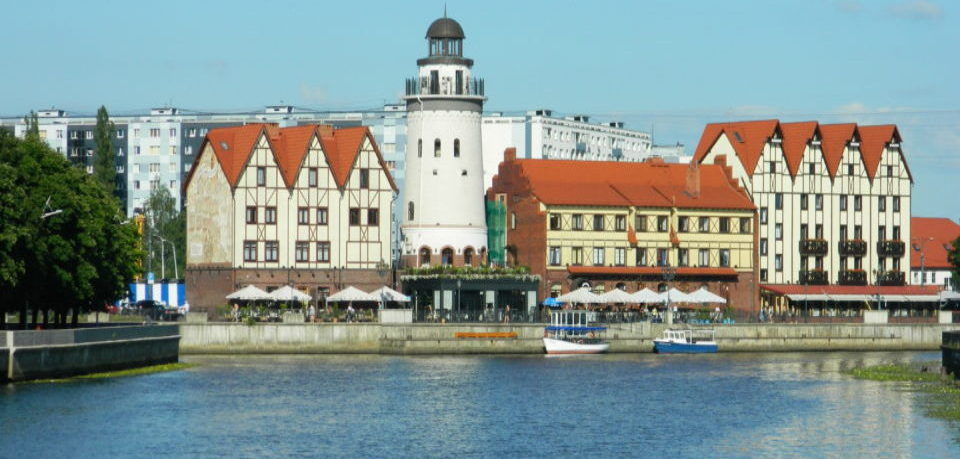
If you haven’t the foggiest where the following photos were taken, then you evidently haven’t read my post on Königsberg Cathedral. The down-to-earth views are photographed on a very cold, snowy evening from the side of Honey Moon Bridge, which is the bridge that connects Kneiphof (Königsberg) with Kant Island (Kaliningrad) to the Fishing Village. The other snapshots offer a grandstand view out and over the sublime expanse of the cathedral’s rooftop, with its distinctive decorative cupola-shaped knop and skyline-commanding mast.
The streets of Kaliningrad
Self-explanatory really: street scenes of snowbound Kaliningrad. If you’ve never clapped eyes before on a photo-posing historic fire hydrant, you have now. If it could operate a smartphone, I’m sure it would take a selfie – or perhaps it has too much pride.
Youth Park snowed under
Kaliningrad’s Youth Park is usually teeming with life, but a few days ago, when these photos were taken, it was a snow-inhabited ghost town. Apart from snow-shovelling men, nothing else was working. The indoor skating rink was open. A great place to be on a cold and icy day!
Sledging (or should that be doughnutting) in Central Park, Kaliningrad
Just before the big thaw set in, we set off to Kaliningrad’s Central Park, which at first sight may appear flat, but at the furthermost end, that’s the one where you don’t come in through the main gate, is characterised by a pronounced declivity – let’s say ‘slope’.
The Marilyn Monroe of curves, the landscape’s flattering figure makes it the perfect place to position yourself and slide off into the stream below – if, of course, you are not too careful. We were.
I stationed myself at the base of the sledge-run and arrested the first descent in such a way that it almost took my arm off. This taught me that the best method of halting the sledge was to stoop down with hands outstretched as if I were a wicket keeper, which I rarely was, because second to football, I hated cricket; yet, had I been more compliant, I might have been correctly informed that a decrease in speed could be best effected by the pilot of the speeding snowcraft using their heels as brakes. These modern doughnut-shaped things are mighty fast on snow, albeit a little less dignified than their more conventional counterparts.
Winter in Kaliningrad can be both harsh and beautiful
In winter, much of Central Park, like the trees that occupy it, lies dormant. But after a game of snowballs and lying in the snow, you really need something to pep you up. I have generally found that in winter at least one of Central Park’s refreshment kiosks debunks shutdown and that snacks, teas, coffees and even ice creams are still available for the cold and brave.
Catering for those whose resuscitation requirements are rather more sophisticated, I was pleased to learn that on the day in question – the question being, whatever was I doing standing around in the snow? – The winter-friendly kiosk was adult enough to provide mulled wine.
At four quid a pop, you don’t get pop, but you do get a very tasty, very warming and satisfactorily large helping of a put-colour-back-in-your-cheeks beverage. Just the job for a man with frozen feet and his doughnut-stopping, beer-raising arm having narrowly escaped dislocation.
Essential survival garments for cold weather in Kaliningrad
Mick Hart’s 2025: a nostalgic review in photographs
30 January 2026 – 2025 that was the year that was: UK and Kaliningrad
As the photographs immediately below illustrate, Kaliningrad has been and is experiencing a real winter this year. Snow fell on cue, a week or so before the New Year celebrations, and its festive debut at this time was very much appreciated. Three weeks into the New Year, however, and like that ‘long time, no see’ distant relative, who, out of the goodness of your foolish heart, you invited to stay for the Yuletide season, snow, ice and formidable temperatures hovering somewhere between minus ten and minus 14 are beginning to overstay their welcome.
With spring and summer still out of sight, one way of looking forward to more hospitable climes is to look backwards. Hiding in the house is, I think, a lot less disagreeable than struggling into heavy boots, thermal coats, hats and gloves and braving the great outdoors. If I wanted to be a snowman, I would never defrost my heart. Moreover, shutting the door on the outside world provides the excuse and opportunity for stepping inside your computer and doing a bit of digital spring cleaning ahead of the leaves and buds returning to the trees.
I don’t know about you, although I’ve heard what others say, but both my smartarse phone and laptop are like pictures at an exhibition after a hurricane has gatecrashed.
In days of old our forebears seemed to have been smitten by the optical difficulty in seeing the wood for the trees; today, in snappy la-la land, the wood has become the photograph and the trees a forest of images forever growing more expansive across the finite landscape of digital storage.
Like you, I can think of better things to do whilst whiling away my time indoors, but computers and digital storage systems, like overburdened, unkempt woodland, need to be attended to, lovingly tidied up and judiciously pruned back.
The estate managers among you will appreciate what I say, when I do say that there’s a lot to be said for ridding oneself of dead wood (not to mention fallen trees), for rolling up one’s sleeves and trousers, and with knotted hanky on your head in lieu of the summer to come, buckling down to some good old-fashioned lopping, chopping and admin work.
In practising what I preach, whilst waiting for the snow to melt, I have sifted, sorted, catalogued, carefully reassigned and refiled chronologically a prodigious number of scattered images; a making-me-smug endeavour, enabling me to extrapolate those which feature in this post; images which, in my opinion, open a retrospective window on the nature of my personal world in 2025.
Kaliningrad, January 2025
2025 that was the year that was: UK and Kaliningrad
As you can see, January 2025 in Kaliningrad was not much different than January 2026, except that in 2026 the temperatures have been hovering around minus 8 degrees and minus 14 degrees. It was not quite that cold back in 2025. At least not cold enough to prevent one from indulging in the fully explainable practice of falling backwards into the snow. Something for you to try sometime. And no, that’s not me dressed as a woman.
As spring approached in 2025, we took the opportunity to indulge our philosophical/mythological side by visiting Ponart Brewery’s Creation of the World Exhibition, after which, with no excuse intended, we side-stepped into the Art Depot Bar , which is part and parcel of the Ponart Brewery complex. Here, you can enjoy the historical ambience of one of the brewery’s original beer cellars and have your beer delivered to you in the trucks of a model train.
Back in the UK, my Gothic alter image was inspired by a susceptible reaction to the living and studying conditions in which, I am grateful to say, I entrancingly immersed myself:
“Once upon a midnight dreary, while I pondered, weak and weary, Over many a quaint and curious volume of forgotten lore …” – Edgar Allan Poe
Such volumes of ‘forgotten lore’ were indeed forthcoming, complete with ink inscriptions, naming the person or persons to whom each book belonged, those who had lived out their mortal sentence in the early 20th, late 19th and even 18th centuries.
It was still officially or unofficially winter, and though not so excessively cold that it could hold a candle to Kaliningrad’s temperatures, the UK’s outrageously high utility costs made, and continue to make, candle-burning the second option to staying in bed until spring – which is not that far away; just a couple of paragraphs down.
The only way to keep warm in Britain in these troubled times is to rail at those wrongly elected who have all but destroyed our homeland, some by incompetence, some by design, but all by disavowal of the suicidal part they have played in orchestrating the migrant invasion.
Into spring we go, where it’s time once again to dust off one’s antiques. In the early 20th century, a celebrated chat-up line, at least on the stage of the music hall, was, “Would you like to come home and see my etchings?” but in the twilight years of one’s spent youth, or in my case misspent youth, “Would you like to come home and help me to polish my antiques?” seems somehow more appropriate, if admittedly rather tawdry when paired with the grace of early spring.
With the buds returning to the trees and it being warm enough to escape the inclement weather of one’s sparsely heated house, it was away we went to conduct business of a sort that I wont bore you with, stopping off on one’s return at the atmospheric Brampton Mill.
At the curiously named ‘The Hill’, a public house in Wollaston, where they serve, I don’t mind saying, a fine and revolving array of ales, the night scene outside the pub was hauntingly English Gothic. Yet, nearby Rushden by night is infinitely more unnerving; come to think of it, not only by night. Take a drive down Rushden High Street (prudently with your doors and windows locked!) and let me know what you think. The theme of Gothicism and antiques persisted as long as spring existed and followed us into the warmth of summer.
Summer (Ah, sun and warmth – sometimes …) saw us set sail in 2025 on a monumental, intriguing and adventurous voyage of discovery to Cornwall and North Devon, calling on the way, and whilst we tarried there, at, among other places, Tintagel, Port Isaac (Portwenn of Doc Martin fame), Boscastle, Padstow, and, following in the footsteps of her much-devoted fans, the Agatha Christie trail; taking in the Art Deco and earlier historic wonders of Burgh Island and then onto Christie’s adored 18th-century summer home, the reclusive-seclusive Greenway House.
2025 that was the year that was: UK and Kaliningrad
Summer in Kaliningrad found me undertaking grossly inadvisable experiments of a selfie kind, as seen here in the photo, which was snapped out front of Kaliningrad’s vast and intricate Baroque fantasy, the multiple entertainment and bar complex, Residence of Kings. Like the historic Blue Anchor in London’s Southwark, bars sufficient there are inside this gargantuan establishment not to venture outside if a ‘pub crawl’ is what you’re after.
On a return trip to the Art Depot Bar (Ponart Brewery), Olga and I went bananas. Let me rephrase that: on this occasion, she elected to join me. We also did a spot of amber dredging along the Baltic beach and shabby-chiced the entrance hall to arty-fart the dacha. Later, we solicited the assistance of real artists to illustrate the outside paint job.
Arguably the best month of the year for me – the glorious and sadly soft transition from extraversion to mellow introspectiveness. Having said that, the famous Königsberg monument depicted below, as captured in September, is not bull-orientated, so you haven’t discovered a worthy joke there. Neither will it assist you should your first name be Bill and your last name Cody. The famous bronze creatures locking horns on Prospekt Mira, opposite the Regional Scientific Library, are, in fact, Bisons, sculpted by August Gaul in 1910 and valued as well as intrinsically for having survived the city’s destruction at the close of World War II.
The chap standing there with an anchor in his hand and pointing at me as if he is trying to tell me something is, as if you didn’t know, the one and only Peter the Great.
Mick ‘the very rarely even close to great’ polishes his tree-hugging skills, which he does in one of the photographs here, to a very grateful tree, which has very little else to do but stand the test of time on a hilltop deep in the North Beds countryside. Staying with the Bedford theme, there’s also a picture above of the state-of-the-art Gothic revivalist De Parry’s Avenue D’Parry’s hotel, framed within the gathering hues of autumn’s transitionary season.
Coincident with the autumn school term, when, presumably, there would be less family convergence on Poland’s Sopot resort, we stole away for a five-day break. This was my second visit to Sopot, in which I discovered architectural gems Art Nouveau in nature and, wouldn’t you just know it, gems of a different but not indifferent kind to a man of my discernment: ‘Bar, Bar, Black Sheep’. For some people it was sea and sand, and how does that expression go, ‘like a kid in a sweet shop’.
This time of year also found Mick Hart giving an impromptu address to Kaliningrad’s lucky ProSchool students.
Late November ushers in, with a defining sublimity that never grows old, the dying shades of verdure, taking a last, impressive bow before, come the final encore, they leave the seasonal stage, handing over the act to winter. There are more deep, dense, poetically invocative and graduated praiseworthy colours in a typical autumnal scene than you and I could shake a stick at, and as November plays itself out, less on high upon the sticks than are woven at ground level into a semblant natural Axminster, the wonderful reams of golden yellows, astonishments of auburns and the artists’ palettes of burnished browns waft us gently away on a seasonal magic carpet into the swan-song realm of Christmas and its boisterous prelude to the end of the year.
What goes around comes around, and here we are, back again in winter.
Kaliningrad’s Svetlogorsk, its premiere Baltic resort, which, in summer, is a hubble bubble of touristic jostling bustle, with streets teeming, beaches embattled and popular bars and restaurants bursting at the seams, is, in the earliest throes of winter, an altogether different, essentially meaning quieter, place; for, as many of you likely know, out-of-season resorts, when experienced as a solitary cloud might enjoy its singular company, are like the recuperative restoration, the danger past in the aftermath, that follows in the wake of a raging distemper akin to flu.
Thank Heaven! the crisis The danger is past, And the lingering illness Is over at last And the fever called “Living” Is conquered at last – Edgar Allan Poe
Aw, come on, Edgar, old mate, I’m with you totally on this kind of sentiment in its relation to mortal existence, but it’s a bit strong in this context, isn’t it!
Excuse him, if you will; he’s rather given over, you know, to lifelong fits of self-indulgence in the addictive vagaries of bleak melancholia. Let’s merely fall back on words and phrases that do to seasides out of season no conventional harm, such as ‘deserted’, ‘quiet’ and ‘reflectively peaceful’.
One thing that covers all seasons, and has been for me for the past 54 years, is the daily writing of a diary. Not content, however, by exhausting the present with thoughts of the past, in 2025, I stepped up the arduous process of scanning in, and thus digitally converting, 40 years of handwritten copy. Bless him, that’s what I say! It keeps him out of mischief – “And not before time!” say those who know him!
Hello Spring: <a href="/ru/”https://www.freepik.com/free-vector/fancy-lines-dots-hello-spring-lettering_6992212.htm/#fromView=search&page=1&position=16&uuid=42aab2a9-9c0f-4fa6-83d7-c57dc3e4d659&query=spring+antique+typographic+image”">Image by freepik</a>
Hello Summer: <a href="/ru/”https://www.freepik.com/free-vector/summer-background-design_1084447.htm/#fromView=search&page=1&position=42&uuid=e75660f9-e7ca-4ad9-b222-fcc3664d6f3d&query=Hello+Summer+antique+typographic+image”">Image by mariia_fr on Freepik</a>
Hello Autumn: <a href="/ru/”https://www.freepik.com/free-vector/elegant-hello-autumn-lettering-composition_2659814.htm/#fromView=search&page=1&position=16&uuid=781c1b5d-05f1-46f2-8e85-c0dbe722dc9d&query=Autumn+antique+typographic+image”">Image by freepik</a>
Hello Winter: <a href="/ru/”https://www.freepik.com/free-vector/hello-winter-lettering-with-leaves_10612573.htm/#fromView=search&page=1&position=39&uuid=056e05c8-7285-4de1-b3c5-3cdbeaee5a94&query=Hello+winter+antique+typography”">Image by freepik</a>
Book with glasses: <a href="/ru/”https://www.freepik.com/free-photo/top-view-book-flower-glasses_4881633.htm”/">Image by freepik</a>
Strangely enough, there is nothing in my year 2000 diary regarding our first glimpse of Kaliningrad by train. Later, in 2001, when I returned to Kaliningrad via Vilnius, I did refer to the maze of concrete jutting out and across the horizon which asserted itself as our train drew near and the daunting prospect that this presented compared to the quaint medieval streets of the city from which we had departed, and which now was a long way behind us.
This omission in my 2000 diary may have been due to the fact that the scene on my arrival had such a potent effect. For we had passed through the exit of Kaliningrad station onto a Spielberg film set.
Outside the door was snow ~ a wide plateau of it. It was still snowing heavily and fall upon fall had covered melted snow that had since turned to ice. Directly outside the railway station’s door stood two old army trucks, both open backed. From one spilled a group of young Russian soldiers, the other was being filled with snow by a second group of soldiers attempting to clear a path through the drifts. The engines of the trucks were running, and the strong smell of diesel fumes wafted across the wasteland. The shovel blades beat an erratic tattoo, thumping against the snow, cracking at the ice and scraping across the concrete. Spielberg’s costume department had spared no expense. Each soldier was garbed in smart regulation great coat, thick woollen trousers, high canvas boots and those distinctive furry Russian hats with flaps (ushankas).
Nearby, two or three comrades (for that is what they looked like) squashed inside big heavy coats, black peaked caps with folding side flaps stuck upon their heads, all bewhiskered and dragging on fags, huddled around a big old oil drum that had been requisitioned as a source of warmth. Another of these makeshift braziers burned a few feet away. Red and orange flames funnelled from their tops together with bright little firework sparks, which danced, crackled and exploded loudly in the frozen atmosphere.
In front of us, across the expanse of white, stood a three or four storey procession of grey concrete flats. This was not Kaliningrad 2022, so our view was virtually unimpeded, the only large object being the statue of Kalinin, his arm and hand outstretched as if commanding the heavens to stop dropping snow. Behind him, along the top of the not-so venerable buildings, giant metal letters spread out along parallel bars, the imposing Cyrillic script traversing the entire block in a wonderful piece of letter spacing. At one end sat a large Soviet star, at the other, I was thrilled to observe, a gigantic hammer and sickle. And then it actually struck me: “Oh dear,” I thought, “we’re here!”
Three big, old, Mercs, battered and rusting, with little
white ‘Taxi’ signs strapped to their roof-racks, stood idly by, waiting for
instructions.
The little band of
men, which I had observed earlier, were taxi drivers.
Don’t let them know you are British!
Olga whispered to me that she was off to negotiate a price
with them. She instructed Joss and I to stand away and not to speak, warning us
that should they, the taxi drivers, get
the slightest inclination that we were foreigners the taxi fare would double.
Five minutes of negotiating later, a fare had been agreed, and
we were off. But where to? The plan was to ferry us off to the nearby (about 44
kilometres away) coastal resort of Svetlogorsk. Olga was very conscious of the
rundown condition of Kaliningrad, and she had made plans for us to stay in what
was then the only 4-star hotel in the region, which was Svletogorsk’s Hotel
Rus. Nothing else would be good enough for two well-to-do Englishmen like us!
The journey by taxi was an interesting one. The big old
Merc, coughed, belched and spluttered almost as much as its driver did. We
roared through the snowbound streets of the city, a combination of abject fear
and snow working in Olga’s favour, as we were much to alarmed to take anything
in and even had we wanted to all we could see was snow.
Out on the open road the conditions were worse, but it was
OK because no one had told our taxi driver. For a while, whilst we were stuck
behind a truck with a snow blade on the front, our confidence returned, but it
soon took a hit, for in overtaking the truck, as the driver pressed his foot
down hard, the car slewed erratically on the snow and ice beneath. From that
moment our knuckles were destined to be as white as the pure-driven. Relentless
snow, drifting snow and an old German road lined on either side with trees ~
big, gnarled trunks perfect for colliding with ~ dismayed the driver not a jot.
On and on we sped, as though Danger had taken a holiday.
To be fair, give or take one or two slippery moments of
panic, our chain-smoking driver seemed to know what he was doing, and I do
believe that had not the road surface changed beneath the wheels without us realising,
we could have boasted later that by the time we arrived in Svetlogorsk the
journey had been a piece of cake. The cake collapsed, however, when tarmac
changed to cobbles. We were not endangered in any way, well no more than we had
been, but the sudden rumbling and jolting gave us the right old KGBs. In
hindsight, I actually believe that it brought back nerves to our nerveless driver,
for he slammed on the anchors a little too hard, swinging the car to the right
and then back again to the left before bringing the vehicle under control.
“Ah, we’ve arrived in Svletogorsk,” Olga announced.
Svetlogorsk by night
At this time (before
Svetlogorsk became commercially exploited) it was designated a health resort, a
place where people went to take the air and rehabilitate. This meant that cars could only be taken into
Svetlogorsk if drivers were willing to pay a tariff, the ostensible logic being
that it would reduce the numbers of cars entering Svetlogorsk and by limiting
exhaust emissions keep the atmosphere pure. You know the routine, that nice Mr
Sadiq Khan has done something similar in London, to help with congestion and
massage our lungs ~ shame about our pockets!
Thus, we stopped, and money was handed over to someone
sitting in a little concrete building at the side of a pull-in just off the
road. Boy was it good to have stopped! This must be what they meant when they
said Svletogorsk was good for your health!
Dusk had begun to fall as we continued our journey. We were now travelling through the streets of Svetlogorsk. Once again, with the snow still falling and much of the little coastal resort enveloped by it, and with deterioriating light and travel-weary minds, we could not make much out. The streets in the town itself were very poorly lit, and what light there was peeped out timidly, but cosily from little orange-hued windows in houses set back from the road tucked within pine-tree glades. Indeed, no sooner were we in the town than we seemed to be travelling out of it. I distinctly remember a long, dark road lit by one lonely streetlamp and, shortly after that, a sensor-activated light coming on as we approached a crossroads or junction. At this point we swung left, the lights of the houses on either side comprising the only illumination, apart from our headlights, of course.
The Hotel Rus, Svetlogorsk
We had travelled along this road but a short distance when darkness was dispelled by two floodlights pointing at and exposing what appeared to be a steep, broad ski slope from which multiple shards of light stabbed out through the whirling snow into the night sky. It was, in fact, Svletogorsk’s, and indeed the region’s, much-celebrated Hotel Rus.
As the taxi drew to a halt ~ a happy halt as far as we were concerned ~ a better view of the Rus was afforded. We were parked adjacent the gable end of the building. It was a tall perpendicular invested with large windows. The ski slope was its roof. In fact, that might have been a better name, Hotel Roof, because there was far more roof than walls. Roof, walls, what did we care! All we wanted to do was wave farewell to our driver and say hello to our 4-star luxury.