24 February 2026 – Winter in Kaliningrad can be both harsh and beautiful
No sooner had I posted Snow in Kaliningrad than the first signs of a thaw occurred. At 4.30am on the morning of the 22nd February 2026, my long-term insomnia allowed me to listen with immeasurable clarity to the roar of glaciers leaving our rooftop and the commensurable and sporadic sounds of smaller pieces of ice, mimicking handfuls of gravel, sliding and rattling stridently off terracotta and metal surfaces as they literally lost their grip.
Fate’s forceful intervention, either betraying the promise of a snowbound world or working with Nature to release water from frozen petrification, are interpretations only to be mediated by your personal understanding of the benign and malignant forces that constitute our natural/unnatural world. Are postulations of a beautiful Nature all that they are cracked up to be, or is Nature merely an aberration, a mistake, which, including us, is nothing more than a virus more invasive to planet Earth than a dinghy full of migrants powered by liberal-leftism on its way to England? In the stillness of 4:30, it all seems so peculiar.
Winter in Kaliningrad can be both harsh and beautiful
Snow may have brought the Old West quick draw to Kaliningradians armed with shovels and across its frozen tundra made otherwise manly men mince, but the flip side to the challenge is, or has been, many a pretty and picturesque scene, with white landscapes, crystalline trees, a wonderland playground for children, including for those that have never grown up, and, once you’ve contended with frozen toes and mastered the art of your balancing act, an all-pervading magical atmosphere.
Herewith is a handful of images from the cards that winter has so far dealt us. The cards for March are yet to be played; thus, all bets for a no-snow spring are off for a few days more.
It looks cold, and it is!
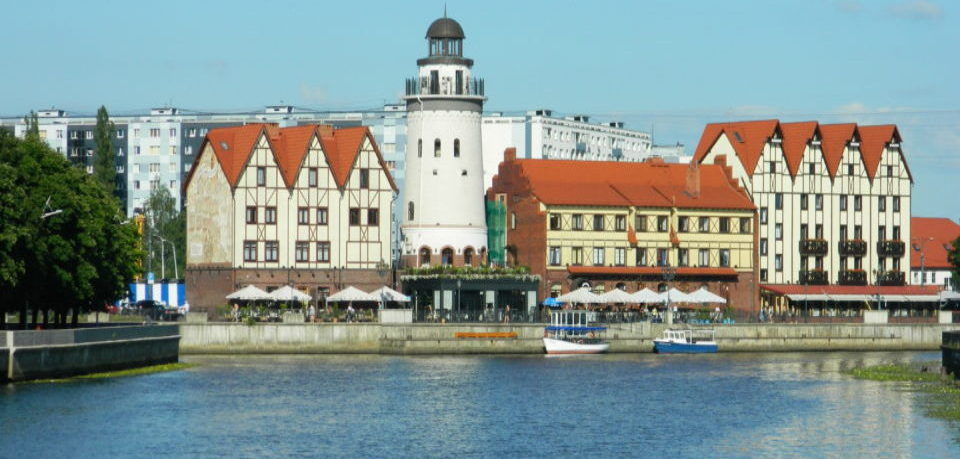
If you haven’t the foggiest where the following photos were taken, then you evidently haven’t read my post on Königsberg Cathedral. The down-to-earth views are photographed on a very cold, snowy evening from the side of Honey Moon Bridge, which is the bridge that connects Kneiphof (Königsberg) with Kant Island (Kaliningrad) to the Fishing Village. The other snapshots offer a grandstand view out and over the sublime expanse of the cathedral’s rooftop, with its distinctive decorative cupola-shaped knop and skyline-commanding mast.
The streets of Kaliningrad
Self-explanatory really: street scenes of snowbound Kaliningrad. If you’ve never clapped eyes before on a photo-posing historic fire hydrant, you have now. If it could operate a smartphone, I’m sure it would take a selfie – or perhaps it has too much pride.
Youth Park snowed under
Kaliningrad’s Youth Park is usually teeming with life, but a few days ago, when these photos were taken, it was a snow-inhabited ghost town. Apart from snow-shovelling men, nothing else was working. The indoor skating rink was open. A great place to be on a cold and icy day!
Sledging (or should that be doughnutting) in Central Park, Kaliningrad
Just before the big thaw set in, we set off to Kaliningrad’s Central Park, which at first sight may appear flat, but at the furthermost end, that’s the one where you don’t come in through the main gate, is characterised by a pronounced declivity – let’s say ‘slope’.
The Marilyn Monroe of curves, the landscape’s flattering figure makes it the perfect place to position yourself and slide off into the stream below – if, of course, you are not too careful. We were.
I stationed myself at the base of the sledge-run and arrested the first descent in such a way that it almost took my arm off. This taught me that the best method of halting the sledge was to stoop down with hands outstretched as if I were a wicket keeper, which I rarely was, because second to football, I hated cricket; yet, had I been more compliant, I might have been correctly informed that a decrease in speed could be best effected by the pilot of the speeding snowcraft using their heels as brakes. These modern doughnut-shaped things are mighty fast on snow, albeit a little less dignified than their more conventional counterparts.
Winter in Kaliningrad can be both harsh and beautiful
In winter, much of Central Park, like the trees that occupy it, lies dormant. But after a game of snowballs and lying in the snow, you really need something to pep you up. I have generally found that in winter at least one of Central Park’s refreshment kiosks debunks shutdown and that snacks, teas, coffees and even ice creams are still available for the cold and brave.
Catering for those whose resuscitation requirements are rather more sophisticated, I was pleased to learn that on the day in question – the question being, whatever was I doing standing around in the snow? – The winter-friendly kiosk was adult enough to provide mulled wine.
At four quid a pop, you don’t get pop, but you do get a very tasty, very warming and satisfactorily large helping of a put-colour-back-in-your-cheeks beverage. Just the job for a man with frozen feet and his doughnut-stopping, beer-raising arm having narrowly escaped dislocation.
Essential survival garments for cold weather in Kaliningrad
21 Feb 2026 – Snow in Kaliningrad: Great Shovels and Icicles!
Brrr! That’s something that we all understand in England. At 14 degrees above outside, it’s brrr in most English houses, not simply because we are not used to the cold, but from the shiver that passes down our spines and out through the toots of our toes when we have, in the last resort, to switch on the central heating: Better the shiver we know and must live with than the aaargh that comes with the gas bill.
Fortunately for the UK, however, whilst we really should open the coal mines and pile that lovely black stuff into our stoves and onto our fires without a thought of tomorrow, global warming has come to our rescue. Temperatures in England – not the ones that are rising under every true-born Englishman’s collar, owing to the government’s sponsored migrant invasion – are typically, if not perversely, generally low in summer (you’d think that would drive the blighters away, would you not?) but not so low in winter.
Passing over pointless places of which the UK is composed, and, focusing solely on the one and only UK country that counts, that being obviously England, we will state in connection with our winters that it’s just as well that things are as they are; for given the slightest touch of ice and the most meagre sprinkle of snow, the government and the media go immediately into national crisis overdrive – ‘Help, there is snow on the road!’ – when all we should be concerned about at any time of the year are migrants, muggers and terrorists and with signing up to reasonable campaigns such as banning the hoody from our streets along with the types that wear them. Not yet put your name to this? Then do so straightaway!
Snow in Kaliningrad: Great Shovels and Icicles!
It pleases me to confirm that in Kaliningrad this year, we have experienced, and are experiencing, what I would call a real winter. For several weeks at least, temperatures have been hovering between -9 and -14, dropping sometimes dramatically to -24.
There are certain sounds associated with real Kaliningrad winters, which are alien to their unreal England counterparts, and of this we can honestly say vice versa. For example, mild winters in England are apt to bring forth incredulous cries of, “What the f…?! I can’t believe this gas bill can be right! ”, whereas in Kaliningrad, and I imagine most everywhere else in Russia, when the temperature rises slightly, one is wont to hear, especially in one’s attic, a terrifying and mighty roar, like the tortured grate of metal on metal, which could easily be mistaken for the frightening din of Casey Jones’ train hurtling out of control down the MF of railway gradients (A conversation in Islington: “Mummy, who the [beep] is Casey Jones?” “Hush, now, dear, put out the light and try to go to sleep. Don’t read that terrible stuff; it is the workings of the fetid mind of one of those naughty men The Guardinistan calls a populist; besides, even with the help of daddy’s child support benefit and contributions from your many uncles, and with I working every hour that the tax god sends, we cannot pay the electric bill, so please don’t give me cause to wonder why I am blessed with being a mother, particularly at this stressful time, and put that light out, now!”), or, for those, like the child in Islington, who have never heard of Casey or his Cannonball Express or owned a pair of stoker’s gauntlets, a substantially different comparison, but one I am sure you will all agree lacks no less of the colourful, is that of the sandpaper sound emitted by a big fat woman hauled along on a sledge, albeit not very gracefully, over freshly gritted ice or across a piece of pavement where the snow has mischievously melted.
Thankfully, this ginormous roar emanates not from either one of these two most obvious sources or even, as might be supposed, from the jaws of a passing lion. They are broadcast by the peremptory movement of prodigious drifts of snow and underlying sheets of ice taking their leave from sloping rooftops. This is why, as you saunter around Kaliningrad, you will observe on many an apex roof protrusive wire frames put there for the strategic purpose of cunningly arresting the wanton and wayward slip of snow, the ultimate objective being to prevent its rapid downward motion so as to mitigate the risk of it plummeting onto your head and doing to you, as a result, without recourse to expletives, what your maiden aunt might coyly describe as ‘a right old mischief, make no mistake!’.
We desperately need something like this – wire frames, not aunties – positioned just a little below the surface of the water and preferably fitted with very sharp spikes, invisibly laid length and breadth across the English Channel. Apart from the entertainment value accruing from the implementation of such a delightful and curious contraption, it would, methinks, provide some budding entrepreneur with the opportunity of making a killing (language of the stock market) on the crowded shores of France, before the inevitable killings are made (language on the streets) in England, by selling to the former country’s lucrative and ever-expanding inflatable dinghy industry thousands of puncture repair outfits, which much of Britain would surely sponsor, as the last thing that its people want is to stop the boats rolling in and prove Elon Musk’s predictions wrong that in them, along with the migrants, a civil war is coming.
The other tell-tale sound of winter heard with fascinating regularity in the attic of your former Königsberg house is the one that goes scrape, scrape, scrape, wafting upwards in the chill of the night from the snow-challenged ground below. This is the winter serenade of many plastic-bladed snow shovels, wielded by men in thick woolly hats, shovelling snow off paths, both in private gardens and on public streets, as though should their husbands fail to do it when they are expected to, then their wives might form the opinion that there is something seasonally wrong with them.
Snow in Kaliningrad is a shoveller’s paradise
Shovelling snow in Kaliningrad is rather more than just a must-do occupation during the winter months; it is, most vitally, when push comes to shove, an intensely competitive sport intended to determine who can do it more frequently and with the most success.
Hailing from a country that is largely less white than it should be, by which, of course, I mean snowless England, where all you have to do is sneeze from any part of the body and the little snow that there is gets blown away, I confess that I am not, by culture and also by lack of experience, particularly good at shovelling, and being rather competitive, or so I have been told and more often than not accused, I tend to subscribe to the mantra of letting sleeping snow lie, preferring rather to trudge across it, even should it cover my knees, than spend a proverbial month of Sundays digging away at snowdrifts as if they never have any intention of disappearing on their own accord.
However, like so many things in life, once bitten, forever smitten. Public Health Warning: Shovelling snow can prove addictive!
A word to the wise, therefore! Before you take to your shovel, it is as well to glance at the nearest rooftop to ascertain the amount of snow and estimate its adherence, prefacing this wise precaution with yet another you may not have thought of, which is that before you start to wield your shovel, stick a tin helmet on your head, or alternatively a Russian castroola (that’s saucepan in your lingo). Once you get beyond the question, “What am I doing this shovelling for?”, which is quickly followed by “Is it necessary?”, and which runs to the conclusion that “I suppose I must. I’ve bought a snow shovel”, you really can get into it, both the saucepan and the shovelling; and, after a while, its all systems go and, dare I say it, really quite fun.
Snow in Kaliningrad paves the way for new experiences
I find that the pleasure of shovelling snow is intensified considerably if, by using the imagination that God saw fit to give you, you trundle forcefully through the snow, making a brr, brr, brr sound as you go. Since it is so cold, so very cold, at -24, you will probably find these sounds occur in the absence of conscious effort, but rattling teeth and knocking knees, though they add tremendously to the experience, are never nearly quite so satisfying as going ‘brr, brr, brr’, when the object of the exercise is to pretend you are a snow plough cutting along the highways and byways in blizzard-blown Siberia.
Adopting this clever fantasy (clever because it stops you asking, ‘What am I doing this for?’) inspired the efforts of a certain man, who uncannily looked a little like me, to such a devoted extent that he found it hard to stop, which in hindsight was rather unfortunate, because having shovelled a surfeit of snow from the pavement outside on the street, quite by accident or malevolent fate, overnight the temperature rose, causing some of the snow to melt and that which was travelling down to earth from an inconsiderate universe to turn whilst on its long descent partially into icy water before coming to rest on terra firma, thus threatening to transform his (this man who looked a little like me) nice, neat, snow-clean path into a local skating rink.
This unforeseen development had the effect of persuading me, I thought not injudiciously, to desist from looking out of the window through which the altruist’s handy work was so demonstrably evident. There were other windows that one could look out of without incurring a sense of guilt, advocating remorse or entertaining rum predictions of unspeakable turns of events, but possibly not with so much success of not inviting jealousy, as from the window I had chosen I could only admire and gasp out loud at how big the neighbour’s had become. Sagely, I said to myself, against the lamentable backdrop of someone vigorously shovelling, ‘Should Kaliningrad hold a competition to see whose is the biggest, it would have to be our neighbour’s.’ I mean, just look at the size of that one! What a beauty! What a monster! What a magnificent icicle to behold!
It saddened me to think that when soon the shovelling shall be heard no more, this prize-winning shard of ice will melt and shrivel away no different to us and to nothing, and all that will be left of winter, as with every seasonal change in life, will be an echo of the past, marked by the eerie silence of redundant snowmen’s shovels, since disbanded in garden sheds, their handles and blades covered in cobwebs, and in their forced retirement singing, humming and sighing gently of shovelling feats and duty done.
But take heart, those that do, compared to those that don’t or rather petulantly won’t! Spring is not as distant as the snow would have you believe. No sooner will your magic shovels be sadly stashed away than the long green grass will rise on your lawns, over which you will feel the duty-bound need to wave and waggle your strimmers.
And to think that there are philosophers out there who waste their entire existence deliberating and discoursing on the purpose and meaning of life. Give them a shovel, I say, and put them to something needfully useful!
A blog post for those who delight in quests for meaning with some compensatory tilts towards coincidence and the intervention of luck
12 February 2026 – Königsberg Cathedral, Kaliningrad: a story of survival
It did not dawn upon me until recently, although it had been percolating around and around in my subconscious for yonks, that here am I dwelling in old Königsberg and to date have failed to write a post devoted to its wonderful cathedral, which only happens to be Kaliningrad’s most visited and popular tourist attraction and the last remaining marker of what is often described historically as Königsberg’s spiritual and cultural centre. I suppose that you will tut that I have been too busy taking potshots at the antics of the liberal left and writing curated highbrow on such topics as tin buckets and badgers dressed in underpants, but I confess that my penance is overdue, and so it is with humbled contriteness that I take you by the hand and lead you to the one and only Königsberg Cathedral.
Königsberg Cathedral, Kaliningrad: a story of survival
The most profound, iconic and spectacular testimony to Kaliningrad once being Königsberg is the continued presence of Königsberg Cathedral. Contrary to appearances, the cathedral’s spiritual connections did not throw a shield around it during WWII. It was not singled out by divine intervention for survivalist dispensation. Although, the fact that it was gutted and that its outer walls remained intact, thus preserving a shell of its former self, could be offered up as evidence of how wrong I am in this assumption. For had the walls not remained, it is doubtful, if not impossible, that later, much later in fact, the remainder of this poignant tribute to the glory that was Königsberg would have become its advocate for conservation and regeneration.
I haven’t the vaguest idea whether you are asking how and why the cathedral escaped demolition from the postwar Soviet dictate to eradicate all things German. But just in case you are, the answer to such a hypothetical question is that Königsberg Cathedral owes a debt for its salvation to a coalition of culturally minded people and indulgent local history groups, felicitously supported by Moscow’s Ministry of Culture.
It is said that in the drive to expunge all things German, Kaliningrad’s local authorities actively sought to demolish the cathedral, as indeed became the fate of Königsberg Castle, but that a handful of heritage-conscious historians, emphasising the building’s historical value, countered with the argument that the building was worthy of reprieve. There can be no doubt at all that the Ministry of Culture’s backing must have applied crucial leverage for the preservationist’s cause. But help was also forthcoming from the most unlikely of sources, that of the city’s most famous inhabitant the German philosopher Kant, whose tomb, like the cathedral to which it is attached, had survived the aerial bombing and Soviet siege of Königsberg.
Ironically Kant, who was a lifelong resident of Königsberg, who hardly ever left the city that he loved, but who, in later life, it is said, tended to visit the cathedral less and less, played an indispensable part in saving the stricken building from the swoop of the demolition ball and alteration by dynamite.
Kant to the rescue
During the Soviet era, particularly in the immediate aftermath of WWII, all distinguished and distinguishing German buildings which in Königsberg had survived destruction were looked upon as offending symbols of a militaristic nature and objectionable reminders of Fascistic ideology.
However, to have laid waste to Königsberg Cathedral would have entailed the simultaneous destruction of Kant’s tomb, which was and still is located at the cathedral’s northeast corner. Fortunately for both, Soviet ideology regarded Kant a progressive thinker whose work had greatly influenced the philosophical tenets of Soviet-approved Hegel and Marx.
The preservation-destruction debate continued unabated, but before a decision could be taken, Sovietism collapsed, ushering in a bold new era. Perestroika had arrived: It wasa time of possibilities for what before may have seemed impossible. And it was during this transitionary period, in the early 1990s, that the green light was finally given and restorative work commenced on raising the wounded cathedral out from under its wartime ruins.
Konigsberg Cathedral, Kaliningrad: a story of survival
Harking from England, whenever I think ‘cathedrals’, I visualise, from experience, massive, conspicuous structures predominantly constructed of carved grey stone. The red-brick Gothic style, the category in which Königsberg Cathedral fits, is incongruous with this vision. Such buildings are predominantly Germanic and also Baltic in origin, erected in red brick rather than in stone due to a regional lack of the latter for use as a source of building material.
Historic buildings of note, particularly those initiated to fulfil religious purposes, are virtually never not preceded by an earlier version, and Königsberg Cathedral is no exception to this rule.
The forerunner to the red-brick building with which today we are familiar was smaller than its successor. It was made of wood and served the Catholic Church. This comparatively modest place of worship took shape at the end of the thirteenth century and beginning of the fourteenth. In 1322, Johann Clare, the Bishop of Samland, obtained the eastern quarter of Kneiphof Island from the Teutonic Knights. Here, development of the new cathedral is thought to have begun in 1330, with the first cathedral demolished in unison and parts of it removed for incorporation within the newbuild.
The bombing of the cathedral in August 1944 can be viewed as the apotheosis of a long line of setbacks and serious structural mishaps that plagued the building’s construction and threatened its existence from the moment of its debut on Kneiphof Island.
From the very outset, the island’s silt and mud ground presented a contradiction to the successful erection of a structure of the cathedral’s considerable size and weight. Soil had to be brought in from elsewhere and hundreds of poles driven into the earth to stabilise the foundation bed.
Mindful of past Prussian and Lithuanian conflicts, the cathedral, with Johann Clare’s blessing, began to take a formidable shape, with walls constructed in some places up to 3 metres thick. When the Master of the Teutonic Order, Luther von Braunschweig, got wind of this, it quite unsurprisingly fair put the wind up him. Instantly, he halted all construction whilst he attempted to ascertain what it was that Clare was erecting, a cathedral or a fortress, bearing in mind, of course, that the whereabouts of the structure placed it slap bang in the middle of the Teutonic Order’s domain.
For work on the cathedral to recommence, Clare had to sign a document confirming that all defensive elements pertaining to the cathedral’s spec would be dropped forthwith and also guarantee that certain walls of the building would be assembled within parameters that made their defensive role less credible.
It is doubtful that the cathedral would have gone ahead had these concessions not been made, but the making of them introduced serious inherent weakness into some parts of the cathedral’s structure, requiring buttresses and other remedial mechanisms to compensate for the heavy loads imposed by the arches and vaulted ceilings. Although these engineering features eventually lent the cathedral a distinctive look all of its own, they would later prove insufficient in preventing some of the walls from sinking and listing to the south by as much as 50cm.
Due to the unstable nature of the substrate on which the cathedral rested and the inadequate foundation base, by the turn of the seventeenth century cracks had begun to appear in various walls, particularly in relation to the placing of the towers. It was initially believed that the fault lay in the walls themselves, which explains why at the front of the building almost every window has been bricked up.
It took the complete collapse of the arch within the northern nave for the extent of the problem to be realised.
A worse fate awaited the cathedral in 1544. Up until this time, the cathedral’s front elevation possessed a symmetrical grandeur, with towers of equal style and proportion positioned on either side. In the conflagration of 1544, both towers were destroyed. Only one tower was replaced, where its facsimile stands today, on the southern flank of the entrance. Instead of replacing the northern tower, a gable roof was added, with one of a smaller but similar nature in the intervening space where the twin towers once had stood.
Fast forward now to January 1817, the year of a ferocious hurricane, which promptly, impudently, and with blatant disregard for acts amounting to sacrilege, whipped away the cathedral’s roof.
The cathedral’s checkered structural history pursued it through the nineteenth century, during the second half of which substantial soil erosion caused parts of its walls to collapse and associated damage to wreak havoc with other build elements. Enter Richard Dethlefsen, a German architect and monument conservator, who, during the first decade of the 20th century, directed a major engineering project, which included shoring up the cathedral with foundation beams of concrete, stabilised and reinforced with metal tension cables.
Königsberg Cathedral: the destruction of WWII
After all this sterling remedial work, come 1944, along came the RAF, which, on August 26th and 27th of that year, very nearly succeeded in adding the ancient monument to the greater part of Königsberg, which it systemmatically bombed into almost total oblivion. As it was, however, the incendiary devices the RAF dropped, burned the cathedral out, leaving in their wake a gutted, hollow shell.
It is only by comparing photographs of what remained of the great cathedral after that fateful raid and how long it endured as a burnt-out husk with photographs of its present self, or better still by visiting the monument in person, that one can fully appreciate the dedication, time, effort, professional skill and money that have underpinned its restoration.
Within six years, the initial, visible transformation of the cathedral’s shattered exterior was complete. In 1994, a new spire was lifted into place by helicopter; in 1995, a new clock, replicating the earlier one, was added, and between 1996 and 1998, the entire cathedral roof was reconstructed. Six years from the start of the project, Königsberg Cathedral had been reborn!
With major reconstruction work to the outside now completed, the focus then was turned to detailed conservation and restoration. The cathedral’s interior is widely accredited with having undergone restoration to a high standard, the veracity of which can be validated by once again comparing photographs of the wreckage of the building wrought by World War Two with the Cathedral as it appears today.
Among the many fine examples of restoration detail is the cathedrals’ baptismal font. Housed in a small room separated from the main hall by a carved wooden screen, this replica of the destroyed original is deceptively authentic. The atmospheric baptistry, the original of which dated to 1595, also contains two ancient plaques. Other plaques of interest displayed on the interior include two on the southern wall: one devoted to Luther von Braunschweig, the Master of the Teutonic Order; the other to Johann Clare, the Bishop of Samland.
The pièce de résistance of the interior restoration, discounting for the moment the omnipotent presence of what is famed to be one of Europe’s largest and most impressive organs, are faithful copies of Königsberg Cathedral’s tablature and mural monuments – wall-mounted memorials to the passed-on ‘great and good’.
The best examples of reconstructed wall tablets are to be found behind the main hall’s stage in what once was the choir. This chamber is also the burial place of the Prussian nobility as well as masters of the Teutonic Order and figures of royal descent. Not surprisingly, therefore, these devotional monuments contain the full ornate regalia befitting the status of those whom they serve to consecrate, complete with intricate scrollwork, chubby cherubs, a portrait bust or two, the family’s coats of arms and the traditional symbols of death, skulls with bone accompaniments – embodiments of both the material-spiritual worlds readily associated in style and execution with the late Renaissance and Baroque periods.
The most ornate and intricate of these epitaphs are devoted to the last master of the Teutonic Order and Albrecht Hohenzollern Ansbach, the first secular duke of Prussia. His first and second wives are buried in the same chamber, causing cynics among you to say, ‘No escape there then!’
The former choir benefits from the illumination of eight stained-glass windows, bearing the coats of arms of the most influential East Prussian families: Oulenburg, Greben, Don and Lendorf.
Twelve stained glass windows, recreated by Kaliningrad master artists, permit and modulate the ingress of light within the cathedral’s basilica.
Konigsberg Cathedral, Kaliningrad: a story of survival
The cathedral in its modern format plays a multifunctional role. It still serves a liturgical purpose, having two chapels in its west towers, one Lutheran, the other Orthodox, but the main hall of the cathedral is dedicated to organ concerts. Königsberg Cathedral houses one of the largest organs in Europe. The cathedral also contains a museum dedicated to the life and times of one of Königsberg’s most famous residents, the renowned philosopher Immanuel Kant, whose mausoleum, annexed to the cathedral, is an international place of pilgrimage for Kantian academics and for those who wish to savour and collect the historical experience of Kant’s last resting place. The mausoleum was designed by German architect Friedrich Lahrs and completed in 1924 to coincide with the bicentennial year of the philosopher’s birth. Upon his death, Kant was first interred inside the cathedral, within the ‘Professor’s Vault’. In 1880, his remains were exhumed and re-interred in a neo-Gothic chapel, which was later replaced by the present edifice.
At the time of its destruction towards the end of the Second World War, Kneiphof Island was the perfect example of high-density living, a compact network consisting of densely crowded urban buildings and seemingly narrow streets. The cathedral, which today can be clearly and dramatically seen from several approaches and prospects, was, in its pre-war days, resplendent yet partially enclosed, particularly on the east and north sides, where the Albertina University, into whose possession the cathedral came in 1544, formed an L-shaped ‘wall’ along the edge of the Pregolya River, with the roof, the spire and masts of the partly concealed cathedral rising above the quadrangle of which its presence helped contrive.
Today, the monument stands alone, the vast sweep of its fantailed roof and unmistakeable spired turret quietly reposed in open and sculpted parkland – a reminder of the ghost of Königsberg, a symbol of deliverance from uncompromising total warfare, an icon of endurance and longevity and the city’s most significant landmark, linking, by its pre-war history and postwar reconstruction, the ancient city of Königsberg with modern-day Kaliningrad. It is the poignant story of two different eras, the unlikely bridge between two different cultures, occupying a destined space reserved by Fate and Fortune.
There isn’t in this respect anything else quite like it. Königsberg Cathedral is unique; and, at the risk of sounding vaguely offensive, perhaps it is just as well.
Königsberg Cathedral Organ
The first purpose-built organ was installed in the cathedral shortly after construction was completed in the 1380s. Henceforth, the organ would grow in size, complexity and power. It would also be elaborately embellished, ornately carved, painted and gold plated, a suitable livery for what was destined to become the largest organ in Prussia. In the first half of the eighteenth century, a new organ was constructed. It was huge and being dressed in the grandeur of the Baroque style, with angel figures, fine carving and sumptuous gilding, commanded a prepossessing and inspiring spectacle. Both the decorative exterior and the instrument itself would undergo maintenance, repair and restoration well into the 20th century.
Obliterated in World War II, the organ, like the cathedral in which it had resided, was brought back to life as part of the 1990s’ reconstruction programme. Like its magnificent predecessors, it, too, is Baroque in style and follows the applauded tradition of its 18th-century forebear, which had the reputation of being the largest organ in Europe; the current organ is recognised as one of Europe’s largest organs and the largest organ in Russia.
A second, smaller, choral organ upholds the cathedral’s legacy as a two-organ music venue. Completed in 2006, the smaller organ conveys in its overall shape and appearance elements Art Nouveau in nature as well as conventional Gothic.
Königsberg Cathedral Museum
The southern and northern towers of the cathedral are given over to a museum dedicated to the life and times of the great German philosopher Immanuel Kant, who lived most of his entire life in Königsberg and whose remains are interred in a mausoleum adjacent to the cathedral. The displays include a life-size model dressed in Kantian clothes, personal memorabilia and interactive digital technology, allowing the user to fraternise with Kant and learn about his life and lifestyle.
The museum extends across several floors situated at different levels. The staircases are precipitous, so take it easy on your way up! The museum also contains historical documentation, artefacts and exhibits relevant to the Teutonic Order, Kneiphof Island (since renamed Kant Island), the Albertina University and the city of Königsberg. It’s well worth visiting for all the reasons mentioned and specifically to see the large and detailed scale model of Königsberg.
Wallenrodt Library at Königsberg Cathedral
In 1650, Count Martin von Wallenrodt, the Chancellor of Prussia, created the first secular library in Königsberg Cathedral, a unique collection of ancient books and manuscripts. Much of the library’s exclusive contents were lost during the Second World War, and the library itself gutted along with the rest of the building. It was restored to its former glory, and restocked with antiquarian books, coins, banknotes, seals and plaques as part of the cathedral’s reconstruction in the last quarter of the 20th century and the early years of the 21st, and now is a key element of the cathedral museum’s experience. The Baroque interior, enriched by the highly ornate carved columns and intricate moldings spanning and surmounting the floor-to-ceiling shelving units, creates a scholarly space which is at once intimate, private and studious; in fact, an interior so well replicated that reconciling the subdued grandeur of the 20th century iteration with its 17th-century antecedent is rendered quite unnecessary.
The Tomb of Immanuel Kant
Kant’s tomb, which is situated at the northeast corner of Königsberg Cathedral, is a replacement memorial, originally neo-Gothic in style, restyled in 1924 by the respected architect Friedrich Lahrs to mark the 200th anniversary of Kant’s birth.
The mausoleum is designed in a minimalist, neoclassical, open-colonnade form, which, to all intents and purposes, should be quite at odds with the cathedral’s Gothic character, and yet, oddly enough, it is not.
The columned and canopied hall contains a granite sarcophagus, beneath which Kant’s remains are buried.
A bronze wall plaque denotes the duration of Kant’s life from birth to death, and the monument is inscribed with an oft-quoted quote from his work, Critique of Practical Reason: “Two things fill the mind with ever new and increasing admiration and awe, the more often and perseveringly my thinking engages itself with them: the starry heavens above me and the moral law within me.”
Sculpture Park on Kant Island (formerly Kneiphof Island)
Kongsberg Cathedral is located on what today is known as Kant Island, which was Kneiphof Island, and which some people refer to as Sculpture Park.
Occupying almost the entire space of Kneiphof, 12 hectares, the park functions as an open-air art gallery. It contains numerous sculptures dotted about among its landscape garden, with the accent on both historical and contemporary figures, showcased under the title of The Man and the World.
At the front of the cathedral can be seen a bronze model called the Center of Königsberg 1930, a detailed reconstruction in miniature of the centre of Königsberg as it would have looked before WWII.
At the rear of the cathedral sits a monument in bronze to the famous philosopher Immanuel Kant, whose tomb is also located there. The pedestal which supports the monument is said to be the original.
Other monuments include:
A statue of Duke Albrecht of Prussia, the founder of the University of Königsberg (Albertina), and a memorial plaque to Julius Rupp, a German noted for his progressive views (1809-1884), inset into a granite stone.
The latest addition to the park is a large electronic screen on which Kant welcomes visitors and invites them to take selfies of them and him together. He is a clever Kant, for he then transmits the selfies to visitors’ smartphones or sends them by email. He is also a very friendly Kant, who parts company with his visitors by wishing them well and regaling them before they leave with some of his famous quotes.