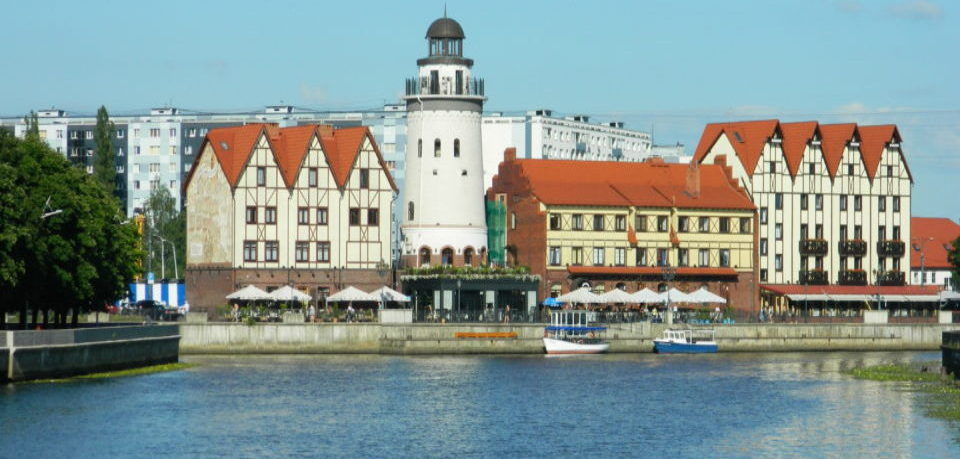
Hotel Rus, Svletogorsk, Russia

The Hotel Russ, Svetlogorsk

The Hotel Russ, Svetlogorsk

27 December 2000

I recently visited the Hotel Russ (August 2019). It is interesting to observe what has changed in the past 20 years and what has not. The following description is taken from my notes of the Hotel Russ as it was on that celebrated day in 2000 when we first arrived in Russia, almost 20 years ago. Later, we hope to write a review of what it is like to stay in the Russ today. Meanwhile, this was our first experience …

Having passed through the main gate of the Hotel Russ in Svetlogorsk, we followed the path along the side of the building to the entrance. Two large glass doors opened up into a wide, airy and spacious foyer. You could not miss the reception area as it was elevated and had the word ‘Reception’ emblazoned across it, surprisingly in English.

Hotel Russ reception area 2000
Reception area, Hotel Russ, Svetlogorsk, Russia, December 2000

Previous article: Kaliningrad: First Impression

To get there necessitated climbing up two or three steps onto a wider platform and then approaching the bar. I do not mean the sort you get in pubs; this experience was rather more similar to approaching the bar in court (as far as I am aware).

The two young ladies behind the counter were, well, beautiful springs to mind, but it was a cold, unsmiling kind of beauty; the next word that sprung to mind was ‘’officious and, after that, ‘very’. Olga did the talking; we did the looking and the walking.

From our elevated position we could see that on one side of us there was, indeed, a bar. We both felt instantly better ~ who said ‘at home’?

Bar Hotel Russ December 2000
Bar area, Hotel Russ, Svetlogorsk, Russia, December 2000

The bar area contained the usual outcrops of tables and chairs, which extended down one side to the end of the building. The chairs were chromium backed and the round tables marbled topped. Indeed, marble ~ or simulated marble ~appeared to be the material of the day within the Hotel Russ. To the left of us, in front of the bar, stood a row of tall, square-section pillars, which fanned out in vaulted form before folding into the ceiling. One of the pillars was decorated with artificial shrubs and climbing plants and beneath it we could hear a water feature bubbling

The area beyond the pillars was effectively the hotel lounge. It was well appointed, with a bank of windows which extended along the entire side of the room and soared up into the heavens above. The ceiling was very high, and if you stood in this lavish area, with its reproduction antique furniture and comfy, cushioned divans, and looked up at the ceiling it was evident  they had designed the Russ to look like an ocean liner, complete with curving staircase that took you up majestically onto the upper deck.

Hotel Rus, Svetlogorsk, Russia
Lounge area, Hotel Russ, Svetlogorsk, Russia, December 2000

As grand as they were, we did not take the steps. Our luggage was extremely heavy and bulky, even discounting the Sausage, so we took the lift instead.

A tall, thin man, with a face he had purchased from Serious & Co, was summoned to help us with our luggage. He came across the room in a most peculiar way, but it was not until he turned back again towards the lift with a couple of bags, including the Sausage, which were far too heavy for him to manage, that my brother, with an alacrity of mind that was so atypical that he must have borrowed it for the occasion, identified the gait as ‘mincing’. From that moment on, our tall assistant would be known to us as Mincer and Mincer he became.

Mick Hart & Joss Hart at the Hotel Rus, Svetlogorsk, Russia, December 2000
From left to right: Joss Hart, a man from the Hotel Russ and Mick Hart , December 2000

For a big hotel the lift was little. It was also not very wide. Certainly not wide enough for Olga, Joss, myself, two hefty cases, the Sausage and Mr Mincer. We got in and were all squashed up, something like Dad’s Army when they all crowd into the vicar’s office. There was nothing for it, something would have to give. So Olga got out and walked upstairs. There goes another myth, ‘the typical English gentlemen’.

It was a small lift and it was also a very slow lift. It did not start moving straightaway. Titter ye not, I thought, but it was hard not to all cramped up like that with Mincer looking so serious. But we knew better than to laugh in Russia ~ thank heavens for the stiff upper lip.

Ping, went the lift, at last. I felt as if we had travelled to the top of the Empire State Building not just to the first floor. Joss and I squeezed out and Mincer followed, or he would have done had not the mischievous Sausage found another small door to straddle. We helped our hapless baggage boy out and relieved him of the obnoxious case.

We were now standing in a wide area overlooking the bar, three or four tables and chairs around the perimeter and a pool table in the centre. The rooms on this floor were arranged around an oblong balcony with the centrepiece open and from which you could look down onto the floor below.

The first room that we entered was the one reserved for my brother, Joss. It was not bad at all. A little formal, perhaps, by British standards, I mean not at all like Mrs Musson’s Guest House at number six No-Beach Brightlingsea, but lacking nothing in the clean, neat, tidy and comfortable department.

In addition to the usual appurtenances, Joss had a large, three-quarter size bed and a rubber plant.

Next it was our room, which was on the other side of the balcony facing the Rus garden. In we went, all excited, only to discover that our double room was smaller than Joss’ single and that whilst he had a double bed ~ of sorts ~ we had two singles?

My brother has always been a true gentleman, mostly by accident, and today was one of those, because he surprised us all, including himself (and that doesn’t happen very often) by making the supreme sacrifice: he was willing to give his room up for ours ~ to swap rooms.

Isn’t it obvious!?

Feeling altogether sensible Olga went downstairs to reception to request the transfer. She was back almost quicker than she went with the intelligence that we could not change rooms as Joss had a single room and we had a double, so any change was impossible. The exact response from the ladies at reception had been, “Isn’t it obvious: the single room is for the single person and the double for two people”.

To say that we were not perplexed would be an understatement and Olga, perceiving that her two English associates had been skittled, left them sitting on the bed in Joss’ room, to which we had retreated, sipping vodka thoughtfully out of a hip flask, whilst she went off ‘to see what could be done’.

Ten minutes later she returned. “It’s OK, they are taking care of it,” she assured us.

And they were, sure enough, but not in the way they might have done it back home. As we walked past the open door to our bedroom, we caught sight of the solution to the problem, in the shape of two burly Russian gentleman moving the single beds together and securing the legs at either end with two thick pieces of rope. This made us chuckle; Olga was not amused. She was also not very amused as in passing the upper extremities of the Christmas tree, which extended from the ground floor up through the oval aperture almost to the roof, Joss noted that there was no adorning fairy or star on the top. His suggestion to hang an old pair of underpants on it was a step too far in the smutty English humour direction for Olga, and she went from feeling annoyed to visibly irritated.

To take the wind out of her sails (my brother was also suffering from wind, and she was not too amused about that, either), I suggested a tour around the hotel to get ourselves familiarised with it. At such a time when many companies were still in the embryonic stage of website development, surprisingly enough the Russ was ahead of itself, and we had been able to appraise the quality of this 4-Star hotel by consulting its site ahead of our trip.

As we descended, this time by the grand staircase, we met Mincer on the ground floor, and Olga asked him if we could see the sports centre. “It’s broken,” he replied.

Joss and I shot a glance at each other: perhaps something was lost in translation?

Broken or not our guide continued. We followed him down a short flight of stairs into what appeared to be a typical sports centre changing room, wide and open with slatted bench seats around the wall. We then turned right into a passageway. Against the wall stood an exercise bike, its front wheel hanging off. Mincer said something. Olga translated: “Broken,” she said.

There was little point in arguing. But what about the swimming pool, surely the wheel could not have fallen off that.

It had not. But it had shrunk. On the photographs it appeared to be a full-size pool, whereas, in real life, it was a large, deep bathtub into which one plunged after vacating the sauna. Was the sauna working? Er …

Fully refreshed after our workout, we returned to our respective rooms. Olga had made arrangements to meet with her friend, Helen, the plan being that we would venture into Svetlogorsk for a drink, but what was needed now was a cup of tea and a refreshing bath.

Don’t drink the water

Spoilt by literally having drinking water on tap in England, Olga had alerted us to the fact that in the Kaliningrad region it was strictly a case of ‘don’t drink the water’. I wondered whether it could be as bad as we had been led to believe. The answer came when I began to fill the bathtub. To say that the water was black may well be an overstatement, but it was certainly getting that way. We called Joss in from his room to witness this hitherto unseen spectacle, and then we had Olga ring to reception to report the anomaly. Her reply was, “Isn’t it obvious? You must let the water run!” So, we did exactly that, until we feared that we had dissipated half of Svetlogorsk’s water reserves. Oh, well, we would have to forgo the bath. But what about something to eat? Something simple, such as a cheese and tomato sandwich prior to going out on the town? Our request, by phone to reception, was met with some confusion. The person who took the call had to consult with somebody else. Eventually we were informed that we could have two slices of bread, some cheese and tomatoes on the side of the plate, but they could not do a sandwich. Well, I thought, isn’t it obvious!

It was around this time that we received a phone call to reception from another of Olga’s friends. Olga telephoned the friend in return and was invited to go out somewhere for a drink. As we had a prior engagement, we declined, but Joss solved the double commitment by electing to meet up with the second party whilst we went ahead with our original plans.

Joss’ company arrived first. They were a couple, both persons of which were, I thought, most refined in dress and in manner. What would they make of my brother, I mused, as they whisked him away for the evening?

Olga’s friend, Helen, arrived a few minutes later: attractive, very sweet natured but, I thought, rather, and unduly, concerned about my first impressions of Svetlogorsk. I had no idea as to why this apprehension should constitute the status quo in these parts, although I realised later that in the year 2000, apart from Germans returning to the region to see where their family once lived, foreigners were quite a rare species and English men perfectly alien.

Out into the cold ~ very cold ~ and snow-laden night we ventured, retracing the route that our taxi had taken. We had difficulty walking, the snow was that thick and, where it was not, it was that icy. Also, as I had observed earlier, there were little or no streetlights of which to speak.

Sundial on Svetlogorsk promenade, December 2000
Sundial sculpture on Svetlogorsk promenade during the winter, December 2000

Our pedestrianisation seemed to go on forever, until we took a right turn in the direction of the sea. We eventually reached the top of a steep bank of steps. I could hear the sea in the near distance and feel the sea air ~ it was as sharp as the proverbial razor blade! Carefully, very carefully, we picked our way down the gallery of steps until we reached the promenade. Directly in front of us stood a man-made and man height (sorry about the lack of PCism) sundial, the wedge-shaped blade reflecting what light there was as it cut its way upwards from the ground. I took hold of this blade, and, in listening to the rolling sound of the tide, thought to myself, “I’m actually here!” (Do not forget, dear reader, that having read or heard nothing positive about Russia since I was a child and, more recent to the time of my trip, having been the recipient of negative media coverage from, without exception, every UK media source available and, in particular official channels (no change there, then!)  make no mistake that being in Russia was a truly awesome thought!)

It used to be

The icy blast across the Baltics rendered any further deliberation untenable, and we cut a hasty retreat. It had been somewhat easier descending than ascending, and we stopped at the top of the steps to catch our breath. To our left there were a couple of derelict buildings, about which Helen volunteered some information as to what they used to be. By the time we had reached our destination, a café-bar close to Svetlogorsk centre, ‘this used to be’ had developed into a catchphrase. We passed several collapsing or deserted structures all of which had been ‘Used to Bees’.

A welcome sight was a little neon sign marking the spot where a café-bar stood. As we drew closer, I could make out a single-storey building with a glass door. There was nothing else around the building. Today, as with most of Svetlogorsk, this area has been developed, but the little café into which I first took refuge on 27 December 2000 is, I am pleased to say, still there and still functioning and nothing much, if anything, has changed!

Inside, the café was a simple rectangular room, tables ranged down either side and in the far corner to the right a small semi-circular or curved bar. The establishment was neither grand nor overtly plain. The lighting was just right ~ not too bright, not too dim ~ and the walls were conservatively decorated with framed pictures of the Svetlogorsk coastline and town. Most importantly, on a night like this, it was cosy, comfortable and warm ~ and, of course, it was also licensed.

I cannot remember what lager I drank that evening. I did not really bother. As a seasoned real-ale drinker, I had made my mind up in advance that anything lagerish would be poor, but I drank it all the same.

My one abiding memory of this establishment, and one that would stay with me for a long time, was that there was only one toilet, and it was unisex. This perplexed me a little. There were only three other people apart from us in the bar, but, when the establishment was full, how did a one-toilet system work? The other thing that surprised me about this odd Russian toilet arrangement was that you were unable to use the facility unless you asked for a key from the bar. I would learn later that this inconvenient convenience was by no means a one-off and in some places today the tradition has not moved on much!

I also learnt this evening that whenever I spoke English in a café or a restuarant I would be looked at ~ and I do not mean in the sense of a casual glance! As I noted earlier, foreigners were a rare thing in ‘these ‘ere parts’ and when you were looked at you were really looked at. I believe that throughout the 45 minutes we were in this bar, the other inhabitants, bar staff included, never took their eyes off me, not for a single moment.

We moved on, not because of this, but to pastures anew. If anything, our brief sojourn and the comfort afforded by it, had rendered the great outdoors even more hostile, or perhaps the temperature was dropping even further.

Café Mozart , Svetlogorsk

Luckily, we had only walked a short distance before another neon sign glowed its way into our vision: in a purple-red flowing script, it identified the building on which it was erected as the Café Mozart.

I will never forget that first encounter with the Mozart. The building was well lit on this extremely murky but atmospheric evening, a large picture window flooding the ground with light outside, whilst other lit windows and external lamps threw patches of light onto this and that aspect of the building and wove shadows above and around, picking out and hiding at will the nooks, crannies, decor and detail of what was unequivocally a fine example of the Gothic Revival style. As we approached, the wooden slatted and clad exterior put me in mind of early 20th century American Romanticist architecture, but it was far too chilly a night to bring this contemplation to a proper conclusion.

Inside the building, large and spacious as it was, there was a traditional dance floor to the right, complete with revolving glitter ball, and to the left a good-sized lounge with a welcoming fire. Although this was not a real log fire but a gas-fired replica, it made the interior very cosy indeed. Comfortable bench seats lined the window, with armchairs and sofas scattered here and there inviting you to sink into them, an over-mantle mirror hung above the fireplace, which may or may not have been authentic antique, and various framed pictures adorned the wallpapered walls, the mood lighting from a combination of pendant and wall-mounted lamps making this habitat the perfect choice for reasonable refreshment and good conversation.

As for the latter, most of that revolved around what it was like to live in England and the English way of life. I would soon learn that the Russian vision of Merry England was as quaintly outdated as our authorised version of what it was like to live in Russia today.

Sad to say, the Mozart, which had affected me with such appealing and positive vibes, closed shortly after this visit ~ at least it was closed when I returned a year later, never to re-open in the same style. Six months ago, the building was up for sale. It has been on the market for a long while and may still be for sale today.

Related: Hotel Russ 2020

Copyright © 2018-2020 Mick Hart. All rights reserved.

Kaliningrad: First Impression

Kaliningrad: First Impression

27 December 2000

Strangely enough, there is nothing in my year 2000 diary regarding our first glimpse of Kaliningrad by train. Later, in 2001, when I returned to Kaliningrad via Vilnius, I did refer to the maze of concrete jutting out and across the horizon which asserted itself as our train drew near and the daunting prospect that this presented compared to the quaint medieval streets of the city from which we had departed, and which now was a long way behind us.

Previous article: Into Russia

This omission in my 2000 diary may have been due to the fact that the scene on my arrival had such a potent effect. For we had passed through the exit of Kaliningrad station onto a Spielberg film set.

Outside the door was snow ~ a wide plateau of it. It was still snowing heavily and fall upon fall had covered melted snow that had since turned to ice. Directly outside the railway station’s door stood two old army trucks, both open backed. From one spilled a group of young Russian soldiers, the other was being filled with snow by a second group of soldiers attempting to clear a path through the drifts. The engines of the trucks were running, and the strong smell of diesel fumes wafted across the wasteland. The shovel blades beat an erratic tattoo, thumping against the snow, cracking at the ice and scraping across the concrete. Spielberg’s costume department had spared no expense. Each soldier was garbed in smart regulation great coat, thick woollen trousers, high canvas boots and those distinctive furry Russian hats with flaps (ushankas).

Nearby, two or three comrades (for that is what they looked like) squashed inside big heavy coats, black peaked caps with folding side flaps stuck upon their heads, all bewhiskered and dragging on fags, huddled around a big old oil drum that had been requisitioned as a source of warmth. Another of these makeshift braziers burned a few feet away. Red and orange flames funnelled from their tops together with bright little firework sparks, which danced, crackled and exploded loudly in the frozen atmosphere.

In front of us, across the expanse of white, stood a three or four storey procession of grey concrete flats. This was not Kaliningrad 2022, so our view was virtually unimpeded, the only large object being the statue of Kalinin, his arm and hand outstretched as if commanding the heavens to stop dropping snow. Behind him, along the top of the not-so venerable buildings, giant metal letters spread out along parallel bars, the imposing Cyrillic script traversing the entire block in a wonderful piece of letter spacing. At one end sat a large Soviet star, at the other, I was thrilled to observe, a gigantic hammer and sickle.  And then it actually struck me: “Oh dear,” I thought, “we’re here!”

Three big, old, Mercs, battered and rusting, with little white ‘Taxi’ signs strapped to their roof-racks, stood idly by, waiting for instructions.

 The little band of men, which I had observed earlier, were taxi drivers.

Don’t let them know you are British!

Olga whispered to me that she was off to negotiate a price with them. She instructed Joss and I to stand away and not to speak, warning us that should  they, the taxi drivers, get the slightest inclination that we were foreigners the taxi fare would double.

Five minutes of negotiating later, a fare had been agreed, and we were off. But where to? The plan was to ferry us off to the nearby (about 44 kilometres away) coastal resort of Svetlogorsk. Olga was very conscious of the rundown condition of Kaliningrad, and she had made plans for us to stay in what was then the only 4-star hotel in the region, which was Svletogorsk’s Hotel Rus. Nothing else would be good enough for two well-to-do Englishmen like us!

The journey by taxi was an interesting one. The big old Merc, coughed, belched and spluttered almost as much as its driver did. We roared through the snowbound streets of the city, a combination of abject fear and snow working in Olga’s favour, as we were much to alarmed to take anything in and even had we wanted to all we could see was snow.

Out on the open road the conditions were worse, but it was OK because no one had told our taxi driver. For a while, whilst we were stuck behind a truck with a snow blade on the front, our confidence returned, but it soon took a hit, for in overtaking the truck, as the driver pressed his foot down hard, the car slewed erratically on the snow and ice beneath. From that moment our knuckles were destined to be as white as the pure-driven. Relentless snow, drifting snow and an old German road lined on either side with trees ~ big, gnarled trunks perfect for colliding with ~ dismayed the driver not a jot. On and on we sped, as though Danger had taken a holiday.

To be fair, give or take one or two slippery moments of panic, our chain-smoking driver seemed to know what he was doing, and I do believe that had not the road surface changed beneath the wheels without us realising, we could have boasted later that by the time we arrived in Svetlogorsk the journey had been a piece of cake. The cake collapsed, however, when tarmac changed to cobbles. We were not endangered in any way, well no more than we had been, but the sudden rumbling and jolting gave us the right old KGBs. In hindsight, I actually believe that it brought back nerves to our nerveless driver, for he slammed on the anchors a little too hard, swinging the car to the right and then back again to the left before bringing the vehicle under control.

“Ah, we’ve arrived in Svletogorsk,” Olga announced.

Svetlogorsk by night

 At this time (before Svetlogorsk became commercially exploited) it was designated a health resort, a place where people went to take the air and rehabilitate.  This meant that cars could only be taken into Svetlogorsk if drivers were willing to pay a tariff, the ostensible logic being that it would reduce the numbers of cars entering Svetlogorsk and by limiting exhaust emissions keep the atmosphere pure. You know the routine, that nice Mr Sadiq Khan has done something similar in London, to help with congestion and massage our lungs ~ shame about our pockets!

Thus, we stopped, and money was handed over to someone sitting in a little concrete building at the side of a pull-in just off the road. Boy was it good to have stopped! This must be what they meant when they said Svletogorsk was good for your health!

Dusk had begun to fall as we continued our journey. We were now travelling through the streets of Svetlogorsk. Once again, with the snow still falling and much of the little coastal resort enveloped by it, and with deterioriating light and travel-weary minds, we could not make much out. The streets in the town itself were very poorly lit, and what light there was peeped out timidly, but cosily from little orange-hued windows in houses set back from the road tucked within pine-tree glades. Indeed, no sooner were we in the town than we seemed to be travelling out of it. I distinctly remember a long, dark road lit by one lonely streetlamp and, shortly after that, a sensor-activated light coming on as we approached a crossroads or junction. At this point we swung left, the lights of the houses on either side comprising the only illumination, apart from our headlights, of course.

The Hotel Rus, Svetlogorsk

We had travelled along this road but a short distance when darkness was dispelled by two floodlights pointing at and exposing what appeared to be a steep, broad ski slope from which multiple shards of light stabbed out through the whirling snow into the night sky. It was, in fact, Svletogorsk’s, and indeed the region’s, much-celebrated Hotel Rus.

As the taxi drew to a halt ~ a happy halt as far as we were concerned ~ a better view of the Rus was afforded. We were parked adjacent the gable end of the building. It was a tall perpendicular invested with large windows. The ski slope was its roof. In fact, that might have been a better name, Hotel Roof, because there was far more roof than walls. Roof, walls, what did we care! All we wanted to do was wave farewell to our driver and say hello to our 4-star luxury.

Copyright © 2018-2020 Mick Hart. All rights reserved.

Into Russia

Into Russia (27 December 2000)

Updated 12 September 2022 | First published 20 October 2019 ~ Into Russia

We had left England only three days ago but already the cheap hooch, relatively cheap by British standards, and recourse to a hip flask was taking its toll. A lot of quips and asides about British spies and gulags had joined forces with our excesses and were beginning to seep out of us in a low-brow paranoia. It didn’t help that my future wife-to-be, Olga, had started to take a perverse delight in our advertised insecurity and was adding to it by slow degrees with quips and asides of her own.

Previous article: Boxing Day in Gdansk

Farewell Gdansk!

I will never forget our exit from our hotel in Gdansk, but first our planned itinerary: Leaving Poland today, it was our intention to stay for seven days in the Kaliningrad region and then return to the same hotel by train and taxi, prior to leaving for England the following day from Gdansk Airport. We had booked our rooms in advance, so on leaving for Russia this morning the staff knew of our plans.

Meats and cheeses had not been available this morning as we were off to the railway station at 5.30am. We were travel weary and hungover. The Sausage was obviously not in the mood to be disturbed at that time of morning either, as twice on the way downstairs, once when vacating the room and then when accessing the lift, it had jammed itself at a silly angle in both doorways, necessitating a volley of imprecations and a couple of stout clouts.

We had settled the bill and were standing in the hotel doorway just as our taxi rolled up.

“Goodbye,” I called, to the hotel staff, “see you soon.”

“Or, perhaps not!” Olga retorted slyly.

The hotel staff chuckled; we looked alarmed.

Before we could even consider not being seen again once we were on the other side of the Iron Curtain, we had the train journey to contend with. A large part of my Lever Arch file containing research on our trip had been devoted to the precariousness of travelling on Polish railways. As we were driven from the hotel to the station, I wondered what I was going to use. The FCO advice was to secure your train carriage door with a piece of flexible wire, but, strangely enough, I had nothing like that on me.

Into Russia via Gdansk

It was snowing again and the train was late. The more I eyed our fellow would-be travellers roving around at the station, the more suspicious they seemed to become. On reflection, they were probably thinking the same about me. What is that bloke staring at?

At last, our magic carpet to Russia rolled in. It was a great chugging piece of clanking, rattling metal; a big old box of a tool, slow and cumbersome and stinking of diesel fumes. If ever a train was designed to house denizens from the deep, this was it!

These big old trains were high old trains and getting into them meant climbing up four or five steps. Now, the Sausage was dead set against this and had, in no uncertain terms, to be ‘persuaded’. I may have been mistaken but it seemed that three or four of our potential assailants on seeing how brutally we treated the Sausage fell back. In any event, they were right behind us when we got on ~ a surly mob if ever I saw one ~ but did not follow us when we turned immediately right into the first compartment. That is correct ~ compartment. These trains ~ or, at least, this particular train ~ are compartmentalised, with small self-contained ‘rooms’ running down the right side and a corridor on the left. In England they had more or less phased these out in preference for open-plan carriages. As Mr Woolworth once said, ‘Load them in and stack them high!’ ~ well, he didn’t really, but he did say something to this effect.

There we were in our compartment, the three of us, two bags and the Sausage. Potential assailants were still climbing onto the train, and some of them not only looked in our carriage, they positively leered ~ where’s that piece of flexible wire when you need it! But at last the column thinned out and with our compartment now full ~ two old ladies and a boy the size of a stick ~ we could breathe a sigh of relief.

I cannot remember whether we had chosen this carriage as it was close to the toilet or not, but the toilet was close, next door to us in fact. As soon as the train pulled out of the station, sounding as if it had taken half the tracks with it, I ventured to the bog, peeping furtively this way and that, as if life had suddenly become an old black and white suspense film.

The toilet certainly looked as if it belonged to a black and white something or other, or perhaps a better description would be a brown something. Like the train itself, and its passengers, it was a rough and neglected piece of equipment ~ a metal funnel sans-seat with a hole in the base where a trap should have been. I was mighty glad that I had only gone in there for a jimmy and nothing more substantial, as the icy blast up the hole was ~ would have been ~ most disconcerting. A second and third discomfort was ~ surprise, surprise ~ that the door did not shut and the place where you stood to position yourself in front of the pan seemed to be on a connection plate linked to the carriage’s hook-up system. Whatever it was, it was moving erratically, jerking from side to side and jumping up and down. I made two mental notes that day as regards Polish toilets on Polish trains (1) don’t wear white trousers; (2) bring your own toilet roll.

“That took you long enough,” brother remarked on my return to the carriage. I made a third note, ‘don’t rely on brother if you happen to go missing’.

Into Russia from Gdansk
On the way to the Russian border, 27 December 2000

Frozen lakes, snow and ice, acres of white-capped pine forests, little cottages with smoke curling out of their chimneys and red-brick Gothic castles ~the journey out of Poland had both a picturesque magic about it and an air of formidability: with each turn of the engine’s wheels Russia was getting nearer! Then, all of a sudden, we were almost there!

No laughing! You are entering Russia!

As we approached the Russian border we received strict instructions from Olga to behave ourselves: “Please refrain from making your silly English jokes. Travelling through the Russian border is a very serious business!” We composed ourselves accordingly.

The heavy old train and its rumbling carriages rolled slowly to a halt. There was nothing much to see. We couldn’t have been in the middle of nowhere, because everybody’s been there, perhaps we were a bit to the left (east) of it. We sat there for what seemed like the proverbial eternity. Olga was right. Crossing the Russian border was a serious business. Nobody said a word; all that could be heard was the rustling of bags and pockets as our fellow passengers fumbled around for their official documentation. At long last eternity ended. A string of Russian personnel, excitingly decked out in the sort of clothes that you would expect them to be wearing, full length woollen great coats, matching hats (ushankas), big boots etc, with the insignia of The Russian Federation emblazoned in all the right places, boarded the train. There were, in total, three men and two women. This was my first sight of real Russian authority, so I craned forward to get a really good look at them. They were all very young. I wouldn’t have thought that any of them were a day older than 25. Ssshhh, they were working their way down the train; they were coming in our direction.

Olga was sitting opposite us near the window; Joss and I were next to each other. We had been practising our serious expressions for a good half-hour. Joss was doing well; I had never seen my brother look so serious before, well, perhaps with the exception of the time when he accidentally bought a round in the pub.

Finally, the cavalcade of Russian authority stopped at us. We were asked, brusquely, to produce our passports. Both Joss and I did so in the most orthodox and restrained manner imaginable. When needs must, we could be as serious as the best of them. Suddenly, a rip-roaring rollocking snort, a burst of suppressed laughter, emanated from Olga. Joss and I shot surprised and alarmed glances in her direction. The young man who had taken our passports did the same. Now we were smirking, and he was as well, whilst the rest of his crew were desperately trying to keep straight faces. No one could really have known what they were laughing at. Least of all us; we didn’t have a clue. As if connected by an invisible string we all regained composure at one and the same time. The young military gentleman quickly returned our passports and the line of authority went travelling by, trying to look as if nothing had happened.

When asked why she had laughed, the only explanation that Olga could give was that we ‘looked so stupid’. If that was the case, I thought, she should be laughing more times than she wasn’t.

It took a proverbial age for the big old train to up anchor and trump off again in a Kaliningrad direction. As we rolled away from the border checkpoint, there stood one very lonely Russian soldier. He was standing there in his big coat and hat with flaps on. Now he was in the middle of somewhere, and it wasn’t very hospitable. He was surrounded by snow; behind him there was nothing but a lot of barbed wire; and as the train went slowly past him ~ clunkety, clunk, clunk, clunk ~  my last and lasting impression of the lonely Russian border guard was the sight of his bright red nose glowing refulgently like a Belisha beacon.

Copyright © 2018-2022 Mick Hart. All rights reserved.

Boxing Day in Gdansk: Kaliningrad 2000

Boxing Day in Gdansk

Is it just me, or does it get increasingly difficult to enjoy yourself on Christmas Day as you get older? And, as you get older do you find yourself looking forward more to Boxing Day than to the day before? One thing I can say about this Christmas in Poland, it may have been my first year away from Blighty during the festive season but at least in Poland I was in for no surprises. And as Boxing Day is an improvement on Christmas Day in England, so it came to pass that the same step up was replicated here.

Previous article: Christmas in Gdansk

It was Olga’s idea that we should redress our sedentary yesterday with a leg-stretching stroll along the sea front. Another similarity between Christmas rituals in England and those in Poland was, apparently, that after overdoing it in the grub department folk assuaged their conscience with a morning constitutional before returning to the table and overdoing it again.

Boxing Day in Gdansk

Olga must have had an informed knowledge of Polish people’s Christmas habits since she correctly predicted that we would not be alone on the beach this morning. The sight was most unusual.  The sand was frozen solid, the pools of water where the sea met the sand had iced over and some were coated with a fresh sprinkling of snow, and yet, as far as the eye could see, a line of people, a well-dressed procession of folk of all ages, were promenading along the edge of the seafront. I remember thinking to myself that I had never seen such an outstanding display of real fur hats and coats. The women’s coats were long, opulent and luxuriously trimmed; they shone magnificently in the luminous air, the darker and lighter shades of pelts both in the coats and matching hats catching the sunlight, holding it for a moment and then reflecting the nuanced patterns beautifully. Looking back, this was possibly my first introduction to the futility of political correctness.

Boxing Day Gdansk Year 2000
Promenading on Gdansk beach, year 2000

A little further along the coastline my eyes alighted on a quite different scene. Shivering on a low wooden jetty stood three red lobsters laughing. One, who had just taken a meaningful swig from a vodka bottle, was about to dive back into the icy cold sea. I was not ignorant of such peculiar goings-on in country’s such as these, but what a carry on; you certainly would not catch us Brits doing this in the middle of winter in Heacham or Hunstanton ~ in fact, come to think of it, we wouldn’t most likely be doing this in Heacham or Hunstanton in the middle of summer!

The site of lobsters in trunks and a fresh flurry of snow gave us just the excuse we’d been waiting for to investigate the probability that the impressively large red-brick hotel in front of us might be concealing a bar. I cannot remember the name of this place and I never entered it into my 2000 Diary, but after a bit of research on the internet I am of the opinion that it was more than likely The Grand.

Boxing Day Gdansk
MIck Hart & Olga, Gdansk, 2000

I did write in my diary that the lounge bar was a tad disappointing, a little bit run of the mill, but compensation comes in the most unusual of places ~ the toilet. Yes, the bog was magnificent! It was tiled from top to bottom in contrasting hues of green marble and had urinals that dated back to Edwardian times. They were ~ if you know your urinals ~ deliberately contrived with modesty in mind. Big, tall, impressive curves of sparkling white vitreous enamel built into brickwork pillars, more than enough to ensure the absolute privacy expected by the widdling Edwardian gentleman, who could have virtually stood inside them, tuxedo, tailcoat and all. What was most thrilling, however, was the fact that they were British made, each urinal inscribed in blue with the name of Armitage Shanks! 

It had been so edifying, this discovery of a real Edwardian rest room, English designed and so far from home, that no sooner had we returned to the bar than we ordered another round of vodkas.

No doubt seeing where this was going, too much drink too early, Olga interrupted our celebrations suggesting that we should visit some place cultural, somewhere on the edge of town. The proposed destination was a small museum. We bowed to her better judgement, finished our vodkas, vacated the hotel and were whisked off by taxi to the place that she prescribed. Sadly, however, her culture-verses-drinking gamble didn’t pay off. We ended up, having left the taxi, in a rather drab and sorry-looking urban backwater, with nothing much to see but row upon row of lack-lustre flats. The museum, or any museum, was never located and stranded as we were we had the miserable misfortune of having to take refuge in yet another bar.

A railway platform somewhere in Gdansk

This place was not a haven. It was a modern glass and metal-framed structure parked in the intersection of a busy road; it was pokey, with a small Coca-Cola dispensing machine which, given the size of the room, was the inverse ratio of Dr Who’s TARDIS. We only stayed for one gassy pint of Polish beer, having learnt that the railway station was just around the corner. This turned out to be a rewarding ~ as in different ~ experience in itself. I don’t believe that I had ever stood on such a cold, miserable, basic railway station in my life, and I certainly haven’t since! It was simply a low slab of crumbling, decaying concrete, with three buckled metal seats, six poles ~ which once belonged to a canopy since gone ~ and three dented and weather-stained signs. Poland may well be fighting for cultural survival since joining the EU, but surely by now someone, someone like George Soros, for example, must have donated benevolent money to make Polish railways better?

How good or bad Polish railways were, we would soon find out, as early next morning, at the crack of dawn, we’d be leaving Poland by train and crossing over the border into Russia.

Copyright © 2018-2020 Mick Hart. All rights reserved.