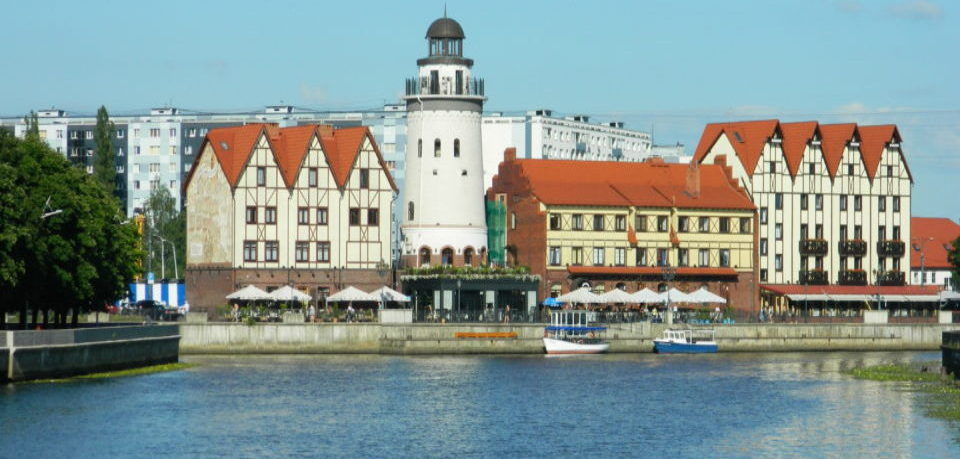
Meet Kant and shake hands with the history of Königsberg
14 March 2026 – Kant Museum Kaliningrad – all you need to know
Those who have a passion for everythingKant could not do better than direct themselves towards one of Kaliningrad’s most multifunctional cultural centres, the major surviving landmark of the former city of Königsberg, Königsberg Cathedral.
The museum is located in the cathedral’s towers. It occupies three floors, accessible by a series of steep and challenging staircases, the first being stone and spiral.
The museum, as the name suggests, is principally dedicated to the celebrated 18th-century German philosopher Immanuel Kant but also embraces the concomitant history of the cathedral, Kneiphof Island, as Kant Island was formerly called, Königsberg itself, and the Albertina University, which, before the arrival of the RAF in 1944, was so conveniently situated at the cathedral’s eastern side that the adoption of the latter as the university’s church could not have been more fortuitous.
Kant Museum Kaliningrad – all you need to know
The three floors that constitute the museum have distinct areas of interest: the first is a historical tribute to Kneiphof (Kant Island); the second contains an authentic reconstruction of the Wallenrodt Library; and the third is a shrine to Kant.
The Kniephof exhibition is a must-see for anyone interested in the juxtaposition of prewar Königsberg with its Soviet and modern-day successors. Kant, who lived and worked in Königsberg all of his life, knew Kneiphof in the 18th century as one of the city’s four central districts. Over time, Kneiphof Island became overbuilt, assuming the character of a highly concentrated urban environment. The wartime visit by the RAF abruptly changed all that, laying waste to Kneiphof as it did to the best part of Königsberg. In more recent years, this lamentable space has evolved with some careful landscape coaxing into a gentle, relaxing retreat, thoughtfully planted with shrubs and trees and intersected throughout with meandering hard-surface walkways.
Exhibits in the Kant Museum at Königsberg Cathedral in Kaliningrad include historic artefacts and images relevant to the Albertina University.
The Kniephof exhibition contains a number of maps, images and artefacts, illuminating the island’s history, including vintage items and ephemera connected with the Albertina University. But the jewel in its crown is undoubtedly the detailed scale model of Königsberg, which clearly shows not only Kneiphof in its 1930s heyday but also the layout of the city of which it was comprised, which seven years from the time depicted would abruptly cease to exist.
The Wallenrodt Library on the museum’s second floor is named after its founder, the Prussian Chancellor Martin von Wallenrodt, whose private collection of ancient books and manuscripts became the first secular public library to be hosted by a religious establishment. The library was donated to the cathedral in 1650 by Wallenrodt’s son, and its contents increased year on year until, just before the cathedral was bombed in 1944, some 10,000 written works had been sedulously amassed and carefully curated for the edification of the general public.
Fortunately, both before the war and during the time it raged, much of the library’s invaluable contents were transferred elsewhere for safety, but for those volumes that did remain, fate showed a less lenient face than the one that had partly smiled upon the cathedral’s tenuous destiny, for the library and its remaining contents suffered to be obliterated.
The library’s reincarnation is largely acknowledged to be a faithful replica of its former self in all its relative dimensions and an accurate aesthetic and atmospheric facsimile of its 17th-century origin. The Baroque appearance and scholarly ambience echo throughout the sumptuous mahogany woodwork, particularly in the carved detail that overlays the library shelves. If ever a place was intended by God for learned study and quiet reflection, then here, I feel, is a better place than most – allowing, of course, for its constant stream of visitors.
Kant Museum Kaliningrad – all you need to know
The third floor of the cathedral’s museum is a paean to philosopher Kant, where personal artefacts, sketches, portraits, busts and documents of various kinds consort with digital technology to introduce the visitor to the life of the man and philosopher, locating him in the history of the world in which he lived and worked.
Hello, Mr Kant!
An adjoining room demonstrates Kant’s adherence to the dining etiquette advocated by Philip Stanhope, 4th Earl of Chesterfield, whose considered opinion was that dinner parties should never consist of fewer than three persons and never more than nine, this number including the host. Exemplifying rigid rituals typically Kant in nature and, indeed, no less in practice, this prescription was one which the philosopher, so it is said, adopted in order to equalise his solitary existence with structured social interaction sufficient enough to divert and enjoy whilst informing his lifelong pursuit of the moral and intellectual stimulants his calling held so necessary.
In reflecting this sense of order, the room is symbolically staged according to the principles Kant accepted and of which he approved; the table and chairs are laid out as prescribed to accommodate guests conforming to the strict limits of a propitious number, the host, of course, included, and are presented then to visitors against a dynamic, colourful tapestry, the lively content of which depicts a typical evening at home with Kant. Who would have thought that a man so widely considered to be intractably pedantic could demonstrate his critique of reason through such perfect hospitality!
In contrast to this merry scene, but quite in keeping with life itself, this room also contains two Kantian exhibits which some of a sensitive disposition might consider macabre. The first, staring blindly from the cushioned base of the glass case in which it resides, is a copy of the philosopher’s death mask, about which it is probably true to say he fails to look his best; the second is a framed painting hanging on the wall, which captures the haunting moment of the exhumation of Kant’s body, in which one man is depicted standing inside the open grave, passing Kant’s skull to a colleague, whilst the rest of the congregation look on with expressions of awe and wonder, morbid fascination or an irresistible inclination to surrender to all three.
Kant’s remains were removed from where his body had been buried inside the cathedral’s walls and reinterred in a mausoleum constructed in his honour annexed to the cathedral, which is where they are today, though no longer in the original bespoke structure, whose character had been Gothic, but in a remodelled modernist setting designed in the 1920s by the German architect Friedrich Lahrs, about which, no doubt, we will have something to say in a later post at a later date.
You might very well find this useful …
The Kant Museum is located in Königsberg Cathedral: Ulitsa Kanta, 1, Kaliningrad, Kaliningrad Oblast, 236039
Our second cultural day in a row (yesterday we attended an unusual art exhibition) found us heading off for a guided tour around a flat that had belonged to a Königsberg merchant in the early 20th century. I had heard of this flat from our dear friend Victor Ryabinin ~ artist, philosopher, historian (sadly now deceased) ~ who had, as with all things Königsberg, stimulated my curiosity by informing us that the flat in question had been preserved, and restored where necessary, in all its original glory.
The flat we were going to visit today is located at
11-1 Krasnaya Street, Kaliningrad. The official name of the venue is simply but
effectively ‘Apartment Museum’. A century ago, it was the home of merchant and
grocery store owner, Gustav Grossmann, and his family. As the advertising
leaflet boldly and honestly claims, the authentic interior allows you to
‘travel back a hundred years’ and experience life ‘as a citizen of Eastern
Prussia’.
Public interest in and success of the project had prompted the exhibition owner to invest in a retro café on the site of Grossmann’s original store, which is located in the same building as the merchant’s flat, and it was here that we were rendezvousing with friend and Königsberg historian Stanislav Konovalov, known to us as Stas.
The café, which is housed in a corner section of the historic apartment building, extends from the main structure out towards the pavement. The entrance to Grossmann’s apartment is recessed, away from the pavement, a small flagstoned area leading to the front door, and can therefore be easily missed. However, the café signage does a wonderful job, calling your attention to a building of stature, which is distinctive and old-world gentrified thanks predominantly to the large show window on the ground floor and above it on the first and second floors the unusual arched windows.
The lower window has been fitted out with shelving and, even before we climbed the small flight of steps leading to the café entrance, it excited us to see a variety of bygone items beckoning us inside. The artefacts displayed included, but were not limited to, kitchen pans, clothes’ irons, ceramic pots, oil lamps and the stock in trade of antique emporiums in this part of the world, the ubiquitous German stein.
Gustav Grossmann Cafe, Kaliningrad
Anyone obsessed with the past could tell, from the demeanour of the building and the items displayed in the window, that you would not be disappointed when you stepped inside. The interior of the building has been subject to a complete and comprehensive retro makeover, with so much by way of antiques and collectables adorning shelves, festooned on the walls, cuddling in cabinets, swinging from the ceiling and dotted here and there that ~ as it is with the nature of such places ~ it was impossible at first glance and even ten minutes afterwards to take everything in. Certain features, however, made their mark and stayed there. Behind the front counter, for example ~ a long counter and one of impressive height ~ wall-to-ceiling shelving has been erected, and this shelving, consisting as it does of different sized compartments, the top section reserved for larger items such as a pair of antique radios, is occupied by a mixture of vintage and antique objects rubbing shoulders with the modern accoutrements that are vital for running a business like this, such as branded cups and saucers, selections of teas, different kinds of coffee varieties and so on. The café till, which may be modern, appears on the customer side of the counter as though it is made of wood, whilst the coffee machine, all made of shining chrome, is, in shape and appearance, an icon of the 1950s. Indeed, not everything in the café was what we English would call Edwardian or of early 20th century origin: the radio in the window, which has most likely been fitted with an electronic player, was post WWII, although the music it aired pre-dated it as late 1920s or 30s.
Window Seat, Apartment Museum, Kaliningrad
As with the interior décor no expense in detail had been spared with regard to the café’s furniture, all of which has a heritage background, from the open-sided armchair beside the counter to the two armchairs and circular salon table in front of the window. As these chairs were occupied by patrons, who were studiously observing an unwritten code of conduct, which is, or so it would seem, to adhere to a kind of library silence in the presence of the past, we took up temporary residence in the only seats available, Olga on a dining chair with a Rococo-style splat and myself on an interesting settle, which was comfortably upholstered and had, at either end, small fitted cabinets with carved, pierced fronts.
Partaking of tea in Apartment Museum Cafe ~ Königsberg
Tea was served in two dish-shaped china cups with matching saucers, backstamped Konig… . We could not make out the exact wording, but we felt certain that the proprietor of this establishment would not have trusted us with an original Königsberg tea service.
Vintage china tea cup, Gustav Grossmann Cafe, Königsberg
More or less observing the silence that everyone else was bound to, we drank our tea and continued our visual assessment, taking in the various enamel-fronted advertising signs that no antique-oriented premise should ever be without and recognising three wall-mounted cast-iron signs as tram destination plates, each bearing the number of a specific tram and the Königsberg districts which each tram had served. These distinctive and, I should imagine, highly sought-after Königsberg mementoes, which remembered the route that specific trams took, I had only seen once before and that was in the art studio of our late friend Victor Ryabinin.
Apartment Museum Cafe sells antiques
Alas, these plaques were not for sale, but some of the items were. There were three large wood and glass display cabinets containing all manner of small antique pieces ~ ceramics, tableware, relics from Königsberg ~ as well as some larger items, such as a silver-topped walking cane and a silk top hat, all of which could be purchased. Both Olga and I took an interest in the two-tier, Art Nouveau plant stand, which was slightly more unusual than the standard fare, but as the asking price was considerably higher than that which I would normally expect to pay for a similar piece in England, our interest remained just that.
We finished our tea and now that Stas had arrived and wanted a smoke, we joined the other interested parties who were waiting outside on the damp and chilly streets for the venue to open.
As 11am came and went Stas took the initiative to ring the doorbell. And seconds later the door was opened by a tall lady appropriately dressed Edwardian style, that is in a high-necked blouse and long woolen dress fastened and highlighted around the waist by an enamel-buckled cinch belt.
We were shown in to the communal hallway of the
building, a spacious entrance hall with a flight of six or seven steps to the
ground-floor landing, beyond which could be seen a rather imposing wooden railed
staircase.
The door to the time capsule we were about to enter was mid-brown wood, with long vertical paneling , the upper section letting in light through a series of small windows, the glass inside being of the wire-reinforced variety. Our little entourage filed one by one inside and as we passed ~ me gratefully ~ from the 21st century into the past, I pointed out the doorbell to Olga, which was housed in a metal plate wrought into a typical and prepossessing Art Nouveau design.
Art Nouveau doorbell, Apartment Museum, Kaliningrad
The corridor inside the flat was rather narrow and, indeed, we were soon to discover that this merchant’s flat was of no great proportion anywhere. Naturally, the space was made considerably less by the unusual volume of people that it now occupied, all at once milling and jostling as they tried to divest themselves of their outer winter garments to place in temporary storage within the deep, but not very wide, cloakroom reserved for this purpose.
Naturally, the initial impact of the transition from now to then, from new to old, would be better served with less people present, but ventures such as these need to be administered and maintained, and I would anticipate that the fee for a private viewing might prove cost-prohibitive. Nevertheless, I did find room to reflect on how reserved and dignified Mr Grossmann’s hallway was, with its black and white tiled floor, tall dark doors fitted with ornate and heavy brass handles and its wonderful bygone telephone, equipped with open cradle and sporting a large pair of bells.
Open-plan design
When we were all partially disrobed, so to speak, we were led into the living quarters, which was fundamentally one large room divided into two halves by the simple decorative effect of wooden vertical frames and pierced and moulded fretwork where the uprights meet the ceiling.
The door through which we had entered had taken us effectively into the living room/study. In the corner of the room, in front of the window, was a desk with shelves and drawers in all the usual places and with more incorporated in the elevated section of a glazed cabinet super structure. The desk held various interesting and curious pieces, including the first typewriter I had seen manufactured by Mercedes Benz. Next to the desk there was a large double-fronted glazed cabinet, containing many antique artefacts, and next to that a small sofa and copper-topped circular table.
This table was one for us. It had a built-in standard lamp, with a large bell-shaped fabric lampshade centred above it, c.1920s. Other objects of interest in this part of the room included a small, circular gramophone table complete with horn-type gramophone, a very nice carved and stuffed-over seat corner chair, used here as a desk chair, and various wall-hung paintings and antique ornaments.
Mr Grumpy (photograph withheld)
One thing that Olga had not forewarned me about was that Stas would be translating as the guide spoke, and Stas, in turn, had not been forewarned that Mr Grumpy was present. Mr Grumpy took umbrage at Stas’ mumblings in English, and even after Stas had explained his intent and purpose, Mr G could not quite permit himself the liberty of graciousness, turning every now and then to scowl at us, until eventually he slid away. At first I felt myself lean charitably in his direction, after all had not he paid for the tour like everyone else? ~ so why would he want to be distracted by Stas’ infernal utterances? But by and by I noticed that he was pretty much dissatisfied with everybody and everything. Perhaps his wife had dragged him there when he should have been in the bar? (If that had been the case, then it was perfectly understandable!)
Gustav Grossmann? No, Mick Hart at Gustav’s desk!
The guide’s talk continued for some time but the duration was necessary as we were not after all in the Palace of Versailles but in a very small, lower middle-class apartment, which, had the guide whipped us through, would have no doubt had Mr Grumpy demanding his entrance fee back!
Judging by the reaction of the rest of the group, with the omission of Mr Grumpy, the guide’s efforts appeared to meet with universal appreciation. Even with my sparse knowledge of Russian I could tell that she was a good speaker, instigating and maintaining interest and adding to it, from time to time, by drawing our attention to certain curious items, which she passed around for people to hold and examine, asking if anyone knew what they had been used for in their previous life. This technique was adopted throughout the tour, and, I am proud to say, I got most of the items right, except for a small pagoda-style, black-lacquered miniature house which, it transpired, had been a pet sanctuary for crickets, no less. As they say, and quite rightly so, you learn something new every day.
The second half of the room into which we had first been shown functioned as the dining area, the taper-legged table and simple but appealing early 20th century chairs occupying centre place. Behind the table, set against the wall, stood a typical Könisbergian lump of a sideboard. I do not mean to sound disparaging, since these heavy, massy pieces of furniture typically adorned with heraldic and armorial appliques and supported on chunky ball and claw feet or, as in this example, large lion pads, solicit the Gothic in me, but I fully understand that their dominating presence is not, as we English are wont to say, everyone’s cup of tea.
Apartment Museum magnificent fireplace/stove
In this instance, however, it was the fireplace that got the better. Here we had a typical German glazed-tile fire-come-boiler affair ~ a masonry heater ~ distinguished above any I had seen hitherto, with the possible exception of one very ornate example, which may or may not be original, which resides within a hotel bar on a picturesque stretch of the river a few kilometers from Königsberg.
The fireplace we were privy to today owed its impressive status to its two-tiered format, and the fact that the decorative tiling was taken up from floor to ceiling, the top being surmounted with a rather elaborate carved and scrolled finial.
The metal grate doors at the lower level of the boiler also expressed an Art Nouveau intricacy, the artistic quality of which I have not witnessed elsewhere in this region.
Overall, the furnished and decorative note struck in Mr Grossmann’s flat was a mellow and conservative one, possessing and conveying an unaffected dignity. Towards this consummation the doors, all of which exhibited the same uniformity of design, added not a little. In fact, they stamped an authority of social standing on the nature of this abode, their dark-wood, tall and sober character surmounted by a dignifying architectural gable pediment.
Crotchless bloomers
The next stop on the itinerary was the bedroom. It was not at all very spacious and the two wooden single beds pushed together to make a pseudo double bed allowed for nothing more than a cabinet and a dressing table. The most remarkable bygone in this room was the mannequin, or rather the female underwear in which it was dressed, of which the principal feature was the long pantaloons. These, our guide revealed, were split-crotched in the most significant manner, which, my wife concluded, explained why men in the early 20th century made such an eager audience when young ladies danced the can-can.
Apartment Museum guide, Kaliningrad
You see what I mean when I say, ‘you learn something
new every day’.
We could not all get into the confines of the bed chamber, so some of us were necessitated to undertake our viewing from the hall, along which we then walked, as instructed by our guide, to the kitchen.
Nowhere does bygone domestic life impress itself more contrastively than in the kitchen setting. The kitchen décor of our modern age and the implements we use therein would seem so thoroughly futuristic from an early 20th century point of view, and also more recently for those who lived in the 1940s, as to make them impossible to envision. In years gone by kitchen items were heavy, solid-state, screwed, riveted, mechanical; they were constructed from metal and glazed stoneware, cast and wrought iron, and they were obviously made to last, which is why they are still with us. A few people aspire when they behold kitchens of yester-year to recreate something similar in their own home as a retro statement, but few people ~ only those of the most stalwart nature with a near to obsessive love of obsolescent times ~ are willing to go the whole hog, completely renouncing smooth, easy-to-clean surfaces and modern, time-saving kitchen utensils [see Art Exhibition Kaliningrad] for their more quirky but difficult to use and maintain predecessors.
Early 20th century kitchen utensils
In Mr Grossmann’s flat, the kitchen was quite small. Too many cooks was certainly not an option. The kitchen stove, or range, ruled the visual roost, it was, after all, an indispensable piece of home-living equipment, in this case cast iron, the front beige and green-enamel tiled and the whole raised on sculpted, ornate cabriole legs.
Above the cooker there was a row of hooks containing various kitchen utensils and, on the wall, cream and white enamel back-plates with integral hooks on which hung various straining, stirring and other culinary implements. The back plates to these utensil holders are lovingly shaped and are much sought after today by discerning collectors and interior decorators. Enamel products were, of course, the kitchen equipment stalwarts of their day, and another nice example, one of which I had seen before in Victor Ryabinin’s studio, was a three-compartmentalised kitchen-cleaning substance holder, which included a slot for a product well-known in England, Persil, the name of which, along with others, is printed on the surface.
Slider-controlled enamel kitchen shopping list reminder, c1910-20
One item that I was not acquainted with was an early refrigerator. The appliance looked like a tall, square, solid wooden box, but when the lid was lifted the top section could be seen to contain a perforated metal basket. The cabinet space below held the provisions whilst the ice above cooled the interior. A simple mechanism indeed, but I suppose it must have worked.
The kitchen was large enough to accommodate a dresser,
with glazed cabinets to the upper middle section flanked by two enclosed
cabinets, in which an assortment of curious contraptions were displayed, and
the storage space offered by this piece of furniture was augmented by a small
larder in the corner of the room, containing a stimulating jamboree of bottles,
tins and jars, many with ageing contents.
The last room on the inventory was the toilet and bathroom, and this indispensable facility was to be found on the left just inside the door. You’ve just got to love a proper toilet, being one with a high-rise cistern with a chain and porcelain hand-pull, of German heritage of course.
Gustav Grossmann’s toilet requisites
Whether large country estate, stately home or a relatively small apartment such as this one, the question I always ask myself at the conclusion of my visit is not did it interest me but did it have the desired effect, namely during the time I spent there was I there at the time and in a different time at the same time? The answer in the case of Kaliningrad’s (Königsberg’s) Museum Apartment is Yes. Thank you Apartment Museum and thank you Mr Grossmann!