
How to Use Public Transport and Get Around Kaliningrad Like a Seasoned Expat
1 November 2026 – Getting Around Kaliningrad: Public Transport & Travel Guide
Doddle. That’s what it is. Getting around Kaliningrad. Public transport, comprising as it does of an amalgamation of regular-sized buses, mini-buses, trolleybuses and trams, gets you where you want to go efficiently and, depending upon the level of traffic, in as rapid a time as you could wish for.
Getting Around Kaliningrad: Sections
Mini-buses
Trolleybuses
Trams
Kaliningrad Bus Routes: If in doubt, ask!
Bus Fares and How to Pay

For the foreign traveller, getting around Kaliningrad is made considerably easier by the flat-rate fare. Whichever mode of transport you choose, the cash price is pegged at 44 rubles (40 pence) payable to the driver or conductor. The price of a ride drops even lower should you happen to have in your possession a Volna Baltiki (Volna Baltiky) card and/or a Russian bank card, but as you most likely will not, keep in mind ‘44 rubles’, and with this you might think you cannot go wrong, whereas, in fact, you easily could.
Kaliningrad Public Transport Fare-Paying Options
Buses, trams, mini-buses and trolleybuses, whichever mode of travel you choose, fares are fixed per ride regardless of the distance travelled.
| Payment Method | Cost Per Ride | Best For | Where to Buy / How to Use |
|---|---|---|---|
| 💳 Volna Baltiki Card | 33 RUB | Frequent travellers & budget backpackers | The card costs 100 RUB at local ‘Pressa’ kiosks or bus station ticket offices. |
| 📱 Contactless Bank Card | 38 RUB | Quick day trips | Tap your material plastic card onto the conductor’s mobile terminal or use a virtual MIR card via the Mir Pay app. |
| 💵 Cash | 44 RUB | Convenience. No unexpected card issues! | Pay cash to the conductor or mini-bus driver. |
*Note: Luggage that takes up a passenger seat is treated as a passenger and will require an additional ticket, priced at the standard fare determined by your payment method.
Buses in Kaliningrad: What to Watch Out For
As everywhere and in all corners of the world where buses need to be caught, you obviously need to watch out for them. I won’t waste either your or my time expatiating on what a bus is and looks like, because if you don’t know by now, then perhaps you never will.
One thing that you do need to be aware of these days is that on some of Kaliningrad’s standard-size buses, human conductors have been replaced by electronic touch-card devices. There now follows a cautionary tale:
Oblivious to this development, I found myself a few months ago in the unenviable position of being on a bus that didn’t take money, which is something that I did have, but did take cards, which is something that I didn’t have. To avoid embarrassment, which, as you know, is the Englishman’s greatest fear, all I could do, I decided, was to nip sharpishly out of the central doors as soon as the driver opened them, a plan that could possibly not have gone wrong had he done what I thought he would do but, as it happened, didn’t. He only opened the front door so that he could cunningly check each passenger’s ticket as they disembarked. Oh dear, and what a bugger!
Clutching at my rubles whilst attempting to work out how I was going to explain myself in Russian, I nervously joined the queue, but luck for once was on my side. As my turn to present my ticket approached, the driver was distracted, and with a spasm of glee tempered by guilt, I floated past on a sigh of relief safely unnoticed and onto the street. In mitigation of my actions, the unforeseen and awkward circumstances into which I had been thrown were completely of an accidental nature. There was no attempt to fare dodge guvnor – and that’s the honest truth. And yet since that inauspicious ride, I have solemnly failed to determine which of the buses accept cards only, other than learning inadvertently that orange ones certainly do. So, take heed of my mistake, and let that be a lesson to you!

Mini-buses (Marshrutkas): The Popular Transit Option

Services across all three bus types – standard buses, mini-buses and trolleybuses – are exceedingly frequent and cater to numerous interconnecting routes. The smaller buses, ‘vans’, run in parallel with their larger counterparts, offering a nippy, if not when laden down with heavy or bulky bags, tricky-to-use alternative.
These small units are extremely popular and, therefore, often overcrowded. On tarmac surfaces, whether you are a seated or standing passenger, they pose no imminent threat, but when they are bouncing at speed across Königsberg’s bygone, cobbled streets, you tend to dance when standing, so that remaining perfectly upright can become a bit of a challenge. Equally challenging, when jam-packed full, is rising from your seat, always assuming, of course, that you have had the good fortune to nab one, as is struggling through the standing passengers to get to the door on time before you miss your stop.
The mini-buses of Kaliningrad are notorious little devils with infamous reputations for tearing along at breakneck speed, making diving on and off something of an art form; as is swinging the heavy door shut as you climb into the bus, an occupational difficulty very much compounded by, when having paid your fare, you reach back to close the door just as the bus is slammed into gear and flies off down the road. The sudden, startling momentum can have you rolling about as daft as if you are drunk when you’re not, and when you are, alas, making you instantly, tragically sober; an awkward and bouncy situation at best, this predicament is made far worse if the road on which the bus is travelling happens to be an ancient one, one built for horses and carts when Kaliningrad was Königsberg.
Mini-Buses (Marshrutkas): For Speed and Flexibility
These fixed-route mini-buses are Kaliningrad’s public-transport equivalent in speed and flexibility to the motorbike courier: they boldly go where big standard-sized buses have difficulty in going, and they do so with a nippy, sassy attitude.
Hail a mini bus like an expat: Marshrutkas can be flagged down by sticking your arm out as you would when hailing a London cab. In central city areas drivers strictly adhere to designated bus stops, but in quieter, residential districts, should they espie you on the pavement with your arm held up aloft, they may in effect pull over. Sometimes they will just flash their lights and go merrily sailing past. This is not an act of condescension; the driver is merely informing you that the bus is already full.
If in doubt, shout!: Now you are on the bus, you will want to get off somewhere. If they, mini-bus drivers, see in their rear-view mirrors nobody making a move to get off and ahead of them an empty bus stop, they may very well go charging by. As you approach your stop, it is just as well, therefore, to adopt the golden rule: If in doubt, call out!
A last and sanguine salutary piece of advice when it comes to travelling by mini-bus. I read recently on more than one travel site and was also told by Arthur Ingram (code name A.I.) that passengers must stump up their fares as they get off these buses. Once true, but not anymore. Now you pay when you get on. That’s the way to do it.


Kaliningrad Trolleybuses: Because They Are Different

Now, these wheeled devices are an interesting collation. I look upon them as a cross between ‘normal’ buses and trams. I like them even more, as they do not exist in the UK and therefore form a novel mode of transport.
Like any other bus, trolleybuses run on pneumatic tyres without the need for tracks. They draw their power from overhead cables using a pair of spring-loaded poles hinged to the top of the roof. The bus is driven like any other, but the driver must ensure that the rods on top of the bus stay in contact with the overhead power source. Some of the older trolleybuses incorporate a battery backup and/or are fitted with an auxiliary diesel motor, both designed to permit them to stray short distances from the contact wires, delivering to mobility and manoeuvrability an extra dimension for pilot control, without which, in whose total absence, they would otherwise be reined in by absolute reliance on the wires’ prescriptive allowance.
Kaliningrad’s newest super-duper trolleybuses have the capability to disconnect from the overhead cobweb of wires and drive wirelessly away for up to a quite astonishing 80 kilometres. This is a handy contingency plan, enabling these souped-up trolleybuses to outmanoeuvre traffic jams and avoid being beached by mechanical mishaps and unforeseen malfunctioning and, when they can and do happen, power supply disruptions. Everything may stop, but the trolleybus keeps on rolling.
There’s no mistaking the new, sleek, Sinara-6254 trolleybuses. They look impressively modern, because they are. Come rain, hail, snow or shine, the Sinara’s built-in climate control takes over. USB ports come as standard, and next-stop announcements are fully automated.
Kaliningrad’s Trolleybuses Serve Key Routes
Paired down to a core set of lines, nevertheless, Lines 1, 2, and 7, cater marvellously for tourists, locals, and expats alike by interlinking major tourist hubs with residential satellites.
Lines 1 and 2 are a tourist’s dream. They criss-cross the city’s central squares, take in the historic gates and are conveniently accessible from the major northern transport rings.
What I like about the older trolleybuses is that they generally have a holding rail that runs along the inside ledge at the very rear of the bus, which a standing passenger can effectively use to steady oneself whilst gawping, as one invariably does, and whilst gawping to one’s heart’s content, out of the large rear window. I cannot begin to tell you whether the modern versions are similarly equipped, because, surprisingly enough, I am yet to travel on one of them.
Trolleybuses are truly lovely things, but they are not so plentiful in Kaliningrad as their standard bus or mini equivalents, so I do not get to journey on them as often as I would like. But in the general scheme of the city’s transport system, their contribution to getting around is no less valuable a transit resource than any of its partner vehicles.

Kaliningrad Trams: Scenic and Historic Routes

When I first came to Kaliningrad, which is now more than a quarter of a century ago, much of the old Königsberg tram network was still functioning, albeit after a fashion. The classic red-and-white-coloured trams, the ‘biscuit tins’ as I affectionately call them, whose history dates to the 1970s, would rattle along quite famously, as indeed today many still do. Nothing about them has changed that much, except perhaps for here and there the urban curse graffiti and for here and there again vandalistic etchings trending on victimised window panes, although looking back at the turn of the century there were a lot more trams in operation and many more tracks on which to operate.
Like a lot of things, its got smaller over time, meaning the Kaliningrad tram network, but riding the tram remains the best option for romancing the past, as it gently weaves its way across the city’s historic landscape.
My consciousness
In those days, now lost forever, when life was a lot more raw and real, children would make their own entertainment by hitching an illegal ride on the coupling link of the tram’s last carriage, hopping on and off at will. Some people never grow up, and I remember regarding these antics with more than a twinge of envy. In these health- and safety-conscious, robustly regulated and X-Box times, such daring-do is outlawed, and though much of the 1970s’ tram stock continues to rattle and roll, they are at any rate gradually being replaced by gleaming, swish, updated models, with significantly higher comfort specs, which do not include, as I recall, a child seat at the rear.
The traditional tram, comparatively speaking, already appears bone-shakingly basic and ambivalently dated, and whilst those with poetry in their hearts might be tempted to say all the more quaint for the fact, anything that holds back time is a feather in my romantic cap, the practical story inside is one of cold, hard, metal, lack-of-comfort pan-shaped seats, hardly supporting the folklore prejudice that because things in the past were simpler, particularly public-transport seats, simpler equals better. It is the sovereign right of pampered rumps to rail against the sacrifice that anachronisms such as this condone, but if you are owned by one of these, there’s always the option of standing.
Kaliningrad’s Vintage and Modern Trams
Venerable Vintage: Kaliningrad’s classic bright-red and cream trams are Soviet-era Czech-built Tatra cars. They have been roving around Kaliningrad for decades, and as with first come, first served, first seen, first loved. Given the choice, me being me, these are the trams I like riding best.
Current ‘Corsairs’: Sleek, air-conditioned, roomy, cushioned, with large viewing windows, low-floored access, smooth, silent acceleration and even USB charging ports, the modern ‘Corsair’ (Korsar) trams are a different beast altogether than their classic Tatra forbears. Payment options include touch terminals used in conjunction with Russian bank MIR cards and Kaliningrad’s dedicated transit card, the Volna Baltiki, (the cheapest fare option); or paying cash to the onboard conductor.

The past was certainly a time when ‘Commonsense ruled, OK! ’ – a time when self-preservation deferred to this and little else and on which its application solely depended, not, as it does today, on written laws and regulations. I cannot imagine, for example, witnessing now as I did then, at a busy intersection, the driver of the tram clambering out of his cab and with a long metal pole in his hand using it to lever the points to alter the tram’s direction. Does it still happen? I ask. But not availed of the answer, content myself with the supposition that this might be what is meant today when people say that he or she is very much a ‘hands-on’ person. It’s not conclusive in itself, but the explanation could hold water, and sometimes an iron pole, and after all it is less risqué.
Over the past 26 years, an interval in which Kaliningrad became the second home it is to me, large sections of its tramline system have suffered ignominiously the ravages of neglect (it’s not my fault) and have fallen, as a result, haphazardly, into a right old state of decline, as evidenced today by the long, broad, roadside stretches which, terminally abandoned, have been taken up and requisitioned as convenient car-parking spaces.


Abandonned tram avenue in the historic German district of Maraunenhof, Kaliningrad
Until about a year ago, or perhaps by dint of accuracy it could be slightly more – time has a habit of slipping away unnoticed, don’t you know – the only tram line functioning was tram route Number 5, but Number 5 has been recently augmented by the newly restored route Number 3.
Together, these two tram lines service the city’s key central routes and, since they retrace in part sections of the tram map original to Königsberg, offer to their passengers a distinctly historical, often scenic and trundlesome alternative to getting around Kaliningrad. Seeing and stopping off at the sights in whatever proportion takes your fancy, you pays your money and you takes your choice, and you takes your choice and pays your money: getting around Kaliningrad is choice-replete and inexpensive.
Tram Line Number 5: Scenic and Nostalgic
Tram line Number 5 potters along through some of Kaliningrad’s finest urban memories.
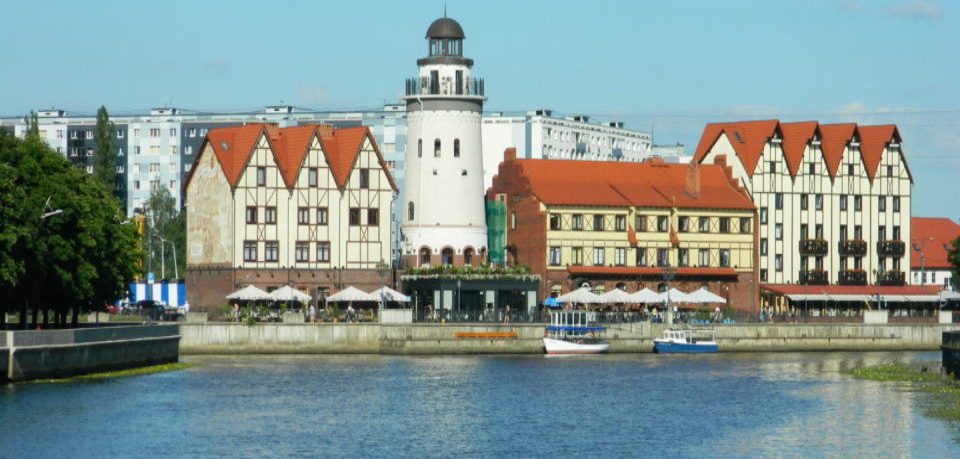
In autumn, when Kaliningrad is a sea of russet browns, auburns and gold, you can expect to delight in leafy vista journeys retracing the transport pathways of old Prussian Königsberg. On the way, you will meet with the red-brick fortifications housing the Amber Museum, you will circle and swoop by the soaring gothic spires of Königsberg Cathedral on Kant Island and wend your way through the half-timbered Fishing Village, its eclectic array of hotels, boutique shops and cafes embroidered by the Pregolya River.
Unlike Kaliningrad’s buses, big or small, that shoot along at a frantic pace, Kaliningrad’s trams offer the tourist a more sedate travel experience, allowing that smartphone camera of yours to earn its pocket- and bag-bulky keep whenever an ancient or Soviet landmark yearn to become your keepsake.

Identifying Kaliningrad Bus Routes: If in doubt, ask!
The one consideration, and it is a relevant one, that a lot of travel guides forget to mention, or suggest you tackle with ‘handy learnt phrases’ is the language barrier. A short course in Russian specifically tailored to bus-type questions could be in order, but are you going to? And will you? Really?
Whilst there is no shortage of public transport to get you where you want to go, strangely enough, apart from the Arabic numbering system, all destinations are written in Cyrillic. You could, of course, ask someone waiting for a bus, except that most of Kaliningrad’s city bus stops are fairly, if not, frantically busy, so there is little time to get out your phrase book or resort to your translation app. With the latter, however, you can at least stop and and ask someone what you want to know before you reach the bus stop; a precaution simple enough, but one I have found that works rather well. Alternatively, see below: nothing ventured, nothing gained.
| What You Want to Say | Russian (Cyrillic) | Pronunciation Guide | When to Use It |
|---|---|---|---|
| “At the stop, please.” | На остановке, пожалуйста. | Na os-ta-nov-ke, po-zhal-uy-sta | Call this out to a mini-bus (marshrutka) driver when you want to get off. |
| “Do you accept cards?” | Можно картой? | Mozh-no kar-toy? | Ask the bus conductor if you want to pay with a contactless bank card. |
| “One ticket, please.” | Один билет, пожалуйста. | O-deen bee-lyet, po-zhal-uy-sta | Use this when buying a single ticket with cash from a conductor or driver. |
| “Does this go to…?” | Этот идет до…? | E-tot ee-dyot do…? | Show a landmark name on your phone to double-check if you are on the right vehicle. |
| “Are you getting off at the next one?” | Вы выходите на следующей? | Vy vy-kho-dee-tye na slye-doo-yush-chey? | Say this politely if someone is blocking the exit on a crowded bus. |
Getting around Kaliningrad: The Last Word … or more
Kaliningrad’s internal transport system is like a perfectly handcrafted toupée: it works, is convincing and you can’t see the joins. If anything will be daunting to the city’s first-time visitor, it will not be for want of ways to travel but the many ways of travelling and the umpteen routes to travel on. Navigating the hybrid options provided by the transport system may take some getting used to, but, once you’ve passed your logistics exams, getting around Kaliningrad is, as I should have made clear at the outset, really a bit of a doddle.
Associated posts
How to Get to Kaliningrad from the UK
Is the Poland-Kaliningrad Border Open?
Russia Kaliningrad Visa Information
From Kaliningrad to Zelenogradsk and Svetlogorsk
Copyright © 2018-2026 Mick Hart. All rights reserved.