2 July 2024 ~ Vote Rough Speaking Parker for a Better UK!
The rough-speaking cockney geezer who, like Nigel Farage, is to be congratulated for injecting life and humour into what started out to be the most dull as dishwater general election ever, is, it would appear, a well-spoken actor, who was certainly, definitely, absolutely not hired by a hard-left British media corporation, who had employed the man before and who just happened to have an undercover reporter in the right place at the right time, that is on the day that Parker volunteered to canvas for Reform.
If Parker is to be exonerated for anything, apart from his wonderful accent (I have met him a thousand times in back street London pubs and seaside resorts in Essex.), it is for seizing the opportunity to say nationwide exactly what he thinks (and he may speak for many others) about British politics and ‘British’ politicians and to offer his solution (which others may secretly back, but not whilst being ‘secretly filmed’) to the single most-important issue of our time, the immigration crisis. My only criticism of him is that I wish he would stop bleeping and just say f*ck like most British people do. British women are particularly good at it; saying it, I mean.
Vote Rough Speaking Parker for a Better UK!
A seaside sideshow, the manifestation of the intemperate use of a truth serum, staged or not, the ‘secret’ filming of Parker revealed him to be an incisive and deliberate thinker, able to offer cheap, though admittedly somewhat unorthodox, solutions to the UK’s ‘small boat’ problem. Whilst Parker may never be nominated for a chance to win the Nobel Peace Prize, as many lefties are ~ he talks too posh for that ~ the Parker Solution, as his advocates call it, is certainly worthy of serious debate in the forthcoming sitting of Parliament.
For the time being, however, I shall stick to my guns, not Parker’s, and vote Reform. But if this man, Parker, ever attempts to act himself into Number 10, and he’s far more likely to get an Oscar than Starmer in that role (I have the feeling that Starmer will play a strictly walk-on/walk-off part.), then I’d vote for him in a heartbeat.
Vote Rough Speaking Parker! His Parker Solution is bang on target!
Breaking Wind and News Just Out (Broadcasting source: Across the English Channel~4) (in fact, more than 4, there’s boat loads) Rough Speaking Parker may form new UK Outrage Party
Here’s something you’ll want to take advantage of 🤔 A one-time discounted offer of a free day out in Clacton, if you enrol now in Mr P’s “‘ow to talk ruff, like me … guvna!” course. Plus, a special ‘Meet Nigel Farage the Prime Minister in Waiting’ coupon for ex-prime ministers of the disgraced and soon-to-be defunct Conservative party. Email Channel 4-and-a-half using the catchline: *F*cked up by our own ‘secret’ filming*
Nigel Farage shakes up election in a bid to rescue Migrant Beleaguered Britain
Update 30 June 2024 | First published: 11 June 2024 ~ Nigel Farage Election Hope for Migrant Invaded UK
30 June 2024: Thought for the day: A ‘carefully selected’ BBC Question Time audience, Woke cries of Racism and other tricks to incense the brainwashed and get the liberal sheep barking, demonstrates how terribly frightened Britain’s fifth column is of Nigel Farage’s mission to take on the establishment and save the country from its dystopian fate. A vote for any other party other than Reform is a vote to put the last nail in the coffin of your country.
You cannot trust the mainstream media. You cannot trust the UK’s old political parties. It’s the usual dirty tricks time as the pseudo-libs go running scared …
Nigel Farage: Not frightened to speak out
Imagine waking up the day after the election and finding that the only truthful man in British politics, the one that the pseudo-left are knicker-twisted about, has won the General Election. Yes, Nigel Farage is in! Not only would the UK have someone in office who means what he says, who is a true patriot, who is not frightened to speak out about the iniquities and threats of socially engineered immigration, who would enforce his call for net zero migration and put British people first, but he and his Reform party would change the landscape of British politics forever ~ and forever for the better.
First off, the immigration problem would be kicked into touch. Farage recognises, or rather is willing to state what other politicians are too frightened or too self-interested to acknowledge, that immigration, particularly illegal migration, is the single most important issue of our time.
Nigel Farage Election Hope
In this YouTube video, the ‘Negative Impacts of Immigration’, https://www.youtube.com/watch?v=KYHOmT0f13c footage is included from the topical debate programme Question Time, in which Nigel Farage spells out the negative impact immigration is having (and remember, this address was made in 2016!) on local school placements, GP access and young people’s chances of getting on the housing ladder. More importantly, he makes a case that the globalist fallback on the economic advantages of never-ending, uncontrolled and unvetted migration is not nearly as significant as the negative impact it has on quality of life.
Hitting the immigration nail firmly on the head is Farage’s forte, but he stops short in his definition of quality of life of including the deleterious effects of an increase in serious crime and terrorism, the loss of safety on our streets and the disintegration of social cohesiveness*. An interesting point, however, flagged in this video is that the population of the UK has risen by 10 million since 1997, when Tony Blair came to power, 85% of which is directly due to immigration.
“A foreign court in Strasbourg [is] telling us how we can control our borders” *Nigel Farage*
Comments accompanying the video, ‘Negative Impacts of Immigration’ provide a consensus of opinion of what ‘quality of life’ entails:
@yamyam3905: Why do you think you can’t get a council house ? Why do you think you can’t get a doctor’s appointment, Why do you think it takes you hours to drive anywhere. Why do you think you can’t get your child into a school. Why do you think people are too afraid to go out at night ??????
@veronicapetersen8915: Welcome to South Africa since 1994. This … happened in South Africa since and we were silent we just went with the flow. [Note: Good comparison. Another good comparison would be Sweden, which owing to its open-door immigration policy is rapidly descending from dysfunctional to dystopian.]
@garyfallows1123: If Enoch Powell had been listened too, Britain wouldn’t have this problem. [Note: Ah, Gary, the Usual Suspects are as frightened of Enoch’s ghost as they are of Farage’s presence]
@bobcat2378: It is high time the house of lords was abolished! [Note: And with it the dictatorship of the European Court of Immigrant Rights and the Europhiles Convention on Migrant Rights and any connection we have with these two manipulative networks.]
The question “Why do you think people are too afraid to go out at night?” and allusions to South Africa derive from the routinely unpublicised perception that UK society largely is, and UK streets predominantly are, unsafe.
Just off to the local shop, dear, to buy the Guardinistan
To put it bluntly, the economic argument for supporting immigration palls into insignificance against the perceived need to wear a stab vest whenever you walk up the street, and the pragmatic need to weigh the odds of survival before attending a concert, theatre production, before participating in a major event and assembling in any crowded place for fear of nutters brandishing knives and detonating bombs*.
“Our towns and cities are literally becoming unrecognisable in every way.” *Nigel Farage*
Let’s rerun the intro to this post> Imagine waking up the day after the General Election to discover that the Reform party had taken office with Nigel Farage as leader. Nigel Farage as Prime Minister of the UK. Wouldn’t that be handsome! It would truly herald a new dawn, not only for British politics but for the positive fate of our once, but no longer, glorious country.
Sadly, however, as Nigel Farage points out in his recent Talk TV interview, such is not possible [see video]
Mike Graham, the host of the show, asks Nigel, why they, Reform, “are not looking at going all out and winning?”
Farage replies simply and honestly that it is impossible. The political voting/electoral system does not permit it.
“If this was proportional representation … an Italian-style system, a Dutch-style system, I promise you, I’d be sitting here saying ‘I can be Keir Starmer’,” says Farage. I trust he did not mean that in the literal sense!
What Nigel does not say, but he could have, is that the UK ‘first past the post’ voting system is rigged, insofar as it ensures that the grossly imperfect status quo of British politics goes virtually unchallenged. In this respect, the UK’s democratic system is no different from any other: it is a managed one. The Old Guard, Liebour and the Cons, will stop at nothing to keep the seesaw going, ensuring that every five years the same two tired, past-their-sell-by-date parties jockey for prime position.
Nigel Farage Election Hope
On the issue of immigration, the most important issue of our time, the Tories have proven themselves to be woefully inadequate ~ fourteen years of woefully inadequate. The explanation that they have been too busy fighting amongst themselves to run the country properly is a credible one, but methinks it is only half the story.
To give the Tories their due, the one thing that they were successful at was drawing the British people’s attention away from the real threat to our society, immigration/migration, by instituting mass hysteria, first with coronavirus lockdowns and calls for successive jabs and then with Ukraine.
INCOMING!!!
In both cases, instead of listening to the siren warnings that Farage & Co were sounding, apprising us of the threat to social stability and British values posed by the migrant invasion, our sorry excuses for leaders were urging us to change our avatars, first to ‘I have had my vaccine’ and then to the colours of the Ukrainian flag. Whilst the majority of Brits were falling for these ploys, our streets were becoming steadily more dangerous, terrorist plots and acts were increasing and the economy nosedived dramatically.
Coronavirus costs and the wasteful moral and economic extravagance of arms shipments to Ukraine became the government’s get out clause for price hikes on almost everything. Migrant hotel bills of £8,000,000 a day is a lot of money to find. It has to come from somewhere folks! Isn’t it all so wonderfully liberal!
Meanwhile, Labour, the party without any policies, who opened the floodgates to mass immigration in 1997, looked on dumbfounded: Could the Conservatives really be beating them at their own game, upstaging them in the race to divide and rule and inflict grievous racial harm on a moribund British society? They could hardly believe their left-wing binoculars as boat after boat of migrants romped in.
The most important issue of our time, immigration, is a good yardstick with which to measure how closely aligned the agenda of the UK’s main political parties has become under the auspices of the globalist-liberal cartel.
It also discloses how crucial the ‘first past the post’ system is for ensuring the permanency of a two-party political system.
“The national debate on immigration has gone so far to the left during 14 years of Conservative rule“ *Nigel Farage*
This raises the question that If our ‘first past the post system’ is a deliberate bar to any small party making significant headway against the old two, which it is, then what can Farage and his Reform party hope to achieve by standing in the election? Farage claims that he is not ‘back’ just for the election but for the long haul, to build Reform into an effective opposition to a Labour government, which I suppose means a political entity that is capable of holding a Labour government’s every suspect bill and anti-British policy to account, especially with regard to immigration.
“The Conservatives are going to be in opposition, but they won’t be the opposition” *Nigel Farage*
Imagine how mortified Liebour and Cons must be, recalling Farage’s superlative performance in the European theatre of politics. There he will be, in the House of Commons, meting out the same indomitable and no-holds-barred Farage treatment that he visited on the despots of the European Union. The thought of Nigel in the House of Commons asking awkward questions about failed immigration farces and every other wokist kowtow must already be giving his enemies in and out of Westminster the most collusive shit fit. How entertaining it is all becoming. At last a ‘reality’ programme worth paying one’s TV licence fee for.
“It’s like D-Day in reverse!!” Nigel Farage, commenting on the UK’s migrant invasion
We must all by now have grown accustomed to the lead-in-to-election blackmail that a vote for another party other than the establishment twins is a vote for the twin you least like. Within the straitjacket restrictions of the ‘first past the post’ system, this perhaps is the most honest thing our politicians tell us.
From the word ‘Go’, even before Nigel Farage threw his cap into the ring, the Tory party were falling back on the old tried and tested mantra that a vote for Reform will be a vote for Labour. And what? It’s worked before, but who cares now? The miserable performance of the Tories in the past 14 years has clearly demonstrated, particularly with regard to immigration, that apart from the old school tie there is fundamentally no appreciable difference between the mainline politics of Cons and Labour, most of whom are Europhiles, and, one would have to be daft not to suspect, in the globalist paymaster’s pocket. As for ‘throwing away your vote’, Liebour and the cons are so much and so often in the same bed together when it comes to globalist policies that you will be buggered if you do, and buggered if you don’t, merely, I hope, in a manner of speaking.
So, the message this time around is don’t worry about ‘throwing your Tory vote away’, because in their present form they are Tweedledee to Labour’s Tweedledum, and the foregone conclusion is that Starmer and his crazy gang are going to get in anyway ~ that is the nature of British seesaw politics.
See Saw Everyone’s Sure Brits will have a New Master Democracy is a cross in a box But it’s always a liberal Disaster
The net result of this farcical catastrophe will be a doubling down on all things detrimental to British values and our British way of life. But take heart, the cloud may yet have a silver lining ~ of sorts.
Will Labour bring it on!
The socio-political situation in the UK is so dire now that it can only get worse and in one sense ~ Hobson’s choice ~ the quicker it does the better. In other words, if there is going to be a ruck, best get it over with, and at this point in time, the advantage is yet to be lost. Give it another decade, however, and if things in politics don’t radically change, there will be nothing left to fight for. So, the completely favourable thing about Liebour coming back to power, albeit a grim but realistic one, is that by facilitating the migrant invasion and pushing all those ‘ists’ and ‘isms’ to the top of their agenda, they will be sure to stoke division faster than the Tories ever could through culpable indolence and sheer ineptitude, and up will go the powder keg one way or another. Let’s face it, the question of the end game is a question of ‘sooner or later’. It is not as if it will not happen.
Time for the UK is fast running out …
A peaceful, but Britons-first resolution, is clearly what is needed. But that can only be brought about by a strong and determined leader with strong and determined leadership skills. Wishy Washy no longer washes. The UK has past the tipping point.
Nigel Farage Election Hope
So, if you want more of what we already have and don’t want, such as millions of third-world migrants, draconian tax increases to pay for them, more street crime and candle-lit vigils*, more division in the name of diversity, destabilising sectarian politics, more houses, roads and cars and more hypocritical soundbites about environmental issues and saving the poor old planet, less money in your pocket, less valuable items left in your homes after visits by Burglar Bill* and no Old Bill to follow it up as they are all too busy monitoring tweets, no-go areas in towns and cities, even no-go towns and cities, and a suffocating smog of woke ~ if you want, in effect, your once great country to look and to be like South Africa, with a distinctly Swedish flavour, then put your ‘X’ in the box for Labour.
What’s that I hear you say? “It can’t get any worse!”
Updated: 30 June 2024 | First Published: 29 January 2023 ~ Zelenogradsk Restaurant BALT a Lesson in Harmony
I’m sure, almost certain, that it was not there 18 months ago when I last visited Zelenogradsk (doesn’t time fly!), but it was there now. I am talking about a new restaurant ~ new to me ~ that sits smack bang at the midway point of Zelenogradsk’s serpentine high street: a large, impressive, luxurious establishment set back from the street inside a broad paved plaza, its plate-glass single-storey extension forming a scaled juxtaposition against the taller four-storey building to which it is attached, the latter meticulously refurbished to a grand and imposing standard.
In the winter months when we were in town, the first impression of this restaurant from the outside looking in was PC; that’s not politically correct, but plush and cosy.
It was bitterly cold that day, and if the hallmark of a successful bar or restaurant is principally defined by the pulling power it possesses to tempt one off the street, then rest assured Balt restaurant has it.
Oh, did I forget to tell you? The name of the restaurant is Balt.
The first impression from the exterior of the building, which is so categorically bourgeoisie that Lenin had turned his back to it, was swish. I made a mental note, a simple equation: plush+posh+impressive+coastal-resort-town-centre = expensive. So, let’s jump to the bill. We had three dishes, nothing elaborate, a speciality tea and a glass of beer. It didn’t break the bank.
The second impression the Balt conveys is ‘big’. “It’s so big!” say your senses, when perhaps what they should be saying is not that it’s so ‘big’ but “It’s so tall”! In keeping with the modern trend in bar and restaurant design, the Balt is undeniably big, but, initially and accurately, the spaciousness perceived is confined to the height of the ceiling. In fact, the seating area which leads away from the entrance hall is limited to the perimeter of the extended part of the building; it forms the letter ‘L’, being a long, but slightly wider than the word implies, corridor. This is because, once again conforming to popular predilections, the restaurant is built around the kitchen, in other words built to a plan in which a centralised kitchen is King.
In the olden days, restaurants concealed their kitchens as though they were the black sheep of the family, the philosophy seeming to be ‘out of sight, out of mind’. This closeted mentality was an excellent way of keeping patrons on edge, since they never knew come the following morning, having enjoyed their meal the night before, whether their friends would be ready and waiting to scream, “You didn’t eat there, did you!” and then hamming it up with relish, proceed to recount in lurid detail the latest hygiene scandal.
Today, there is no need to be told by the ‘well-meaning’ ~ friends, family or the media ~ what goes on in restaurant kitchens, because everything is on display and laid out for the eyes to see. Restaurant kitchens have come of age. They are open, accessible, uninhibited, something to be admired, something to be proud of, not hidden away like a seedy back room in the depths of a mucky book shop. Restaurant kitchens have been emancipated, and a large part of that liberation lies in the transformation from an observance of cautious propriety to out-and-out exhibitionism.
True, some bar and restaurant designs tend to over-egg the soufflé. Displaying a kitchen eagerly in all its stainless steel, hygiene-oriented, busy, industrious, functioning glory is one thing, but it is quite another and quite inexcusable to overdo the exposure. Thankfully, Balt’s kitchen is a far more sophisticated and in-keeping centrepiece, enabling it to escape comparison with a man in a mac on a hill surrounded by too little foliage. I think the word I am searching for is ‘subtle’.
In fact, everything about Balt, not in its individual accoutrements but taken as a job lot, regarded in its entirety, is the epitome of subtle. How this works exactly is rather clever, because Balt is far and away not without a surprise or two, not undernourished in novelty.
Zelenogradsk Restaurant BALT
We were able to appreciate both the component parts of this dichotomy and its overarching effect from the favourable location of the table to which we had been escorted. The seats to which we had been shown occupied the latter portion upon the longer extension of the ‘L’ shaped room, almost at its inflection, thus availing us of a first-class view of each and all the different elements, which, when assembled as a whole, add up to the Balt experience.
First off, we were close to the kitchen, just a few feet away from the serving area: a long, curved counter on which chefs add the finishing touches to the dishes they are preparing before popping them into the tandoor oven, and from which attentive waiters pick up meals that are ready to go.
From our vantage point, we had a privileged view of the kitchen and the floor-to-ceiling tandoor, a large cylindrical-shaped oven used for baking unleavened flatbreads and for roasting meat. Once the open oven door and blazing fire beyond had ceased to remind me of crematoria, it was fun to watch the chef at work, sliding the various dishes and breads into the wood-fired oven with the help of a peel, a long-handled shovel-like implement with a flat metal pan attached to its furthest extremity.
Looking straight ahead, I noted with satisfaction the high-backed wooden chairs belonging to the nearest table. The back rests consisted of two vertical ebonised planks slightly angled toward one another. Close to their highest point a pair of semi-circles had been cut out so that in alignment they formed a circle. The only other concession to decoration was the seemingly random inclusion of small, pierced motifs ~ simple shapes which donated a touch of mystique without disturbing the minimalist balance.
My forward view also provided examples of ingenious lighting styles, including a heavy, orange tassel-roped pendant and lampshades mimicking small sheaths of straw.
The tables to the left and behind me were objects to be marvelled at. The tops were made of marble, the ends scalloped to give an uncut look. They were supported on a cluster of angled posts, recycled wave-breaking poles, some of which had been allowed to protrude through the table’s surface, and hovering above them with remarkable pendulosity was a clump or cluster of shell-like bowls, off-white in shade and in shape asymmetrical, which had me wondering, out loud as it happens, if they were really made from the pumpkin skins I imagined they were or from moulded papier-mâché
Every item in the Balt’s atmospheric makeup is an imagistic letter in the word and concept of ‘Natural’: wood, stone, fire, rope, straw, vegetables. At one end of the subtle spectrum, Fred Flintstone and Barney Rubble would not look out of place, but the Balt’s natural is a polished natural that borrows as much for its appeal on the application of chic sophistry as it does from down-to-earth and back-to-nature.
For all its emphasis on the natural world, Balt’s designers’ have hedged their bets, choosing not to preclude but include the fashionable tried and tested, omniprevalent in bar and restaurant, distressed industrial look.
This approach has become so widespread that it has gone beyond ‘must have’ to ‘can’t do without’. In the Balt, it has gone one further, becoming ‘Would you Adam and Eve it, the concept actually works!’: rocks, marble, stoneware vases, corn plants, vegetables and pieces of tree, rub along quite nicely, thank you, with gnarled brickwork, whitewashed slat-board, old beam ceilings, exposed ventilation ducts and suspended arty farty spots.
It is a tribute to Balt’s interior designers that they have managed to pull off a subtle, seamless fusion of modern chic and reclaimed-rundown and then wrap it all up in an eco-friendly ethnicity.
In a nutshell ~ and I am sure that Balt would approve of the use of such natural imagery ~ the key word to Balt’s come-hither and dine-within appeal is harmony. Everything, including things that would normally be at odds with each other, are wedlocked. It might be a marriage of convenience, but one that is no less perfect for it. Even the ethnic music, with its emphasis on tom-tom beat and repetitive chanting, is low-key, Sade-like and subtle.
At the centre and everywhere else of this is lighting. I’ve said it before; I’ve said it again; I’ll say it again and keep on saying it: from Restaurant Guy Savoy in Paris to The Four Seasons B&B in Brightlingsea, if the lighting is not right everything else will be wrong. Lighting is the magic drawstring that pulls everything together.
Balt’s lighting is soft, suffused and artistically modulated: a harmonising integration of ambient-sensitive ceiling spots and downlighters, overhead table pendants ~ each paired with its own novel shade ~ soft-glow wall lights, natural fire and candles. It’s good, because it works. It works because it’s good.
At this juncture, I know what you are thinking: So much for the Balt’s design; what about the grub?
Those of you who have read any of my bar/restaurant reviews will know that when it comes to food I’m hopeless. Why do I go to bars? To drink. Why do I go to restaurants? Usually because the company I’m in wants to go to restaurants, and so I tag along, but also because, as you may have deduced, I am an ardent fan of interior design and a connoisseur of atmosphere.
As a baked-beans-on-toast man, a man who likes simple food, I cannot provide you with a gourmet breakdown of the range of food Balt has to offer or the quality of its meals, and neither shall I try. However, a quick twirl around the internet should satisfy your curiosity. It might even tell you all you need to know.
Our order at the Balt amounted to a snackette: a spicey vegetable platter on oven-baked bread ~ a white leavened flatbread similar in texture and taste to naan ~ and some exotic-looking poppadoms. It was not in the least expensive, but I will say that presentation took precedence over quantity. Now, were you to indulge in a main meal, the situation may be completely reversed or, like everything else at Balt, a happy medium struck.
I had a beer, naturally. It was palatable but served up in one of those peculiar ‘neither here nor there’ glasses, ie glasses that are neither small nor large, which frankly I find irritating. Half a litre, fine; half a half litre, fine; anything else exceeds my mathematical ability (see Soul Garden post).
The Balt, I am told, offers a range of dishes based on Indian subcontinent fare, which is something of a luxury in this part of the world. The prices are so-so, but not so expensive that they will tear the lining out of your pocket, and the carefully choreographed atmosphere, which is as restful and relaxing as it gets, beats anything I have experienced anywhere else in the Kaliningrad region or for that matter in the UK. Recommend the Balt? I’d buy it if I could!
The main thing Balt (restaurant) Kurortny Prospekt, 16, Zelenogradsk, Kaliningrad region
Angel Park Hotel > An inspirational rural recreation centre on the site of an East Prussian settlement Amber Legend Restaurant > Amber Legend Yantarny, a jewel in the coastal town of Yantarny Fishdorf Country Guest Complex > A family-oriented retreat, secluded and steeped in nature Fort Dönhoff (Fort XI) > An evocative 19th century redbrick fortress, part of Königsberg’s labyrinth defence network Polessk Brewery > Beer, history and German-Gothic architecture (that’s my personal order of preference!)
23 June 2024 ~ Hotel Mercure Gdansk reasons to stay there!
You may recall, if you were listening to me (“Now, pay attention, as I will be asking questions later!” ) that returning from the UK to Kaliningrad, I made the fatal mistake of booking via Booking.com the apartment Tawerna Rybaki in Old Town Gdansk. To all extents and purposes, the apartment never existed, and I was left on the streets of Gdansk, me and my faithful laptop, with nowhere to lay my head for the night.
The subsequent hunt for alternative accommodation was a long and arduous one, eventually culminating, not before time, at Gdansk’s Mercure Hotel.
Although I appreciate that my positive affirmation of the Mercure’s finer points may be tinged by the fact that at the time I was desperate and ‘any port in a storm’ had become my alma mater (original use of the term), in reviewing the Mercure Hotel, I have attempted to put the object of my misfortunes, the bogus Rybaki apartment, as far behind me as I can and write with objectivity.
So, here we go: My first reaction to the Mercure was “Oh, it’s a tower block”; my second, “It looks a tad upmarket for a chap who just wants a bed for the night”; my third, “Bugger this for a game of soldiers, I have been walking around for hours. I need to book in somewhere and head off to a bar!”
Getting the feel of the place
On the other side of its perpetual revolving door, the Mercure’s interior is TARDISial. It’s grand, it’s palatial, it’s swish, say your senses, but once you have checked in and taken a second look your senses qualify your first impression with ‘it is also rather passe’.
The lobby, indeed the Mercure in its entirety, has a distinctly 1980s’ look and a period feel to go with it. It is not faded and jaded, on the contrary, the hotel could not be more 1980s than if it was still the 1980s. And yet, it is not unfair to say that the swish has lost its swashbuckle.
Nevertheless, there is enough of the right thing going on in its aircraft hangar interior to strike the gong of plush. The vast space is broken down into open-plan units: seating areas with big, spongey recliners, coffee-table resting points, unusual modernist sculptures, a shimmering shiny floor, downlighters, uplighters, pendulous globular basket lampshades, and, ah yes, at the back of the room, that all-important traveller’s requisite the hotel lounge and bar. Don’t leave home without one!
It had been a long day for me when I booked in to the Mercure, and I was dying to use the loo, so I was not entirely enamoured when I was given a plastic card instead of a good old-fashioned key. First off, I shoved it in the hole, and it did not work the lift; then I nipped quickly off to the toilet, and it did not work the toilet lock, then when I rushed up to my room in it went and opened the door, ruining whatever chance I had of changing my pants and complaining. Just in the nick of plastic-card time!
My opinion of the interior downstairs décor, that it was 1980s, was given a serious leg up when the lift went ching on the hotel’s sixth floor. In contrast to the capacious lobby, the sixth-floor landing and long, long corridor was a little Alice in Wonderland. I felt as if I had sipped from Alice’s ‘Drink Me!’ bottle, and now my head was touching the ceiling.
The imposing and all-suffusing chocolate browns of the carpet, which match the tones of the doors, the walls and the ceiling, and which are brought into intimate proximity thanks to the carpet’s thick and heavy mercurial globular patterns and their blotting paper absorption of the well-intentioned low-lit lighting, has 1980s stamped right through them like a piece of seaside rock, and the rooms, or at least my room, completed that turn of the retro page.
Turning back the page need not be disagreeable if, like me, you find that direction infinitely more appealing than moving with the times. Thus, although the tones of the hotel room, at least the room in which I was staying, followed the lead of the communal areas in their 1980s’ love of chocolate, the amenities therein neither added to nor subtracted from the context of backdated.
There was everything you would expect to get from a hotel of this scale and calibre. It came in spades and with enough variation to seduce you into believing that it offered more than you had expected and all with an extra air of luxury tinged with a personal touch.
The lighting alone was sufficient to do this to you. Ambient lighting, lighting for reading, mood lighting, soft lighting and lighting to get you in the mood ~ multiple combinations of it and all at the flick of a switch ~ or two.
Not the Hotel California, hence no mirrors on the ceiling, for which I was truly grateful. For I would not wish to inflict on myself a view of myself like that first thing in the morning! But the room did have its fair share of mirrors, including, above the convenient desk, a nice, big, long, rectangular one, which looks a bit like a telly? I could not tell you for certain as I have not used one for years.
The seating was also variegated to suit every type and class of bum. And there was an adequate wardrobe with sliding doors and adequate chests with sliding drawers. And a bed with a firm and comfortable mattress, on which to sleep and what have you.
The 1980s was not so primitive as to exclude the presence of an ensuite bathroom, and neither, I am glad to report, was my 21st century room. It had a credible bath and shower room and even contained a toilet, which was just as well in the circumstances, as a tower-block hotel with a lavvy out back in the yard would be mighty inconvenient.
Ah, excuse me, I almost forgot, there was also a safe to put things in, if only you knew how to use it (I believe you put your bits inside, then close the door and lock it Mick.) (Quite so.), and the room comes equipped with its very own window, which is useful for letting in natural light, which if there was no window, you would need to bring your own natural light, and, of course, when letting in light and even when it is not, the window comes in handy when you get the urge to look out of it.
I am not about to pretend that the view from my window was actually inspiring, but equally shall not argue that it was not. As the photograph below reveals, the view does capture Gdansk; the new Gdansk and the old.
Excited by the red-brick church, you swear on a pint of good beer that as soon as you have unpacked your things, attended dutifully to your reasonable ablutions and put on a different cravat, you will point your brogues decisively in the direction that you want to go and permit them to carry you off towards the architectural/historic masterpiece that those ever-inventive Poles did christen the Old Town.
Unfortunately, however, although the Mercure Hotel is devilishly close for on-foot types to the town’s historic quarter, my shoes belong to an era, as I do myself, in which modern navigation aids play no understandable part.
I could have asked the way of course, but that would have been too easy and obviously much too sensible, and so, of course, I didn’t. I simply relied on my sense of direction, and for once I got it right.
This is something else that speaks in Mercure’s favour. If, like me, never becoming a navigator was one of the most applaudable things you did in your life, then the Mercure should appeal to you. Its name emblazoned in bright white light at the very top of its tower acts like a lighthouse beacon. It can be seen from many points of the compass and therefore can be used in co-operation with other landmarks to guide you safely home in the unlikely event you have drunk too much after a night on the town.
In summarising my Mercure experience, I would say “a solid hotel ~ rock solid”. Comfortable, appealing ~ in a slightly old-fashioned sort of way ~ and supremely atmospheric, it effortlessly brings together the feel of a hotel somewhere above its station with a kindly welcome that is home-from-home. The bar, my natural habitat, has that cushty, big upmarket hotel, relaxing, come-hither air. You just order yourself a drink and sink yourself carefree into its soft and sumptuous seats. The staff are as pleasant as they are helpful; the service cannot be faulted. Everything around you is as easy on the eye as it is upon the senses, which is quite an achievement in itself as the hotel contains some visual surprises. And in its relativity to Gdansk’s Old Town and to the central railway station, if any hotel deserves the accolade of being well-appointed then that hotel is the Mercure.
I know and I do appreciate that on that fateful day when I first laid eyes upon it, the Mercure appeared on my troubled horizon like an oasis in a desert of lies and deceit, but be that as it may, from any objective viewpoint, the Mercure delivers the goods and with it value for money. What else would you expect? It is not for nothing that it derives its name from the Roman God of Travellers!
The main thing
Hotel Mercure Gdańsk Stare Miasto Jana Heweliusza 22, 80-890 Gdańsk, Poland
Craft, Imported and Specialty Beers: Keptinis (Farmhouse Beer)
Mick Hart’s difficult job of reviewing craft, imported and specialty beers in Kaliningrad
6 June 2024 ~ Keptinis (Farmhouse Beer) in Kaliningrad is it good?
“Anyone for tennis?”
Hardly!
“Anyone for Keptinis?”
I should say so!
‘Keptinis’ ~ it doesn’t exactly roll off of the British tongue, does it? How I remember the name of this beer is to think of a sport I don’t like. Problem is there are many ~ football, cricket, rugby, tennis, I have a healthy dislike of them all. But for the sake of recalling the name of a beer, and a very good beer at that, no sacrifice is unjustified.
Thus, I take the silly game in which three rackets are involved, two that are held in hands and the other that coins in money, and, by the simple cross-referencing method, I think of that common earole complaint medically known as tinnitus, but spelling it wrongly ‘tinnitis’, and I allow the tail of the misspelt word to wave in my direction. Then all I have to do, by way of association, is to think of a beer so all consuming that it would save me from anything foolish or rash, like playing or even watching tennis, and ‘kept away from tennis’ thus, with tinnitis in my ear, I say it so fast it becomes ‘Keptenis’, which is as near to Keptinis as dammit and as damn them is to a boat load of migrants steaming into Dover.
An easier, far less linguistically challenging means of bringing this beer to mind is to focus on the label. With its striking green and yellow shapes and the stovepipe hat and long moustache of its mysterious pop art poster man, it really is, to coin a phrase and in the process mix two metaphors (which like mixing race is never advisable), the ultimate dog’s whiskers, and just to please the equality conscious, the absolute cat’s bollocks. Mix your metaphors if you will, but before you go mixing anything else, for heaven’s sake think of the pups.
Keptinis is a mixed-up beer. The moment you flip the Keptinis stopper you are nose to brew with a different species. This is no simple mass-produced, wishy washy paleface lager or bland keg-bitter fizz bomb. What you have is a subtle hybrid. So subtle, you may not know what it is, but it sure as hell smells different!
So, there I am, sniffing away like a kid in a baker’s shop. Although, I never was a kid, as I never was American. And my first reaction to Keptinis is: For what I am about to receive, will it taste like liquefied rye bread?
“Is there any body there?” I ask, like the only one at a lonely guy’s séance.
And remarkably there is. An awful lot of body. Almost too much in fact (and also too much in fiction): a crowded coven of smell apparitions which, in no one order of merit or preference, gives vent to nasal impressions like dried fruit, molten caramel, aromatic scents, spices of the orient and something not dissimilar to chestnuts roasting on an open fire.
Whiffed from within the glass, the subtle and complex combination of deep and rich aromas give way to a smell that is more pronounced, more reminiscently rounded. The jury is out on the soft drink kvas, which is, it may surprise you, mildly alcoholic, while at a stonking 5.7% Keptinis commands a virile strength that by any stretch of the wotsit is hardly soft and rarely limp.
The creamy head that flows profusely and lathers up at the top of the glass looking like old-fashioned shaving foam is a sight for proverbial sore eyes, especially eyes up North (It’s looking up at those pigeons that does it. Why are they all wearing head scarves these days?). But it reminds me more of ice cream; Mr Whippy passing his flake. It was all 69 in the ’70s. (That’s ’99’ with a bit knocked off.)
Keptinis (Farmhouse Beer) in Kaliningrad is it good?
The first mouthful revs up your kvas. Talk about turbo-charged! The taste is full-throttle and it comes at you fast, bouncing from taste bud to taste bud, like brown ale on a Friday night down at the working It’s club, and though incipiently and enduringly dry, both the finish and the aftertaste possess a hitherto secret hint of a not unlikeable sweetness.
The contrast is right-on punchy and funky. To give it a visual translation, a kind of non-binary gender-neutral pole-vaulting limbo dancer strutting her stuff on a pinball table. Please, if you must indulge you fantasies, Keptinis them to yourself!
Some beers are disappointing. They flirt with you in the early evening yet fold before the evenings through, after parting with your money. You might just as well have sat and drank tea whilst watching some tripe on the BBC (It rhymes!) Is this something else you shouldn’t have paid for? A lie, lie, lie, lie, lie-sense. Look out, you’re being investigated! Will you be in next Thursday? You bet your wife I will, but possibly not for the rest of the week! (Sorry, that’s an ‘in’ joke.)
Of all the things on God’s great Earth that are not worth the salt of being kept in by, the BBC is top of the pops. They forgot to investigate Jimmy. But even without a TV licence, I would do everything in my power not to be kept in by a Liebour party political broadcast, or by something equally appalling and unequivocally just as implausible, which rules in coronavirus. And I never have, at least to my knowledge, been kept in by the rogue desire to watch a game of tennis. I would rather stand outside in the street and laugh at cyclists in Lycra shorts. Yet, to be keptin by Keptinis, now that is a horse of a different colour. We won’t divulge which colour (clue, it’s nothing to do with Persil) or we may be coerced into ruining our trousers, along with our integrity, by doing something really stupid like taking a virtue signalling knee. Ho! Ho! Ha! Ha! He! He!
Thankfully, Keptinis is 100% hysteria free: a ‘no one size fits all’ beer that bucks (Did I get that right?) the stereotyping straightjacket. It is less insane than more well-balanced, and though it does resemble kvas, in unassuming and subtle ways, especially if you smoke, has flavours hidden deep within arranged in such cunning and clever ways that the taste bouquet only glitters (all that glitters is not Gary) by slow and teasing degrees, which is all to the ‘so say all of us’, hooray! ~ for Keptinis, it is telling us, is not a one-glass beer and that in order to fully appreciate the deluxe brew it surely is, you have to finish the bottle. I suppose it is what is colloquially known as a drink that is rather morish.
They say, and they are always saying, and I suppose they always will, that the saying about the ‘good thing’ of which, it is said, ‘you can have too much’, will, if you say it often enough, get in the way of the very thing that you cannot get enough of. But shucks (and a word that rhymes with shucks), what the hell do they know!
“Anyone for Keptinis?”
Everyone, I should think.
Disclaimer: Keptinis bears no resemblance to cyclists living or dead or to anyone else not as daft as cyclists who nevertheless would not be seen dead in a pair of Lycra shorts? (sponsored by the Save Me from Being a Sheep Society and the Campaign for Corduroy Trousers in association with Bicycle Clips)
BOX TICKER’S CORNER Name of Beer: Keptinis (or is that ‘Keptenis’?) Brewer: Aukštaitijos Bravorai Where it is brewed: Lithuania Bottle capacity: 1litre Strength: 5.7% Price: It cost me about 230 roubles in 2021. More recently in Kaliningrad, it cost me about 399 roubles/£3.44 Appearance: Dark Aroma: Not unlike kvass Taste: Predominantly caramel but with other things going on Fizz amplitude: 3/10 Label/Marketing: Pop Art Would you buy it again? Faster than I would buy the Labour party’s policies
Beer rating
About the beer: Aukštaitijos Bravorai | Keptinis
Keptinis is categorised as a ‘Farmhouse Beer’, a rare beer, difficult to brew, native to Lithuania. It is called ‘farmhouse’ for the very good reason that it was traditionally brewed by farmers. Rumour has it that as the special kind of malt that was needed for the brewing process was cost and distance prohibitive, the crafty farmers would create a mash and then bake it at high temperatures in order to produce the distinctive caramel taste for which it is renowned.
The brewers, Aukštaitijos Bravorai, refer to it as an ‘Oven Unfiltered Beer’ and describe its unique personage thus: “This beer stands out because it uses not only caramel and Pilsner malts, but bravura roasted malts, which give this beer a mild bitterness and aroma. Beer after fermentation and maturation has a frozen taste and a dark color.”https://www.aukstaitijosbravorai.lt/
Wot other’s say [Comments on Keptinis (Farmhouse Beer) from the internet, unedited] 😑Taste is close to aroma, but with harsh yeasty note. [Comment: Yeasty note, yes; harsh, no]
😊A very rare farmhouse style [Comment: Wellies and all the rest of it?]
🤔Initial malty flavours soon got tired, it really needs some hop bite to balance it out [Comment: Your application for tightrope walker has not been successful]
😊 Kvassy, super bready, yeasty and bit funky, bit caramelly sweet and quite bitter [Comment: Yesy, very goody, welly saidy]
Promenade Apartments Svetlogorsk Showcase Stylish Living
30 May 2024 ~ Svetlogorsk Promenade a New Chapter in its History
At the point at which the new stretch of promenade on Svetlogorsk’s coastline meets the old, a broad canvas containing an evocative black and white photograph of the promenade as it appeared when Svetlogorsk was German Rauschen effectively softens the large metal fence behind which work is ongoing to upgrade the original walkway.
The photograph, which was taken in the early twentieth century at a time which we in England would call Edwardian, harks back to a quieter, more sedate and less populated period in the evolution of the modern world and in Svetlogorsk’s personal history. In those days, people dressed better (that is, those who could afford to do so), and life, at least in the pictures, had a better feel about it and seemed to move at a far more leisurely pace.
‘Oh! I do like to be beside the seaside! I do like to be beside the sea! Oh I do like to stroll along the Prom, Prom, Prom!’ ~ John H. Glover-Kind (1907)
Fast forward to the third decade of the 21st century:
Walking along the ‘Prom, Prom’ ~ as there are (or nearly are) two in Svetlogorsk ~ has not been the easiest thing to do in the Kaliningrad region’s coastal town for quite some considerable time.
First, there was the Sovietised prom left behind by the Germans; then there was a quiet, narrow stretch of beach left behind by perestroika; then there was the construction of a new promenade; then the promised construction of a sparkling, spanking new set of des-res apartments hugging the new prom coastline; and then … and then it stalled.
When the first stage of the new promenade reached accessibility, those of us who had not grown impatient and swapped allegiance for Zelenogradsk, strolled along the ‘prom, prom, prom’; some of us marvelling at what was to come and some, no doubt, bemoaning the loss of the rocky ribbon of beach, with its golden memories of long hot days, the basking bodies of former girlfriends, the odd kapoosta pie or two and a couple of tins of lager.
At this juncture in Svetlogorsk’s transformation from sleepy spa retreat to resort boutique, the old legacy prom with its cafes, restaurants, outside bars and amber-selling stalls was still firm favourite.
Then, possibly a couple of years ago (the memory grows dim), one evening, when the sea was particularly tantrum prone, a section of the old prom surrendered to its attitude problem and promptly fell apart, as old proms and seaside piers have the disturbing habit of doing.
The missing piece was soon replaced, but shortly afterwards came the announcement that the old prom would temporarily close for a period of refurbishment. And that is the way it has been for a proverbial month of Sundays and considerably more than a month of sunny summer days.
Behind the ubiquitous blue and white building-site fences, obscuring both prom and the sea, an extensive restructuring programme to defend the platform from the sea’s worst excesses labours on relentlessly, incorporating a face lift which, when it is finished, I should imagine, aims to bring the old prom cosmetically into line with its glossy, upmarket protégé.
The simultaneous reconfiguration of both of Svetlogorsk’s proms led to the loss of the beach from one end of its coastline to the other. The collateral damage was marked by a substantial tourist exodus from Svetlogorsk to Zelenogradsk, the Kaliningrad regions second resort, and indeed to the other resorts that share the Baltic coastline. Fortunately ~ for Svetlogorsk that is ~ stunning sea views from the uppermost reaches of the coastline’s steep embankment and a seamless stream of investment into the town’s inland facilities and its tourist attractions cushioned the brunt of the blow. And some of us kept coming back just to see how things were progressing. I was one of those someones.
Svetlogorsk Promenade a new chapter in its history
I returned to Svetlogorsk earlier this May, approaching the seafront via the Central Staircase, the great parade of steps that since 1974 has led to the giant sundial. The steps still go where they have always gone, but the sundial, including its brilliant tessera mosaic based on the signs of the zodiac, appears to have been uprooted.
Above: Svetlogorsk Sundial in June 2021 Below: The same location as it is today, photographed from the Central Staircase
In a less exuberant period, before Svetlogorsk was ‘discovered’, when a ‘permit’ was needed to enter the town by car, as it was then considered a health resort in which the ozone air was sacrosanct, the sun dial, designed by Nicholas Frolov, was counted along with the water tower as one of the town’s star attractions.
On an evening in the year 2000 ~ it was the month of December and blisteringly cold ~ I took hold of the sundial gnomon, the upright blade that casts the shadow. “I shouldn’t have done that,” I thought. “My hand is freezing to it!” And then I thought, “I am actually here. I am actually here in Russia!” That moment was quite symbolic; quite a personal moment. Let’s hope they put the sundial back. They ought to, don’t you think? If only just for me.
Svetlogorsk Promenade a new chapter in its history
As it is no longer possible to access the old promenade due to its debasement as a construction site, a temporary boardwalk filters pedestrians onto the new promenade (Novyy Promenade), where ~ lo and behold! ~ after what seems like a brief eternity, or the torturous interval we had once to endure between the opening times of English pubs, the foundations for a three-phase series of swanky new apartments are finally metamorphosising into the shape of things to come.
You can see what this stretch of coastline looked like in the earlier stages of the apartments’ construction by clicking on the following links:
This is the closet that I have been to a high-rise building site in years, and it must be said, for want of a better reason, such as getting onto the beach, it is worth toddling off to Svetlogorsk to see exactly how they do it, build buildings that high, I mean, and by becoming a casual observer catch history in the making.
Before gawping skywards, it is interesting to study first the full-colour canvas banners strapped to the baseline hoarding, each containing artist’s impression of how the built coastline will look when the job is completed. Then, when you have matched the buildings in the illustrations to their skeletal incarnations, marvel at the blokes aloft, hauling heavy and awkward building materials from one man to another up different levels of scaffolding and the audacity of those above them, who, defying the laws of gravity, precariously perch on slim steel girders, working away with hammer or drill some seventy feet above your head. It’s enough to remind you of what you could do, although you never would.
Looking upwards is sufficiently vertiginous without the encumbrance of climbing ladders. Best to look to the sea. It does not hurt your neck, and it can be therapeutic.
Above and beyond the promenade wall, which is hefty, tall and chunky, the sea is visibly seeable, but not without a distracting impediment. Someone, when no one was looking, appears to have gone and dumped thousands of tons of granite boulders over the seaward side of the wall, completely overriding what little was left of the beach.
I was asked, as if I was the prime suspect, whether these outsized chunks of stone would remain in their present location or be used to bolster the groynes (yes, I’ve spelt it right!), the heavy pole-shaped wave-breakers that march regimentally in parallel lines from Svetlogorsk’s shore out into its sea.
I knew the answer, of course, but I wasn’t about to let on. It could be that I was busy contemplating what it would be like to own and to live in a luxury apartment overlooking the Baltic Coast.
The sunsets along the Baltic Coast rank among the most spectacular anywhere in the world. Imagine sitting in your des-res flat. Would you ever tire of the spellbinding view? It’s doubtful.
Quotes from the appartment developers’ website “Promenade Life Health Resort A long-awaited project in which you can live, take care of your health, raise children, create and be proud of your heritage”
“PROMENADE is a hotel and health complex with more than 220 turnkey apartments with extensive infrastructure and a high level of service. It is located in a unique location – on the first line of the Svetlogorsk seaside – and occupies almost one and a half kilometers of coastal territory.”
“The Baltic coast is one of the most amazing and beautiful places on Earth. Both romantics and pragmatists will find refuge here. The first will be inspired by amazing seascapes, the second by the undoubted convenience of geography (the Baltic coast connects 9 countries). A place of power is a place where you can relax and conduct business in comfort.”
At present, the new promenade is serviced by one bar and one restaurant only, both integral features of the embankment lift. But when the residential complex is complete, apart from and in addition to the plush apartment interiors, nature in all its natural glory and everything else that Svetlogorsk has to offer ~ eclectic bars and restaurants, good shopping facilities, tranquil woodland walks, engaging cultural and social history, convenient road and rail links both to Kaliningrad and the region’s airport ~ those lucky promenade dwellers will have right upon their doorstep the use of a pump room, spa and clinic all wrapped up in a breathtaking view inside a great location.
You can find more about this desirable lifestyle by clicking the link to the developers’ website here > https://promenad-park.ru/
In the meantime, I will bide my time in the sure and certain knowledge that any day now I will hear the sound of keys dropping into my post box, heralding the arrival of a personal invitation to take complementary possession of a deluxe apartment on Svetlogorsk’s prom.
You have to admit, it’s nice of them. My thank-you note is already written.
22 May 2024 ~ Life in Kaliningrad through the lens of a camera
They could be curated, they could be aggregated, but I suspect that they are a random collection of photographs, some more recent than others, taken in and of Kaliningrad. Judge for yourselves.
Life in Kaliningrad
Above: Trams {Click on images to enlarge} The new and the old ~ and I am not referring to myself. Here am I riding one of Kaliningrad’s latest trams. They are smooth and swish, and you can buy your ticket using touch-card technology. The old trams, c1970s (second photograph), good looks, as far as I am concerned. For me, these two-carriage ‘biscuit tins’ have classic kudos. I love the sounds and the movements they make. I even love the metal seats. Whenever I use these trams, our old friend Victor Ryabinin comes to mind. I can see him now, holding onto the rail at the back of the tram, observing life, as artists do, through the tram’s rear window. Rear Window! That’s a good name for a film.
Above: 2019 Golden Shadow of Königsberg When things were different, and they often are, the Auto Retro Club Kaliningrad held an international and classic car show. The photo of me in a wide-brimmed trilby (a Fedora) was taken in what was that year (2019) the main arena for car competitions, the carpark of the King’s Residence, Kaliningrad’s most elaborate family leisure centre and restaurant complex. (Tweed jacket courtesy of Mr Wilcox)
Orthodox Christian Cathedral Kaliningrad The photograph of yours truly was taken in March of this year (2024) in Victory Square in front of The Cathedral of Christ the Saviour, Kaliningrad. In days of yore, meaning the early 2000s, this spot was dominated by a large bronze statue of Lenin, since removed to another quarter of the town. With the construction of the cathedral, the centre of Kaliningrad moved from Königsberg’s cultural and spiritual centre, directly in front of the Kaliningrad Hotel, to where it is today. In Königsberg’s days, the area known as Victory Square and everything beyond lay outside the city’s defensive walls. (Yes, I know, from a compositional perspective, it would have been much better had I stood so that I was centred in the photograph in line with the door. It annoys me as well!)
< Left: Königsberg Relics A lot of Königsberg was blown into bits and pieces during World War Two, so it is hardly surprising that bits and pieces of its past keep turning up, and a good place to find them ~ in fact the best ~ is at Kaliningrad’s flea market, just to one side of the city’s central market. This photo illustrates why I love this market so much.
Below: QR Code Checkers Here’s a blast from the past ~ and let’s sincerely hope that it remains that way. Here we have QR Code Checking Officers on duty during the Coronavirus era, not letting anybody inside the cathedral unless they had a QR code proving they had been ‘jabbed’. Looking back on this sinister period of history makes walking in and out of doorways unchallenged instantly gratifying.
Life in Kaliningrad
Above: Kaliningrad Botanical Gardens Unlike many cities, you do not have to travel far in Kaliningrad to enjoy nature in its natural habitat. This photograph captures the tranquility of the lake in Kaliningrad’s Botanical Gardens. It was taken in autumn 2023.
Above: Kaliningrad Sculptures {Click on images to enlarge} Kaliningrad is renowned for its sculptures: Schiller, Kant, Lenin and the composition of two fighting bison to name but four. They may possess an attitude of assumed permanence thanks to who and what they are, but this distinction should not cancel out the ephemeral and the esoteric. This purple faceted moggy was last seen sitting statuesque outside Kaliningrad’s latest shopping centre in the central market district, and it is not everyday you will see an updated Russian samovar sitting on top of an oil drum in the grounds of Königsberg Cathedral.
Above: House of Soviets A poignant picture of the House of Soviets framed between the hotel and restaurant buildings of Kaliningrad’s Fishing Village and the reconstructed ‘New Synagogue’ c.2023. Stand in the same spot today where the photograph was taken to appreciate the laws of transience by which our lives are governed.
Above: CCCP (that’s USSR to you) As you know, because it’s general knowledge, there’s no time like the past, which is why as a collector of what’s left of it, I was thrilled to discover on a hot day in ’22 an ice cream with an historical theme. After chilling out on it, I was able to say with impunity, “ I enjoyed the USSR”.
Above: Sunny Day in Youth Park{Click on images to enlarge} They say that ‘youth is wasted on the young’, but whenever I stroll through Kaliningrad’s Youth Park, I put this prejudice behind me and think instead ‘young at heart’. Some would say, ‘never grown up!’ I vow one day that I will attempt to complete every adult ride in the park in series. Until that day dawns, I will continue to enjoy those days when the park is less rumbustious. At the time these photos were taken (May 2024), I was more than happy simply to purchase a cup of specialty tea and sit and drink it on a park bench. The park attendants were filling the planters with flowers, and the sun had got its hat on.
Above: Königsberg Villas It is hardly surprising that when residents of Moscow, Siberia and other far-flung places across this huge territory that is Russia, visit Kaliningrad, they fall in love with the city. Kaliningrad, in all its many and diverse facets, is, by virtue of its Prussian-Russian history, a unique experience, central to which is its surviving German buildings. Contrary to the belief that all of Königsberg was raised to the ground during WWII, many splendid, curious and fine examples of architectural merit are extant, and it is not always necessary to adopt a ‘seek and ye shall find’ approach. In the districts of Amalienau and Maraunenhof, for example, almost every street contains something of architectural significance, and some streets have enough large houses and grand villas on them to make even the most abstemious ashamed of their secret envy.
Above: Contrasting Scenes of Kaliningrad {Click on images to enlarge} Two cityscape views: one taken from a high-rise flat complex; the other from a balcony (May 2024), to coincide with the first blooms of spring.
17 May 2024 ~ Ozerki Lock Masurian Canal the brave and beautiful
Pursuant to our trip to Znamensk, we motored on that same afternoon to a lock on the Mazurski Canal (aka Masurian Canal), a German project implemented in 1911. The plan was for the canal to connect Königsberg (now Kaliningrad) with Lake Mauersee (aka Lake Mamry), but the project faltered and eventually failed due to Germany’s hyperinflation.
Travelling from Znamensk, we were to pick up the trail of the Mazurski Canal at the Ozerki Lock. There are no major roads servicing this region, thus the trip by car from Znamensk is seemingly protracted but on the way you get to appreciate views of woodland, open countryside and original East Prussian dwellings, some of which are delusively quaint for the sightseer, or, where standing empty and derelict, curious objects on which to dream and speculate. These are the homes of those who enjoyed, or did not, the day-to-day realities of an agrarian lifestyle and do, or do not, enjoy it today.
Ozerki Lock Masurian Canal
Popular theory has it that first impressions are often wrong and in the case of Ozerki Lock, they are often wrong and right. Yes, Ozerki Lock is a great slab of concrete, this is the first impression, but as with most first impressions, there is more to the subject than meets the eye.
Like a lot of things German, especially leading up to and during the Second World War, Ozerki takes you unawares, sitting there, as it does, on a 90-degree sharp bend, camouflaged to a certain degree (Them Germans were good and are good camouflagers.) by the outer reaches of a ragged coppice. But the real drama is concealed inside, waiting patiently to ambush your senses blitzkrieg style. It’s all so very German, isn’t it!
Pulling off the road, we came to a halt on a dirt track widened on the nearest side to the lock by constant use as a makeshift carpark. Although the number of vehicles in our retinue had diminished since we left Znamensk, some drivers having decided that it was time to head back home, the improvised carpark was yet insufficient to take all of the remaining retro club cars, thus those that could not be accommodated dutifully regrouped on the outside curve of the bend.
A metal staircase with an open rail, similar to those in England that climb the sides of control towers on disused WWII bomber bases, was the means by which we would ascend to the upper level of the lock’s superstructure
I am not very good when it comes to guessing heights, but I would say that we were about twenty-five feet above ground level when the old metal staircase on which we were climbing turned at an angle of 90 degrees. No great height, admittedly, but the unexpected discovery that age and rust had done for the handrail had quite an unnerving effect. It actually signalled what was to come, but nothing of a preparatory nature was in and of itself sufficient to subtract from first-hand experience.
The initial encounter is, to coin a phrase, breathtaking. There are no handrails, no safety rails of any type; nothing to stabilise or assist yourself with. You are standing upon a ledge little more than six feet in width, staring across the cut to its opposite half, a sheer and brutal-walled descent into a dark abyss of semi-stagnation. You follow this man-made ravine, drawn to what appears to be a solid wall of water at the farthermost end of the lock. It is nothing of the sort, of course, simply an illusion, created and perpetuated by a constant flow of water escaping at a uniform rate over the top of the lock gate. Nevertheless, the spectacle makes you pause, and then you are falling, visually down, carried by the sheet of water into the yawning gulf below ~ a precipitous man-made canyon entombed in reinforced concrete.
Hailing from Northamptonshire in England, to be a stranger to waterway locks would be more difficult than impossible. Along the river Nene and Grand Union Canal, many fine examples are to be found, some in fact quite deep, but nothing that comes nearly as close to the overpowering awesomeness of this giant concrete sandwich.
Ozerki Lock Masurian Canal
Far be it for me to confess that I shrunk from my response and instinctively made my way towards one of two small rooms that flank the structure at its roadside end. But had I gone in search of solace, I would not find it there, for not only was the chamber skeletised ~ it had no doors, no roof, its windows had no frames nor glass ~ it was in short as open to the world as any object could be ~ but also and often at floor level deep declivitous shafts, waterlogged some several metres below so that they borrowed in appearance from a staggered series of man-made wells, presented themselves as cunning traps intended to compromise life and limb. The feeling, or rather the inclination, that this combination of heights and pits engender, is an interesting voyage of self-discovery that is not to be fostered or encouraged.
A second doorway, second to the one through which I suspect I had passed in haste, also had no wood to close. It looked out high above the road, giving access to a narrow walkway, some of which was shattered, connecting either side of the lock to the other. It formed a bridge, a precarious one, between the two opposite chambers.
As myself and my male associate hesitated, contemplating the daunting prospect of crossing the narrow divide, the ladies in our company took the initiative for us and verily showed us up, as altogether in one mind and without a second thought, even pausing at the midway point to pose for several selfies, they traversed what we had not and eventually decided would not.
“Huh, anyone can do that!” I thought.
Back on terra firma (about two seconds after “Anyone can do that!”), I decided to walk in line with the lock and approach it again at the opposite end via an earthen bank. This I succeeded in doing with no incredible effort, arriving at the end of my circumventing labours once again at the top of the lock but overlooking the gate.
The vertical view at this point is altogether astonishing, invoking a sense of sublimity in the purest sense of the term.
A momentary distraction
A beautiful young lady with her midriff all on show, whom and at which I was looking purely because she and it offered some respite from the effect of staring giddily down into the swirling depths, had a large boyfriend with her, so I quickly looked away. But then, quite unexpectedly, it was he who became the object of my fascination, and for reasons understandable; for caring not a fig, even if he should have done (does anybody care a fig?) he strutted across to the other side of the ramparts and, without a care in the world, or care to remain within the world, judging by his temerity, proceeded to descend inside the bowels of the concrete monster via a series of cylindrical rungs embedded in its wall. Meanwhile, the voluptuous Miss Midriff, teetering on the edge of the platform arm in arm with her own excitement, leant out at a remarkable angle and snapped some photos of her man, who had decided to take his fate in one hand and also on one leg.
This ‘cast all caution to the wind and laugh in the face of danger’ stunt is one that I can readily associate with my English friends, the Wilcox family, who, in all the long years that I have known them, have never been backwards in coming forwards when Challenge throws down its gauntlet, no matter how dangerous that challenge may be or simply because it is dangerous.
I returned to the car and drank tea.
When we were all safely back inside the car, not talking about who had been brave and who hadn’t, it was time to motor off to a nearby glade opposite a dwelling place. Unbeknown to me, arrangements had been made to stop here for refreshments.
The occupants of the aforementioned house showed us to a picnic table at the side of the canal, whose footpath they had cleared. Here we were able to park our arses and partake of the picnics we had brought with us. Some people, those who had not signed a secret treaty many years ago with the Vegetarian Society, were occasioned with meat soup from a sizeable cauldron, so expertly slotted into a motor-vehicle hub mounted on a metal pole that customisation could not be ruled out.
The spot was perfect, but for the absence of a public lav? It was a long way to the bushes and without a rope and a course in abseiling, it would have been indecent, but rejoicing came in two flavours: one, that the owners of the nearby abode possessed a privy we were welcome to use, and two, it was outside.
What a thrill! Talk about reliving my childhood! Our family had, and had a reputation for having, the last outside loo in our village. It became so phenomenally unusual by virtue of its archaism and also so utterly embarrassing for reasons of the same that I cannot imagine what life would have been like without it: more difficult certainly, yet not so amusing. It furnished us with many a joke and anecdote and became so embedded in family folk lore and legend that it and it alone was enough to turn us one and all into after-dinner raconteurs.
It is difficult to explain such an honest affection honestly to someone with an outside loo without sounding condescending and raising the hackles of suspicion, but as in Monopoly I took a chance, and the people to whom the loo belonged took it in good part. It was far less controversial than the passionate urge to sing, on seeing Olga’s photograph, “Oh dear what can the matter be, xxx lady stuck in the lavatory.” Best not, ay! Discretion, as they say, is the better part of valour! I was heavily into discretion today.
From Ozerki lock to outside privies in one fell swoop, there’s an epic digression for you!
Ah hem: Getting back on subject, the Ozerki Lock. If I had been expecting somewhere National Trust protected, the lock renovated, enclosed within its own neat grounds, with a ticket office up front, a carpark in the near beyond and the whole outlay serviced by cafes and souvenir shops then, like they say of the teddy bears’ picnic, I would have been in for a big surprise. Seeing it as it is and exploring it in the raw, so to speak, and doing it all for free, has obvious advantages, but I would not be at all surprised if my fertile imagination does not one day give birth to fact and the vision that I have outlined is not a reflection of Ozerki’s future.
“Ozerki Lock! Tickets, please! And mind the steps as you go!”
If you like thinking, Kant’s tomb is a good place to do it 26 March 2026 – Kant’s Tomb at Königsberg Cathedral in Kaliningrad A visit to Königsberg’s Cathedral and/or the Kant Museum, which it contains, would hardly be complete without stopping off to pause philosophically next to Kant’s tomb, which, as every trip-advising website… Read more: Kant’s Tomb at Königsberg Cathedral in Kaliningrad
Culture on a cold evening Revised 23 March 2026 | First Published: 8 February 2021 ~ Awesome Königsberg Cathedral Organ Concerts Can you spot the clue in one of the photographs providing evidence that this was first written in 2021? First prize: a face mask. We recently received a kind invitation to attend an organ… Read more: Awesome Königsberg Cathedral Organ Concerts
Königsberg Cathedral organ is a musical landmark 19 March 2026 – Königsberg Cathedral Organ pulls out all the stops! Konigsberg Cathedral, reconstructed from the ashes of the Second World War, is a culturally nostalgic landmark, all that remains of Kneiphof Island, and a fascinating historic and architectural monument of the first order. It is also… Read more: Königsberg Cathedral Organ pulls out all the stops!
Meet Kant and shake hands with the history of Königsberg 14 March 2026 – Kant Museum Kaliningrad – all you need to know Those who have a passion for everything Kant could not do better than direct themselves towards one of Kaliningrad’s most multifunctional cultural centres, the major surviving landmark of the former city of… Read more: Kant Museum Kaliningrad – all you need to know
The perfect presents for Women’s Day Revised 7 March 2026 | First published 6 March 2020 ~ International Women’s Day Kaliningrad Just before the dawn of International Women’s Day 2020, we took a trip to the BauCenter, where I bought Olga a nice trowel and some other romantic garden implements. I thought these would make… Read more: International Women’s Day Kaliningrad
There are more things in Znamensk than meet the eye
9 May 2024 ~ Znamensk (Wehlau) Before You Go What to Know!
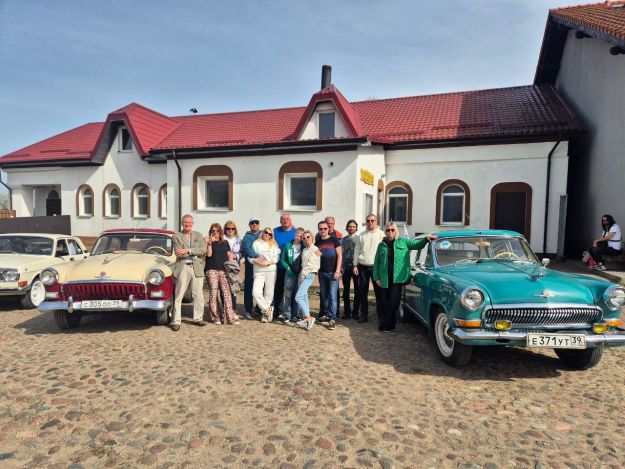
It is about 50km / 30 miles from Kaliningrad to Znamensk. That is no distance when you are whipping along in an all-mod-cons motor vehicle, but when you are travelling by classic car, such as a 1960s’ Volga, ‘Vorsprung durch Technik’ is less likely to spring to mind than ‘oversprung and lurch quite drastic’. But isn’t that just the fun of it!
As is the custom of the Kaliningrad Auto Retro Club, those members who were attending the latest meet, met up on the concourse of a filling station. As pre-planning goes, this strategy cannot be faulted. Most large filling stations have all you need for a temporary stop: fuel, food, tea and coffee, toilets, and, most importantly, a place to park and space to stretch your legs.
They are also perfect for saying hello to and shaking hands with people whom you may not have seen for months, and you can amble around and look at the cars and, of course, take numerous photographs.
All of these things we did, until, when all the participants were herewith assembled, we hopped into our respective motors and cavalcaded away.
Znamensk (Wehlau)
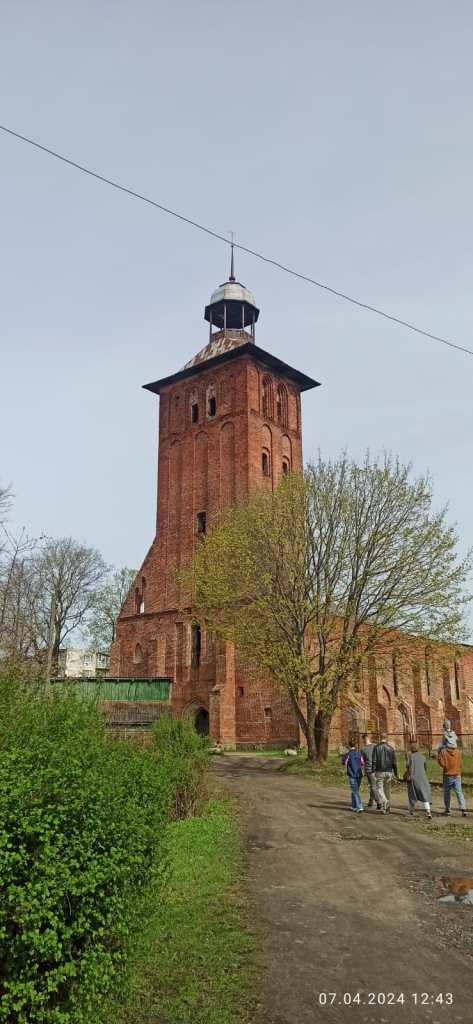
Znamensk, our destination, is a small rural settlement, population less than 5000, situated in the Gvardeysky District, east of Kaliningrad, Russia. As with many places in this region it has a chequered and violent history, changing hands many times over the course of centuries.
Wehlau, as Znamensk was known in Prussian times, fell to the Teutonic Order in the mid-13th century. Having populated it with Germans, the Order then went on to fill the town with horses. In the first half of the 14th century, civic charters were granted turning the hitherto sleepy settlement into a major centre for horse trading. Three horse fairs were held each year, one of which lasted for three whole days.
Opposition to Teutonic rule in the mid-fifteenth century sparked a war between the Kingdom of Poland and the Teutonic Order. Lasting for 13 years, someone with an eye for detail decided to call it the Thirteen Years’ War. The outcome of this conflict was that the eastern lands of old Prussia, including the town of Wehlau, was granted to the Teutonic Order as a fief and protectorate of Poland. The Teutonic Order had not been entirely vanquished, but it was certainly no longer the force it had been.
The sixteenth century came and went. It was not the best of times for Wehlau as it suffered a number of natural disasters, including a terrible fire. But in the 17th century, its fortunes changed. Frederick William, ‘The Great Elector’ of Brandenburg, acquiring full sovereignty over Prussia, proceeded to develop the country into a major power.
In January 1701, the Kingdom of Prussia was formed, and in 1871 Wehlau, along with the rest of Prussia, was absorbed by the German Empire.
During the 19th century and up until the mid-20th century, Wehlau grew into a handsome town and one with a thriving community. The town was served by all essential amenities, including a school, a court and a church. The Prussian Eastern Railway provided access to Königsberg and also to Berlin and from Berlin a link to St Petersburg.
On the 23 January 1945, Wehlau’s history ended. After two days of gruelling urban warfare, Russian troops wrested the town from its embedded German defenders. By the time the fighting was over, nearly all that was left of the old town centre was rubble. In the aftermath of war, the ruins were flattened and cleared, and the town in its pre-war form was never rebuilt.
WWII: January 1945, the Red Army attack and take Wehlau Wehlau (now Znamensk) was almost totally obliterated in the last year of the Second World War, but it was not an easy prize. Record has it that it took the Soviet forces two days of intense fighting to defeat the German defenders and, as with other East Prussian towns, the only way to rout the enemy was to confront them street by street, building by building. The Soviets eventually won the day but casualties were high.
Znamensk (Wehlau)
Before we set out on our trip today, I had been forewarned not to expect too much of Znamensk, as there was little left to see.
First impressions of the still-standing Seven-Arch Bridge over the Pregolya River and the bronzed cupola of St Jacob’s Church visible above the distant rooftops appeared to belie what I had been told. But after snaking our way through a narrow street with German buildings on either side, we emerged into nothing much — much of empty space but little of town. To the left stood the ruins of St Jacob’s church, to the right a block of flats, typically Soviet 1970s, rather rundown and tired and of no aesthetic value.
Trundling on, we eventually hung a right, which brought us into a little enclave of shops nestled against the side of the river. This partly developed oasis in the desert of Wehlau’s former glory is pretty much today what Znamensk is all about — a place to come if you own a boat and want to make use of the water. And what a lovely stretch of water it is!
We passed a rack of canoes and a vehicle with a boat in tow and pulled up beside a building, which, we would later be pleased to discover, was an attractive restaurant serving good food.
It was here on a narrow strip of ground that our Captain of Ceremonies, Arthur Eagle, would have the unenvious responsibility in his role of car-club president of marshalling the cars in our company into some kind of orderly parking
With no responsibility for us to abdicate, which is one of the joys of travelling passenger class, Olga and I disembarked, and, after a statutory session of photograph-taking, using the river as a picturesque backdrop, we took to the nearby restaurant.
Minimalist and light, bright and sensorially breezy, it is hard to picture a restaurant more inviting, especially after an hour or so of motoring classic style.
Halfway through our repast, however, Mr Eagle attempted to roust us out, we and the other club members who had sidled in for a bite to eat, for a guided tour of St Jacob’s, but the twin considerations of the restaurant being well-appointed and a paucity of enthusiasm when it comes to guided tours, we politely declined the order.
We would stroll to St Jacob’s church in our own good time, take in it’s red-brick architecture and feel our way back through the centuries to the dawn of its inception (1380), but as for the moment, it was comfy seats and coffee.
St Jacob’s Church Znamensk (Wehlau)
Like so many churches decommissioned by time, St Jacob’s is a shell, but it must have been born with survival in mind, because in 1540 a fire engulfed the town and the church was one of the very few buildings to resist complete destruction. Likewise, in 1945, most of Wehlau went up in smoke, save for St Jacob’s church. It seems that in this world of ours some things are heaven blessed, whilst others suffer the consequences of unmerciful indifference.
St Jacob’s church is often described as the only building of note in Wehlau to have survived the Second World War, but this is in fact untrue. Rising above the German buildings on the approach to the railway crossing, in all its faceted and Gothic glory, is the lead-crowned tented roof, complete with spire-topped dormer windows, of what easily could be mistaken for the bold, extravagant centrepiece of a medieval castle but which is in point of fact a 1913 water tower.
Standing on an abrupt eminence next to the railway crossing, the tower built according to the Gothic revivalist style cuts an imposing figure, its tall tapering brick arches contrasting with and complementing the railway lines it looks down upon, as they sweep past in opposing directions and vanish quite spectacularly into the distance of themselves.
Wehlau tower was love at first sight, which is probably why fate stepped in and prevented me from buying it. ‘You can’t buy love’, the Beatles warbled? And when I inquired is the tower for sale? I learnt the bitter truth that it had been for sale most recently but most recently had been sold.
Thwarted, thus, there was nothing more to be done than to cross to the other side of the tracks and find yourself in an abandoned graveyard.
Between two brick piers, minus their gates, the ground beyond was unkempt, and though not a spinney as such, it was interspersed with far more trees than would otherwise permit it to be described as open land.
Not exactly a stranger to graveyards, on the contrary I have tarried within and walked through many a graveyard in England, most of which are neglected to some degree, and yet I cannot recall witnessing one so complete in its desertion that, like the inmates it accommodates, it had fallen into abject decay.
I assumed this piece of ground was once the town’s main burial plot, dating at least to the mid-19th century, but should my assumption be correct, where was the immediate evidence of legacy German tombstones?
It had been the railing enclosures that first made it known to me that I was walking across a graveyard, and these, as I suspected and later would confirm, were not of German but Russian ancestry. All told, the sight they presented was emphatically forlorn, almost film-set in their sorry spectacle, randomly scattered among the trees, some with trees having grown up through them. The railings forming their compounds were for the most part intact, but with yellow, green and blue paint fading, bleached by the sun, scoured by the frost and the rain. And some of the enclosures lay at awkward angles, pushed up from the ground by tree roots or brought down into hollows by water-logged and sinking soil.
The tombstones, where surviving, were all to an object gnarled and cracked, their inscriptions barely legible. They shared their space with plastic containers, improvised make-shift flower vases, now destitute of purpose and strangled by the undergrowth. All were sad reminders of moments of grief in people’s lives, who, many years long since past had gathered at these gravesides to bid farewell to their nearest and dearest. They had placed their flowers upon the graves and continued with this ritual until, within the relentless march of time, they had either grown too old to visit, moved so far away that visiting was impractical or kept their own appointments with death and now, in turn, were the visited ones and would continue in this way until such a time would come when the reasons I have given would commit them to a solitude even greater than first inflicted. And now, in the here and now, was I, staring down at the graves of the dead-forgotten, among whose number we already belong in the eyes of those who are staring down at us and thinking the thoughts that I am thinking, but whom we will never know as they exist in a future that we have run out of.
Whilst I was engaged not in what I would define as a reflection of a morbid kind so much as a contemplation of mortality, Olga had gone on a mission, to hide from what I was seeing and not to share in what I was thinking. For a short while, therefore, but who is to say it was not an eternity, I was given free reign to immerse myself in the oddity of it all; to ponder on time’s mysteries and the obsolescence it inevitably brings. Znamensk is that sort of place, you know; it does this sort of thing to you and does it when you are least expecting it.
Suddenly a grating noise, as though Peter Cushing was dragging the lid from Christopher Lee’s sarcophagus, startled me from my solitary reveries. For a split second I knew not what to make of it, and then I remembered my smartphone ~ yes, I actually had one of those. It was ringing in my pocket, but not with a ding-a-ling-ling or a tune to make you look silly. It was ringing with a customised tone, the guttural sound of the TARDIS in the famous throes of it taking off. How very appropriate, I caught myself thinking.
There are no prizes for guessing who it was who was ringing me. It was not a long-distance call. She was, in fact, ‘next door’, having discovered, as she said, a ‘wonderful Catholic church’.
We made arrangements to meet there. Not bad things, these smartphones, ay?
The gardens of the church next door do have an air of wonder about them. They are neatly laid out, formal style, in stark contrast to the graveyard opposite, and the church which they contain alludes to renovation in a period not too distant to the one we occupy now.
I found Olga where she said she would be, sitting on a park bench with the caretaker of the church, whom she had told me was about to lock up and go home but was willing to wait a while to allow us to look around.
This church, the deserted graveyard, the gorgeous red-brick water tower, St Jacob’s church, the handful of old town buildings that had refused to give into destruction, the river bridge and near-river scenes, everything, in fact, that constitutes the town that was and the settlement that is, works a kind of magic. I could feel it in the air as surely as I could feel the warmth of the sun upon my body.
Don’t be fooled by what people tell you: There is much to see in Znamensk: much of what was and is. And that which you cannot see with your eyes, if you give in to your inclination, you will see with your mind and your heart, and something, call it imagination, will join the dots between.
Places to visit in the Kaliningrad region
Waldau Castle A 750-year-old castle, now under the auspices of a friendly curator-family from central Russia. The castle shares ground space with a fascinating museum. Nizovie Museum Once it was a multifunctional retail premise, then a school and now an evocative museum dedicated to local social history, vintage transport and Soviet militaria. Fort Dönhoff (Fort XI) One of the 19th century forts that formed historic Königsberg’s formidable ring of defence, now restored to a high standard and offering visitors a labyrinth experience on a scale and of a kind most likely never encountered. Angel Park Hotel A rural recreation centre on the site of an old East Prussian settlement set in a beautiful natural landscape replete with timeless mystique.
30 April 2024 ~ Kaliningrad Celebrates Kant on his 300th Year
Of the many things that Kant and I do not have in common, two stand out more than others. The first is that he was one of the world’s great philosophers, considered to be the third wheel behind Plato and Aristotle, the second he did not like beer. The first is an accomplishment worthy of applause; the second we will let quietly slip away, as it does not behove a gentleman of such intellectual stature whose name is synonymous with logic and reason.
Not widely read today, because his style of writing does not conform to the SEO prescription for sentences of 20 words or less, it is indeed a sobering thought that had Kant lived in the early 21st century, the systematic dumbing down of language and generational attention deficit attendant on this rule, would seriously have obstructed him in his quest to play linguistic games on paper. Instead of engaging the intellect with works of a ground-breaking nature, he would most likely be biding his time posting snippets to Twitter, taking selfies for social media, and pinning pictures of cakes on Pint-rest (incorrectly referred to as Pinterest). Deprived of these unspeakable pleasures, he had to be content with the lesser mental dynamics required to come to grips with epistemology, metaphysics, ethics, and aesthetics.
300 Years of Kant
Immanuel Kant was born on 22 April 1724 in Königsberg, East Prussia, where he lived until he died on 12 February 1804. Hardly venturing from his home city, Kant, nevertheless, through philosophical thought based on transcendental idealism, is largely credited for changing the way that people think around the world. So, if you have ever wondered why it is that you think the way you do, just think Kant and you have the answer.
Kaliningrad Celebrates Kant on his 300th Year
In life, Kant was a professor at Königsberg University, specialising in logic and metaphysics; in death, he lays entombed near Königsberg Cathedral on the appropriately named Kant Island ~ Kneiphof Island in Königsberg times.
Did you know? Kant was German. I bet you knew that. But did you know that for seven years he became a Russian subject? During the ‘Seven Years’ War’ in Europe, Austria’s allies, Russia, captured the East Prussian city of Königsberg , whereupon Kant, along with other Konigsberg citizens, pledged his allegiance to the Russian empress, Elizabeth. It was an allegiance he would not renounce even after Königsberg was returned to East Prussian rule.
As a philosopher of universal acclaim, a distinguished member of Königsberg ’s academia and one of the city’s most prominent citizens, Kant was fully qualified to be buried inside the cathedral itself. In 1880 that honour was extended when his remains were exhumed and rehoused in a chapel purpose built for him at the cathedral’s northeast corner, opposite the then prestigious Albertina University.
Was he boring, Kant? History has it that Kant was so regular in his routines that Königsbergians could set their watch by him. His habit of walking the same route at the same time each day earnt him the nickname of ‘The Konigsberg Clock’. However, contrary to his stereotype, that he was dull and prone to reclusiveness, Kant, by all accounts, possessed an uncommonly good sense of humour, loved to drink red wine and was a congenial host of dinner parties.
The university perished in the heavy Allied bombing of World War Two, but the mausoleum that would eventually replace Kant’s chapel, the one that we know today, whilst not escaping damage entirely at least escaped it sufficiently to allow for restoration.
Described by some as ‘minimalist’, the simple column and canopy structure has a certain aesthetic elegance and a dignity not detracting from the cathedral’s Gothic profile. The chapel, built in 1924, is the brainchild of Friedrich Lahrs, renowned East Prussian architect.
“The anniversary of the philosopher will be celebrated by the whole of Kaliningrad and guests of the city. The International Kantian Congress, various lectures, presentations, seminars, concerts, excursions, performances, as well as several exhibitions are planned here. Events dedicated to the 300th anniversary of Kant will take place in the city throughout 2024.”