Tag Archives: Victor Ryabinin artist

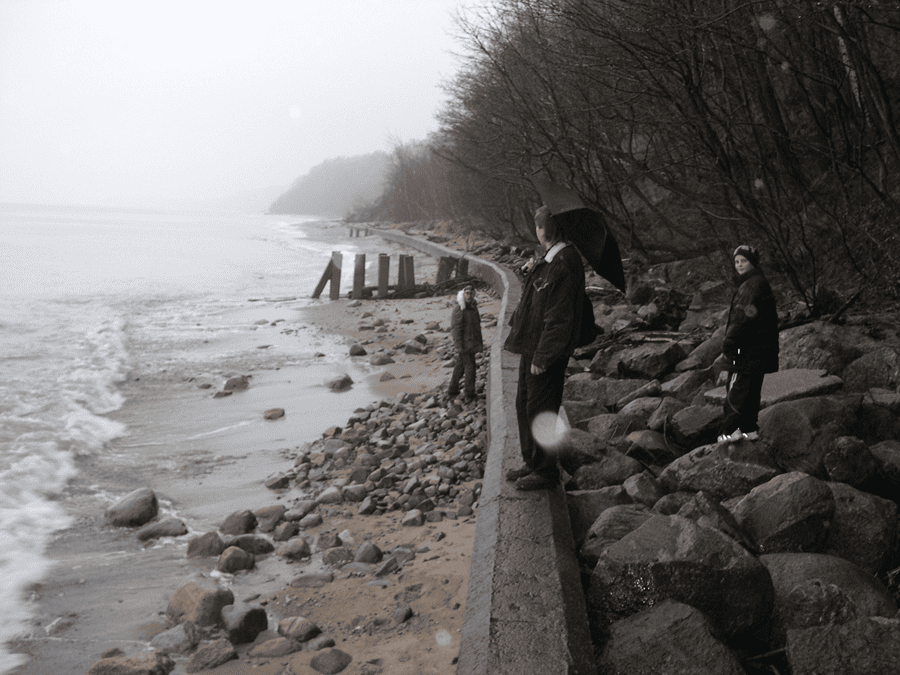
Mick Hart with Victor Ryabinin Artist on Otradnoye beach in the Kaliningrad region, January 2005.

Victor Ryabinin Artist: a man who continues to inspire

A scene from Otradnoye beach, January 2005

18 July 2026 – Victor Ryabinin Artist: a man who continues to inspire

This post’s feature photograph rates as one of my favourites from the album devoted to Victor Ryabinin, a friend and Kaliningrad artist who died on the 18th of July 2019.

It holds a special place in my memory, for in a brief snapshot, a split second in time, it captures one of Victor’s most endearing character traits, that admirable part of his personality which demonstrates his ability to play down adversity and take everything in his stride.

Victor Ryabinin Artist: a man who continues to inspire

Staying with my recent focus on the small, Baltic coastal resort of Otradnoye, the aforementioned photograph was taken on Otradnoye Beach in January 2005, following an unseasonably wet November and December.

The high earthen banks skirting Otradnoye beach had, after two months of nigh-incessant rain, sunk sponge-like into themselves, and the underlying soil erosion, together with high winds, had, by the dual action of undermining and invisible climatic battering, caused the banks to slip and the trees to break and splinter. In the worst scenario, entire trees had been brought out by their roots, and those not already strewn across the beach were stumbling like a drunken orgy to join the ones that had.

Victor Ryabinin Artist: a man who continues to inspire

Somehow, our gallant little group, consisting of Victor, Olga, Olga’s son Daniel, myself and an English friend called Barry, had descended to the beach by way of the crumbling banks. Our walk from Svetlogorsk had been a dicey one, rain-soaked and windswept, alleviated only by a planned excursion to Brachert House Museum. Now, standing on the beach, ready to take that iconic picture, although the wind had dropped a little, the rain was with us again.

Whilst I huddled up in my totally inappropriate London city overcoat, which, being made of pure new wool, would, by the end of the day, thanks to the teeming rain, be twice as heavy as when I had taken it from the wardrobe, Victor, demonstrating typical nonchalance, lowered his umbrella. And that’s the spirit in which I knew him and also how I remember him. For all I know, he may have been privately carrying all the cares in the world on his shoulders, but if such had been the case, he certainly never showed it.

It is true his symbolist art betrayed a tormented sensibility. It had been with him since his childhood and was the driving force behind his work. Victor sometimes hinted that he was locked within an eternal struggle, with haunting apparitions of the ruins in which he had been born and the echo of the city’s suffering ringing in his ears. Growing up in this traumatised environment, his gentle disposition and vulnerable romanticism experienced at first-hand the slow, grinding metamorphosis from scarred and bombed-out shell to modern-thriving urban centre, but the world beyond which shaped his city never left his heart.

I sometimes felt this pain and made it mine, but for me it was but a fleeting impression, not something forged across a lifetime. I could drop the catch, whilst he could not, or give it back whenever I chose, or so I erroneously told myself, whereas for him his only escape, albeit one which spiralled inwards, was through consultation with his muse and by working daily through his recollections on the level of social history. However, if this had been his mortal lot, he rarely ever showed it. To us, he was always and forever a pennies-from-heaven man, holding aloft his open umbrella, a twinkle in his philosophical eye and a smile upon his kindly face, skipping over the Kaliningrad potholes and singing in the rain.

There is music in his memory, and I am privileged that it comes back to me almost every single day.

Victor Ryabinin: 17 December 1946-18 July 2019

^Why is that man carrying that dog? That’s a good question. Because he was convinced that it was a stray. So, he carried it for a mile or more along a narrow and winding seawall, and when he put it down, the ‘rescued’ dog trotted calmly away up and over the bank and presumably went home.

Copyright © 2018-2026 Mick Hart. All rights reserved.

Victor Ryabinin, artist

Victor Ryabinin, Artist — A Grave Decision

On the sixth anniversary of Victor Ryabinin’s Death

18 July 2025: Victor Ryabinin, Artist — A Grave Decision

As the sixth anniversary of our friend, Königsberg artist Victor Ryabinin’s, death approached, the established etiquette of paying our respects to him at his graveside was brought into question by a discourse on the imperative or expectations of doing so. The postulation was challenged by another: that unconditionally consecrating the memory of the deceased is greater testimony to everlasting endearment than obedience to the yearly ritual of paying homage at the grave.

Looked at from the departed’s point of view, having stepped out of mortal time to make room for eternity, like the fabled ten thousand men of the Grand Old Duke of York, who, when they were up, they were up, and when they were down, they were down, within the abyss of eternity, when we are there, we are there, and when we are not, we are here. Or are we?

In mortal terms, but not in the dominion of the mortal deceased, a time will come when everyone known to him personally — family, friends and work colleagues, indeed, in time, his entire generation — will no longer be soil-side up, an incommoding inevitability which is almost certain to make visitations of any order difficult, with, perhaps, the exception of the supernatural kind.

Never is this inability to reunite at the graveside more problematic than when you are in your own grave. And never is this fact driven more firmly home than when walking solitarily, consumed by quiet reflection, among the weathered and stooping tombstones within a typical English churchyard.

^^Grave of Samuel Treeby, Ringmore, who departed this life in 1828 …

Pull back the ivy and brush away the lichen and moss from the tombstone of your choice, and there you will find the names of those who lie beneath your feet. There is every possibility that they have been lying there for nigh on a hundred years or more, living their lives again and again, trapped inside the immutable time capsule that begins with birth and ends in death but which only culminates long enough to begin the process all over again.  Not a single detail of their lives — our lives — is vulnerable to change, once the lid has been screwed down and the capsule sealed forever. Even Britain’s most fanatical revisionists, the history-rewriting BBC, who constantly lie to the young, are but fleetingly successful in their ideological ambition to reshape and corrupt the past. Their falsification of history may persist for a while, briefly, for a flirtatious interlude, but bound by the law of immutability, the past, when it does, as it will, eventually reasserts itself, all is reset as it should be.

In the last analysis, the already interred are safe, and we who are waiting to be interred, we are safe as well. Somewhere, out there, in our future, locked within our immutable time capsules, the dates and the details of our lives, literally written in stone, are irreversibly and unrevisably sacrosanct: date of birth, date of death and everything in between — nothing and no one can change that, not even those that hate you for living out your life without ever paying for a TV licence.

Related content:

Художник Виктор Рябинин Кёнигсберг – Expat in Kaliningrad, Russia
Дух Кенигсберга Виктор Рябинин – Expat in Kaliningrad, Russia

Comparatively, the world has changed considerably in the six years that Victor Ryabinin moved decisively out of time. Coronavirus, the Ukraine conflict, the shift towards, or constant references to the shift towards, a New World Order (most of us are patiently waiting for a world order of any kind!), I wonder what Victor would have made of all this. I am sure the events of the past few years would have elicited a sketch or two in his daily journal or sent him reaching irresistibly for his easel and his paintbrush.

All deaths are hard to accept, especially for those who are most affected by them, but the death of a creative person is perhaps among the hardest deaths to reconcile. The imponderable is forever present: what would they, the artist, have gone on to create had death not overtaken them? What gems of culture has the world been deprived of?

Victor Ryabinin, Artist – a Grave Decision

The death of someone creative who was also a valuable lynchpin between the lives of numerous people from different backgrounds and walks of life, as Victor professionally and personally was, adds to this imponderability, since once the main link breaks, instantly or gradually, the remaining links are bound to suffer severance, resulting, either way, in the chain’s disintegration. I wonder how many of Victor’s relatives, his friends and art-world colleagues will honour him with their presence this year. Time is often praised, and so it should be, for being the healer it indubitably is, but people are apt to forget that the great healer is also a great invalidator and that with the more time that passes, the more forgetful we become and the easier it becomes to simply forget. 

Where anniversaries are concerned, particularly those that relate to death, it is often the case that, willed or not, life gets in the way. ‘Time waits for no man’, making it rather sexist, and life, the bugger, it just goes on until, of course, it doesn’t.

I remember watching a film in which somebody utters the common idiom to the main protagonist, whose fictional wife has recently died, [paraphrased] ‘Life must go on,’ to which the main protagonist replies, “Well, I don’t know about must go on, but go on it certainly does.”

I think we will all agree that life does exactly that: it just goes on, with or without us. Its perpetual motion never ceases: the daily grind with its wearing demands, the past’s emotional baggage bearing heavily down upon us, the cast-iron plans we make for a future we may not live to see, the years that blow away with yesterday’s confetti, more deaths in one’s personal circle and, with each successive page that lifts and flies from the calendar, even be they on angel’s wings, the encroaching prospect of one’s own demise getting ever closer and growing ever larger in one’s consciousness. Yes, I think we can safely say that life goes on alright, irrespective of who we are, what we are, who we weren’t, and who we would have liked to have been and nevermore can be.

The death of a loved one may slow us down, but however hard it slams on the brakes, nothing stops life’s carousel from turning. Life and the world are indifferent mechanisms: Around and around and around they go; why they do it, nobody knows. As one gets off, another gets on. The organ grinder keeps on grinding. Hark! He’s playing our tune. Hum along; it’s called ‘Tricked by Nature’.

It was Mr Wilcox who said to me, “We are fighting a war against human nature.” He went and died in Spain, you know. He imparted these words of wisdom to me when I was at an impressionable age. His words made a lasting impression.

I have often wondered since, as I wonder now, have most of us surrendered? Conscientious objectors to thought are everywhere, and if actions speak louder than words, think what they can do to logic. Losing is never impossible, but fighting on the losing side has its compensations: it relieves you of responsibility and releases you from a troubled conscience should you ever wake in the middle of parenthood with the words upon your lips, “Lord, what is it that I have done?!” The Grand Old Duke of York had ten thousand men, none of whom, like you or me, ever escaped their destiny: when they were up, they were up, and when they were down, they were down. And we’ll all be that way some day and forever. 

And so it is with our dear friend Victor: born 17 December 1946, died 18 July 2019.

Victor Ryabinin, artist
Victor Ryabinin in his art studio, February 2019, displaying a work of art – a bottle of cognac

I never made it to Victor’s grave this year. Intention was vetoed by humdrumicity. In other words, life got in the way. I did raise a glass to his memory and to who he was and would always be, consoling myself with the thought that I was exactly where I had left myself in the summer of 2019. That’s the other haunting thing that old graves have in common: the mourners never get to leave them, no matter how often they return or if they never return at all.

Copyright © 2018-2025 Mick Hart. All rights reserved.