It is with great sadness that I report that our dear friend Stas (Stanislav Konovalov) passed away recently from post-operative complications whilst undergoing hospital treatment.
My wife, Olga, and I met Stas in January 2019. We were introduced to him by a mutual friend, Victor Ryabinin the artist. Stas told me later that Victor had said to him, “There is an Englishman moving to Kaliningrad. You should meet him. He is an interesting man, and I think you will find a common language.”
I am not altogether certain that I deserve the appellation ‘interesting’, but we did find a common language in our love of history generally and specifically for Königsberg-Kaliningrad and the surrounding region.
An important element in that common language was the inspiration we both received from our friend and mentor Victor Ryabinin.
A short while after Victor Ryabinin’s death in July 2019, I told Stas that I had found two paintings by Victor among my possessions in England. He replied, with characteristic modesty, that whilst he did not have a signed painting by Victor Ryabinin the artist, it was enough that he had a “secret pride”, which was that he had been “close to this great man”. “I was his student for many years,” he said.
When I ventured to suggest that Victor had also been his friend, he replied, once again with characteristic modesty, “Victor knew a great many people and associated with a great many people, but he probably would not have considered them all to be his friends. I can say that I was his student, that I admired him and enjoyed his company …” He then paused, before saying, “But I would like to think that he thought of me as his friend.”
Stas was a modest man. He was modest about all of his achievements, when it was quite obvious that he had as much right, if not more, to blow his own trumpet with the ‘best’ of them.
Stas worked extremely hard on his tour guide projects, honing and perfecting them, making several YouTube videos and always asking, “What did you think of this aspect?” “Was that alright?” “Is there anything in my tour guide script that you think needs clarification?”.
Like Victor Ryabinin before him, Stas’ death has robbed Königsberg -Kaliningrad of yet another great ambassador.
It has robbed us of so much more.
Stas was a straight-talking, open, sincere individual. He was a kind man, always ready to help and good company.
Together, we shared the common language of the past, and I, through him, the common but all-important language of humanity.
In summation, Stas was that most precious of all commodities ~ he was the indispensable friend that we could ill afford to lose.
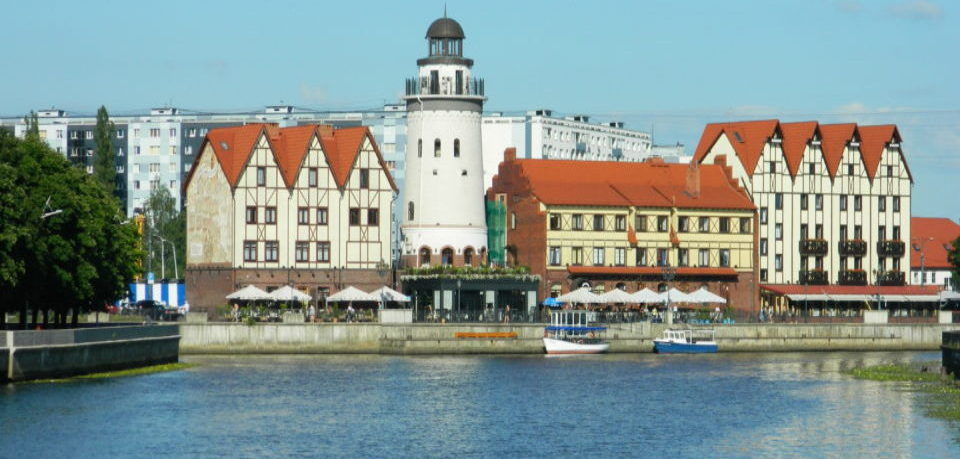
A sunny afternoon with Stas Konovalov, ‘Stas’, [right of picture] Kaliningrad Königsberg Guide
Published: 24 November 2020 ~ Why wearing a mask is different from wearing pants
Of all things that are mysterious and confusing about coronavirus, the salient example is mask wearing, or rather the contentious issue of mandatory mask wearing.
Enter Bill Gates. Bill would seem to be an ardent mask-wearing supporter, so much so that he has difficulty in comprehending why anyone should object to wearing a mask. Peeping out into our world from behind his very large wallet, nothing could be more natural or normal to Bill than slinging a piece of fabric about one’s nose and mouth. His is so convinced about the normality inherent in this practice that he considers the psychology of anti-maskers ‘weird’ and asks “I mean, what are these, like, nudists?” Then goes on to make a bizarre comparison between wearing masks and wearing pants: “We ask you to wear pants and, you know, no American says — or very few Americans say — that that’s, like, some terrible thing.” {source: www.wionews.com} [29/03/24 Link to this page no longer exists]
You see, Bill, my old mate, the thing is that this comparison is not really a valid one. I don’t know where you wear your pants, but most people wear them around their arse, and have been doing so for years. There are distinct convenience and comfort factors in pants-wearing that do not readily relate to the experience of wearing face masks.
For one, a bandage wrapped around your nose and mouth tends to get in the way of that all-important function of breathing, whereas pants do not, unless, of course, you are wearing them over your head ~ Bill?
Where Bill wears his pants or mask is entirely up to him. Correction, where he wears his pants is entirely up to him; I forgot for a moment that mask wearing is obligatory.
It was not always this way.
Time was once, and recently, although it seems like an age away, when if you were to wear a mask in public you would be guaranteed to excite a certain degree of suspicion. Indeed, before we were forced to do otherwise the only people wearing masks, discounting for the moment those who have a penchant for PVC or leather, were muggers and bank robbers. In the bad old pre-mask days, shops, banks and government offices would not insist that you wear a mask, they would insist that you remove it! How times change ~ and suddenly!
Fauci claimed that “wearing a mask, keeping a distance, avoiding crowds, being outdoors as much as you possibly can – weather permitted – and washing your hands” are the defining ways for one to return to the normal world’. {source: wionews.com1} A nice sentence that begs a one-word response. When?
When, Mr Fauci, when?
The mask is the single most potent reminder that normality has gone, and its odiousness is this respect has not been helped any by suggestions that mask wearing may be with us forever. So, for the time being at least (let us be optimistic), the mask is the visual signal, the day-by-day reminder of our altered state of reality ~ the corporate logo of the so-called New Normal.
Some cynics believe that this visual statement, the compliance it represents and the fear it engenders, is an essential weapon in the psychological arsenal of governments and Big Pharma intent on ensuring the maximum uptake of their rushed and suspect vaccine products. Where there’s a will there’s a way, and where there are millions, billions of people, purchasing cart loads of vaccines, not to mention vitamin pills and, lest we forget (how could we?), masks, there is money to be made. Lots.
But let’s not be trite, here. A few months back there were a number of articles written by medical and health specialists postulating that not only are masks useless in the fight against coronavirus but that they can actually contribute to your chances of catching it. The out and out criticism was that wearing a mask for virus prevention was like wearing string underpants to stop a pea. Here we go again, Bill?
The case against mask wearing has since swung to wearing masks correctly, ie moulded around the facial contours, never touched by hand, changed periodically ~ at least every two hours ~ not placed in one’s pocket, not washed and not re-used. An idealistic scenario unlikely to be achieved when the majority of mask wearers do not seem capable of rising to the challenge of the basic principles of how to wear a mask.
How many mask wearers have you clocked wearing their masks correctly? Sitting baggy, possibly like Bill’s pants (who knows?), swinging from the ears, acting as a chin cuff and, the old favourite, mouth gagged, snout out ~ this is how they are worn.
Whenever I see someone wearing their mask like this, as in the last and most popular example, and, of course, I do, because my wife is one such transgressor (she refers to masks as ‘muzzles’), I am reminded of something I saw on Facebook: two drawings, with captions. The first caption read, ‘Wearing your mask like this …’ (there then followed a drawing of someone wearing a mask with their nose sticking out above it) “is as silly as wearing your underpants like this …” (there then followed an image of a pair of Y-fronts pulled halfway up with a willy hung over the waistband). “That’s funny,” I thought, “doesn’t everyone wear their Y-fronts like this?”
Bill?
And yet the risk of catching coronavirus by improper face mask wearing is possibly not so high as the risk that emanates from face mask fiddling. You see, wearing a chunk of cloth over your nose and mouth is devilishly uncomfortable. After a while it can make your face hot and sweaty, and it can also make you itch. OK, so you can suffer the same inconvenience should you be wearing the wrong kind of pants, but there is a subtle difference. In adjusting your mask and scratching your itch, you generally touch your face and possibly, inadvertently, your mouth, nose and eyes, which is precisely what you are told that you must not do if you do not want to catch coronavirus.
But what about the altruistic argument, the one that goes that mask wearing significantly reduces the risk of passing coronavirus onto someone else, especially if you happen to be an asymptomatic spreader? In the first instance, look no further for the answer in Bill’s string underpants and their pea-stopping potential ~ catching coronavirus is a two-way process: what gets in must get out. And this also applies to the mysterious, unproven asymptomatic as much as it does to the snotty-nosed cougher.
So, extrapolating what we know already about masks from the lack of evidence placed before us, what we can say irrefutably is that no one knows. And this is where we are at, at the moment: mask wearing will protect you from catching coronavirus, mask wearing will increase your chances of catching coronavirus; mask wearing is a temporary measure, mask wearing is here forever. And this ambiguity rolls over into other things, such as: the vaccine is coming, but no one knows when; the vaccine is a game changer, but what game and whose? The vaccine will not be the 100% solution that people have been led to believe: it may work for some and not for others; it may not work at all; it may have serious contraindications; it may have built-in lethal implications ~well, let’s don’t go there for the moment. And what about lockdown? For some it is the bib and tucker; for others it is Bill Gate’s underpants. There is a lot of hot air about it, but no hard evidence to support it, so to speak.
In fact, all that we can say with any degree of certainty about coronavirus, from what we have been fed, is that your guess is as good as mine.
What we can say, getting back to masks, is that generally speaking, the general public are not comfortable wearing them. There is a convincing argument that politicians and big neoliberal corporate globalists have no problem with it as they never show their true face anyway, but for the many, as distinct from the few, normal human contact is not traditionally mask to mask, it is traditionally face to face.
So, to summarise, masks are uncomfortable, they make breathing, one of the main functioning processes of the body difficult and speaking problematic, symbolically they are a constant reminder of a deviant reality, and, at worst, they could actually create the environment for catching the very disease which they purport to prevent.
Whatever one’s feeling about masks, the inescapable fact is that ultimately, human visual contact and human communication is a face-to-face transaction, not a mask-to-mask one, since full-time mask wearing is as alien as it is alienating.
But I should not worry about it too much, Bill, the only confusion you seem to be suffering from is a pants and mask one, and whichever it is and wherever you wear them, it does not seem to have affected you any, as you still seem perfectly capable of talking out of yours.
A Russian Survivor of Mauthausen Concentration Camp
Published: 22 November 2020 ~ Life & Death in Mauthausen Concentration Camp
This summer we had the pleasure of meeting a very special lady in Kaliningrad, Zoya Ostin, the widow of a former Russian soldier, Vsevolod Ostin, who, in his youth, was incarcerated in the notorious Mauthausen Nazi concentration camp in Upper Austria. The young Russian soldier survived his ordeal and later wrote a highly detailed account of life and death within the camp, how he beat the odds and lived to tell the tale. My wife, Olga, has been busy translating his book, Rise Above Your Pain, into English.
During the Second World War, Vsevolod Ostin, a young Soviet soldier, had the grave misfortune to be interned in the notorious Mauthausen Nazi concentration camp in Upper Austria.
Whilst most of us in the West are familiar with the names of Auschwitz, Dachau and Belsen, the name Mauthausen may not be immediately recognisable, but Mauthausen was considered to be one of the Nazi’s most severe and brutal camps, so much so that it was known affectionately by the SS as the bone mill or bone grinder.
Life & Death in Mauthausen Concentration Camp
Mauthausen was the principal camp in an extensive complex of satellite camps operating throughout Austria and the southern regions of Germany. The inmates, mostly drawn from the Soviet and Polish intelligentsia, were used as slave labour for numerous German companies, both local and national, with the majority of prisoners working mainly in the nearby granite quarries, providing raw materials for the reconstruction of German towns and cities.
The regime in Mauthausen and the surrounding sub-camps was so relentlessly brutal that the average life expectancy was estimated to be 3 to 6 months at most. Vsevolod Ostin entered the camp in 1942 and miraculously managed to survive until 1945, when the camp was liberated by the United States Army.
Vsevolod Ostin wrote his account of life in Mauthausen in 1961 but not to the acclaim that he had hoped for. Publishing house after publishing house rejected the manuscript. Various reasons were given, but the main stumbling block seemed to be that the Soviet authorities considered it to be too international, too cosmopolitan, at a time when literary and historical accounts of the war had an urgent imperative to condemn Fascism as irredeemably evil.
Surviving Life & Death in Mauthausen
A man such as Ostin who had survived the horrors of Mauthausen was hardly likely to give up that easily, and he did not. But it would be 25 years from completion of the manuscript before he would see his work in print. Rise Above Your Pain was finally published in 1986, a year after perestroika.
By definition, Rise Above Your Pain is not an easy book to work on, neither is it bedtime reading! The subject matter is grim and grisly and in order to do it justice, to translate and edit it in the tone and spirit in which it was written, we have had to rise above our pain with each successive chapter.
This is because Ostin tells it as it was; he pulls no punches. He lays bare the worst excesses of human nature’s darker side, his book serving as a salutary reminder of how war unleashes the worst in us and how, in its consuming climate of hate, violence and death, the dregs of our societies, the malcontents, thugs and sadists, rise from the sediment into positions of power the consummate nature of which they could only dream of in times of peace and stability.
Nevertheless, between the cracks of inhumanity that the book so meticulously documents, reassuring glimpses of a human light shine through, and it is this as much as the depravity it delineates that makes Rise Above Your Pain a compelling lesson from history and a story that needs to be told.
Life & Death in Mauthausen Concentration Camp
Olga and I were approached to translate and edit Vsevolod Ostin’s book Rise Above Your Pain by Olga Tkachenko, Head of the Sobolev Children’s Library in Kaliningrad, on the recommendation of a mutual acquaintance, author and journalist Boris Nisnevich.
The translated and edited text is scheduled for completion in early 2021, with a view towards publishing an English language version later in that year.
Vsevolod Ostin, survivor of Mauthausen concentration camp, author of Rise Above Your Pain
An afternoon in the company of Zoya Ostin, widow of Vsevolod Ostin, survivor of Mauthausen concentration camp, author of Rise Above Your Pain. {Top middle picture, left to right: Olga Tkachenko, Head of the Sobolev Children’s Library, Kaliningrad; Zoya Ostin; and Olga Korosteleva-Hart.}
Place laid at table for the deceased in keeping with Russian tradition, with glass of vodka and bread
Important to Keep in Touch During Coronavirus Christmas ~ Cheer them up with a card and personal letter!
Published: 17 November 2020
So, what I have been doing for the past week? Did news that they had installed a Democrat in the White House appall me so much that I have not been able to focus and write? No, even stranger than that, I have been busy writing my Christmas cards ~ either a case of there’s forward planning for you, or its time he invested in a new calendar.
Nothing quite as spectacular. I have been writing cards to folks back home, to friends and family in the UK, and cognizant of the fact that the post from Kaliningrad to England is not exactly the 21st centuries’ answer to a hypersonic version of Pony Express, I hope to have mailed them in good time.
Another reason for planning ahead is that every year I include a ‘brief’ note with my card. This has become as traditional as Christmas dinner, party hats, Christmas crackers and auntie Ivy turning Christmas day into a rugby scrum as she insists on clawing open everybody else’s presents.
Important to keep in touch during coronavirus Christmas
My Christmas letter has become such an important element of the annual Christmas ritual that its up there with seasonal sayings like ‘just what I always wanted’, when it is quite obvious that you didn’t (I mean, who in his right mind would wear a jumper like that, and when did your gran lust after a WWII German tin helmet (or even a WWII German in a tin helmet?)) ~ and ‘Oh, you shouldn’t have!”, when you obviously didn’t: that’s the aftershave you were given by someone last year and which you personally would not touch with a barge pole and neither would anyone else. Mind you it makes the perfect Christmas present for social distancing.
The thing about my Christmas letters is that although you have to state out loud at UK post offices these days what you have in your ‘packet’ ~ and my letters are known for being rather bulky, so they always ask ~ they always get through, even though sometimes I cannot resist answering, at first in a whisper, “It’s an inflatable doll,” and then, in response to the lady behind the counter urging me to ‘speak up’, to call out stridently, “It’s an inflatable doll,” so that everyone can hear (you should try this sometime, it really is fun!).
No stopping those Christmas letters
Yes, my letters always get through. Like Reader’s Digest junk mail, electricity and gas bills, even if the Post Office had been sold to China (what’s that, oh, it has been) and my letters rerouted via the M25, carried in the pocket of a young thief travelling on a skateboard during rush-hour, my letters always get through.
They zip past defiled statues, hoody-wearing muggers on handbag-stealing mopeds and bearded men burning poppies. They cruise through ganja-stenched knife-secreted carnivals, through nice areas deprived by people. As slippery as Hope not Hate, they riot their way down Looting Street, defying all manner of social distancing, lockdowns and Tiers for fears and, before you can say Hoorah for Brexit or Joe Biden is as honest as Clinton, they sail up your drive, through your letter box and plummet onto your doormat quicker than the stink from a suspect scientific claim.
They are so popular, my Yuletide missives, that family and friends leave home for them, and come back after Christmas ~ a long while after Christmas. Some people board up their letter boxes, others disguise them as something intimate in such a way that were you to insert a letter through them, you’d have the neighbours shout ‘pervert!’. Some teach their dogs to savage them, and others, those with ‘Beware of the Cat’ on their doors, train their feline friends to hide them under the Christmas tree ~ and scrape the soil back over.
One year my brother shoved his letter under the mistletoe, prompting his gay friend to say that he would rather kiss his own arse. He is a lonely guy, but no worries, he is double-jointed and quite the contortionist.
Selfish people, those who stockpiled toilet rolls when they heard the word pandemic, convert them into paper hats and hide the Christmas crackers for pulling on their own when they think no one is looking. Ahh, but someone is always looking, especially in these days of essential travel only. Do they really think that they can get away with it?
“Where are you going in that Support Bubble Car?”
“I am a victim of self-isolation and social distancing, officer. I am shunning all that I have ever known and all those that know me, even those who have tried to lose me, give me away or pretend that I don’t exist, such as my mother. I am going somewhere where they can’t track and trace me, and there, in the privacy of somebody else’s Tier 1 home, I will hide from the world and pull my Christmas cracker.”
“Very well,” says the Social Distancing Marshall, “but no laughing at the joke inside the cracker, mind. This is no time to be enjoying life, and don’t forget to wear your mask.”
Sorry, that was uncalled for.
“Hello, I think I may have coronavirus. I have been trying to telephone the hospital for the past three hours and nobody has answered.”
“Sorry, the hospital is as full as boatload of migrants from France. Wait a moment. Oh, it is a boat load of migrants from France. Please hang yourself. I mean hang up and try the Samarlians.”
The Samarlians ~ a not-for-profit organization that will talk you out of the ‘easy way out’:
Answer machine: “Hello, you have reached the end of your tether. I am sorry, due to a high volume of excuses about coronavirus we are unable to take your call at the moment, please leave your name and telephone number and you will never hear from us again. You might like to waste what remains of your life by visiting our website, goingaroundincircles.con, where you can often never find what it is you want to know using our FAQ Offs ~ Frequently Asked Questions Offline ~ alternatively, you will find the end of the line at your nearest Midland Mainline Station.”
Once, all you had to do was press Button A to be connected and Button B to get your money back. Now ‘you have the following options’, more numbers than the National Lottery and about the same chance of winning.
What my coronavirus Christmas letters mean to the recipients
Rumour has it that carol singers have written songs based on the contents of my Christmas letters and sold the rights to Leonard Cohen.
Christmas vicars have read them out in their sermons and have been summarily excommunicated.
Edgar Allan Poe, who essentially travelled by TARDIS, was inspired to write The Masque of the Red Death having read my treatise ‘Lockdown ~ the most effective life saver since leaches’.
Important to Keep in Touch During Coronavirus Christmas {See end of article for image credit*}
My letters have tweaked the ears of statesmen, tickled the underbelly of boat-owning philanthropists and have sunk a thousand ships, or would have if I had my way ~ where is my letter to Sir Francis Drake?
Napoleon stuck his arm up his vest after reading one of my letters, and what would Lord Nelson have asked Hardy to do for him had he read my letter before someone shot him first?
Thank heavens Adolf burnt his letter!
As for ordinary mortals, some wrap their present to auntie Joan in them and still others wrap them around uncle Martin’s chestnuts, who would otherwise lose them on Christmas morn as he struggles to adjust his mighty pendulums attached to his very large grandfather’s clock (thank the Lord for Spell Check!).
Looking forward to my letters
People look forward to my letters so much that they ‘wish it could be Christmas every day”. One day they will write a song about it and play it every year with depressing regularity.
This year they are all busy singing to, ‘So this is Christmas and what have you done. Sat in self-isolation it isn’t much fun.” I know, let’s open one of Mick’s Christmas letters and cheer ourselves up (gunshot off stage).
My letters have a sentimental and emotional appeal. They are up there, tugging at the heart strings like that old romantic Christmas Carol, who your mother caught your father with (also Christmas Connie, Christmas Christine and Christmas Cordelia, well, Christmas comes but once a year).
Ahh, the old ones are the best (Connie was 73).
Lovely old Christmas carols
What memories these well-known carols:
“Drug King Wenceslas looked out from his boat to Dover
When the snow is not found out we’ll roll the UK over
Brightly shone the hotel sign, the waiting bus was free
It was worth the trip through several countries and across the sea, He! He!”
And do you remember this one:
“Away in a 4-star I don’t pay for my bed, the tax-payer in England pays for it instead …”
And how could you possibly forget:
“Twinkle, Twinkle celeb star who the F..K do you think you are?
Pontificating up on high?
Spreading all those EU lies.
Twinkle, Twinkle talentless star paid too much, too much by far”
NOW, WHO DOESN’T DESERVE A CHRISTMAS LETTER FROM ME? (Important to Keep in Touch During Coronavirus Christmas)
Dear old Christmas Carol, one of Charles Dickens’ favourites. This will be the one year that Ebenezer Scrooge will be looking forward to a visit from the ghosts of Christmas Past, anything has to be better than Father Boris’s Christmas Present.
Important to Keep in Touch During Coronavirus Christmas
Although it is very important to keep in touch during a coronavirus Christmas, I don’t as a rule send the prime minister a Christmas letter, besides he will be far too busy this year reading and listening to fairy tales from the Brothers Grimm. Chris Witty and Sir Patrick Vallance, sorry I don’t know them ~ and neither do you, but there is a sort of chemistry there. It reminds me of that Chad Valley Junior Scientists set I was given at Christmas a long while ago. As I recall, it was a very disappointing present, all smoke and mirrors, bits missing, as incomplete as a Liberal manifesto and it had a very funny smell about it, something slightly fishy.
Send them a Christmas letter? I would not give them the steam off my turkey. What I do like to do, however, is spice up my Christmas offerings with the odd anecdote from Christmases past.
“Please, pretty please do tell us one.”
Well, all right, if you beg nicely.
Once upon a time, long ago, when England was really England, I worked part time as a waiter. I was young once, and in those days I was a teenager. These were the bad old days, before teenagers became entitled and were able to live at home with mum until their 45th birthday (you can ~ could? ~ always take a loan).
Teenagers in those days were not deprived as they are today. They were lucky, in that they did not have the internet from which to plagiarise articles to pass their exams with and, without keyboards and computers, they had the fun of writing all of their essays out by hand, correcting them by hand and then rewriting them by hand for presentation. This meant that they had less time for anything else, which was good, because there were no smartphones in those days and nothing to twiddle on, no Twatter, Arsebook, Snapcrap and the like. Instead, after school teenagers went out and worked.
I worked at the Talbot Hotel in Oundleshire, a very prestigious establishment, with a long history dating back to Elizabethan times and with a staircase that was said to have come from Fotheringay Castle where Mary Queen of Scots lost her head and on which staircase I almost lost my job for telling two old ladies that Mary was always looking for it in the rooms that they had paid for.
It was a posh place, the Talbot of Oundle, and still is. Standards were high. We had to wear black trousers, white shirt, cummerbund, little white pointed tail jackets and a black dicky bow. We looked like clockwork penguins. We were always well turned out, apart from one person whose flies were never done up, as if, we suspected, by no fault of accident.
It was three days before Christmas, us well turned out and him with his flies undone, that we were called to wait upon a very important table, several tables in fact containing the governors and alumni from Oundle’s prestigious public schools.
I had two salvers: one with Christmas seasoning and the other containing peas on my arm.
Several of we waiters moved along in single file serving our guests of honour. And then it came to her.
She was gorgeous, stunning, wearing a low-cut dress. She had the most diaphanous orbs you could ever imagine ~ yes, her eyes were beautiful. Mesmerised by love, or something that starts with ‘L’ and has the same number of letters, I leant over her and with the seasoning in my hand, asked:
“Would you like stuffing madam?”
The timing could not have been more perfect. Hardly had I realised that I should have used the word ‘seasoning’ than my waiter friend at the side of me, my pal, my very good pal, gave a purposeful nudge to my elbow and off went a spoonful of peas straight down the lady’s cleavage.
Talk about Captain Kirk’s ‘Space, the final frontier’!
And really, what did it sound like: “Madam, can I help you?” As she is reaching down inside, red faced and all a fluster, for those penetrative peas.
Sounds like something out of a Carry On film? How about Carry on Down the Cleavage? Rather that than Carry on Down the Pandemic.
Important to Keep in Touch During Coronavirus Christmas
But what has this got to do with it being very important to keep in touch during coronavirus Christmas? I confess, I have digressed, when my real intention for writing this piece was to say how nice, affectionate and charming Russian Christmas cards are. Different again to the crass and vulgar things that they churn out in the UK.
Every year in the UK, Christmas cards get bigger, which is a problem for my family and friends, for it means that instead of a ‘short’ letter I can really go to town and insert a tome like War & Peace. But British Christmas cards do not just get bigger they become more vulgar each year. In keeping with declining moral standards, smutty innuendo ~which is as traditional as laxatives on Boxing Day ~ has given way to images of a semi-pornographic nature and to captions laced with obscenity. It is enough to make you lie and say that Rubber Band has comedic talent!
How much nicer these traditional Russian cards are. They remind me of the sentimental cards that were produced in wartime England ~ soft, delicate, romantic and affectionate
Of course, they are not really Christmas cards as such, as this is an Orthodox Christian country, and Christmas is celebrated on 7th January. No, these are, for the sake of accuracy, Happy New Year cards ~Snovam Gordams.
Snovam Gordam (Happy New Year!) I shouted that last year on the stroke of midnight. You did too? Really?
Hmmm, we’d better shout twice as loud this year, as I don’t think He was listening.
By the way, sorry if you did not receive my Christmas card and letter.
Illustration for Edgar Allan Poe’s Masque of the Red Death (Image credit: Harry Clarke – Printed in Edgar Allan Poe'sTales of Mystery and Imagination, 1919., Public Domain, https://commons.wikimedia.org/w/index.php?curid=2348546)
Diary of a Self-isolator: Day 239 [8 November 2020]
Going down the Pandemic ~ or just when you thought it couldn’t get much worse …
Published: 8 November 2020
With all the gushing, fulsome and hypocritical talk in the western media of a ‘new dawn for democracy’, clearly it is time to steer clear of Google News for a few days until the gloating and rhetoric subsides, and the ‘New Management but Business as Usual’ sign resumes its rightful place among the beer cans and spliff ends of yesterday’s party aftermath. As sure as the Devil finds work for idle hands, he is sure to find soundbites for delusional minds. Best to keep busy.
My wife, Olga, and I are busy translating and editing a book from Russian into English about a young Russian soldier’s experiences as a prisoner in Austria’s notorious Mauthausen Nazi Concentration Camp, known at that time as the Bone Grinder. Not exactly bedtime reading, but it serves to remind us that the privations and hardships endured by the wartime generation puts our gripes about lockdown and the associated inconveniences of Covid-19 firmly into perspective and underlines the difference between the Grim Reaper’s mortality harvest now compared to then as one of existential proportions ~ a difference on the scale of a sniper’s bullet and the bomb that they dropped on Nagasaki.
I am not saying that the situation is good, far from it. You may be of the opinion that it is not good that ‘Healing’ Joe Biden is the new incumbent in the Whitey House, but it is one of those awkward things that we have to live with, and when we think of it in relative terms, coronavirus that is, not the resuscitation of globalism, we would do worse than recall Phil Collin’s words, “Hey, think twice. It’s another day in paradise.”
With summer having waved goodbye and taking with it further opportunities to socialise outside, in, as we have been led to believe, the relative coronavirus safety of pub gardens and on bar decking areas, and with the media everywhere ramping up second-wave horror stories, the imposition of lockdown in the UK and here, in Kaliningrad, self-isolation, or at best cautious socialising, is back with a vengeance.
Vaccines’ healing powers better be better than Biden’s
So, what do you do? Your mother who is about to turn 80 has been looking forward to celebrating this significant milestone in her life with friends at a restaurant. Arrangements have been made, but as the date approaches, one by one her friends shy away, taking the view that discretion is the better part of valour, that there is clear and present danger in social mixing. This is the coronavirus conundrum for older people, is it not? The older you get the more precious time becomes? So do you go for it, regardless? Get out there and live life whilst you can or allocate the time you have left for hiding in the house? It is, to say the least, a difficult trade-off.
The media repeatedly tells us that the infected world is on the cusp of vaccine roll-out, but what does that mean, exactly? A recent article in The Moscow Times1 claims that “The share of Russians unwilling to vaccinate against Covid-19 has risen to 59% in October from nearly 54% in August, according to the Levada Center pollster.” The same article makes the claim, “almost half of Russians would never vaccinate against the coronavirus regardless of whether it’s produced in Russia or another country.”
They are not alone. People in the UK who I know personally are on the same wavelength. When I spoke to a friend recently, a retired biochemist, a scientist, aged 81, he said that he had never been vaccinated for anything and would not be now. Mind you, I suspect that he owes his longevity more to a frugal diet of muesli and oily fish than to his lifelong avowal of the risk of medication-taking and his strict regime of non-medication use, but then on second thoughts …
Vaccines’ healing powers better be better than Biden’s
In an article from The Lancet2, it is affirmed that “Vaccination is widely regarded as the only true exit strategy from the pandemic that is currently spreading globally.” But, “Hold Hard!!” as my auntie used to say (unfortunately, and I am not sure why?), as we read on we find, “… we do not know that we will ever have a vaccine at all. It is important to guard against complacency and over-optimism. The first generation of vaccines is likely to be imperfect, and we should be prepared that they might not prevent infection but rather reduce symptoms, and, even then, might not work for everyone or for long.”
Having read this, you could be forgiven for believing that the vaccine has about as much chance of warding off coronavirus as Biden has of ~ according to the liberal media ~ healing America’s rifts, which the ideology that he represents ironically created. Why else did so many Americans vote for Trump initially and continue to vote for him now?
The vaccine vote still hangs in the balance, but not wanting to take it or, conversely, dying to take it (so to speak) is not a Russian phenomenon, it is global not Russian roulette.
Vaccines’ Healing Powers Better be Better than Biden’s
What we need now is a plethora of articles elevating science with the same degree of shameless enthusiasm as that used to hoist Joe Biden to a level that he does not really deserve. Or do we?
The tone of the liberal media on Biden’s election victory has Biden cast in the image of a crusading saintly Other, ordained by the deity and sent to earth, his divine mission being to restore the neoliberal globalist vision of an incongruous imperialist democracy. If Trump was the pantomime villain that kept oons of leftist scribblers in feverish employment during his term in office, and how entertaining their toil has been, Jo Biden is the Second Coming, America’s last great hope for the salvation of a dying doctrine, everything and nothing that stands between the meltdown of the melting melting pot.
On every American dollar you will find the words, “In God We Trust”. With Uncle Joe Biden about to be installed (they need a couple of days to attach the strings), these words could take on an entirely new and ominous meaning.
Over here, the Almighty is held in no less high regard, but it is also generally believed that vodka cures everything.
For the time being, at least, I think I will stick with that!
References (Vaccines’ Healing Powers Better be Better than Biden’s)
https://www.themoscowtimes.com/2020/11/02/mistrust-grows-for-russias-coronavirus-vaccine-poll-a71929 [Accessed 8 November 2020]
Is Biden their Last Straw in a show of pantomime proportions?
Published: 4 November 2020
Because I write this blog and update my diary, absolute avoidance of COVID-19 news is impossible, and I must confess that recently I have fallen off the UK media wagon and relapsed into the inexcusable habit, which I managed to kick for three or four months, of ruining my day with Google News.
That is how I know that Boris Johnson’s 3 Tiers ended in tears …
Tiers for souvenirs are all you’ve left me Memories of a love you never meant I just can’t believe you could forget me After all those happy hours we spent (together)
Tiers have been my only consolation But tiers can’t mend a broken heart I must confess Let’s forgive and forget Turn our tiers of regret Once more to tiers of happiness
Thankyou Ken Dodd for this inspiration
… that open-door immigration policies are again in the spotlight in countries such as France and Austria and that there is an election going on in the USA.
How close is Biden to the brick house?
Regarding that election, I gather from Google News that has-been Biden appears to be on track to get his left-wing rump into the seat of power. At 12.30 (Kaliningrad time) today, the UK’s liberal left press is already teetering on the cusp of a great collective orgasm, albeit slightly ruined by the fear that if Mr B does not win by the landslide they hope for, then a further shadow of doubt will be cast on the liberal media’s ability to translate ideological bias into hard support, which, let’s face it, after years of banging the anti-Trump drum they desperately need for their own reassurance.
Consolation is that if Trumper is ousted, at least we may at last be spared the relentless barrage of vitriol and belligerence that exudes from the West’s anti-Trump lobby, together with all those go-nowhere stories about collusion and hacking; all we will have to stomach is a fat dollop of the sweet and sickly ~ the same thick icing atop of the stodgy pseudo-democracy cake that we had to endure when Obuma was in the hot seat (or was that on the very cool fence?)
Someone left the cake out in the rain I don’t think that I can take it ‘Cause it took so long to bake it And I’ll never have that recipe again Oh no!
Thank you Richard Harris
As for ‘he will do their’ Biden, is he having another one of his ‘senior moments’ or is he really that out of touch? I suppose that he has been just too busy winning the election to keep up with events in Europe. I see from The Daily Express* today that he has condemned Hungary’s Viktor Orban and Poland’s Andrzej Duda as “thugs”. Hmm, could this be because they have refused to back down to the EU’s demands that they unlock their borders and take in thousands of migrants? Why, whatever next! Holy Perfect Phobias, Batman!
Well, it’s their lookout isn’t it. I mean, if they want to miss out on enrichment, of the kind experienced by France, Austria, Sweden and the UK, then they only have themselves to blame.
Trump’s drainage plan has siphoned some off
Sometimes, in times of trouble (no, not Paul McCartney) you need to go looking for solace. And with Bill’s Bar closed (‘I’ll go down to Bill’s Bar, I can make it that far …’ ~ Thanks Mr Cohen), I went looking in the most unlikely of places, you’ve guessed it ~ Google News UK. And it was there that I found it, in The Guardian** of all places.
Bogs are not the usual place where solace can be found, but for some reason, call it another mischievous effect of coronavirus, I was in the mood for old clichés. I was not disappointed. I waded through the slush of appeasement and capitulation and derived a peculiar sense of déjà vu from the tired, sad and, in these post-liberal days, weary and worn out apologetic tone, before I arrived at Pipe Dream Station, just in time to see the last deflection train leaving for Desperation. “This is the last train to Desperation, calling at Propaganda, Political Correctness, Tony Blair’s Legacy, Vigilsville County, and Somewhere Nowhere Never Over their Rainbow (obsession).”
It was here that I read the writing on the wall, in a sentence so hollow that it echoes incredulity, “In the UK last year, police warned that the fastest-growing terror threat was from the far right”.
Far right? Yeah, right …
I have had this recurring dream, since 1997. I am trapped in a grotesque pantomime, every bit as fantastic and disturbing as Edgar Allan Poe’s ‘theatre’, The Conqueror Worm†. On stage, the plot, and the plotters, coerce me into looking in the wrong direction. It is Poe’s ‘bidding of vast formless things that shift the scenery to and fro …’ Fortunately, fortunately for me that is, there are still people in the audience who are not afraid to tell the truth. ‘Look Out! He’s Behind You!’ they cry.
The first time I had this dream I awoke at this very moment, and I have been awake ever since. Insomnia is not an easy condition to live with, but it is better than the alternative.
Wake up! They will never give you your money back, but at least you can leave the pantomime before it is too late!
(Image attribution can be found at the end of this post.)
And here is the happy ending you wanted:
You have heard it said, no doubt, that every cloud has a silver lining, but what hope is there of finding one if has-been Biden accedes to the [ ] House? Oh but there is one ~ to be sure, to be sure. It may not be much, but it was flagged in a media article today*** [4 November 2020]. Allegedly, Meghan Markle has vowed that if Trump wins the election, she will leave America. Now, come on, don’t let’s be too hasty!! Besides, the boats are full.
So, if you cannot find any other reason for rooting for, what’s his name(?), you know what’s his name, for the next U.S. president, then this has got to be it!
Image attribution: This image is available from the National Library of Scotland under the sequence number or Shelfmark ID Weir.8(6). You can see this image in its original context, along with the rest of the Library’s digital collections, in the NLS Digital Gallery, Public Domain, https://commons.wikimedia.org/w/index.php?curid=33869245
Surely, the irony cannot have escaped anybody’s attention, that is to say the date on which Boris Johnson proposes to submit England to a new round of severe lockdown restrictions. When? November the 5th. Talk about pissing on your fireworks! Let’s hope that Guy Fawkes doesn’t own a time machine!
For me, personally, the sudden but by no means unexpected surge in coronavirus cases has solved one puzzle. It has ended my indecisiveness as to whether or not I should change the title of one of my post series from ‘self-isolation’ to ‘social distancing’.
Would I be resident in the UK, the choice would no longer be mine to make. The new title would be lockdown. But here, in Kaliningrad, Russia, no such lockdown exists and, as at the time of writing, there is no intimation of one being implemented sometime soon.
Nevertheless, this seemingly clear-cut situation compared to that in the UK has done nothing to ease the difference in opinion that persists between myself and my friend and sparring partner, Ginger Cat Murr, about how we approach life now that coronavirus is once again in the ascendancy.
The difference is a nuanced one. Both of us are batting from the same wicket when it comes to lockdown. We share the belief that any benefits derived from such draconian measures, and there aren’t any, at least proven ones, are offset by the detrimental psychological impact that lockdown is having in its breakdown and fragmentation of normal human relationships ~ proof of which there is plenty.
We both believe, therefore, that the role of those in authority should be to guide and not dictate, and that the decision to what extent he or she decides to isolate themselves should be a matter of individual choice.
Admittedly, at the outset of coronavirus, earlier this year, I fully supported lockdown, as it was, without doubt, a sensible precaution to take as we travelled into the unknown. But that was then and now is now. In moving on we would do well to consider the almost 100-year-old maxim: adapt, adopt and improve.
Thus, as much as I balk against using such media catchphrases as New Normal, if it has taught us anything it is that Covid-19 is here to stay and that there is not only no quick fix but at the moment no fix, full stop.
Less than three months ago, the media was awash with vaccine-race stories, the implication being that at any moment the Lone Ranger would be riding on down to rescue us from Black Hat Corona. Now, we are told that although the vaccine, or myriad vaccines, are on course and will be rolled out soon, there is no silver bullet. It makes you think that someone should be given the bullet, and that it would not be a bad thing if whoever it is fired at it should ricochet a while throughout the world of science and the media.
That being as it should, back to our argument; I mean the debate between Ginger Cat Murr and myself on the pros and cons of lockdown.
Where our opinions diverge is that whilst we are both anti-enforced lockdowners, I have no problem at this point in time of entertaining a limited period of house arrest in order, if it works, to take pressure off the NHS and to give the science community and pharmaceutical companies time to test, develop, produce and distribute the once-vaunted vaccines/drugs, even if, as realists suggest, the end result will be less of a precision hit as we have been led to believe and more like the discharge from a sawn-off shotgun. Well, better hit and miss than no hit at all.
Ginger Cat Murr, on the other hand, sticks like glue to the mantra that the policy should be to protect the vulnerable as best we can and allow the rest, those who do not fit into this category, the freedom and intelligence of individual choice, taking up the logic cudgel that shutting some venues, like pubs and restaurants, whilst keeping other places open is a bit like being in first gear and reverse at the same time. In other words, Ginger Cat Murr is firmly behind the Great Barrington Declaration.
England Lockdown Déjà Vu Scare
In the UK, the debate appears to be going the way Brexit went. The country is becoming polarised into two distinct camps: those that want and welcome lockdown and those that don’t. And here there is a funny (as in bizarre) thing happening. Take a look at these headlines from the UK’s online media:
The Independent [2 November 2020] ~ ‘We need better leadership to beat the virus – not more of Boris Johnson’s false promises’
The Guardian [2 November 2020] ~ ‘The Guardian view on a second lockdown: what took him so long?’
The Independent [1 November 2020] ~ ‘This lockdown is better late than never, but it would have been even better in September’
Making allowances for the usual, and inevitable, ‘party political broadcast on behalf of …’ does it appear to you that it is primarily the liberal left who are rooting for lockdown? If so, how strange? I would have thought that the very word ‘lockdown’ would be sufficient to ignite cries of totalitarian agenda from the usual suspects, and that any government, but particularly a Tory government, advocating such policies would be condemned out of hand for launching an assault against our sacred ‘uman rights! But then, as we all know, liberalism and rationale …?
England Lockdown Déjà Vu Scare
The insult-to-injury kernel of this nut, the lockdown debate, not partisan politics, and what I would hazard a guess will prove to be the enduring symbol of early 21st century angst, by which history will judge our governments, scientists and media, has to be the face mask.
Who would have thought, before coronavirus came along, that this little piece of material slapped across your face would be such a bone of contention? It alone defines the division between those who do as they are told and those who do otherwise? But it represents more than that, a great deal more.
The mask symbolises the confused messages that have launched a thousand conspiracy theories; obfuscated the issue like no other; completely and totally undermined our trust, not only in politicians but also, and more importantly, in the credibility of our scientists, whose case for and against mask wearing veers from claims that masks can trap the virus to masks are perfectly useless, with the disturbing caveat that in the worst case scenario the improper use of masks can aid and abet viral transmission.
What is the proper way of using and wearing a mask? Don’t ask, because once you have the answer you will realise that unless you are a walking ‘laboratory condition’ living in a hermitically sealed sterile environment, your chances of success are about as odds-on as winning the lottery.
Do I personally wear a mask? Don’t we all? [Leonard Cohen: “And if you want another kind of love, I’ll wear a mask for you.”] Well, that all depends, of course, on what I am doing and where I am. But in the ongoing struggle against coronavirus, I do just as much as the rules necessitate, albeit without conviction (in both senses!)
To end on a more personal note, I must confess that I do derive a certain degree of amusement from observing the relationships between individuals and their masks.
Whilst there are some people whose masks seem to have become a sort of never-to-be-removed fungus that they have assiduously adhered to their mug, others do seem to have adopted a loose, indeed very loose, definition of what mask-wearing entails and, by default, what they expect to achieve by it. The best example of this are those that plaster their masks about their mouth but have their noses hanging out, as if the proboscis during this particular pandemic has ceased to play any meaningful part in the respiratory process.
I remember seeing something on Facebook that compared wearing a mask in this way to the unlikely practice of men wearing their pants with their willy over the waistband. (I’m sorry? Have you something you wish to confess to, comrade?)
It would appear that coronavirus mask-wearing has led some of us to completely reinvent our faculty for breathing; why else would anyone wear their mask on their chin or tuck it into their throat as if it is a cravat? And what of those naughty people who in spite of ‘rules are rules’ deliberately flout them and do not wear a mask. Are they rebels? Selfish anti-social miscreants? People who have a justifiable grievance against mask-wearing, ie they believe that they facilitate viral transmission rather than prevent, or cannot wear a mask for medical reasons? Or, in the last analysis, could they be mask wearers of an unconventional kind, ie wearing a mask but not on their face!
Ask yourself this question: Every time you see someone without a mask, is he or she really maskless or have they got one secreted about their person, wearing it in the most unlikely of places? So far, I have not seen any authoritarian rules about how to wear your mask, only that you must wear one! So, where and how you wear it is open to interpretation. And there are cases, of course, where people should be exempt. Take The Invisible Man, for example, there would be as much logic in him wearing a face mask as, er, repetitive bouts of lockdown?
We never did keep that appointment we promised ourselves and go for a picnic this summer in Königsberg’s Max Aschmann Park, but prompted by the delightful autumnal weather, all sun and blue skies, we did walk to the park today and, because it covers a large area, managed at least to stroll through one section of it.
Autumn in Kaliningrad
Our route to the park would take us through some of the most quiet and atmospheric streets of the old city. These are cobbled streets lined with great trees on either side. In spring and summer these trees are a silent explosion of green leaves, and although they have begun to shed them profusely in anticipation of winter’s dawn, sufficient remain to act as a filter to the last rays of the summer sun, which scattering through them illuminate their various hues and shades like a giant back bulb behind an origami screen.
Olga Hart photographing autumn in Kaliningrad, October 2020
Below the sunburst, across the humpty dumpty road surface, the grass verges ~ neat or overgrown ~ and on the pavements, where there are some, the leaves lay strewn like so much wedding confetti ~ yellow, brown, auburn and gold. They would form carpets were it not for the hardworking road sweepers, who are out and about at the crack of dawn piling the leaves into heaps ready for the administrations of the follow-up leaf-sucking lorries.
The street we are walking along is, like many in this neighbourhood and in other parts of remnant Königsberg, a cavalcade of architectural opposites. We pass by the Konigsberg signature flats, a series of long but detached blocks, three or four storeys in height, each one re-equipped with its Soviet steel door and, in this particular instance, curiously clad in wood.
If you know Kaliningrad you are ready for contrasts, but ready does not mean less surprised. In two steps we go from the scene I have just described to another quite improbable, yet not quite so improbable in the light of the status quo.
A large bushy tree rolls back at the side of us and there, of course, they are ~ the new-builds. We were half-expecting them, but not at any moment. They are three or four in number, big brand-spankers; demure-brick faced in parts but striking in their adaptation of Neoclassical principles. They shine and they sparkle with pride in the sun; the sun polishes them and casts an autumnal eye along the neat, trimmed verge evenly planted with shrubs, the upright expensive fence and the ever-imposing gate. The sun seems to wink at me, but perhaps in my admiration I failed to notice the slightest breeze and the way it secretly shifted the branches across my line of vision.
Some of the houses along this street conform to the more conventional and some, which must be flats, are hefty great slabs, albeit with nice arched windows. And then, just when you have stopped thinking ‘phhheww they must have cost a bit’, you reach the end of the road, and there in the corner, at the junction, you immediately fall in love with what once would have been an almost-villa ~ a lovely, lovely property, with its original pan-tiled roof virtually conical in form and with one of those small arched windows typical in Königsberg peering out of its rooftop like the hooded eye of an octopus.
For a few moments I stand in the road looking from my present, as its past looks back at me.
Königsberg house on the corner, autumn 2020
We have no choice but to leave Königsberg at this junction, making our way along a busy thoroughfare where the concrete battery of flats left us in little doubt that we were back in Kaliningrad ~ they in the 1970s and we, by the sight of a facemask or two, again in 2020.
We instinctively knew that we were on the right track for Max Aschmann. We did have to stop and ask someone, but immediately afterwards landmarks from our previous excursion remembered themselves to us, and it was not long before we recognised the lemon church and one of the entrances to the park, the one we had used before.
On our previous visit, we only had time to venture as far as the first group of lakes, but today we wanted to broaden our horizons, so we pressed on. We had not gone far when Olga, always on my left side, relinked her arm through mine.
The broad swathed track curved and as it did another expanse of water opened up to us on our right, set against a verdant backdrop of trees, some still green, others in autumnal garb. The leaves were thick on the ground, but not all of them had fallen, and those that were still aloft painted autumn across the skyline in nature’s soft and mellow brush strokes. It was as if we were walking into the heart of a picture.
At the front of a lake stood a fir tree, anchored to the ground by three or four ropes. It was a Christmas tree, bracing itself for the world’s first coronavirus Christmas. Close by, there was a great pile of tree trunk sections. We wanted one of these for our garden. We had the samovar, the juniper twigs and each other, all we needed now was the log, so that we could sit on it and count the stars like Meeshka and Yorshik in Hedgehog in the Fog (Russian: Ёжик в тумане, Yozhik v tumane)
Christmas comes early to Max Aschmann Park ~ Kaliningrad, October 2020
We walked on. Whatever Max Aschmann Park had been, and it was really something in its day, for all intents and purposes, its modern incarnation is more Max Aschmann forest.
On the hard-surface paths, long and straight that criss-cross the woodland, lots of people were walking. They were people of all ages, babushkas and derdushkas, family groups and teenagers, but no matter who they were or how old they were, a peaceful unification prevailed. There was nothing fast, nothing loud, nothing out of place or obtrusive, certainly no coronavirus madness or any other menace to interfere with the calm repose. And yet here we were in the midst of dense woodland, itself in the midst of a bustling city. The experience was simple but memorable. There was something wonderfully alien about it, not only by what there was but thankfully by what there was not.
An Autumn Walk in Kaliningrad
It does not matter where I roam; wherever I am, something old, something from the past comes forward and makes itself known to me, and that something this afternoon was the remains of a building, here, in the centre of the park. I had read somewhere that in its day the Max Aschmann Park had been a haven for the German well-to-do and a holiday destination for those who by virtue of wealth and status qualified for its privileges, so the sight of this leftover dwelling did not entirely surprise me.
What remains is little more than a great slab of concrete, but closer inspection reveals metal reinforcing rods and the remnants of one or two steps that lead down into a small recess beneath the concrete floor, now silted up with earth and woodland debris but which would presumably once have been a cellar or, perhaps, a subterranean garage, as these are standard features of houses in this region.
Mick Hart sitting on and surrounded by history in Max Aschmann Park, Kaliningrad, October 2020
Before I sat down on the concrete remains to have my photograph taken, as thousands had done before me and would continue to do so afterwards, I discovered one of the house gate piers lying prostrate among the leaves. There would have been a time when it was doing something practical, but it was doing nothing practical now, having relinquished its incipient function for matters of mind and heart.
Next on the voyage of discovery was another lake, this one more expansive than those we had passed already. The ground tapering gently to the water’s edge made an approach quite possible, and three or four people were gathered there feeding a bevy of swans. There were also two or three trees, not many, but just enough to satisfy the idyl along this picturesque border.
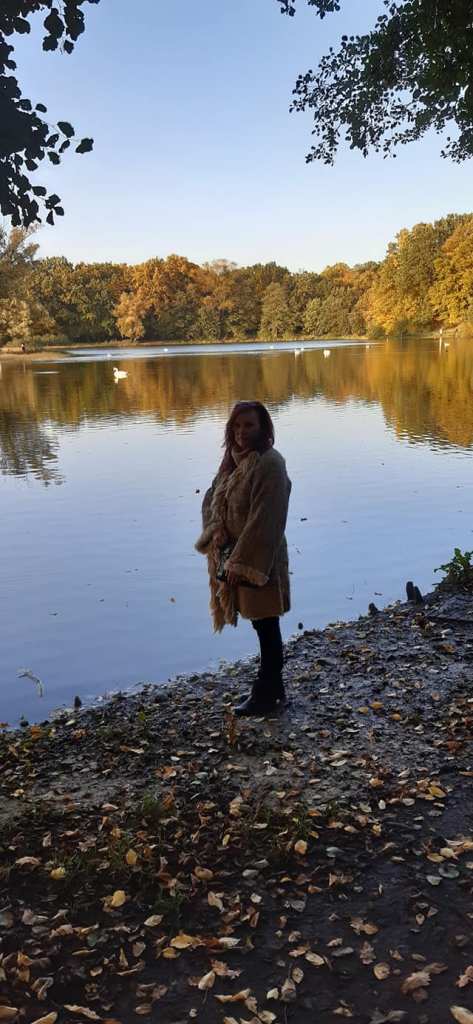
Olga Hart at the side of the lake in Max Aschmann Park, October 2020
Waterside trees always possess an anachronistic architecture, and these were no exception. Complementing the natural contours of the lake, and with the trees and bushes in their variegated shades rolling and billowing around it and into the distance, they and the scene they belonged to put me in mind of a 19th century lithograph, which, if it was mine to own, I would hang on a wall, preferably in my personal bar, in Mick’s Place, where I could sit and savour the view whilst sipping a glass of beer.
A beautiful autumn-leaf hat in Max Aschmann Park, Kaliningrad
But time was ticking on, as it has the habit of doing, and it was time to be making tracks. For this purpose, we chose instead to return through the woodland itself, at least for a short distance before we re-joined the path.
Under the trees, the ground was a little bit squelchy, but this natural hazard of woodland walking was only objectionable as far as our boots were concerned, and it had certainly made no difference to a small group of woodland wanderers who had removed themselves into the fringe of the wood for a spot of al a carte lunch. I wondered, had they carried that old metal barbecue on stilts with them, or had it been donated by an unknown benefactor who had staked out that spot on a previous occasion?
Even deeper into the wood and perched on wooden roundels cut from sizeable trees were people enjoying a picnic. Now that’s an idea, I thought, we really must do that and do that one day soon: go for a picnic, here, in Max Aschmann Park.
Castle, Cheese and Church in the Kaliningrad Region
Published: 28 October 2020
{See Feature image attribution at the end of this article}
Schaaken Castleis located in Nekrasovo, Kaliningrad Oblast. The castle, which was built for the Teutonic Knights in c.1270, was built on the site of an ancient fort and consisted of an octagonal walled-enclosure with two outer baileys. In the first half of the 14th century the original building, which was of wood construction, was replaced with stone. It was atypical of most of the castles constructed by the Teutonic Knights in that its perimeter wall was curved, almost round in formation, a feature that remains to this day.
(Photo credit: Caspar Henneberger, Public domain, via Wikimedia Commons: https://commons.wikimedia.org/wiki/File:Schaaken_Henneberger.jpg)
(Photo credit: Mmdocent, CC BY-SA 4.0 <https://creativecommons.org/licenses/by-sa/4.0>, via Wikimedia Commons; https://commons.wikimedia.org/wiki/File:%D0%A8%D0%B0%D0%B0%D0%BA%D0%B5%D0%BD_2.JPG)
In 1270, the castle defended the coast of the Curonian Lagoon against attacks from a Baltic tribe known as the Skalvians, who, by 1277, had been defeated and subjugated by the Teutonic Knights. Towards the end of the 13th century, Schaaken Castle’s defensive role took on greater significance in protecting the border and coast from repeated raids by Lithuanian pagans. It became one of a number of castles strategically positioned to prevent the Lithuanians from storming through the Curonian Lagoon. Towards the end of the 14th century its military function was controlled from Königsberg. The castle was destroyed by fire in the early years of the 17th century and only partly rebuilt. One of its greatest claims to fame is that Peter the Great and Catherine stayed there on three separate occasions between 1711 and 1717.
During the 19th century it was remodelled in the Romanticist-Gothic style, and it was during this time as part of that refit that the distinctive corner towers, which can still be seen today, were added.
At the end of the Second World War, the castle, which in 1945 was a family farmhouse, came under Soviet state control. The land was requisitioned and used until the 1960s as a collective farm, the castle’s rooms hived off as domestic units. For a short period of time, the castle acted as a children’s home.
By the mid-1970s, the castle had begun to fall into ruins, but one family salvaged the rooms that were inhabitable and continued to live there.
In the early 21st century under a joint Russian-German venture some renovation took place, and the castle was opened as a small museum exhibiting medieval artefacts. In 2012 the museum was damaged by fire.
And on 10 October 2020, it was visited by an Englishman in Kaliningrad, Mick Hart (I don’t suppose they would welcome a wall plaque?).
An Englishman at Schaaken Castle, Russia
Today, Schaaken Castle sits red-brick, gaunt and broken on a small eminence on the curve of a sharp bend overlooking the village of Nekrasovo within the Kaliningrad region, Russia.
To be perfectly frank, the first glimpse of what was left of the castle was one of unalloyed pathos, and getting out of the car into the damp-cold air, on the poor little bit of waste-ground that served as a make-shift carpark, and the sight of the wooden hut, the pay gate, knocked up of old odds and ends of ill-fitting boards, and the dog next to it, rather less than a thoroughbred, hanging off a piece of rope at the front of a homemade dog kennel, perpetuated this first impression. It had not taken me long to work out that this establishment did not enjoy the privileges and patronage of either the state or a private consortium, in other words that it was not part of the National Trust or any other such august body, which is a crying shame as Schaaken Castle has a rich and noble history, both in its East Prussian and Russian context.
Today, there was a man at the castle gate. He came out of the rather sad little hut in his jeans and baseball cap and, after some money had exchanged hands, we were allowed inside.
We passed through the entrance into the enclosure. To the right and close by to us was what remained of the castle’s living quarters. The functional building is little more than a narrow strip of red brick, not battle scarred but weathered and distressed from years of neglect and, from what I have been told, actions amounting to cultural vandalism.
For the sake of our hosts, and Victor, I tried to look and sound interested, not an easy thing to do as I was busy wondering if, apart from the narrow remains and crumbling exterior, there was anything here to see.
Had I been on my own, however, what there was would have been enough. It only takes an old brick or two to get my nostalgic flails turning, but, amazingly enough, we were not alone. There were four or five small groups milling around in the courtyard and, I would soon discover, about 20 more visitors at subterranean level.
This was where we went first. I had perplexed myself enough wondering what the proper name was for the small Gothic ‘towers’ erected at either end of the castle building, high upon the roof level, and going down underground seemed like a good idea.
No sooner had I begun descending, down the steps under the low curved brick ceiling, than out came my wife’s, Olga’s, mobile phone, and I was instructed to pose for a photograph. Needless to say, this would be one of many photos, but I restrained my natural inclination to criticise her illicit love for the camera, reasoning that should I write a piece for my blog on our visit to the castle, photographs would be needed and besides, no matter how much I complained, if 10 years of Arsebook-incentivised photo-snapping had taught me anything it was that such remonstrations are just about as futile as asking a liberal to examine his conscience.
So, I posed for the photograph graciously, grimaced just a bit and eventually life resumed.
Mick Hart going underground at Schaaken Castle
Down below, we found ourselves in one of two vaulted chambers. Space was relatively limited and the floor uneven. This was no dungeon by any stretch of the imagination, but the curators of the castle had seen fit to imply that it had been by using what space there was to mount an exhibition of medieval torture. You cannot blame them. Castles and dungeons go together like beer and hangovers; the two are inseparable, and there is nothing like an excursion into the dark side of human nature to draw in the punters and make them feel normal.
There were two chambers in this vaulted basement. We were in the first and in the second, the group of about twenty people I mentioned earlier, who were gathered together listening to the commentary of their guide, who was a young, stocky, bearded fellow. On hearing us talking in English, the guide called out to me in English. He addressed me as if I were an English gentleman (which, of course, I am) and I replied in kind, causing some of his audience to chuckle. On the way out, I was able to get my own back by addressing him in Russian, at least enough to state that “Excuse me, I have to go now as I want to drink vodka.”
Although the diabolical apparatus exhibited in the underground vaults are knocked-up scaled-down examples accompanied by photographs and text, if this sort of thing appeals to you there is enough to see, and from what I could make out the guide was doing a very good job of engaging his congregation.
Later, this same guide, on finishing his tour and we finishing ours, presented me with two small gifts outside the castle gate; one being part of a red brick from the castle itself, with the name of the manufacturer impressed into the surface, and the other a long, crooked smithy-made nail.
Mick Hart with Schaaken Castle guide and historic iron nail
On reflection, I do feel more than a little guilty for accepting these gifts. There is not much left of Castle Schaaken, and it is evident to me that it needs giving to and doing to rather than taking from. “Conscience. What a thing. If you believe you got a conscience it’ll pester you to death,” Humphrey Bogart’s Fred C. Dobbs once said. And am I not very proud to have these artefacts displayed on the shelf in my attic? “Ahh, hypocrisy, who needs it?” ~ I said that.
Inside the walls, the living quarters, constituting three rooms and an entrance hall, are enclosed and complete, but the taller structure to which they are appended is a narrow, crumbling shell, the wing extending to the rear in a state of open collapse. The surmounting crenellation of the main structure has survived, and the Gothic interest it stimulates is further assisted by the balancing presence of two turrets raised at either end to form the highest points of the building.
End towers to the extended section of Schaaken Castle. (Photo credit: Сергей С. Петров, CC BY-SA 4.0 <https://creativecommons.org/licenses/by-sa/4.0>, via Wikimedia Commons; https://commons.wikimedia.org/wiki/File)
Inside the three rooms, the curators have done their best to mock-up exhibits pertaining to the days when knights fought each other in armour and chain mail. There are a number of historical wall charts that map the history of the castle and of Königsberg, and a small diorama depicting a Soviet living room comprised of real artefacts and furnishings.
Outside, in the oval courtyard, other exhibits can be found demonstrating the skills of medieval artisans, and you can try your hand at archery. The centre of the courtyard contains what appears to be a combat ring, an area of ground set aside for re-enactors to demonstrate their skills of medieval martial arts. At one side, and close to the wall, a viewing stage complete with canopy has been erected, and in front of this, on a lower platform, a chair has been affixed where, no doubt, during tournaments the adjudicator presides and who, at the close of the contests, hands prizes out to the victors.
In one corner of the compound, stands a large, brick building, which has undergone extensive renovation. It contains the castle’s cafeteria, but, as enticing as it was on a chilly day like today, we reluctantly avoided it in keeping with the official guidelines to limit association in the wake of coronavirus. My wife, who lives by her Facebook images, made sure that a couple of photographs were taken of us standing next to the window shutter, on which the skin of a wild pig had been nailed (not a good advert for a vegetarian! ~ not too good for the pig either).
Mick & Olga Hart at Schaaken Castle, Kaliningrad region, October 2020
There are more buildings that run along the end of the defensive wall, but these are hollowed out ruins. Beneath them, however, lies another chamber containing the castles well, and this is well worth a visit (ah hem).
To speak honestly and plainly, it does not take you long to see what there is and what there isn’t left of Schaaken castle. And yet, if you are a Time junky like me, this is irrelevant, as it is enough to visit and to rub shoulders with so much history. Having said that, however, even on an inclement day like today there were 30 or so visitors in the short time that we were there. Imagine how many more there would be if funds were allocated, first for a comprehensive programme of renovation and then for the installation of a fully fledged East Prussian museum!
Cheese-making centre
The second leg of our trip today involved using our legs to walk the short and pleasant distance from the castle to the local cheese-making centre. The friendly guide, who had presented me with gifts earlier, advised us to follow the castle wall into the meadow and cut across it to the cheese-making plant from there.
This route allowed us to take in just how massy the granite-boulder perimeter wall was, how high and thick and curved. It also allowed our friend Sergei to introduce me to some concrete silos in which at one time hay would have been stored for farm animals. I had always wondered what these concrete cylinders were and was slightly disappointed to find that they were not some kind of rocket launcher.
From these disappointments, it is only a short walk from the castle to the cheese-making plant, which is housed in a long, large, old brick building. From the looks of it, I conjectured that in a previous life it had most likely been a cattle barn. Inside, the presence of iron rings in the original wooden uprights and walls seemed to lend my supposition credence. The supports and cross timbers were a mixture, some extant to the original structure others added in sympathetic style, replacing, no doubt, earlier ones that had gone too far down the road to decay to bring them back to life.
In here they make and sell lots of delicious cheeses!
In the centre of this capacious barn stands a rectangular counter where one can purchase all manner of cheeses, whilst on the left a central display unit and shelving extending around the L-shaped perimeter overflows with what they used to call up North in England ‘suckers’, but which we more civilised on our way down South colloquially referred to as sweets.
At the opposite end of the room, and to the right of the entrance, the brick wall ends at waist height, the remainder finished in glass, allowing visitors to look inside at the cheese-making process at work.
During my appreciation of the finer elements of the building and its history, my wife, Olga, had been procuring an adventurous selection of sweets and cheeses, which she passed to me for carriage as we emerged from the front door. On the shop forecourt stood a large decorative … “What do you call it in English?”
“Millstone,” I replied. “I’ve got one of my own; it’s called a wife!”
Our Russian friends enjoyed this sleight, as they had my previous remark, when, concerned that I might find the castle wanting in things to see, they asked me, “Is it [the castle] interesting enough?” To which I replied, “It’s fine. I love anything old … that’s why I love my wife!”
Fortunately, after 20 years together my wife makes allowances for me, and as long as I was carrying the chocolate and cheeses and doing an excellent job of alerting our party to the pavement presence of sheep droppings (Smartree Gavnor!!), which is where my knowledge of Russian language really excels, she was happy to let me babble inanely.
I shut up for a few moments whilst we were walking back through the village of Nekrasovo. It may only have one street, but now I had the opportunity to see at closer quarters, and therefore in more detail, the humble rusticity of the low-build German cottages and, of course, later domiciles that reared out and above the natural and cultivated vegetation, a little too obtrusively for scale and historical comfort.
The circuitous route we had taken also permitted us to see the castle from the opposite side of the enclosure, looking now at the perspective from the road to the T-shaped structure with its crumbling external walls and collapsed interior. It was obvious from this angle that to safeguard against further and irreparable dilapidation precise and extensive remedial work was urgently required.
Schaaken Church
From the castle, we drove the short distance to Schaaken Church, another ruined edifice of historical importance. Had it been built as a Gothic folly it would have been a wonderful evocation, but although its degenerated condition inspired reveries of a Romanticist nature, as the ruin it actually is, and as with all ruined churches, it was wreathed in a sense of loss that transcended the fault lines in bricks and mortar. What happens to all those prayers, all that hope for salvation once a church is abandoned and dies?
Through nature’s reclaiming influence ~ spindly trees, climbing plants and bushy overgrowth ~ the rectangular tower and outer walls, though partially screened from the road, are visible still. As with all ruins, the sight triggers an irresistible yearning to explore and, as with most ruins, when you get there you realise that so much human traffic has been there before you over the years ~ spot the early graffiti ~ and so much time has elapsed that it is an enduring mystery how the accumulative and many moments invested in the building are still able to exert such a powerful stimulus upon the imagination.
From a distance, this particular building looks less desecrated than it actually is. Close up comes the discovery that the roof is missing, the gaping holes in the walls are not all vestiges of former windows and much of the brickwork spalled on the outside are, on the inside, hollowed out in parts exposing the rubble core.
Adding greatly to the Romanticist ideal of the atmospheric ruin is the thick carpet of undergrowth that reigns supreme where once stone slabbed floors and pews would have been. The photograph that we had taken of us in the nave from inside the tower serves to illustrate the extent of the church and the extent to which nature is capable of re-asserting its claim over man-made structures, whatever they set themselves up to be.
Mick & Olga Hart inside Schaaken’s ruined church, October 2020
Mick Hart going up in the world at Schaaken Church, Russia, October 2020
It was just as well, then, that from the church we were taken to enjoy the view from an outcrop of land looking out over the bay. Our journey took us through an interesting and altogether uneven tract, which we would not have been able to traverse had we been travelling in anything else but a 4×4.
I cannot claim that we were off the beaten track, because the track was very beaten, but the joy was that it took us through one of those wild, densely vegetated areas that you stumble across now and then in this fascinating region, which bristles with all kinds of dwellings from different times of origin in all conceivable states of disrepair or stark modernity and whose spanned periods reflect the ethos of each epoch, with a heavy accent on Soviet make-do and esoteric improvisation.
I particularly liked the small series of boat houses, stamped with the individualism of their creators and imaginatively constructed from tin, asbestos, wood and concrete and/or made from the requisitioned back of trucks. These monuments to the Mother of Invention in association with build from what you’ve borrowed, which once would have looked so bold and brash, had, courtesy of the softening effect of time, settled in very nicely, achieving a singularly peculiar and yet quaint harmony in the leafy back-stream settings in which they had come to rest.
When we reached the end of our road (as we all must), the water-front opened out from the narrow stream against which the proud boat houses sat into a wide stretch of water, beyond which a distant Curonian Spit could be seen.
A slight breeze lifted a chill from the surface of the water, a coincidence of no deterrent to the two or three fisherman congregated at the waters’ edge, who, nevertheless, were complaining bitterly about the size of their catch, nor did it seem to worry the boating fraternity, several of whom were coming to shore in a small flotilla of motorised dinghies.
Inland, close to where we were at, a monument had been erected, typically demarcated by a heavy metal chain in black, testifying to the fact that back in the 1940s’ Russian lives had been lost along this stretch of water in running battles with the incumbent Third Reich. During WWII, Kaliningrad (formerly Königsberg) and its region was the scene of many a fierce battle and is therefore of special interest for anyone having a keen regard for military history.
All this history today had made, and was making, me thirsty. Anticipating that this would be the case, I had taken the wise precaution of bringing along a couple of bottles of Lidskae, whose contents I was destined to enjoy later this afternoon when we returned with our friends to their home.
An Englishman at Schaaken Castle, Russia
Schaaken Castle reminds me of a larger and ‘more grand on scale’ replica of a friend’s flat ~ it is being tarted up but needs a lot more doing to it. Having said that, I enjoyed my visit to the castle today. It really is hats off to those people, such as our guide, who put in so much time and effort in maintaining, running and raising funds in order to bring such unique heritage treasures as Schaaken Castle to the notice and appreciation of the public at large. It has not escaped me that with the right sort of planning and investment this modest attraction could be transformed into something monumental, something of a feather in the cap of the region’s cultural history. It already has the makings of a success story; all that it needs now is Vision, Support and Commitment ~ and there is your happy ending.
Updated: 12 March 2022 | Published: 23 October 2020
Warning! In response to Russia’s special operation aimed at ‘demilitarising and de-Nazifying Ukraine’, the UK media has embarked upon and is actively pursuing an intensive propaganda programme which is resulting in widespread anti-Russian sentiment and Russophobia. Aimed at cancelling Russian culture and demonising Russian citizens at every level, incidents of verbal abuse and physical aggression towards Russian nationals have been reported in various western countries, including the UK. This comes against the backdrop of reports suggesting that Facebook is greenlighting hate speech against Russians on its social media platform. You are advised to travel to the UK only for essential reasons and whilst there to exercise caution.
UNLESS you are a Russian oligarch, and reading this humble blog you most likely are not, moving to the UK is not a decision that should be taken lightly*. As with emigrating anywhere, there is a number of important considerations to chew over, especially with regard to where you would want to live, where you can afford to live, and where you can afford to live and most definitely would not want to live unless you are very adventurous or there is something wrong with your head.
In this article, we will focus purely on where you most likely want to live and the cost of living there.
Russians Moving to London: Costs / Jump to Section
Most Russians, when moving to the UK, understandably head for London for three reasons: it is where the money is, the action is and it is probably the only place in the UK that you know very much about.
Let us assume then that the majority of you who are heading to the UK optionally will invariably have your sites fixed on London, unless, of course, you are being sent to the UK on a company relocation scheme, in which case the choice may not be yours.
For the sake of argument, this article will suppose the former, that you are moving on your own volition, are in it for the money and that as you know little or nothing about the UK, London is your destination: you know that the Queen lives there, that the buses are red, the cabs black and that there is an awful lot of nightlife in the West End.
What you are probably not aware of is that London, albeit the capital city of the UK, the seat of government and centre of finance, is, in terms of attitudes, political prejudices, behaviour and mindset, the least representative place of the UK as a whole. In fact, London, economically, socio-politically and demographically, is so removed and distant from the rest of the UK that if it took off tomorrow and landed somewhere on Mars, not a lot of people would be surprised and some might not even miss it.
As the celebrated English comedian John Cleese stated, London is no longer an English city. It is claimed that white ethnic Britain’s are now a minority ethnic group in London. The division is reinforced further when you consider the fact that most London boroughs voted to remain in the EU in contradiction of the socio-political bias of the rest of the country, which mostly ran in favour of Brexit.
All things considered, the best way to consider London in its relationship to England and the UK in general is as a state within a state.
It thus follows that your experience of UK life, of living in London, will be an entirely different one than if you were to reside, say, in Scunthorpe. Where? Precisely!
Thus, for the purpose of this article, I have intentionally dealt with London and England as two separate entities. Why? Because they are.
I have also narrowed the geographical scope to include only London and England, as I have never been to Ireland, visited Scotland once on a flying visit and know very little of Wales, except for its shape on the map. So, let’s stick to what we know.
Russians Moving to London: Costs (Photo credit: George Hodan / publicdomainpictures.net; https://www.freeimg.net/photo/1484282/bank-broken-break-pig)
Russians Moving to London: Costs ~ Money
In this post we will consider that all important criterion, ‘Money’, taking into account the cost of renting or buying a flat/house and the cost of living when living in the capital, and how much you will need to earn to live comfortably. I know that there are guides out there, viz ‘How to holiday/live in London on a budget’. Forget them. If you are visiting London and, more importantly, planning to live and work there, you will want to enjoy the experience, and for this you will need money. If you want England on a budget, forget London and try somewhere else, like Wellingborough instead.
By far the greatest drain on your financial resources on moving to London will be the cost of accommodation. Is it expensive? No. It is extortionate. Whether renting or buying, you can expect to rob yourself of at least one-third of your monthly wage just in providing yourself with a roof over your head.
Let’s look at renting first, and some of those jolly statistics.
Russians Moving to London: Costs ~ Renting property in London
The amount you are willing to spend, or can afford to spend on renting, will determine the nature of the accommodation you rent and its location. Obviously, the financial outlay for a bedsit (everything sandwiched into one room), a house share (who’s nicked my milk from the fridge?), a self-contained flat or a whole house to yourself will attract different tariffs, as will where you live, ie renting a self-contained flat in the City will cost significantly more than, say, one in Brixton (you hope!).
Before starting out, remember that in addition to one month’s rent in advance and a whacking great deposit, you are going to need references, usually at least a character reference, ie from someone senior in the company where you work and from your bank.
Invostepedia.com1, states that “Housing costs are normally one of, if not the, largest expense in any budget. This is particularly true in London.”
It goes on to exemplify that a two-bedroom flat in the centre of London will set you back, on average, $2500 per month. The article is obviously addressing the American market, but at the time of writing this translates into approximately £1940, give or take a few pence. The same article goes on to say that outside of the centre, the cost of accommodation falls, and uses the expression to as “low as $1,400 dollars per month” ~ which in my book is still a substantially high £1083 per month ~ remember, we are talking about a two-bedroom flat, not a family residence.
Metro.co.uk2 tells us that the cheapest average rent to be found is in the Upper Edmonton district, and says that in the second quarter of 2020 the average rent was £538 a month. Now, at first sight, this seems to fare well with rented accommodation in other parts of the UK, until you read on and find that for £538 a month you get a room in a shared house (please, turn that music down!!)
The same article cites the St Paul’s area (EC4) as being the most expensive to rent at £1,316 per month, followed by South Kensington/Knightsbridge at £1,110 per month. How’s that for a room in a shared house! What did you say, where is Wellingborough? Don’t ask, or I might just tell you!
So, what will it cost you to rent a two-bedroom flat in the cheapest part of London ~ let’s forget about Knightsbridge!
According to comparemymove.com3 you can rent yourself a two-bedroom flat in Bexley for £1,152 a month.
So what is Bexley like. According to finder.com4 “The borough with the second-highest crime rate increase is Bexley, with an average increase of 7% over the last six years. Despite the increase in the number of crimes, Bexley still has a low number of crimes compared to other boroughs.” [article updated Aug 18, 2020]
Make of that what you will, but, from a purely economic point of view, remember that high-crime rates areas are reflected in the price for home insurance.
Thus, the cost of the area in which you choose or, indeed, can afford to live should not only be measured in £££s. The website ilivehere.co.uk5 has this to say about Bexley: “There were a total of 319 street level crime incidents in Bexley in August 2020. The largest category was Anti-Social Behaviour, followed by Violent Crime.”
So much for renting a flat in London. What about buying a home?
Russians Moving to London: Costs ~ Buying a property in London
The most desirable, and therefore the most expensive, boroughs in London are continually cited as Kensington and Chelsea, Westminster and Camden. Kensington and Chelsea appear to be in the lead as a place where most people cannot afford to live, with the price of an average home now in excess of £1.5 million6.
Conversely, the cheapest borough in London is said to be Woolwich, with the average price of a house around £322, 0007. (Presumably a three-bedroom house?)7.
What’s Woolwich like? I could tell you, as I lived nearby when I first moved to London, but that was quite some time ago ~ perhaps it has improved?
If you are looking to buy a house in London on a mortgage basis, which you would only be able to do after a rigorous assessment of your means to support that mortgage, including your credit rating, how much cash will you have to put down?
The lowest down-payment that you can expect to make is 5% of the mortgage loan, but 15% is considered to be a more reasonable figure. The simplest way of approaching the issue is to bear in mind that the larger the deposit you are able to afford the more certain you can be of obtaining a mortgage and the more favourable the interest rates will be8.
There are various ‘schemes’ to assist you in purchasing a home in London, such as the appropriately named London Help to Buy scheme, Shared Ownership, Rent to Buy, First Dibs for Londoners and the Starter Homes Initiative. But in the end, it all comes down to £££££££. This article by which.co.uk9 should either help you or help to put you off. In here, you will also learn about the option and pitfalls of buying a property not too far from London and commuting into the city each day. The upside is that you will get more property for your money and the mortgage is likely to be significantly less; and the downside? Any advantages that you are likely to accrue from a lower property purchase price, and therefore a lower mortgage, will, given the inflated cost of rail travel, be lost on your monthly travel fare. Drive into London? Only if you are a stress junky, like sitting in traffic and have no qualms about paying for those out-of-this-world parking fees, oh, and don’t forget the congestion charges!
For the time being, however, let us hypothesise that you have found a place to call home, have stumped up the down-payment and acquired a mortgage. The next thing on the money hit list is council tax.
Russians Moving to London: Costs ~ London council tax
Council tax is a tax levied on domestic property, in other words a tax on your home (and any other domestic properties that you may own). It is demanded by and paid to your local council, the administrative body for the area where your property is located. It is said that the revenue collected, which is paid to the council in monthly instalments, usually spread over a 10-month period for each year, is used to finance local services, such as schools, rubbish collection, road maintenance, street lighting and so on. That is all well and good, but rent and mortgage payments aside, or included, council tax takes a not inconsiderable chunk out of your monthly pay packet.
In London, every property is allocated a council tax band according to the property’s capital value. There are 8 bands in all, identified alphabetically from A to H, with ‘A’ being the lowest rated band and ‘H’ the highest.
In Barking and Dagenham, for example, if your property is valued as falling within the ‘A’ band, you can expect to pay £1,077.91 a year, and if it should fall in the ‘H’ band, a whopping great £3,233.74 a year10,11 .
By comparison, in the borough of Kensington and Chelsea, if your property has been evaluated as a Band A property, you will be charged £824.55 a year and for Band H, 2,473.76 per year12.
But, wait a moment, isn’t Kensington & Chelsea supposed to be one of the most expensive boroughs in London in which to buy and rent a property? Yes. You’ve tumbled it ~ council tax just does not make sense. To understand it properly, you need to know all about ‘stealth taxes’13?
The irony is, of course, that if your property falls into Band H in Kensington and Chelsea, your £2,473.76 charge is not likely to worry you too much, as you would not be living there if you did not have the means to do so, whereas the £3,233.74 for a Band H property in Barking and Dagenham would no doubt be seen as an horrendous expense, wherever you live ~ never mind Barking and Dagenham!
Suspect you are being ripped off? Take heart, it’s the name of the boat we all are in.
If you think this ‘extra mortgage’ is bad, don’t ~ it gets worse. Next on the wage-packet mugging list comes your monthly or quarterly utility bills.
Russians Moving to London: Costs ~ Utility bills & living expenses
According to bystored.com, the average monthly cost for gas, electricity and water is about £160, so £1920 a year14. If you need Wi-Fi, then you should factor in an additional £20–£40 per month. In fact, utility bills are quite competitive in London compared to other areas in the UK ~ which is a blessing, because in some areas they are crippling.
And now we come to the nitty-gritty: everyday living expenses.
How much will I spend each month whilst living in London on everyday necessities, such as food and little luxuries, that is on going out for a drink or a meal? How long is a piece of string?
However long that piece of string is, you do not want to throttle yourself with it. Your monthly expenditure all depends, of course, on your habits and expectations. How much you eat, where you eat, how much booze you put away, do you like to go clubbing or are you a sit at home type ~ which you might have to be, if you have not got the ackers!
There are many websites out there that will give you a blow-by-blow account of how much specific things cost, from food prices to entertainment, two of which you will find in the reference section at the end of this article. And although London is one of the most extortionate cities in the world today, like anywhere else, you can budget yourself.
But, to give you a taster, so to speak, let us confront the most important things first. The average price of a pint of beer in a public house in London is around £4.60, but beware! ~ in some swanky eating and drinking places you can get really ripped off and pay as much as £22 a pint!
Russians Moving to London: Costs ~ Cost of travel around London
One of the greatest drains on your everyday resources is the dreaded cost of travel. Driving around London is a mugs game. You simply cannot get anywhere quickly and the difficulty of finding convenient parking is as ridiculous as the cost. Oh, and do not forget that nice Mr Sadiq Khan’s save-the-planet congestion charges!
It is generally agreed that the cheapest way to zip around London is to purchase an Oyster card. This will allow you to keep costs down at the same time as giving you travel access to all parts of London, whether you are travelling on the Underground, using the Docklands Light Railway (DLR), by overground rail, some river boats and on London’s buses.
To give you some idea of what you will have to fork out for an Oyster card covering Zones 1–6 in London that can be used at any time, it will cost you £12.80 per day15.
How much do I need to earn to live in London?
So, in conclusion, the all-important question is, how much do you need to earn before tax to live comfortably in London? If you trawl the internet on the basis of this question you will find the accumulative answer to be about £50,000 a year before tax. Of course, the definition of ‘living comfortably’ is a subjective one, and at the end of the day ~ at the end of everyday ~ it all depends upon what you call living and the lifestyle you aspire to.
Summary about cost of living inLondon, United Kingdom: Source of data highlighted below: https://www.numbeo.com/cost-of-living/in/London {acessed: 23/10/2020}
Four-person family monthly costs: 295,573.04руб (2,975.49£) without rent (using our estimator). A single person monthly costs: 83,347.81руб (839.05£) without rent. Cost of living index in London is 173.46% higher than in Kaliningrad. Rent in London is, on average, 899.30% higher than in Kaliningrad. Cost of living rank 41st out of 573 cities in the world. London has a cost of living index of 82.60.
*I should not have to say it, but I will. This series of articles is based upon the ever diminishing hope that some day soon our Covid-infected world will assume some sort of acceptable normalcy. Obviously, given the catastrophic Covid situation in London, and the UK in general, at the time of writing, any right-minded person would be better off avoiding it. For the time being, Robinson Crusoe and the lonely guy orbiting the Earth in a space station would seem to have it all! But, as they say, Hope dies last!
Stay tuned for my next post on moving to the UK, as distinct from moving to London.
Additionalreferences Comprehensive tabulated data on cost of living in London. No publishing date, but it appears to be current! [accessed: 23/10/2020] https://www.numbeo.com/cost-of-living/in/London